
Partition or Volume - Extend

How to Extend a Partition or Volume in Windows 7

   Information
This will show you how to extend a hard disk partition or volume into a empty unallocated space on the same hard disk to make it larger using Disk Management or Diskpart in Windows 7.
   Warning
You must be logged on in an administrator account to do this tutorial.

If you disable the Disk Defragmenter service, then you will get the error below when you try to do anything in Disk Management. If you get this error, then make sure that the Disk Defragmenter service is set to only Manual.
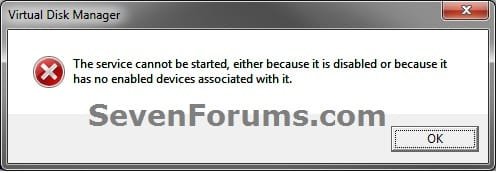
Error.jpg


OPTION ONE

Using Disk Management


1. If you have not already, you will first need to delete the partition or volume that you want to extend into to make it unallocated space.

2. Open the Control Panel (icons view), and click on the Administrative Tools icon. then close the Control Panel window.

3. Click on Computer Management in Administrative Tools, then close the Administrative Tools window.

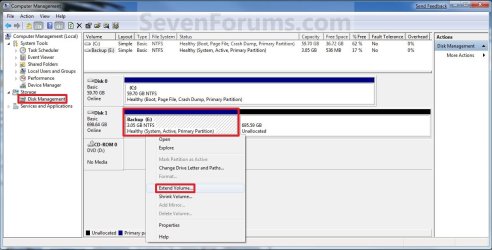
4. In the left pane under Storage, click on Disk Management. (See screenshot below)
Extend_Step1.jpg
5. In the middle pane, right click on the partition or volume directly adjacent (left) of the unallocated space that you want to extend into, and click on Extend Volume. (See screenshot above)

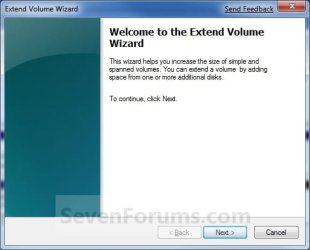
6. Click on the Next button. (See screenshot below)
Extend_Step2.jpg
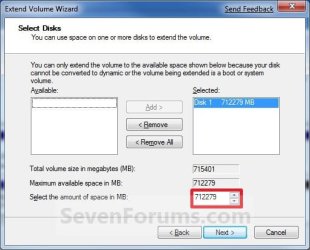
7. Type in how many MB (1 GB = 1024 MB) you want to use from the unallocated space to extend the selected partition (step 5) into, then click on the Next button. (See screenshot below)
NOTE: If you want to use all of the unallocated space to extend into, then type in the maximum available space shown for the unallocated space.
Extend_Step3.jpg
8. Click on the Finish button. (See screenshot below)
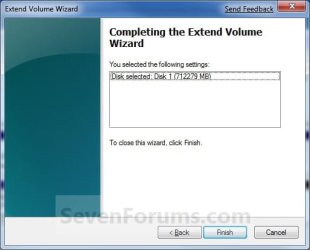
Extend_Step4.jpg
9. The partition or volume has now been extended into the assigned unallocted space (step 7). (See screenshot below)
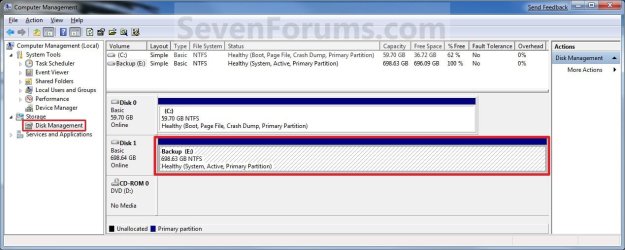
Extend_Step5.jpg
10. Close the Computer Management window. (See screenshot above)


OPTION TWO

Using Diskpart in a Elevated Command Prompt


1. If you have not already, you will first need to delete the partition or volume that you want to extend into to make it unallocated space.

2. Open a elevated command prompt, or a command prompt at boot.

3. In the elevated command prompt, type diskpart and press Enter. (See screenshot below)
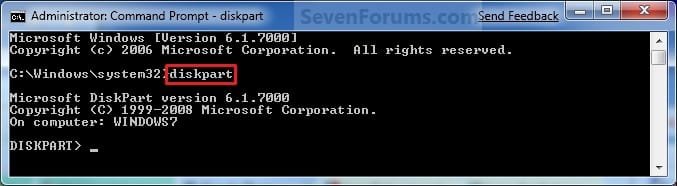
CMD_Extend_Step1.jpg
4. In the elevated command prompt, type list disk and press Enter. (See screenshot below)
NOTE: This is to help you ID the disk that has Free space that you want to extend into, and to see the disk size to make it easier to ID it's volume number in step 5. For example, Disk 1.
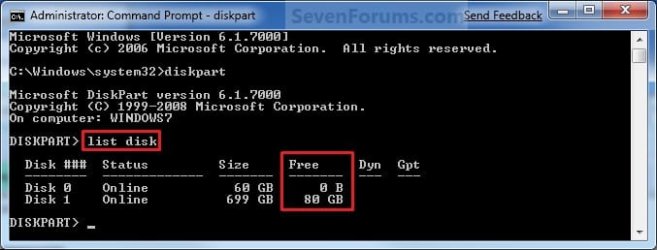
CMD_Extend_Step2.jpg
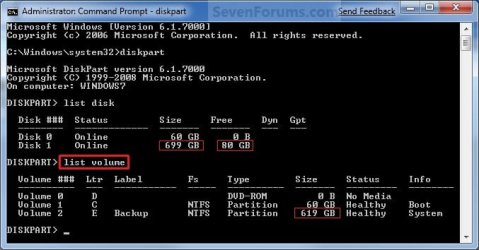
5. In the elevated command prompt, type list volume and press Enter. (See screenshot below)
NOTE: Look for the volume number that has the same Size as from the size in step 4 minus the Free space. For example, Volume 2.
CMD_Extend_Step3.jpg
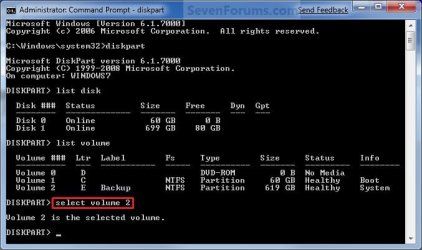
6. In the elevated command prompt, type select volume # and press Enter. (See screenshot below)
NOTE: You would substitute # for the volume number listed that you want to extend. For example, I want to extend the listed volume 2 since, so I would type select volume 2 and press Enter.
CMD_Extend_Step4.jpg
7. To Extend into All of the Unallocated Space
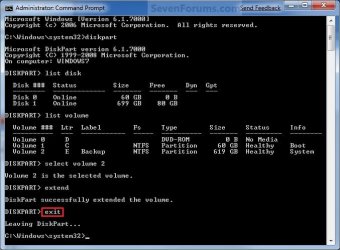
A) In the elevated command prompt, type extend and press Enter. (See screenshot below)
NOTE: The unallocated space will be removed and added completely to the selected partiton or volume (step 6).
CMD_Extend_Step5.jpg
B) Go to step 9.
8. To Extend into the Unallocated Space by a Specified Size
A) In the elevated command prompt, type extend size=(# in MB) and press Enter.
NOTE: You would substitute (# in MB) for how many MB (1 GB = 1024 MB) you want to use of the unallocated space (free space shown in step 4) to be extended into. For example, if I only wanted to extend into 5 GB of the unallocated space, then I would type extend size=5120 and press Enter.
9. In the elevated command prompt, type exit and press Enter. (See screenshot below)
CMD_Extend_Step6.jpg
10. Close the elevated command prompt.

11. The selected partition or volume (step 6) has now been extended into the unallocated space to make it larger.
NOTE: If you did step 8 instead of 7, then you can use the rest of the unallocated space to create a new partition with if you like.
That's it,
Shawn


Last edited:
Apparently there are instructions here for everything I could possibly want to do in windows!

I was trying to extend a partition but it was to the right of the unallocated space that I wanted it to absorb. I was trying to do method two to get my right most partition to extend into the unallocated space to it's immediate left.

Everything seemed well until the elevated command prompt wouldn't extend it. If I simply told it to "extend" it would tell me "Virtual Disk Service error: The size of the extent is less than the minimum." Thinking that for some reason it might have took my general "extend" command and assumed "extend size=0" I tried specifying how much to extend. That didn't work either.

My unallocated amount is ~20gb but no matter what I put for the size to extend it returned "Virtual Disk Service error: There is not enough usable space for this operation." Rather than a 6-digit number I even tried amounts as low as "5" just to see and it still gave me the same result.

I then tried to extend the volume that was naturally to the left of the unallocated space by "5" and that worked correctly. Does this mean that I wont be able to extend my rightmost partition left?

In case it matters, I am running win7 evaluation copy build 7100. Is this my problem?
 

My Computer

Computer Manufacturer/Model Number
Toshiba Satellite A305
OS
dual boot vista x64 and 7 x64
Hello Chan, and welcome to Seven Forums.

Could you post a screenshot of your Disk Management for us to get a better understanding of your drive configuration? This will help us make sure we give you the correct advice.

To extend a left partition into a right unallocated partition, you must extend the left partition into all of the right one in Windows Disk Management. Only a 3rd party disk management program will allow you to extend into part of another partition instead.

Hope this helps for now,
Shawn
 

My Computer

Computer type
PC/Desktop
Computer Manufacturer/Model Number
Self built custom
OS
64-bit Windows 11 Pro for Workstations
CPU
Intel i7-8700K OC'd to 5 GHz
Motherboard
ASUS ROG Maximus XI Formula Z390
Memory
64 GB (4x16GB) G.SKILL TridentZ RGB DDR4 3600 MHz
Graphics Card(s)
ASUS ROG-STRIX-GTX1080TI-O11G-GAMING
Sound Card
Integrated
Monitor(s) Displays
2 x Samsung Odyssey G7 27"
Screen Resolution
2560x1440
Hard Drives
1TB Samsung 990 PRO M.2,
4TB Samsung 990 PRO PRO M.2,
TerraMaster F8 SSD Plus NAS
PSU
Seasonic Prime Titanium 850W
Case
Thermaltake Core P3
Cooling
Corsair Hydro H115i
Keyboard
Logitech wireless K800
Mouse
Logitech MX Master 4
Internet Speed
2 Gb/s Download and 100 Mb/s Upload
Antivirus
Malwarebyte Anti-Malware Premium
Browser
Google Chrome
Other Info
Logitech Z625 speaker system,
Logitech BRIO 4K Pro webcam,
HP Color LaserJet Pro MFP M477fdn,
APC SMART-UPS RT 1000 XL - SURT1000XLI,
Galaxy S23 Plus phone
attached image

Here is a link to an image of my disk:


I hope that makes enough sense. Thanks for the help!
 
Last edited by a moderator:

My Computer

Computer Manufacturer/Model Number
Toshiba Satellite A305
OS
dual boot vista x64 and 7 x64
Chan,

The only way to do this in Windows 7 Disk Management would be to delete the C: drive to have them merge together as unallocated space, then create a new partition out of that unallocated space.

Since that is your C: drive with Windows 7, it's not practical though. You would be better off using a 3rd party pay for or trial disk management type program to be able to extend the unallicated space into the C: drive without having to delete the C: drive.
 

My Computer

Computer type
PC/Desktop
Computer Manufacturer/Model Number
Self built custom
OS
64-bit Windows 11 Pro for Workstations
CPU
Intel i7-8700K OC'd to 5 GHz
Motherboard
ASUS ROG Maximus XI Formula Z390
Memory
64 GB (4x16GB) G.SKILL TridentZ RGB DDR4 3600 MHz
Graphics Card(s)
ASUS ROG-STRIX-GTX1080TI-O11G-GAMING
Sound Card
Integrated
Monitor(s) Displays
2 x Samsung Odyssey G7 27"
Screen Resolution
2560x1440
Hard Drives
1TB Samsung 990 PRO M.2,
4TB Samsung 990 PRO PRO M.2,
TerraMaster F8 SSD Plus NAS
PSU
Seasonic Prime Titanium 850W
Case
Thermaltake Core P3
Cooling
Corsair Hydro H115i
Keyboard
Logitech wireless K800
Mouse
Logitech MX Master 4
Internet Speed
2 Gb/s Download and 100 Mb/s Upload
Antivirus
Malwarebyte Anti-Malware Premium
Browser
Google Chrome
Other Info
Logitech Z625 speaker system,
Logitech BRIO 4K Pro webcam,
HP Color LaserJet Pro MFP M477fdn,
APC SMART-UPS RT 1000 XL - SURT1000XLI,
Galaxy S23 Plus phone
Here is a link to an image of my disk: ...

I hope that makes enough sense. Thanks for the help!

Chan,

The only way to do this in Windows 7 Disk Management would be to delete the C: drive to have them merge together as unallocated space, then create a new partition out of that unallocated space.

Since that is your C: drive with Windows 7, it's not practical though. You would be better off using a 3rd party pay for or trial disk management type program to be able to extend the unallicated space into the C: drive without having to delete the C: drive.

A good free 64bit supported Partition manager is:
Partition Wizard Home Edition
I've used it a couple of times with no problems.
 

My Computer

Computer type
PC/Desktop
Computer Manufacturer/Model Number
76~2.0
OS
Windows 7 Ult x64 - SP1/ Windows 8 Pro x64
CPU
Intel Core i5-3570K 4.6GHz
Motherboard
Gigabyte GA-Z77X UD3H, f18
Memory
8GB (2X4GB) DDR3 1600 Corsair Vengeance CL8 1.5v
Graphics Card(s)
Sapphire HD 7770 Vapor-X OC 1GB DDR5
Sound Card
Onboard VIA VT2021
Monitor(s) Displays
22" LCD Dell
Screen Resolution
1680x1050
Hard Drives
Samsung 840Pro 128GB SSD,
Seagate Barracuda 500GB SATA2 7200rpm 32MB cache, Seagate Barracuda 1TB SATA2 7200rpm 32MB cache,
PSU
Corsair HX650W
Case
Cooler Master Storm Scout
Cooling
Corsair H80 2x12cm Noctua NF P12 , 2x14cm case fans
Keyboard
Logitech Wave
Mouse
CM Sentinel
Internet Speed
Dismal
Antivirus
Avast
Browser
Opera Next
Other Info
Haswell laptop: HP Envy 17t-j, i7-4700MQ, GeForce 740M 2GB DDR3, 17.3" Full HD 1920x1080, 16GB RAM, Samsung 840 Pro 128GB, 1TB Hitachi 7200 HDD,
Desktop: eSATA ports,
External eSATA Seagate 500GB SATA2 7200rpm,
External WD USB 500GB
Thanks for all the help! I'll have to give that Partition Wizard a try. If that doesn't work, I do have a dual boot with Vista on my main partition so I could use that to delete "C:"... I suppose it wouldn't be too cumbersome to reload 7.

Aside for some poor planning with partition size on my part, I am really liking Windows 7.
 

My Computer

Computer Manufacturer/Model Number
Toshiba Satellite A305
OS
dual boot vista x64 and 7 x64
Thanks for all the help! I'll have to give that Partition Wizard a try. If that doesn't work, I do have a dual boot with Vista on my main partition so I could use that to delete "C:"... I suppose it wouldn't be too cumbersome to reload 7.

Aside for some poor planning with partition size on my part, I am really liking Windows 7.

Win7 is good isn't it.

Good luck with Partition Wizard, it works really well.

Reply here, or search 'Partition' or 'Partition Manager' and you'll find many threads with a lot of helpful information.

Let us know how it goes.
 

My Computer

Computer type
PC/Desktop
Computer Manufacturer/Model Number
76~2.0
OS
Windows 7 Ult x64 - SP1/ Windows 8 Pro x64
CPU
Intel Core i5-3570K 4.6GHz
Motherboard
Gigabyte GA-Z77X UD3H, f18
Memory
8GB (2X4GB) DDR3 1600 Corsair Vengeance CL8 1.5v
Graphics Card(s)
Sapphire HD 7770 Vapor-X OC 1GB DDR5
Sound Card
Onboard VIA VT2021
Monitor(s) Displays
22" LCD Dell
Screen Resolution
1680x1050
Hard Drives
Samsung 840Pro 128GB SSD,
Seagate Barracuda 500GB SATA2 7200rpm 32MB cache, Seagate Barracuda 1TB SATA2 7200rpm 32MB cache,
PSU
Corsair HX650W
Case
Cooler Master Storm Scout
Cooling
Corsair H80 2x12cm Noctua NF P12 , 2x14cm case fans
Keyboard
Logitech Wave
Mouse
CM Sentinel
Internet Speed
Dismal
Antivirus
Avast
Browser
Opera Next
Other Info
Haswell laptop: HP Envy 17t-j, i7-4700MQ, GeForce 740M 2GB DDR3, 17.3" Full HD 1920x1080, 16GB RAM, Samsung 840 Pro 128GB, 1TB Hitachi 7200 HDD,
Desktop: eSATA ports,
External eSATA Seagate 500GB SATA2 7200rpm,
External WD USB 500GB
Wow, you are quick with the reply Dave!

It only took 10 minutes but Partition Wizard worked like a charm! My partitions are now the size that I want them to be!

I really liked Vista but as soon as I got a copy of Windows 7 I was eager to try it out! For as much as I liked Vista, 7 is amazing! Furthermore, even for the occasional software incompatibility 64-bit is way worth it.
 
Last edited:

My Computer

Computer Manufacturer/Model Number
Toshiba Satellite A305
OS
dual boot vista x64 and 7 x64
Wow, you are quick with the reply Dave!

It only took 10 minutes but Partition Wizard worked like a charm! My partitions are now the size that I want them to be!

I really liked Vista but as soon as I got a copy of Windows 7 I was eager to try it out! For as much as I liked Vista, 7 is amazing! Furthermore, even for the occasional software incompatibility 64-bit is way worth it.

Welcome to Seven Forums, hope you find the info you need here. A lot of good stuff available.

Glad that you got the partitions where you want them.

I've used Windows disk Management, Paragon, Easeus and Partition Wizard. They're all pretty good, had some partitions that Paragon wouldn't move. Partition Wizard has been excellent so far and is 64bit compatible.

Started using Vista after SP1 and I really liked it. Then I got Win7 and can't imagine using anything else.
I'm completely sold on 64bit, more 64bit programs coming out every day.
 

My Computer

Computer type
PC/Desktop
Computer Manufacturer/Model Number
76~2.0
OS
Windows 7 Ult x64 - SP1/ Windows 8 Pro x64
CPU
Intel Core i5-3570K 4.6GHz
Motherboard
Gigabyte GA-Z77X UD3H, f18
Memory
8GB (2X4GB) DDR3 1600 Corsair Vengeance CL8 1.5v
Graphics Card(s)
Sapphire HD 7770 Vapor-X OC 1GB DDR5
Sound Card
Onboard VIA VT2021
Monitor(s) Displays
22" LCD Dell
Screen Resolution
1680x1050
Hard Drives
Samsung 840Pro 128GB SSD,
Seagate Barracuda 500GB SATA2 7200rpm 32MB cache, Seagate Barracuda 1TB SATA2 7200rpm 32MB cache,
PSU
Corsair HX650W
Case
Cooler Master Storm Scout
Cooling
Corsair H80 2x12cm Noctua NF P12 , 2x14cm case fans
Keyboard
Logitech Wave
Mouse
CM Sentinel
Internet Speed
Dismal
Antivirus
Avast
Browser
Opera Next
Other Info
Haswell laptop: HP Envy 17t-j, i7-4700MQ, GeForce 740M 2GB DDR3, 17.3" Full HD 1920x1080, 16GB RAM, Samsung 840 Pro 128GB, 1TB Hitachi 7200 HDD,
Desktop: eSATA ports,
External eSATA Seagate 500GB SATA2 7200rpm,
External WD USB 500GB
Great guide,and I post to say I saw dave76's post,tried partition wizard,and it worked.
Hope this helps.
 

My Computer

OS
Windows 7 Ultimate x64 rtm
I'm used to using the old Partition Magic 8 for WinXP but Partition Wizard on Win7 is so much faster and easier to use IMO.
 

My Computer

Computer type
PC/Desktop
Computer Manufacturer/Model Number
Homebuild
OS
Windows 7 Ultimate 64 bit SP1
CPU
DualCore Intel Pentium D 820, 2800 MHz (14 x 200)
Motherboard
Gigabyte EX58-UD3R
Memory
Kingston DDR3 (PC3-10700H) 6.0GB
Graphics Card(s)
AMD Radeon HD 6450
Sound Card
Realtek ALC882/D/M
Monitor(s) Displays
Samsung SyncMaster 2233SW
Screen Resolution
1920 x 1080
Hard Drives
Drive #1 - WDC WD2500JB-22REA0 (232 GB)
Drive #2 - WDC WD6400AAKS-65A7B0 (596 GB)
PSU
EVGA Supernova 750w G2 Gold
Cooling
5 x 80mm Generic Fans
Keyboard
Microsoft Comfort Curve 2000
Mouse
SteelSeries IKARI 62001-1 Laser or Microsoft Laser 6000
Internet Speed
1500/256
Antivirus
NOD32 v10.1.235.0
Browser
FireFox 59.0.2 X64bit
Other Info
Telstra Technicolor TG799vac Modem
LG HL-DT-ST DVDRAM GH20NS15 ATA Device
16X52X32X52 COMBO SCSI CDRom Device
Logitech Wave Keyboard
Microsoft 6000 Laser Mouse
Hi, I had a recovery partition leftover from my old HP installation of Vista. So After I installed Windows 7, I decided to reclaim that space since I didn't need it anymore. So I used method one above (actually on my own without looking it up..which was probably stupid). However where it says above:

"NOTE: If the partition that you want to extend is to the right of the unallocated space, then you will need to use METHOD TWO below to extend it instead."

My recovery partition WAS to the right of my C (main) drive. I should have used method 2. I tried using 2 after 1 failed, but now I am left with the following:
-I have a 160GB HD.
-C shows as having about 149GB, which is about right when you subtract the 11GB the Recovery used to have.
-When I add up the space my files should take up, I get that it should take up about 40.6GB, which leaves me with about 109. However, my C is showing only 81GB free...maybe that's restore points from my recent install of 7 and all my other software the other day?

So I'm missing about 40GB of my drive...and I'm not sure where it went. I don't think its bad, it's listed as healthy, and the math has always worked out before. Thanks for any help anyone could give me...I am kinda new to messing around with this kind of stuff.
 

My Computer

Computer Manufacturer/Model Number
HP Pavilion dv5t Entertainment Notebook PC
OS
Windows 7 Home Prm.
CPU
2GHz
Memory
3GB
Hard Drives
160GB
Hello Clarion,

Here are some common reasons for a missing hard drive space:
  • The hard drive always formats smaller than the advertised size. For example, a 750GB (decimal) drive formats to only 680GB (actual).
  • Allocated (reserved) free space for restore points, page file, and shadow copies.
  • Installed programs and data.
  • Windows 7 creates a 100MB System Reserved partition, and up to 20GB for Windows 7 itself.
  • 1 to 2 GB of reserved unallocated space on the hard drive for system use.
Hope this helps,
Shawn
 

My Computer

Computer type
PC/Desktop
Computer Manufacturer/Model Number
Self built custom
OS
64-bit Windows 11 Pro for Workstations
CPU
Intel i7-8700K OC'd to 5 GHz
Motherboard
ASUS ROG Maximus XI Formula Z390
Memory
64 GB (4x16GB) G.SKILL TridentZ RGB DDR4 3600 MHz
Graphics Card(s)
ASUS ROG-STRIX-GTX1080TI-O11G-GAMING
Sound Card
Integrated
Monitor(s) Displays
2 x Samsung Odyssey G7 27"
Screen Resolution
2560x1440
Hard Drives
1TB Samsung 990 PRO M.2,
4TB Samsung 990 PRO PRO M.2,
TerraMaster F8 SSD Plus NAS
PSU
Seasonic Prime Titanium 850W
Case
Thermaltake Core P3
Cooling
Corsair Hydro H115i
Keyboard
Logitech wireless K800
Mouse
Logitech MX Master 4
Internet Speed
2 Gb/s Download and 100 Mb/s Upload
Antivirus
Malwarebyte Anti-Malware Premium
Browser
Google Chrome
Other Info
Logitech Z625 speaker system,
Logitech BRIO 4K Pro webcam,
HP Color LaserJet Pro MFP M477fdn,
APC SMART-UPS RT 1000 XL - SURT1000XLI,
Galaxy S23 Plus phone
Thanks, I figure that's what's happening with the C: drive, but I'm still trying to figure out what happened to the 11GB in the Recovery Partition. I had 80GB free before and after deleting that Recovery Partition.
 

My Computer

Computer Manufacturer/Model Number
HP Pavilion dv5t Entertainment Notebook PC
OS
Windows 7 Home Prm.
CPU
2GHz
Memory
3GB
Hard Drives
160GB
Clarion,

Could you post a screenshot of Disk Management (diskmgmt.msc)? This will let me see the layout of your drives that may explain what happened to the 11GB recovery partition.
 

My Computer

Computer type
PC/Desktop
Computer Manufacturer/Model Number
Self built custom
OS
64-bit Windows 11 Pro for Workstations
CPU
Intel i7-8700K OC'd to 5 GHz
Motherboard
ASUS ROG Maximus XI Formula Z390
Memory
64 GB (4x16GB) G.SKILL TridentZ RGB DDR4 3600 MHz
Graphics Card(s)
ASUS ROG-STRIX-GTX1080TI-O11G-GAMING
Sound Card
Integrated
Monitor(s) Displays
2 x Samsung Odyssey G7 27"
Screen Resolution
2560x1440
Hard Drives
1TB Samsung 990 PRO M.2,
4TB Samsung 990 PRO PRO M.2,
TerraMaster F8 SSD Plus NAS
PSU
Seasonic Prime Titanium 850W
Case
Thermaltake Core P3
Cooling
Corsair Hydro H115i
Keyboard
Logitech wireless K800
Mouse
Logitech MX Master 4
Internet Speed
2 Gb/s Download and 100 Mb/s Upload
Antivirus
Malwarebyte Anti-Malware Premium
Browser
Google Chrome
Other Info
Logitech Z625 speaker system,
Logitech BRIO 4K Pro webcam,
HP Color LaserJet Pro MFP M477fdn,
APC SMART-UPS RT 1000 XL - SURT1000XLI,
Galaxy S23 Plus phone
Here it is . . . the visual box shows the disk going infinitely to the right.
 

Attachments

  • DM.JPG
    DM.JPG
    91.9 KB · Views: 595

My Computer

Computer Manufacturer/Model Number
HP Pavilion dv5t Entertainment Notebook PC
OS
Windows 7 Home Prm.
CPU
2GHz
Memory
3GB
Hard Drives
160GB
Well, there's not any unallocated space on the disk, so you drive layout is fine. It's going to be the reasons above then for your missing hard drive space.
 

My Computer

Computer type
PC/Desktop
Computer Manufacturer/Model Number
Self built custom
OS
64-bit Windows 11 Pro for Workstations
CPU
Intel i7-8700K OC'd to 5 GHz
Motherboard
ASUS ROG Maximus XI Formula Z390
Memory
64 GB (4x16GB) G.SKILL TridentZ RGB DDR4 3600 MHz
Graphics Card(s)
ASUS ROG-STRIX-GTX1080TI-O11G-GAMING
Sound Card
Integrated
Monitor(s) Displays
2 x Samsung Odyssey G7 27"
Screen Resolution
2560x1440
Hard Drives
1TB Samsung 990 PRO M.2,
4TB Samsung 990 PRO PRO M.2,
TerraMaster F8 SSD Plus NAS
PSU
Seasonic Prime Titanium 850W
Case
Thermaltake Core P3
Cooling
Corsair Hydro H115i
Keyboard
Logitech wireless K800
Mouse
Logitech MX Master 4
Internet Speed
2 Gb/s Download and 100 Mb/s Upload
Antivirus
Malwarebyte Anti-Malware Premium
Browser
Google Chrome
Other Info
Logitech Z625 speaker system,
Logitech BRIO 4K Pro webcam,
HP Color LaserJet Pro MFP M477fdn,
APC SMART-UPS RT 1000 XL - SURT1000XLI,
Galaxy S23 Plus phone
No, but there was 11GB unallocated from the deleted D: until I extended drive C: and it all disappeared.
 

My Computer

Computer Manufacturer/Model Number
HP Pavilion dv5t Entertainment Notebook PC
OS
Windows 7 Home Prm.
CPU
2GHz
Memory
3GB
Hard Drives
160GB
True dat. ;)
 

My Computer

Computer type
PC/Desktop
Computer Manufacturer/Model Number
Self built custom
OS
64-bit Windows 11 Pro for Workstations
CPU
Intel i7-8700K OC'd to 5 GHz
Motherboard
ASUS ROG Maximus XI Formula Z390
Memory
64 GB (4x16GB) G.SKILL TridentZ RGB DDR4 3600 MHz
Graphics Card(s)
ASUS ROG-STRIX-GTX1080TI-O11G-GAMING
Sound Card
Integrated
Monitor(s) Displays
2 x Samsung Odyssey G7 27"
Screen Resolution
2560x1440
Hard Drives
1TB Samsung 990 PRO M.2,
4TB Samsung 990 PRO PRO M.2,
TerraMaster F8 SSD Plus NAS
PSU
Seasonic Prime Titanium 850W
Case
Thermaltake Core P3
Cooling
Corsair Hydro H115i
Keyboard
Logitech wireless K800
Mouse
Logitech MX Master 4
Internet Speed
2 Gb/s Download and 100 Mb/s Upload
Antivirus
Malwarebyte Anti-Malware Premium
Browser
Google Chrome
Other Info
Logitech Z625 speaker system,
Logitech BRIO 4K Pro webcam,
HP Color LaserJet Pro MFP M477fdn,
APC SMART-UPS RT 1000 XL - SURT1000XLI,
Galaxy S23 Plus phone
Back
Top