| Windows 7: BSOD (0x0000001A) randomly during normal use |
09 Jan 2013
|
#1 | | Windows 7 Home Premium 64bit |
BSOD (0x0000001A) randomly during normal use Good evening, first time poster here.
I built my computer about 1½ year ago, and until now I haven't had any problems like this. It started just before christmas I think, when I got one BSOD. I didn't think about it too much, as it seemed to happen out of nowhere. But now it has happened three times during the last 1-2 weeks, and it's quite annoying. Especially this last time, as I was painting in photoshop and had forgotten to save my work, which unfortunately was lost in the crash.
Anyhow, the last two BSODs have happened seemingly at random (both times I was starting a playback of an audio file, but not sure if that is relevant) while surfing etc. like normal. Photoshop was open at least 2 of the 4 times it has happened, maybe more.
Data and further info attached in .zip file.
I would appreciate any and all help on this matter, as I've never really dealt with any similar problem with Windows before.
Thank you! | My System Specs |
| OS Windows 7 Home Premium 64bit |
09 Jan 2013
|
#2 | | Windows 7 Home Premium 64bit SP1 |
Welcome
Take memtest. Run for 8 passes and test each stick in a know good slot for an additional 6 passes. Quote: The goal is to test all the RAM sticks and all the motherboard slots.
Check your motherboard manual to ensure the RAM sticks are in the recommended motherboard slots. Some motherboards have very specific slots required for the number of RAM sticks installed.
If you get errors, stop the test and continue with the next step. 1. Remove all but one stick of RAM from your computer (this will be RAM stick #1), and run Memtest86 again, for 7 passes. *Be sure to note the RAM stick, use a piece of tape with a number, and note the motherboard slot. If this stick passes the test then go to step #3. 2. If RAM stick #1 has errors, repeat the test with RAM stick #2 in the same motherboard slot. *If RAM stick #2 passes, this indicates that RAM stick #1 may be bad. If you want to be absolutely sure, re-test RAM stick #1 in another known good slot. *If RAM stick #2 has errors, this indicates another possible bad RAM stick, a possible motherboard slot failure or inadequate settings. 3. Test the next stick of RAM (stick #2) in the next motherboard slot. *If this RAM stick has errors repeat step #2 using a known good stick if possible, or another stick. *If this RAM stick has no errors and both sticks failed in slot#1, test RAM stick #1 in this slot. 4. If you find a stick that passes the test, test it in all the other motherboard slots.
If Part 2 testing shows errors, and all tests in Part 3 show errors, you will need to test the RAM sticks in another computer and/or test other RAM in your computer to identify the problem.
In this way, you can identify whether it is a bad stick of RAM, a bad motherboard, or incompatibility between the sticks.  Information Errors are sometimes found after 8 passes.  Tip Do this test overnight, before going to bed. | My System Specs | | Computer type PC/Desktop OS Windows 7 Home Premium 64bit SP1 CPU Intel Pentium(R) E5200 @ 2.50GHz Motherboard Intel Corporation DG41WV (PROCESSOR) Memory 4096 MBytes Dual-Channel DDR3 @ 398MHz Graphics Card ATI Radeon HD 5450 (ASUStek Computer Inc) Sound Card Realtek High Definition Audio Monitor(s) Displays DELL E170S on ATI Radeon HD 5450 Screen Resolution 1280x1024 pixels Keyboard Logitech PS/2 Keyboard Mouse A4 Tech Co Ltd/Logitech PSU 400W Case Nothing Fancy Cooling Fans Hard Drives 466GB Western Digital WDC Internet Speed 512 Kbps Antivirus Microsoft Security Essentials & Malwarebytes Browser Chrome & Internet Explorer 9 Other Info Imation 8 GB USB, 6 GB Seagate External Hard drive, ASUS DVD-E818A7T ATA Device |
11 Mar 2013
|
#3 | | Windows 7 Home Premium 64bit |
Hi again, sorry for not responding earlier, but I've been busy with moving to another apartment, so I haven't been able to start troubleshooting my computer problems until now.
Anyway, I started memtesting some days ago, and I think I have narrowed it down to one of my two memory sticks being the issue, as it produced errors in Memtest, while the other one did not.
However, I have been getting a lot of new bluescreens lately, but with another error message: bad pool header (or sometimes 'bad pool caller'). This seems to be very closely related to my current internet connection method; I'm using a mobile internet USB stick to connect to the internet through my desktop computer. I've also got a laptop connected to my desktop via a normal crossover cable, and through this I'm sharing the internet connection with the laptop. Now, it seems that the BSODs occur almost every time when the crossover cable is already connected to the laptop, and I try to log on to the internet on my desktop. If the crossover cable is not connected, the BSODs do not seem to happen. This means I can probably circumvent the problem by disconnecting the crossover cable before connecting to the internet, but I would appreciate if there was another solution.
I'm currently only using one of my RAM sticks, and even though I can't find any issues with it in Memtest, these BSODs seem to happen anyway. I've also tried several different USB ports for the mobile internet stick, but it doesn't seem to matter.
Attaching a new up-to-date zip file with (hopefully) the info needed.
I would greatly appreciate all help I can get. :) | My System Specs | | OS Windows 7 Home Premium 64bit |
11 Mar 2013
|
#4 | | Windows 7 Home Premium 64 Bit SP 1 |
Stop using the Huawei dongle. It uses a historic driver, and always problematic with windows7. Code: *******************************************************************************
* *
* Bugcheck Analysis *
* *
*******************************************************************************
Use !analyze -v to get detailed debugging information.
BugCheck C2, {7, 109b, 4410000, fffffa800bebf010}
*** WARNING: Unable to verify timestamp for ewusbwwan.sys
*** ERROR: Module load completed but symbols could not be loaded for ewusbwwan.sys
GetPointerFromAddress: unable to read from fffff800032bc100
GetUlongFromAddress: unable to read from fffff800032bc1c0
Probably caused by : ewusbwwan.sys ( ewusbwwan+2bb5 )
Followup: MachineOwner
---------
2: kd> !analyze -v
*******************************************************************************
* *
* Bugcheck Analysis *
* *
*******************************************************************************
BAD_POOL_CALLER (c2)
The current thread is making a bad pool request. Typically this is at a bad IRQL level or double freeing the same allocation, etc.
Arguments:
Arg1: 0000000000000007, Attempt to free pool which was already freed
Arg2: 000000000000109b, (reserved)
Arg3: 0000000004410000, Memory contents of the pool block
Arg4: fffffa800bebf010, Address of the block of pool being deallocated
Debugging Details:
------------------
POOL_ADDRESS: fffffa800bebf010 Nonpaged pool
FREED_POOL_TAG: usbp
BUGCHECK_STR: 0xc2_7_usbp
CUSTOMER_CRASH_COUNT: 1
DEFAULT_BUCKET_ID: WIN7_DRIVER_FAULT
PROCESS_NAME: System
CURRENT_IRQL: 0
LAST_CONTROL_TRANSFER: from fffff800031b7be9 to fffff80003083c40
STACK_TEXT:
fffff880`02ddd808 fffff800`031b7be9 : 00000000`000000c2 00000000`00000007 00000000`0000109b 00000000`04410000 : nt!KeBugCheckEx
fffff880`02ddd810 fffff880`018bc845 : 00000000`00000000 fffffa80`00000000 00000000`00000000 fffffa80`0aa77830 : nt!ExDeferredFreePool+0x1201
fffff880`02ddd8c0 fffff880`0c29fbb5 : 00000000`00000000 fffffa80`0ce14b01 fffffa80`0ceb6010 fffffa80`0a0b2000 : ndis!NdisFreeMemory+0x15
fffff880`02ddd8f0 00000000`00000000 : fffffa80`0ce14b01 fffffa80`0ceb6010 fffffa80`0a0b2000 fffffa80`0ceb6010 : ewusbwwan+0x2bb5
STACK_COMMAND: kb
FOLLOWUP_IP:
ewusbwwan+2bb5
fffff880`0c29fbb5 ?? ???
SYMBOL_STACK_INDEX: 3
SYMBOL_NAME: ewusbwwan+2bb5
FOLLOWUP_NAME: MachineOwner
MODULE_NAME: ewusbwwan
IMAGE_NAME: ewusbwwan.sys
DEBUG_FLR_IMAGE_TIMESTAMP: 4e4cf144
FAILURE_BUCKET_ID: X64_0xc2_7_usbp_ewusbwwan+2bb5
BUCKET_ID: X64_0xc2_7_usbp_ewusbwwan+2bb5
Followup: MachineOwner
---------
2: kd> lmvm ewusbwwan
start end module name
fffff880`0c29d000 fffff880`0c308000 ewusbwwan T (no symbols)
Loaded symbol image file: ewusbwwan.sys
Image path: \SystemRoot\system32\DRIVERS\ewusbwwan.sys
Image name: ewusbwwan.sys
Timestamp: Thu Aug 18 16:32:28 2011 (4E4CF144)
CheckSum: 0006ABB9
ImageSize: 0006B000
Translations: 0000.04b0 0000.04e4 0409.04b0 0409.04e4 BTW, if you can find updated drivers, you may update it as a test.
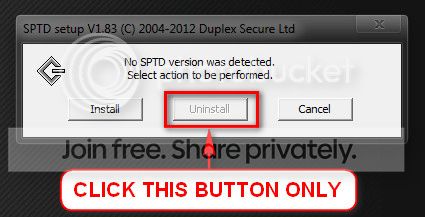
Daemon Tools, Alcohol 120% and Power Archiver Pro uses SCSI Pass Through Direct ( SPTD), which is a well known BSOD causer. Uninstall the program at first. Then download SPTD standalone installer from Disk-Tools.com, and execute the downloaded file as guided below : - Double click to open it.
- Click this button only:
 - If it is grayed out, as in the picture, there is no more SPTD in your system, and you just close the window.
Free up the startup. - Click on the Start button
- Type “msconfig (without quotes), click the resulting link. It will open the System Configuration window.
- Select the “Startup” tab.
- Deselect all items other than the antivirus.
- Apply > OK
- Accept then restart.
| My System Specs | | Computer type PC/Desktop System Manufacturer/Model Number Self Assembled OS Windows 7 Home Premium 64 Bit SP 1 CPU Intel Core i3 2120 @ 3.30GHz Motherboard Gigabyte Technology Co., Ltd. H61M-DS2 DVI Memory Corsair 2GB x2 (Single-Channel DDR3 @ 665MHz) Graphics Card 2047MB GeForce GTS 450 (ZOTAC International) Sound Card Onboard (Realtek High Definition Audio) Monitor(s) Displays LG Flatron E2040T Screen Resolution 1600x900 Keyboard Logitech MK220 Mouse Logitech MK220 PSU uMAX 750 watt. Case iBall Cooling Air/ Fans Hard Drives Western Digital 1 TB
Seagate 500 GB Internet Speed BSNL Broadband Antivirus Microsoft Security Essentials Browser Waterfox Other Info Dell Studio 15" Laptop |
11 Mar 2013
|
#5 | | Windows 7 Home Premium 64bit |
Thanks for your help. I checked the drivers on the USB dongle, and it seemed some of them were from 2006, while others were updated 2011, so I guess that's probably why it gives me trouble. Weird that it works well if I use it with the laptop though. Still, I don't have any other alternative for getting internet currently, so I guess I will have to manage. | My System Specs | | OS Windows 7 Home Premium 64bit |
11 Mar 2013
|
#6 | | Windows 7 Home Premium 64 Bit SP 1 |
Yes if you cannot change the dongle unfortunately you need to adjust with the present situation. | My System Specs | | Computer type PC/Desktop System Manufacturer/Model Number Self Assembled OS Windows 7 Home Premium 64 Bit SP 1 CPU Intel Core i3 2120 @ 3.30GHz Motherboard Gigabyte Technology Co., Ltd. H61M-DS2 DVI Memory Corsair 2GB x2 (Single-Channel DDR3 @ 665MHz) Graphics Card 2047MB GeForce GTS 450 (ZOTAC International) Sound Card Onboard (Realtek High Definition Audio) Monitor(s) Displays LG Flatron E2040T Screen Resolution 1600x900 Keyboard Logitech MK220 Mouse Logitech MK220 PSU uMAX 750 watt. Case iBall Cooling Air/ Fans Hard Drives Western Digital 1 TB
Seagate 500 GB Internet Speed BSNL Broadband Antivirus Microsoft Security Essentials Browser Waterfox Other Info Dell Studio 15" Laptop BSOD (0x0000001A) randomly during normal use problems? All times are GMT -5. The time now is 07:06 AM. | |