| Windows 7: seatools test failed, could that be why not responding issues? |
04 May 2012
|
#1 | | |
seatools test failed, could that be why not responding issues? I am helping a friend with her PC. she has been getting not responding problems for a few years. I do minor tweaks every once and awhile,which help but never solve the problem. She finally gave me her PC to spend a few days with it and a 14 hour memtest came out clean, but seatoools short test failed on her c-drive. I did the boot short-test and it failed, too. I am probably going to do a long test to try to fix the bad sectors, but I want to know if she should just replace the hard drive regardless of the outcome. It's a 250 gb seagate barracuda
This may sound like a stupid question, but can not responding issues be caused by a bad harddrive?
She has a q6600 with 4 gb ram running windows 7. She has an onboard graphics controller, but she doesn't play any games - just watches tv via the web. her N/R issues come whenever she tries to look up emails or contracts, browse around or try to do too many things at once.
Any advice would be helpful!
thanks! | My System Specs |
| |
04 May 2012
|
#2 | | |
Unresponsive issues can definitely have to do with a failing hard drive. In fact, that's often one of the giveaways of a failing drive or bad sectors. You can attempt to recover/fix the bad sectors so she can use it in the meantime, but I would certainly be looking at performing a return (if it's still covered under warranty) or buying a new drive. | My System Specs | | OS XP / Win7 x64 Pro CPU Intel Quad-Core Q9450 @ 3.2GHz Motherboard Asus P5-E Memory 2x2GB GSkill DDR2 Graphics Card NVIDIA GeForce 8600 GTS (EVGA) Monitor(s) Displays Dell 2408WFP Screen Resolution 1920x1200 |
04 May 2012
|
#3 | | |
thank you for the quick response. I will let her know and try to run the temporary fix. | My System Specs | | |
04 May 2012
|
#4 | | Windows 7 Home Premium 64bit (O.E.M) |
Hi,
Here is my advice. First, back up everything on the hdd. There is a possibility that the drive could die completely at any moment. As mentioned, the drive might be replaceable under warranty.
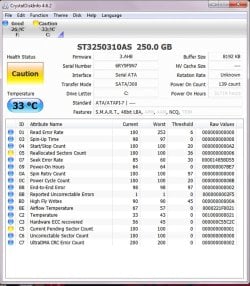
If possible, download this program on the problem PC and then post a screen shot of the program back here.
Hope this helps
Stephen | My System Specs | | System Manufacturer/Model Number Dell XPS 15 L502x OS Windows 7 Home Premium 64bit (O.E.M) CPU Intel Core i7 2630QM @2.00GHz Memory 6GB DDR3 Graphics Card Intel Intergrated Graphics 3000, nVidia GT525M (1GB) Screen Resolution 1366x768 Keyboard Backlit Dell XPS 15 L502x Keyboard Mouse Microsoft Wireless Mobile Mouse 4000 Hard Drives 750GB Seagate 7200rpm Internet Speed 2.5 Mb/s down, 0.36 up |
04 May 2012
|
#6 | | Windows 7 Home Premium 64bit (O.E.M) |
Whilst looking online I found this. Not my work but though I would post it to help you. Quote: It's so sad that SMART is so poorly understood; I think SMART tells alot about the drive and is the best drive diagnostic available. Sadly, few people know how to interpret the SMART data, and programs that try to interpret for the user do a poor job at it.
Realloacted Sector Count = INVISIBLE bad sectors that have been swapped with reserve sectors. These sectors are NO LONGER VISIBLE to your operating system and as such can NEVER cause any more problems.
Current Pending Sector = ACTIVE VISIBLE bad sectors that CANNOT BE READ but are still visible to the operating system. These are VERY DANGEROUS and cause ALOT of problems!
However, the value 200 you're seeing is a normalized value where the higher = better. You have to look at the RAW VALUE instead! For example, a raw value of 0 reallocated sectors might be the equivalent of a 200 normalized value. If the normalized value drops below the THRESHOLD value, that SMART attribute counts as a FAILURE. So if the normalized value is 200 and the threshold value is 100, that would be perfect, while the normalized value being 98 and the threshold being 100 would mean that attribute signals a FAILURE.
My advice: do not look at the normalized values at all. Only look at the RAW values!
Important SMART attributes:
- Reallocated Sector Count = bad sectors in the past; this might have caused problems in the past but does not have to; drives replace weak sectors as a precaution which may never have caused any problems.
- Current Pending Sector = THE MOST DANGEROUS smart attribute; this should ALWAYS BE ZERO or you have severe problems! This can be either weak electric charge with insufficient ECC correction ability -OR- it can be physical damage. Writing to this sector will solve the problem; if there was physical damage it will be realloacted by a reserve sector and the Reallocated Sector Count raw value will increase.
- UDMA CRC Error Count = cabling errors; if this is higher than 1000 and increasing you have severe cabling problems; under 100 does not need to trigger any alarm. Technically this means the receiving end did receive a corrupted version of the data that was sent by the transmitter; the corruption was detected by CRC which means the data is NOT accepted and the request will be sent again. Unless you see very high values or it keeps increasing steadily, this usually is not a big issue. As you have a raw value of one on the current pending sectors count you have issues. The drive needs replacing.
Hope this helps
Stephen
EDIT - Just for the record I found this here. Reallocated sector count: How important is this, really? - Ars Technica OpenForum. Don't want to be accused of plagiarism. | My System Specs | | System Manufacturer/Model Number Dell XPS 15 L502x OS Windows 7 Home Premium 64bit (O.E.M) CPU Intel Core i7 2630QM @2.00GHz Memory 6GB DDR3 Graphics Card Intel Intergrated Graphics 3000, nVidia GT525M (1GB) Screen Resolution 1366x768 Keyboard Backlit Dell XPS 15 L502x Keyboard Mouse Microsoft Wireless Mobile Mouse 4000 Hard Drives 750GB Seagate 7200rpm Internet Speed 2.5 Mb/s down, 0.36 up |
04 May 2012
|
#7 | | |
That doesn't really make sense to me (all Greek), but I will suggest that my friend replace her drive to be safe.
My fear is that I suggest my friend buy a new HDD, reinstall everything, which takes forever, and then still have not responding issues. I will feel like a fool. | My System Specs | | |
04 May 2012
|
#8 | | |
If you take the time to download all necessary motherboard drivers from the motherboard manufacturer's website before-hand and properly format and install the OS with all of the necessary drivers, that situation is very unlikely. | My System Specs | | OS XP / Win7 x64 Pro CPU Intel Quad-Core Q9450 @ 3.2GHz Motherboard Asus P5-E Memory 2x2GB GSkill DDR2 Graphics Card NVIDIA GeForce 8600 GTS (EVGA) Monitor(s) Displays Dell 2408WFP Screen Resolution 1920x1200 |
04 May 2012
|
#9 | | |

Quote: Originally Posted by FliGi7 If you take the time to download all necessary motherboard drivers from the motherboard manufacturer's website before-hand and properly format and install the OS with all of the necessary drivers, that situation is very unlikely. You mean update drivers and install the new HDD and I should see no more "not responding" problems? | My System Specs | | |
04 May 2012
|
#10 | | |
Yes, update all of the necessary drivers from the website after OS installation. Windows tries to make its best guess, which sometimes works and sometimes does not. This is why it's easier to download them all before-hand and put them on a thumb drive so if the network drivers don't work and you can't get to the internet, you can install the appropriate drivers to let you do so. | My System Specs | | OS XP / Win7 x64 Pro CPU Intel Quad-Core Q9450 @ 3.2GHz Motherboard Asus P5-E Memory 2x2GB GSkill DDR2 Graphics Card NVIDIA GeForce 8600 GTS (EVGA) Monitor(s) Displays Dell 2408WFP Screen Resolution 1920x1200 seatools test failed, could that be why not responding issues? problems? All times are GMT -5. The time now is 01:30 AM. | |