| Windows 7: The “cmd” command to show the all the connected machines on network |
20 Jan 2013
|
#1 | | |
The “cmd” command to show the all the connected machines on network The “cmd” command to show the all the connected machines on the network,
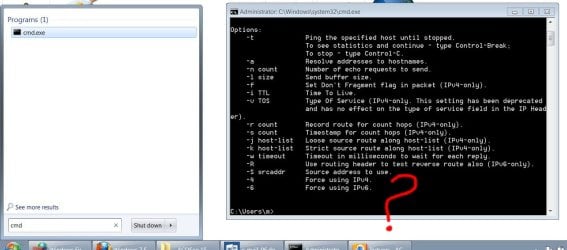
I’m looking for a command that is executed from the cmd (attached) to show all the connected machines on the network
Thank you
Best
Jamal | My System Specs |
| OS Windows 7 Ultimate x64 |
20 Jan 2013
|
#2 | | Windows 7 Home Premium x64 |

Quote: Originally Posted by Jamal NUMAN The “cmd” command to show the all the connected machines on the network,
I’m looking for a command that is executed from the cmd (attached) to show all the connected machines on the network
Thank you
Best
Jamal Type 'ipconfig/all' to show a list of all connected devices on the network.
Then use the default gateway & type it in the address bar of the browser to access your Router...that page will show you all comps/devices using your internet connection.
HTH | My System Specs | | System Manufacturer/Model Number Custom Built OS Windows 7 Home Premium x64 CPU Intel i5 quad processor Motherboard DP67BG Memory 16 GB Graphics Card Radeon HD 5770 Sound Card Realtek High Definition Audio Monitor(s) Displays Samsung SyncMaster Screen Resolution 1920X1080 Keyboard MS Wireless Mouse MS Optical Wired PSU Corsair GS800 Case Tower (Generic) Cooling 3 Internal Fans Hard Drives WD 2TB (SATA Internal)
WD 1TB (USB External) Internet Speed 19.4 Mbps |
20 Jan 2013
|
#3 | | |
Thank you for the answer “Sir George”,
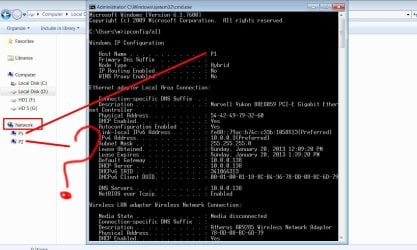
What I wanted is to show exclusively the machines on the network that are displayed under the “network” (attached).
is that possible with cmd command?
Best
Jamal | My System Specs | | OS Windows 7 Ultimate x64 |
20 Jan 2013
|
#4 | | Windows 7 Home Premium x64 |

Quote: Originally Posted by Jamal NUMAN Thank you for the answer “Sir George”,
What I wanted is to show exclusively the machines on the network that are displayed under the “network” (attached).
is that possible with cmd command?
Best
Jamal I don't know of any way to do it. Does that mean it can't be done, I don't know. | My System Specs | | System Manufacturer/Model Number Custom Built OS Windows 7 Home Premium x64 CPU Intel i5 quad processor Motherboard DP67BG Memory 16 GB Graphics Card Radeon HD 5770 Sound Card Realtek High Definition Audio Monitor(s) Displays Samsung SyncMaster Screen Resolution 1920X1080 Keyboard MS Wireless Mouse MS Optical Wired PSU Corsair GS800 Case Tower (Generic) Cooling 3 Internal Fans Hard Drives WD 2TB (SATA Internal)
WD 1TB (USB External) Internet Speed 19.4 Mbps |
20 Jan 2013
|
#5 | | Windows 7 x64 Ultimate A Finnish immigrant in Leipzig, Germany |
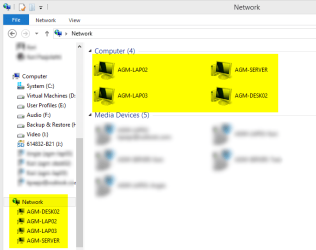
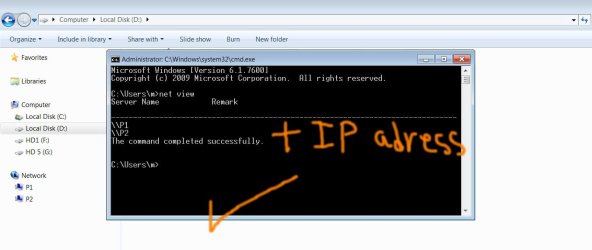
The highlighted computers here:
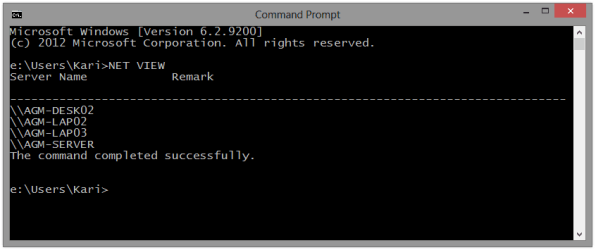
can be shown in command prompt with command NET VIEW: 
(Click to enlarge.)
Kari | My System Specs | | Computer type Laptop System Manufacturer/Model Number HP ENVY 17-1150eg OS Windows 7 x64 Ultimate CPU 1.6 GHz Intel Core i7-720QM Processor Memory 6 GB Graphics Card ATI Mobility Radeon HD 5850 Graphics Sound Card Beats sound system with integrated subwoofer Monitor(s) Displays 17" laptop display, 22" LCD and 32" Full HD TV through HDMI Screen Resolution 1600*900, 1680*1050 and 1920*1080 Keyboard Logitech diNovo Media Desktop Laser (bluetooth) Mouse Logitech MX1000 Laser (Bluetooth) Hard Drives Internal: 2 x 500 GB SATA Hard Disk Drive 7200 rpm
External: 2TB for backups, 3TB USB3 network drive for media Internet Speed 50/10 Mbps VDSL Antivirus MSE, Windows Defender Browser Maxthon 3.5.2. Other Info Windows 7 Ultimate Retail Full in English, additional Guest-user accounts in Finnish, German and Swedish (Working languages English & Swedish, Family language German, my own language, mother tongue, Finnish. I really need Ultimate to get to use Language Packs!) |
20 Jan 2013
|
#6 | | Windows 7 Ultimate x64 Topeka Kansas |
Always beat me to the punch Kari. And your examples are amazing like always. Good work. | My System Specs | | OS Windows 7 Ultimate x64 |
20 Jan 2013
|
#7 | | |
The info Kari provided is probably what the OP wanted (given the OP's screenshot in post 3) but just to be clear, the NET VIEW query may not show every computer on a network as mentioned in the thread title and in the OP.
NET VIEW might not be able to traverse different subnets in a complex network and (even on simple, single subnet networks) there are ways to hide computers from the NET VIEW query - this being one way: How to Hide the Server's Computer Name from Other Computers in the Domain
Disabling NetBIOS over TCP/IP can also hide a computer from various listings... and yet you can still get to it if you know it's name or IP.
I'm not trying to be picky - I'm just thinking of those that find this thread later on. Maybe those that know a certain computer is on their network, but it is not showing via Windows (file) Explorer or via NET VIEW. | My System Specs | | System Manufacturer/Model Number Employer provided Dell E6430 OS W7 Pro SP1 64bit CPU i5 3320M @ 2.6GHz Motherboard 0CPWYR Memory 4GB Graphics Card Intel HD Graphics 4000 Screen Resolution 1600 x 900 Hard Drives 119GB LITEONIT SSD Antivirus Employer mandated Symantec Endpoint Protection Browser Firefox, IE9 & IE8 via VM |
20 Jan 2013
|
#8 | | Windows 7 x64 Ultimate A Finnish immigrant in Leipzig, Germany |
UsernameIssues, you have a valid point there. However, and please correct me if I am wrong, hiding a computer from NET VIEW query also hides it from Windows Explorer > Network view.
If I read OP's question correctly he wants to use a command that shows in command prompt the same computers than he can see in Windows Explorer > Network; hiding a computer from network would hide it both in Windows Explorer > Network and NET VIEW query, ergo command prompt NET VIEW query shows exactly the same computers than Explorer, which is what OP asked.
Kari | My System Specs | | Computer type Laptop System Manufacturer/Model Number HP ENVY 17-1150eg OS Windows 7 x64 Ultimate CPU 1.6 GHz Intel Core i7-720QM Processor Memory 6 GB Graphics Card ATI Mobility Radeon HD 5850 Graphics Sound Card Beats sound system with integrated subwoofer Monitor(s) Displays 17" laptop display, 22" LCD and 32" Full HD TV through HDMI Screen Resolution 1600*900, 1680*1050 and 1920*1080 Keyboard Logitech diNovo Media Desktop Laser (bluetooth) Mouse Logitech MX1000 Laser (Bluetooth) Hard Drives Internal: 2 x 500 GB SATA Hard Disk Drive 7200 rpm
External: 2TB for backups, 3TB USB3 network drive for media Internet Speed 50/10 Mbps VDSL Antivirus MSE, Windows Defender Browser Maxthon 3.5.2. Other Info Windows 7 Ultimate Retail Full in English, additional Guest-user accounts in Finnish, German and Swedish (Working languages English & Swedish, Family language German, my own language, mother tongue, Finnish. I really need Ultimate to get to use Language Packs!) |
20 Jan 2013
|
#9 | | |

Quote: Originally Posted by Kari UsernameIssues, you have a valid point there. However, and please correct me if I am wrong, hiding a computer from NET VIEW query also hides it from Windows Explorer > Network view.
If I read OP's question correctly he wants to use a command that shows in command prompt the same computers than he can see in Windows Explorer > Network; hiding a computer from network would hide it both in Windows Explorer > Network and NET VIEW query, ergo command prompt NET VIEW query shows exactly the same computers than Explorer, which is what OP asked.
Kari I really fear coming across as being argumentative or picky or worse: "look what I think I know" - hence my repeated caveats that I'm posting this just for the sake of clarity. Google will index this thread based on its title (and post content - but more weight is given to the title). I don't want folks to use NET VIEW and think that they have a listing of all of the computers on the network. (Mixed operating systems can mess these lists up as well.)
Look at the original post. It does not mention Windows Explorer. Now look at post #3 - it clarifies (and considerably modifies) the original request. Your answer speaks specifically to the request made in post #3. (And for most people on a home network, that is a perfectly good answer.)
I VPN'd into my office. NET VIEW showed 55 computers (in reality there are 1000s of computers on the network at the moment). The Windows Explorer > Network view showed 58 computers. If I go to START > RUN and type in a UNC to a computer that I know is not on the same subnet as my office computer, that computer is added to the view shown in Windows Explorer > Network, but is still not shown in NET VIEW.
I don't have any computers that I'm willing to test by hiding them - so I cannot speak specifically to your question about "are they hidden from both lists". I don't even know enough to say how NET VIEW's list differs from Windows Explorer > Network list to predict which method of hiding might hide a computer from one list or the other. Maybe NET VIEW depends on NetBIOS over TCP/IP. Maybe Windows Explorer > Network depends on the computer browser service.
All I know is what I've seen in the past - not why I've seen it :-) | My System Specs | | System Manufacturer/Model Number Employer provided Dell E6430 OS W7 Pro SP1 64bit CPU i5 3320M @ 2.6GHz Motherboard 0CPWYR Memory 4GB Graphics Card Intel HD Graphics 4000 Screen Resolution 1600 x 900 Hard Drives 119GB LITEONIT SSD Antivirus Employer mandated Symantec Endpoint Protection Browser Firefox, IE9 & IE8 via VM |
20 Jan 2013
|
#10 | | Windows 7 x64 Ultimate A Finnish immigrant in Leipzig, Germany |

Quote: Originally Posted by UsernameIssues 
Quote: Originally Posted by Kari UsernameIssues, you have a valid point there. However, and please correct me if I am wrong, hiding a computer from NET VIEW query also hides it from Windows Explorer > Network view.
If I read OP's question correctly he wants to use a command that shows in command prompt the same computers than he can see in Windows Explorer > Network; hiding a computer from network would hide it both in Windows Explorer > Network and NET VIEW query, ergo command prompt NET VIEW query shows exactly the same computers than Explorer, which is what OP asked.
Kari I really fear coming across as being argumentative or picky or worse: "look what I think I know" - hence my repeated caveats that I'm posting this just for the sake of clarity. Google will index this thread based on its title (and post content - but more weight is given to the title). I don't want folks to use NET VIEW and think that they have a listing of all of the computers on the network. (Mixed operating systems can mess these lists up as well.)
Look at the original post. It does not mention Windows Explorer. Now look at post #3 - it clarifies (and considerably modifies) the original request. Your answer speaks specifically to the request made in post #3. (And for most people on a home network, that is a perfectly good answer.)
I VPN'd into my office. NET VIEW showed 55 computers (in reality there are 1000s of computers on the network at the moment). The Windows Explorer > Network view showed 58 computers. If I go to START > RUN and type in a UNC to a computer that I know is not on the same subnet as my office computer, that computer is added to the view shown in Windows Explorer > Network, but is still not shown in NET VIEW.
I don't have any computers that I'm willing to test by hiding them - so I cannot speak specifically to your question about "are they hidden from both lists". I don't even know enough to say how NET VIEW's list differs from Windows Explorer > Network list to predict which method of hiding might hide a computer from one list or the other. Maybe NET VIEW depends on NetBIOS over TCP/IP. Maybe Windows Explorer > Network depends on the computer browser service.
All I know is what I've seen in the past - not why I've seen it :-) You are of course right, and I was not trying to prove otherwise. I simply answered OP's question.

Sometimes we need to "read between the lines" to really understand what OP means and answer to that question, a question which might sometimes be slightly different than that what OP actually posted. In doing so we should IMO not think so much about what Google search later shows but OP's actual issue and answer that as well as we can.
My "reading between the lines" this time:
My answer was posted after user posted a screenshot telling very clearly he wants to show computers shown in Explorer > Network in command prompt, and after another member had answered it might not be possible.
As OP's screenshot only shows two PCs and because I had just before read another thread of the same OP which also mentioned the same two PCs, plus other "between the lines" reading, I was and still am quite sure he needs this information for his own either home or small business network. And, of course, were it a thousand PC corporate network with multiple subnets he wouldn't need to ask the question here.
I am sorry but now I think you are a bit picky, splitting hairs as we say in Finnish. My answer to the OP is (never been modest  ) the best given in this thread. Sorry Google if you now index wrong information, wasn't even thinking of that, and never will; I was and will be thinking the best possible answer to the OP's issue, all things considered, and post it if I know it.
Kari | My System Specs | | Computer type Laptop System Manufacturer/Model Number HP ENVY 17-1150eg OS Windows 7 x64 Ultimate CPU 1.6 GHz Intel Core i7-720QM Processor Memory 6 GB Graphics Card ATI Mobility Radeon HD 5850 Graphics Sound Card Beats sound system with integrated subwoofer Monitor(s) Displays 17" laptop display, 22" LCD and 32" Full HD TV through HDMI Screen Resolution 1600*900, 1680*1050 and 1920*1080 Keyboard Logitech diNovo Media Desktop Laser (bluetooth) Mouse Logitech MX1000 Laser (Bluetooth) Hard Drives Internal: 2 x 500 GB SATA Hard Disk Drive 7200 rpm
External: 2TB for backups, 3TB USB3 network drive for media Internet Speed 50/10 Mbps VDSL Antivirus MSE, Windows Defender Browser Maxthon 3.5.2. Other Info Windows 7 Ultimate Retail Full in English, additional Guest-user accounts in Finnish, German and Swedish (Working languages English & Swedish, Family language German, my own language, mother tongue, Finnish. I really need Ultimate to get to use Language Packs!) The “cmd” command to show the all the connected machines on network problems? All times are GMT -5. The time now is 12:52 AM. | |