| Windows 7: New Hard Drive and Windows 7 = slower? |
12 Nov 2009
|
#21 | | Windows 7 SP1, Home Premium, 64-bit |
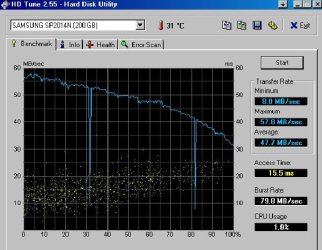
I owned a Samsung 2014N 200 gig drive and liked it very much. I saved the stats on it from HD Tune. I would guess it is representative of the original poster's old drive and can be used for comparison to the figures he quotes for the new WD drive:
Samsung 2014N
Transfer rate minimum 8.0
Transfer rate maximum 57.8
Average 47.7
Access time 15.5
Burst rate 79.8 | My System Specs |
| System Manufacturer/Model Number Ignatz Special; 4 speed manual gearbox; factory air conditioning; one of one OS Windows 7 SP1, Home Premium, 64-bit CPU Intel Sandy Bridge i5-2500, not overclocked Motherboard Gigabyte H67A-UD3H-B3, full ATX Memory 4 GB Crucial DDR3-1333 Graphics Card none; graphics are integrated on CPU Sound Card onboard: Realtek ALC892; external: USB Behringer UF0-202 Monitor(s) Displays NEC 90GX2-BK 19" LCD Screen Resolution 800 x 640 Keyboard Leopold Tenkeyless with Cherry Blue switches, USB Mouse Logitech or Microsoft optical wired; either USB or PS 2 PSU Seasonic SS-560KM, modular Case Antec Solo II Cooling CPU: Scythe Big Shuriken; Case: Scythe Slipstream 800 & 500 Hard Drives System: Intel 320 Series SSD, 80 GB;
Data: Samsung Spinpoint 103SJ, 1 TB;
Backup: WD Caviar Green WD15EADS-00P8B0, 1.5TB Other Info Power consumption of this system, including monitor: 68 watts at idle; 144 watts at full load |
12 Nov 2009
|
#22 | | Win7 Build 7600 x86 Netherlands |

Quote: Originally Posted by se7ensmatrix121 -I'm unsure what the Samsung HDD MB/sec, however, from the last run of HDTune, I can tell you the info on the WD Black. Min: 43.3 MB/Sec, Max: 103.7 MB/Sec, Average: 79.9 MB/Sec with Access Time: 12.6 ms, and Burst of 132.1 MB/Sec 79.9MB/sec, that is an excellent average. It's at the high end of the range.
12.6ms access time is a bit on the slow side, but shouldn't be really noticeable.
Samsung is about 8.9ms access time. That could explain for a tad of sluggishness on WD's part.
. Quote:
But it could also be windows accessing the disk excessively.
Try to find out if some process or service is accessing the disk constantly. -Unsure on how to find this information, but hopefully you can steer me that direction? 1. ctrl alt delete to go into taskmanager
2. go to the performance tab
3. at the bottom there's a button "source control" or something like that. (I'm on Dutch OS)
4. In source control click on "Disk" tab.
5. Go fiddle around with the different views to find out which processes are accessing the disk.
It looks a bit complicated at first, but you'll figure it out.
I will check back tomorrow.
4:15 am over here, going to bed.
Greetings | My System Specs | | OS Win7 Build 7600 x86 CPU Pentium II 300MHz Motherboard Asus Memory 32mb EDO RAM Graphics Card Diamond Viper Sound Card Soundblaster 16 Monitor(s) Displays 14" AOC CRT 16K color Screen Resolution 800x600 Keyboard Trust Ergonomic Mouse Generic PSU 110 Watts Cooling Passive Hard Drives 300mb Quantum fireball Internet Speed 256K u 128K d |
12 Nov 2009
|
#23 | | |

Quote: Originally Posted by SquonkSC 
Quote: Originally Posted by se7ensmatrix121 -I'm unsure what the Samsung HDD MB/sec, however, from the last run of HDTune, I can tell you the info on the WD Black. Min: 43.3 MB/Sec, Max: 103.7 MB/Sec, Average: 79.9 MB/Sec with Access Time: 12.6 ms, and Burst of 132.1 MB/Sec 79.9MB/sec, that is an excellent average. It's at the high end of the range.
12.6ms access time is a bit on the slow side, but shouldn't be really noticeable.
Samsung is about 8.9ms access time. That could explain for a tad of sluggishness on WD's part.
. Quote:
But it could also be windows accessing the disk excessively.
Try to find out if some process or service is accessing the disk constantly. -Unsure on how to find this information, but hopefully you can steer me that direction? 1. ctrl alt delete to go into taskmanager
2. go to the performance tab
3. at the bottom there's a button "source control" or something like that. (I'm on Dutch OS)
4. In source control click on "Disk" tab.
5. Go fiddle around with the different views to find out which processes are accessing the disk.
It looks a bit complicated at first, but you'll figure it out.
I will check back tomorrow.
4:15 am over here, going to bed.
Greetings Seems the only thing taking up the write on the HD is System at the moment. It juggles between 7,000 - 30,000 B/Sec (Averaging 18,000 B/Sec). | My System Specs | | OS Windows 7 x64 CPU AMD Phenom x4 9550 Memory 8GB DDR2 |
13 Nov 2009
|
#24 | | Win7 Build 7600 x86 Netherlands |

Quote: Originally Posted by se7ensmatrix121 Seems the only thing taking up the write on the HD is System at the moment. It juggles between 7,000 - 30,000 B/Sec (Averaging 18,000 B/Sec). So we can rule excessive access out.
I suggest you start checking the disk for surface failures.
It could well be you have some poor sectors on the disk that need re-reading,
and that's what could cause the lag.
You might also consider installing a previous chipset driver, like one build before the last.
The latest isn't always the best. Sometimes new problems are introduced with new drivers.
It's also a way to rule it out as a cause.
Good luck | My System Specs | | OS Win7 Build 7600 x86 CPU Pentium II 300MHz Motherboard Asus Memory 32mb EDO RAM Graphics Card Diamond Viper Sound Card Soundblaster 16 Monitor(s) Displays 14" AOC CRT 16K color Screen Resolution 800x600 Keyboard Trust Ergonomic Mouse Generic PSU 110 Watts Cooling Passive Hard Drives 300mb Quantum fireball Internet Speed 256K u 128K d |
13 Nov 2009
|
#25 | | |
Well, i'm at a bit of a stand still. I made some progress with Photoshop today, it is no longer crashing, which I take as a good sign. Chipsets have no update from MSI or AMD/ATI. I had to adjust a few things with Photoshop to make it perform, such as adding some tweeks and a full update to insure I had everything current. Going to run WD's DLG on the hard drive and check for faults now.
Thanks to all for the help! | My System Specs | | OS Windows 7 x64 CPU AMD Phenom x4 9550 Memory 8GB DDR2 |
13 Nov 2009
|
#26 | | Windows 7 Ultimate x86-64 |
The chipset is not your mobo manufacturer. It would be from Intel, AMD, or Nvidia. | My System Specs | | System Manufacturer/Model Number Sony Vaio Z46GDU OS Windows 7 Ultimate x86-64 CPU P9700@2.8GHz 1066MHz FSB Motherboard Sony branded Memory 6GB DDR3 1066MHz Graphics Card 9300M GS 256MB Dedicated (Speed) + Intel4500MHD (Stamina) Sound Card Realtek HD Audio Monitor(s) Displays 13.1' WXGA Screen Resolution 1600x900 Hard Drives 320GB 7200RPM w/ 16MB cache Internet Speed 1MB/s |
13 Nov 2009
|
#27 | | |

Quote: Originally Posted by Frostmourne The chipset is not your mobo manufacturer. It would be from Intel, AMD, or Nvidia. I also asked where to find chipset drivers at, and noone was able to give me any help. I appreciate the responses that I'm getting, but if you are saying I need to do something and I say I'm not sure I know how, please help guide me in the right direction. | My System Specs | | OS Windows 7 x64 CPU AMD Phenom x4 9550 Memory 8GB DDR2 |
13 Nov 2009
|
#28 | | Windows 7 Professional x64 The Wild West |

Quote: Originally Posted by SquonkSC 
Quote: Originally Posted by se7ensmatrix121 I will attempt this, however, I have a feeling it's going to be a losing battle due to the PCI-E x16 slot covering these two ports. I will report back from my phone if there is any update. Hi se7ensmatrix121,
I'm sorry to disappoint you but there's no way in the world you are going to get 3Gbit/s
That is a theoretical maximum for the Sata II standard, but that applies to the controller, not the disks themselves.
3gbit/s = 384 Mbytes per second and there isn't a "platter" disk in the world that can go that fast.
Somewhere between 60 and 80 Mbyte/s is the max sustained throughput you can get with a single platter disk. And about 128Mbyte/s bursts for very short periods when the disk's cache is read instead of the platters.
Why do they make a 3Gbit/s (384Mbyte/s) standard while no disk can reach that, I hear you think.
Well, for starters the controller standard always has to be ahead of the disk speeds,
so the disks have some headroom, and to allow development of faster disks.
there's no point in making a disk faster than the controller can handle.
Having said that,
The Sata II standard is created with SSD disks in mind.
The newest SSD disks are getting very close to that theoretical maximum.
The fastest to date reads and writes at 260 Mbytes/s.
It won't be long before SSD breaks the 384Mb barrier.
Therefore Sata III is already on it's way, that will be 6Gbit/s (768Mb/s)
Soon SSD will become more affordable and platter disks will die a slowly disappear, just like the floppy disk.
I hope this explains it. Our good friend Anand gave us a look at the new inteface and how it will perform with "normal" disks.
A little off topic but it's good info on this subject. AnandTech: Seagate Barracuda XT 2TB: SATA 6Gb/s Performance Preview | My System Specs | | System Manufacturer/Model Number Keeps changing - (Custom) OS Windows 7 Professional x64 CPU Intel Core i7 860 Motherboard Gigabyte GA-P55-UD4P Memory 4GB DDR3 Mushkin 1600Mhz @ 7-8-7-20 Graphics Card MSI GTS250 1GB DDR3 Twin Frozr Sound Card Onboard realtek Monitor(s) Displays Samsung SyncMaster 24" P2450 + Samsung 20" 2033 Screen Resolution 1920 X 1080 and 1600 X 900 (#2 system 1440 X 900) Keyboard Gigabyte USB keyboard Mouse Microsoft wireless laser mouse 5000 PSU Corsair 750 HX Modular Case Lancool PC-K62 Cooling Cooler Master TX3 CPU cooler and 4-140mm and 1-120mm case Hard Drives Patriot Inferno 120GB SSD + 3 WD Blue 640GB drives Internet Speed 7 Mb down 1.5 up Other Info System #2: AMD Phenom II X6 1055T (Freezer 7 Pro cooler) - Gigabyte 880GMA-UD2H - WD 500GB Black - 9500GT (1GB) 500W OCZ modular PSU - Antec 200 case. System #3 (LapTop) Core 2 Duo T6670 - 320GB 7200RPM HD - 4GB DDR3 RAM. |
13 Nov 2009
|
#29 | | Windows 7 Ultimate x86-64 |

Quote: Originally Posted by se7ensmatrix121 
Quote: Originally Posted by Frostmourne The chipset is not your mobo manufacturer. It would be from Intel, AMD, or Nvidia. I also asked where to find chipset drivers at, and noone was able to give me any help. I appreciate the responses that I'm getting, but if you are saying I need to do something and I say I'm not sure I know how, please help guide me in the right direction. What motherboard do you have? Type msinfo32.exe, then file export and upload that .txt file along with a Belarc Advisor report - all in a .zip file and I''ll point you in the right direction. | My System Specs | | System Manufacturer/Model Number Sony Vaio Z46GDU OS Windows 7 Ultimate x86-64 CPU P9700@2.8GHz 1066MHz FSB Motherboard Sony branded Memory 6GB DDR3 1066MHz Graphics Card 9300M GS 256MB Dedicated (Speed) + Intel4500MHD (Stamina) Sound Card Realtek HD Audio Monitor(s) Displays 13.1' WXGA Screen Resolution 1600x900 Hard Drives 320GB 7200RPM w/ 16MB cache Internet Speed 1MB/s |
13 Nov 2009
|
#30 | | |
Here's the info you request. As mentioned in the first post, I have the MS-7388 Board from MSI (K9A2 CF Series), with an AMD Phenom 9750 Processor. This board uses the AMD 790X North Bridge, and a South Bridge 600.
Last edited by se7ensmatrix121; 13 Nov 2009 at 08:40 PM..
| My System Specs | | OS Windows 7 x64 CPU AMD Phenom x4 9550 Memory 8GB DDR2 New Hard Drive and Windows 7 = slower? problems? All times are GMT -5. The time now is 03:02 AM. | |