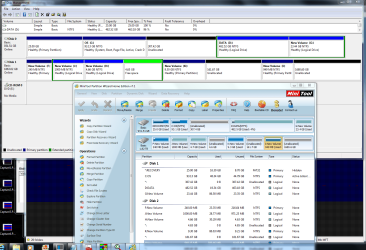
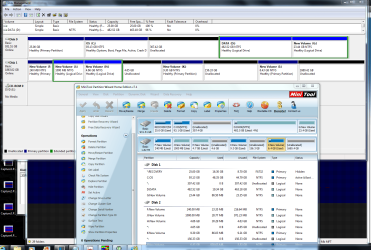
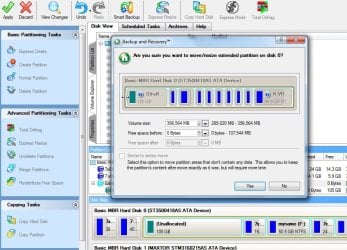
So, in all cases when the extended partition is larger then necessary to encapsulate the logical volumes, then that extended partition is being shrunk by PWBootCD, whatever operation PWBootCD performs on the system drive. In my particular case I shifted just a littlebit the most right primary partition, which is not at all adjacent to the extended partition; that action on the drive resulted in a shrunk extended partition. In fact, PW just minimizes the extended partition size without moving or shifting the logical volumes in it.
I have to say I do not like at all the idea PW is doing particular actions on the drive that I have not asked for, like minimizing the extended partition size. Maybe the developers of PW have their reasons for implementing PW like this, but the least thing they could do is leave it up to the user how PW should behave; One could introduce an option in the settings where the user could choose to switch ON or OFF the action of minimizing the extended partition size.
Your feedback (to the PW author) is certainly appreciated.
But again, I think you're over-emphasizing what you feel to be something "important" which honestly is not. The "extended partition" outer boundary is of no real meaning or value. It is an artificial concept (for visualization only, such as drawing a bold outer border on a graphical picture) defining the lower and upper extents of all consecutive logical partitions along with any imbedded (i.e. between logical partitions) unallocated space within the total lower/upper boundary. What's important here is that the INNER-unallocated space can be used to re-size and move these logical partitions left/right to make use of the "logical unallocated" space.
But otherwise, the current boundaries of the "extended partition" means nothing in terms of everyday use of partitions, logical or primary. It's only for visualization when drawing a picture.
And furthermore, PW treats any type of "outer unallocated space" (i.e. not between two logical partitions) as "generic unallocated space", which you can make use of to move or re-size all partitions, logical or primary. The partitions you want to work on are unlimited, although you may obviously need to perform a sequence of move/re-size operations (like sliding tiles in that kid's puzzle game) to make use of that unallocated space to eventually accomplish the net total move/re-size you want.
In other words, what is thought of as the "extended partition", and inner or outer unallocated space, really is of no consequence in terms of limiting what PW can do for the net total combined move/re-size of ALL partitions to achieve ANYTHING you want to achieve! It may take a sequence of several small discrete steps to get there, but PW understand (a) allocated partitions, and (b) unallocated free space. All its functionality then derives from that knowledge.
And that's all that's really important. The so-called "extended partition" is really an artificial concept used to describe something (although it clearly is one of the four allowed primary partitions on the MBR drive), but other than that is in no way limiting PW in terms of satisfying your partitioning move/re-size objectives.
I know it's subjective, but I think you're just perhaps not used to seeing this particular graphical representation or working with re-partitioning. I do feel you're ascribing much too much significance to "shrinking the extended partition". It has ZERO impact on what you can do or not do in terms of accomplishing your partitioning objectives from that point forward in time. It's just "housekeeping" for PW, and has no consequence to you. You can still continue to do further partitioning work using any unallocated space, and isnt' that what's important?
Also the fact that the extended partition shell, encapsulating the logical volumes, is not visualized is really a serious drawback; it leaves the visual representation of the volumes incomplete, somehow. It increases the chance for confusion.
Subjective again. I find there to be no confusion seeing the outer boundary surrounding the consecutive logical partitions, with any outer unallocated space just being "unallocated".
In that respect I believe the implementation in DM is better than in PW. Also here the developers of PW could introduce an ON/OFF option in the settings leaving it to the user to visualize or hide the extended partition shell.
Well, again this is personal preference... and probably stems from the fact that PW is a new program you're just betting used to.
What's important for me is the ability to work with partitions, and use PW almost 100% of the time (rather than DM) to accomplish my goals. In fact I really only use DM to change drive letters if I want to, although PW can also do that as well. But for true partition work I use PW 100% of the time.
And for me, it's the partitions and unallocated space which are relevant to move/re-size/create. I have no concern for the large bold outer-boundary which might be drawn around the consecutive logical partitions in a graphical image. I know what that boundary is and means (and it's purely conceptual, really) and also that it does NOT impact what I want to accomplish. Only existing partitions and existing unallocated space impacts what and how many sequential steps I need to go through to accomplish my end re-partitioning objective.
I noticed that some unallocated area on the system drive, which was on the level of primary partitions, was marked as *logical* in PW. So it looked like it was free space within an extended partition, but that was clearly not the case.
It's all just "unallocated".
What is important is that "inner unallocated" (logical) space cannot just be given to an outer primary partition without sliding logical partitions around through several re-size/move steps, so that the originally inner unallocated space now arrives at an outer location, so that it can now be used for an adjacent primary partition.
And once any unallocated space is to the left or right of the "extended partition" which surrounds all of the consecutive logical partitions, that unallocated space can now be used for anything you want... to extend the adjacent logical or primary partition.
Whether unallocated space is referred to as "logical" or "primary" isn't really of any consequence. Only its location is relevant, in terms of how you make us of it in one or more steps (sliding the "chicklets" left and right) to accomplish your ultimate overall partitioning goal.
Conclusion: I am not at all impressed by Partition Wizard (PWWin7, PWBootCD)
Certainly you're entitled to your opinion. But I do feel it's just a new program that you're not used to yet. And you are over-emphasizing in your own mind the significance and importance of the "extended partition" as drawn in a graphical representation. It actually has almost no consequence, other than to define its limits as one of the four primary partitions allowed on the MBR drive.
I believe if you try other similar products (Easeus, Paragon, etc.) you will find them all to appear virtually identical to PW graphically.