| Windows 7: Defraggler adds 10+GB |
19 Jan 2012
|
#1 | | 7 Ultimate x64 On my chair, in my room |
Defraggler adds 10+GB I was defragging, and I don't know why, but when it finished with the drive fragmentation at 1%, I started it again. Big mistake, my hard drive space went from 140GB to 155GB. I think it moved data in this area: 
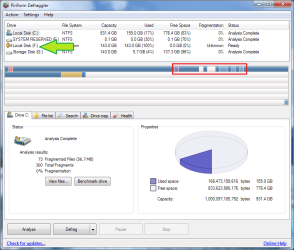
The green arrow is pointing to my backup drive. I need to keep my Local Disk under 143GB to be able to run backup. I know, it's a 1TB and I'm using under a quarter of it. I will sort this out (hopefully in this thread) about new backup locations etcetera and buy a hard drive when prices fall.
Back to topic, it might show white in those middle spots, but there is data there: 
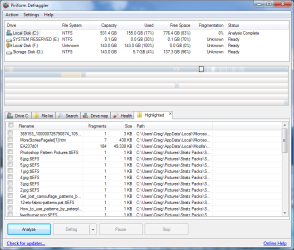
So, would it be possible to resolve this and get my hard drive space back down? | My System Specs |
| Computer type PC/Desktop OS 7 Ultimate x64 CPU AMD Phenom II X6 1090T Motherboard Asus M4A89GTD Pro Memory Corsair XMS3 8GB DDr3 1600MHz Graphics Card EVGA GeForce GTX 670 2GB Sound Card Asus Xonar DX Monitor(s) Displays Acer H236HLbmjd Screen Resolution 1920x1080 Keyboard Mionix Zibal 60 Mouse Mionix Naos 5000 PSU Cooler Master GX650 Case Silverstone Raven 3 RV03B-W Cooling Akasa AK-CCX-4002HP Venom Hard Drives Seagate 320GB - WD Caviar Black 1TB @ SATA III 6Gb/s - WD Caviar Blue 500GB SATA-III 6Gb/s Internet Speed 60+MB/s Down, 2.8MB/s Up Antivirus Bitdefender Internet Security 2013 Browser Internet Explorer |
19 Jan 2012
|
#2 | | |
I think it does this because it is trying to make contiguous blocks while it is copying/moving files around so temporarily creates these files. | My System Specs | | OS Windows 7 Ultimate x64 CPU Intel Core i5 2500k at 3.3 GhZ Memory 2x4GB DDR3 1333Hz Graphics Card Ati Radeon 6770 Sound Card Speakers Monitor(s) Displays 1x 15" HD 572 Screen Resolution 1024x768 Keyboard Wired Keyboard Mouse Wired Mouse PSU 500W Cooling 3x Fans Hard Drives 2x500GB Internet Speed 10MB/s Other Info Netbook: Dell Inspiron Mini |
19 Jan 2012
|
#3 | | |
It is probably because you have system restore enabled on the volume. System Restore uses volume shadow copy service (vss). Defraggler is not VSS aware, so when it moves blocks around, the OS interprets this as file changes and makes a copy of the blocks for the restore point. If you want to avoid this, use a defragmenter that is VSS friendly like Windows 7 defragmenter (what I would advise), or Diskeeper. OTOH, you could disable system restore for the volume, but that has obvious drawbacks. | My System Specs | | Computer type PC/Desktop System Manufacturer/Model Number Home built (GeneO industries)/Model 3 OS Windows 7 64 bit SP1 CPU i5 2500k @ 4.5 GHz, 1.264V 124 GFlop (IBT with AVX) Motherboard ASUS P8Z68-V PRO/GEN3 Memory 16GB (4GBx4) 1600MHz G.skill Ripjaws X 8-8-8-24 Graphics Card MSI GTX 660 Ti PE/OC, 2GB 7160 MHz DDR5 clock, 1228 Mhz Core Sound Card Onboard Realtek HD Monitor(s) Displays NEC Spectraview 2490WUXi-SV Screen Resolution 1920 x 1200 Keyboard HP Wireless Mouse HP wireless PSU Seasonic X-850 (2012 KM3 model) Case Fractal Design "Define R3" Cooling CM TPC 812 push/pull, 3 120mm, 2 TY-140 case fans Hard Drives Samsung 128GB 840 Pro SSD (System), Crucial 128GB M4 SSD, 2x WD Caviar 1TB Black internal (data), 1x WD Blue 6Gb/s 1TB Internal, 1x 2TB eSata WD20EARS Green, 2x 500GB Seagate external USB, 1x 350GB exte Internet Speed 27.8 Mb/s down, 5.6 Mb/s up Other Info USB 3.0 x4 , SATA III x4, eSATA x3, SATA II x4, USB 2.0 x8. 2 Samsung DVD R/W drives.
WEI: CPU 7.7, Memory 7.8, Graphics 7.9, Disk 7.9 |
19 Jan 2012
|
#4 | | |
For what it's worth, the very latest version adds a VSS compatibile mode, which should avoid this entirely. If you aren't using 2.08.373 of Defraggler, time to upgrade. | My System Specs | | System Manufacturer/Model Number HP Z400 workstation OS Windows Server 2008 R2 CPU Intel Xeon 3550 @3.06GHz Motherboard HP Memory 16GB DDR3 Graphics Card Nvidia Quadro 600 Sound Card Realtek ALC262 Monitor(s) Displays 2x Hanns-G HG281 Screen Resolution 1920x1200 Keyboard Microsoft Natural Ergonomic Keyboard 7000 Mouse Microsoft Intellimouse Explorer 3.0 PSU HP Case HP Hard Drives 1x Samsung 160GB SSD
2x WD 1TB (RAID1) |
19 Jan 2012
|
#5 | | |
That looks quite different than what windows and diskeeper do. I believe they try to avoid triggering VSS copies during defragmentation while it looks likes this version of defraggler disables VSS. I expect that has a pretty negative impact on system restore points if you are updating files while defraggler is running. | My System Specs | | Computer type PC/Desktop System Manufacturer/Model Number Home built (GeneO industries)/Model 3 OS Windows 7 64 bit SP1 CPU i5 2500k @ 4.5 GHz, 1.264V 124 GFlop (IBT with AVX) Motherboard ASUS P8Z68-V PRO/GEN3 Memory 16GB (4GBx4) 1600MHz G.skill Ripjaws X 8-8-8-24 Graphics Card MSI GTX 660 Ti PE/OC, 2GB 7160 MHz DDR5 clock, 1228 Mhz Core Sound Card Onboard Realtek HD Monitor(s) Displays NEC Spectraview 2490WUXi-SV Screen Resolution 1920 x 1200 Keyboard HP Wireless Mouse HP wireless PSU Seasonic X-850 (2012 KM3 model) Case Fractal Design "Define R3" Cooling CM TPC 812 push/pull, 3 120mm, 2 TY-140 case fans Hard Drives Samsung 128GB 840 Pro SSD (System), Crucial 128GB M4 SSD, 2x WD Caviar 1TB Black internal (data), 1x WD Blue 6Gb/s 1TB Internal, 1x 2TB eSata WD20EARS Green, 2x 500GB Seagate external USB, 1x 350GB exte Internet Speed 27.8 Mb/s down, 5.6 Mb/s up Other Info USB 3.0 x4 , SATA III x4, eSATA x3, SATA II x4, USB 2.0 x8. 2 Samsung DVD R/W drives.
WEI: CPU 7.7, Memory 7.8, Graphics 7.9, Disk 7.9 |
19 Jan 2012
|
#6 | | |
True, but a defrag program that does "VSS-aware" defragmentation (which means it does copy-on-write file movement with larger than 16KB allocation unit size chunks) has the potential to be less effective than a "full-on" defrag (and it still fills up VSS and can age out data, it just does it much more slowly), which is the counter to that pendulum swing. You either deal with the potential for more fragmentation after a defrag pass but with far less VSS aging, or you disable VSS, defrag more agressively, and have a much higher risk of losing VSS data and the always-there potential of disk usage growth.
It's a hard choice to make, but as we generally recommend full backups before screwing with the system, it does makes VSS restore points less necessary. It is a good point to make, though, and one must debate which is more important - if you want a defrag program that is "VSS-aware", as far as I am aware you will have to pay for it if inbox defrag.exe isn't good enough for you - I know of no freeware that does this other than the inbox defrag. | My System Specs | | System Manufacturer/Model Number HP Z400 workstation OS Windows Server 2008 R2 CPU Intel Xeon 3550 @3.06GHz Motherboard HP Memory 16GB DDR3 Graphics Card Nvidia Quadro 600 Sound Card Realtek ALC262 Monitor(s) Displays 2x Hanns-G HG281 Screen Resolution 1920x1200 Keyboard Microsoft Natural Ergonomic Keyboard 7000 Mouse Microsoft Intellimouse Explorer 3.0 PSU HP Case HP Hard Drives 1x Samsung 160GB SSD
2x WD 1TB (RAID1) |
19 Jan 2012
|
#7 | | |

Quote: Originally Posted by cluberti True, but a defrag program that does "VSS-aware" defragmentation (which means it does copy-on-write file movement with larger than 16KB allocation unit size chunks) has the potential to be less effective than a "full-on" defrag (and it still fills up VSS and can age out data, it just does it much more slowly), which is the counter to that pendulum swing. You either deal with the potential for more fragmentation after a defrag pass but with far less VSS aging, or you disable VSS, defrag more agressively, and have a much higher risk of losing VSS data and the always-there potential of disk usage growth.
It's a hard choice to make, but as we generally recommend full backups before screwing with the system, it does makes VSS restore points less necessary. It is a good point to make, though, and one must debate which is more important - if you want a defrag program that is "VSS-aware", as far as I am aware you will have to pay for it if inbox defrag.exe isn't good enough for you - I know of no freeware that does this other than the inbox defrag. I don't think that is correct. There is more to VSS-awareness than recognizing 16k allocation unit. The algorithms avoid copy on write by other means from what I can reckon from the literature b. In my experience I found Windows 7 defragmentation did little to grow my shadow space on my HDD, knows about the internals and how to fragment the MFT and other system files - I wouldn't trust another. | My System Specs | | Computer type PC/Desktop System Manufacturer/Model Number Home built (GeneO industries)/Model 3 OS Windows 7 64 bit SP1 CPU i5 2500k @ 4.5 GHz, 1.264V 124 GFlop (IBT with AVX) Motherboard ASUS P8Z68-V PRO/GEN3 Memory 16GB (4GBx4) 1600MHz G.skill Ripjaws X 8-8-8-24 Graphics Card MSI GTX 660 Ti PE/OC, 2GB 7160 MHz DDR5 clock, 1228 Mhz Core Sound Card Onboard Realtek HD Monitor(s) Displays NEC Spectraview 2490WUXi-SV Screen Resolution 1920 x 1200 Keyboard HP Wireless Mouse HP wireless PSU Seasonic X-850 (2012 KM3 model) Case Fractal Design "Define R3" Cooling CM TPC 812 push/pull, 3 120mm, 2 TY-140 case fans Hard Drives Samsung 128GB 840 Pro SSD (System), Crucial 128GB M4 SSD, 2x WD Caviar 1TB Black internal (data), 1x WD Blue 6Gb/s 1TB Internal, 1x 2TB eSata WD20EARS Green, 2x 500GB Seagate external USB, 1x 350GB exte Internet Speed 27.8 Mb/s down, 5.6 Mb/s up Other Info USB 3.0 x4 , SATA III x4, eSATA x3, SATA II x4, USB 2.0 x8. 2 Samsung DVD R/W drives.
WEI: CPU 7.7, Memory 7.8, Graphics 7.9, Disk 7.9 |
20 Jan 2012
|
#8 | | 7 Ultimate x64 On my chair, in my room |
So, Windows Disk Defragment or Defraggler with the advanced option enabled? 
My hard drive fragmentation is >1%, so if I where to use Defraggler VSS aware, would it move the blocks appropriately? | My System Specs | | Computer type PC/Desktop OS 7 Ultimate x64 CPU AMD Phenom II X6 1090T Motherboard Asus M4A89GTD Pro Memory Corsair XMS3 8GB DDr3 1600MHz Graphics Card EVGA GeForce GTX 670 2GB Sound Card Asus Xonar DX Monitor(s) Displays Acer H236HLbmjd Screen Resolution 1920x1080 Keyboard Mionix Zibal 60 Mouse Mionix Naos 5000 PSU Cooler Master GX650 Case Silverstone Raven 3 RV03B-W Cooling Akasa AK-CCX-4002HP Venom Hard Drives Seagate 320GB - WD Caviar Black 1TB @ SATA III 6Gb/s - WD Caviar Blue 500GB SATA-III 6Gb/s Internet Speed 60+MB/s Down, 2.8MB/s Up Antivirus Bitdefender Internet Security 2013 Browser Internet Explorer |
20 Jan 2012
|
#9 | | Windows 7 Ultimate x64 SP1 / Ubuntu 12.10 x64 Kolkata, West Bengal, India |
What are the advantages of deffraging a hard disk ?? I never used it. Does it increase performance ?? | My System Specs | | System Manufacturer/Model Number Lenovo Ideapad Y550 (4186) OS Windows 7 Ultimate x64 SP1 / Ubuntu 12.10 x64 CPU Intel Core 2 Duo 2.20 Ghz Motherboard LENOVO KIWB1 (U2E1) Memory 4.0GB Dual-Channel DDR3 @ 398MHz Graphics Card NVIDIA GeForce GT 240M 1GB Sound Card Realtek High Definition Audio Monitor(s) Displays 15 inch (1366x768@60Hz) Screen Resolution 1366*768 Keyboard Build In Mouse Touchpad Hard Drives 320GB Hitachi HITACHI HTS545032B9A300 (SATA) Internet Speed 30 KBps (Dial up) |
20 Jan 2012
|
#10 | | |
Only for hugely fragmented drives. 1% is NOTHING. Anything below 20% is really not that big of a deal. Windows 7 does defragmention automaticly behind the scenes on a weekly bases. | My System Specs | | Computer type PC/Desktop System Manufacturer/Model Number Alienware Aurora ALX R4 OS Windows 7 x64 (SP1) CPU Intel Core i7-3930K (3.2GHz, Turbo 4GHz) Motherboard Alienware Aurora-R4 x79 Memory 4x Samsung 4GB PC3-12800 DDR3 (16GB 1600MHz) Graphics Card Nvidia Geforce GTX 690 (Stock) Sound Card RealTek Integrated Audio Monitor(s) Displays Dell UltraSharp U3011 Screen Resolution 2560x1600 PSU 875W Some Dell PSU <.< Hard Drives Samsung P830 256 GB, WD Raptor 150GB, 2x 1TB HDDs Other Info Dell Inspiron Mini 10v (Intel Atom N270 1.6 GHz; 1GB; Windows 7 Ultimate) Defraggler adds 10+GB problems? All times are GMT -5. The time now is 12:19 AM. | |