How to Enable or Disable the Thumbnail Cache in Windows
Information
By default Windows stores the images for thumbnail previews in cache memory so that it can redisplay the images quickly each time you reopen a folder in Windows Explorer. However, with thumbnail caching enabled by default, this may pose a security issue with some people or companies since all of the thumbnail picture view images stored in the thumbnail cache can be view by anyone.
This will show you how to disable thumbnail caching to prevent and stop the thumbs_*.db thumbnail cache database from been saved to, free up some memory, and force Vista, Windows 7, or Windows 8 to load the thumbnail picture views each time you reopen a folder.
You must be logged in as an administrator to be able to do the steps in this tutorial.
Note
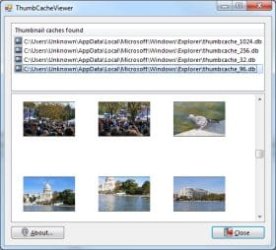
The thumbnail cache thumbs_*.db database files are stored at the hidden system folder below:
When the thumbnail cache is disabled, it may cause a delay when opening folders while the thumbnail picture views are loaded from the hard disk instead of the thumbnail cache.
OPTION ONE
Using a REG File Download
NOTE:This option is more thorough that OPTION TWO below.
1. To Enable Thumbnail Caching for All Users
A) Click/tap on the Download button below to download the file below.
Enable_Thumbnail_Cache.reg
B) Go to step 3.
2. To Disable Thumbnail Caching for All Users
A) Click/tap on the Download button below to download the file below.
Disable_Thumbnail_Cache.reg
3.Save the .reg file to your desktop.
4. Double click/tap on the downloaded .reg file to merge it.
6. Click/tap on Run, Yes, Yes, and OK when prompted.
7. Log off and log on, or restart the computer to apply.
8. When done, you can delete the downloaded .reg file if you like.
2. In the left pane, click/tap on the arrow to expand User Configuration, Administrative Templates, Windows Components, and on Windows Explorer (Windows 7) or File Explorer (Windows 8). (See screenshot below)
3. In the right pane of Windows Explorer (Windows 7) or File Explorer (Windows 8), double click/tap on Turn off caching of thumbnail pictures to edit it. (See screenshot above)
4. To Enable Thumbnail Caching
A) Select (dot) Not Configured or Disabled. (See screenshot below step 6)
B) Go to step 6.
5. To Disable Thumbnail Caching
A) Select (dot) Enabled. (See screenshot below step 6)
6. Click/tap on OK. (See screenshot below)
7. In the right pane of Windows Explorer (Windows 7) or File Explorer (Windows 8), double click/tap on Turn off the caching of thumbnails in hidden thumbs.db files to edit it. (see screenshot below step 2)
8. Do step 4 or 5 above, and go to step 9 below.
9. Close the Local Group Policy Editor. (See screenshot below step 2)
10. Log off and log on, or restart the computer to apply.
You have missed the point that when browsing a network share with write permission, for some reason Windows 7 does not store the thumbs.db in Appdata. Instead it creates a hidden thumbs.db inside the folder containing the files like Windows XP used to...
Part 1 and Part 2 in your guide do different things
Part 1: Disables all local thumbnail caching, and I'm not really sure if it affects remote network shares.
Part 2: disables thumbnail caching on remote shares only.
System Manufacturer/Model Number Sony Vaio VGN-FE31M OS Windows 7 Ultimate 32bit CPU Core 2 Duo Mobile Motherboard Sony Memory 2gb Corsair Graphics Card Geforce GO! 7600 Sound Card Sony Monitor(s) Displays Sony
PSU Sony Case Sony Cooling Sony Hard Drives OCZ Vertex 2E Sandforce SSD
Hello there. If possible for someone with the Local Group Policy Editor to verify, which of the entries at the top does disabling cache for all users/computer actually create? Thanks!
Group Policy adds this entry below into the registry when enabled. The REG files available for download are the same for this, but they also include the other options to do this in them as well to be extra thorough to make sure they work no matter what method was used.
I tried disabling Windows 7 thumb caching, both using GPE and Regedit, and subsequently used Linux to remove the thumb folders completely, but a Windows 7 reboot would immediately recreate the folders, and viewing images would immediately repopulate them with thumbs.
The only way I could prevent Windows 7 recreating them was to remove system privileges from the folders and make them read only for my own userID.
That finally created a situation in which no thumbnail cache appears to exist, and a "disk cleanup" on the Windows 7 partition finds no thumbnails to remove, but in truth, there must be another cache somewhere.
Proof of this is simple to demonstrate on my PC, where I can view thumbs which were created when I scanned colour negatives. These scans were reversed, edited, cropped and saved, so in theory, viewing thumbs of these images, should dynamically recreate a thumb of a positive cropped image, but in fact a negative uncropped thumb will appear for an image which hasn't existed for several years in that form.
In the years since these ghost thumbs were created, the cache has been "cleaned" out multiple times, removed, recreated, removed again, disabled and apparently no longer exists, and yet there they still are.
All thumbs.db files from XP and Vista versions of the same image folder based caches were also scrubbed from the system, and yet they're still being conjured up from somewhere !
There's a longer, detailed discussion in another forum, with attached proof of my ghost thumbs existing despite total absence of any official cache, but I haven't linked it, not wishing to infringe site etiquette as a new poster.
I'm a long-time mod in the other place, and can link it if required.
Disabling the thumbnail cache doesn't stop thumbnails from being created or loaded. It only make Windows load the thumbnails in memory on the fly each time instead of from the preloaded cache.
Hi Shawn, thanks for the reply.
All the images demonstrating this can be found here in the thread I mentioned.
The Windows 7 cache(s), as I said no longer exist. The .user\myname\appdata\....\explorer folder now contains just a couple of startuplog.etl files and absolutely no .db files. The picture folders themselves contain no .db files.
Just to emphasize the point, I'll attach one specific example, where you can see a negative has been scanned upside down, turned 180 degrees, colour reversed, cropped and saved.
Despite the fact that the thumbnail cache has been subjected to "disk cleanup", deleted with Ubuntu, prevented from being recreated, and to all intents and purposes just doesn't exist anymore, the thumbnail still remains as originally created.
I must admit that I don't know where it may be pulling the thumbnail image from since you have the thumbnail cache disabled, and still after refreshing the window or restarting the computer.
I suppose it wouldn't hurt to rebuild the icon cache as well to test, but I wouldn't think it would come from there though.
Hi Shawn, thanks for the reply.
All the images demonstrating this can be found here in the thread I mentioned.
The Windows 7 cache(s), as I said no longer exist. The .user\myname\appdata\....\explorer folder now contains just a couple of startuplog.etl files and absolutely no .db files. The picture folders themselves contain no .db files.
Just to emphasize the point, I'll attach one specific example, where you can see a negative has been scanned upside down, turned 180 degrees, colour reversed, cropped and saved.
Despite the fact that the thumbnail cache has been subjected to "disk cleanup", deleted with Ubuntu, prevented from being recreated, and to all intents and purposes just doesn't exist anymore, the thumbnail still remains as originally created.
Where is it picking it up from ?
Hi Terry,
I created an account just to reply to your quandry, because I'm almost certain that I know whats going on here. Almost all (but not 100%) of the popular image formats allow for embedded metadata and embedded thumbnails. The concept is that for larger files thumbnail generation could be time consuming, so by embedded a thumbnail in the image the image can be quickly previewed etc.
The embedded thumbnail needs to be regenerated when modifying an image with an embedded thumbnail, for example if you edit a jpeg file with a embedded thumbnail (btw: JPEG File Interchange Format - Wikipedia, the free encyclopedia and they discuss this a bit), and you make visual changes to it, the thumbnail should be updated by your editing software when you save the file.
Long story shorter - Not all photo editing software, especially command line tools and automated cropping and rotating scripts update embedded thumbnails, and even in photoshop when you edit a photo you can tell photoshop to not update the embedded thumbnail, in which case you will get what you see in your example.
An image with an older version thumbnail that does not visually agree with the full image content of the file.