Partition or Volume - Create New

How to Create a New Partition or Volume in Windows 7

   Information
This will show you how to create a new primary partition using Disk Management or Diskpart in Windows 7 from a empty unallocated partition or volume.
   Note
A primary partition is a type of partition created on a hard drive that can have a operating system installed on it. A primary partition functions as though it were a physically separate hard drive.

By default on a basic MBR disk, you can create a maximum of 4 Primary partitions, or 3 Primary partitions and 1 Extended partition with up to 128 logical volumes in the extended partition on a single hard disk.

*You must be logged on in an administrator account to be able to do this tutorial.
   Warning
If you disable the Disk Defragmenter service, then you will get the error below when you try to do anything in Disk Management. If you get this error, then make sure that the Disk Defragmenter service is set to only Manual.

Error.jpg


OPTION ONE

Create Primary Partition using Disk Management

1. You will first need to shrink a partition or volume from the free space on a disk to create unallocated space on that disk to use to create the new partition or volume with on the same disk.

   Note
If this is a disk that is unallocated, then skip this step and go straight to step 2.


2. Open the Control Panel (icons view), and click on the Administrative Tools icon. then close the Control Panel window.

3. Click on Computer Management in Administrative Tools, then close the Administrative Tools window.

4. In the left pane under Storage, click on Disk Management. (See screenshot below) Create_Step1.jpg
5. In the middle pane, right click on the empty unallocated partition or volume and click on New Simple Volume. (See screenshot above)

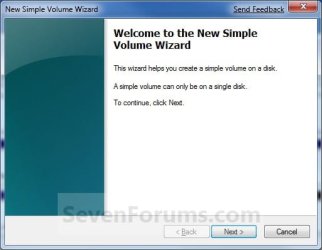
6. Click on the Next button. (See screenshot below) Create_Step2.jpg
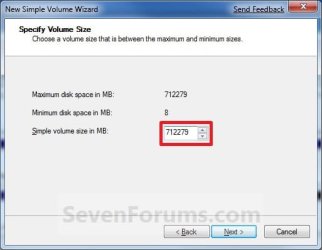
7. Type in how many MB (1 GB = 1024 MB) you want to use from the unallocated partition to create the new partition with, then click on the Next button. (See screenshot below)
NOTE: If you want to use all of the unallocated partition to create the new partition with, then type all of the maximum disk space shown for the unallocated partition. If you do not use all of the maximum disk space, then you can use the left over space from the unallocted partition to create another new partition with. Create_Step3.jpg
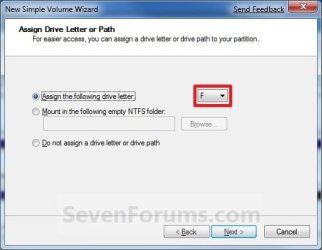
8. Select an available drive letter that you want to be assigned to the new partition in Computer, then click on the Next button. (See screenshot below) Create_Step4.jpg
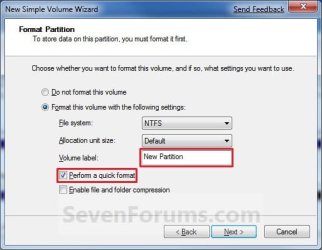
9. Type in a volume label name that you want for the new partition, check the Perform a quick format box, and click on the Next button. (See screenshot below) Create_Step5.jpg
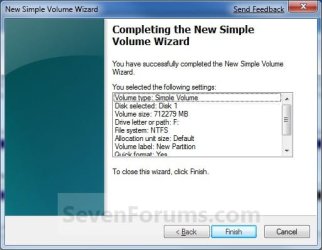
10. Click on the Finish button. (See screenshot below)

   Warning
If you get a pop-up with the message below, then click on No. You DO NOT want to convert the disk to dynamic. Doing so could render Windows 7 unbootable. A clean install of Windows 7 would be the only way to fix this afterwards if you were to click on Yes.

The operation selected will convert the disk to dynamic... are you sure you want to continue?
Create_Step6.jpg
11. The new primary partition or volume has now been created with the assigned unallocted partition space (step 7). (See screenshot below) Create_Step7.jpg
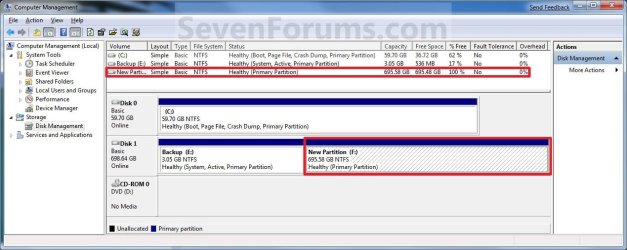
12. Close the Computer Management window. (See screenshot above)


OPTION TWO

Create Primary Partition using Diskpart in Elevated Command Prompt

1. You will first need to shrink a partition or volume to create a unallocated partition to use to create the new partition or volume with.

2. Open an elevated command prompt, or a command prompt at boot.

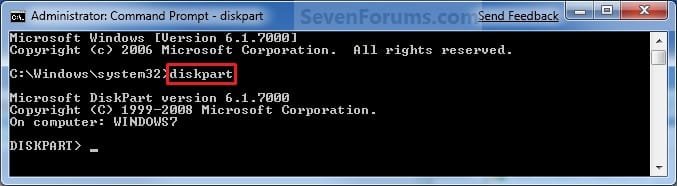
3. In the elevated command prompt, type diskpart and press Enter. (See screenshot below) CMD_Create_Step1.jpg
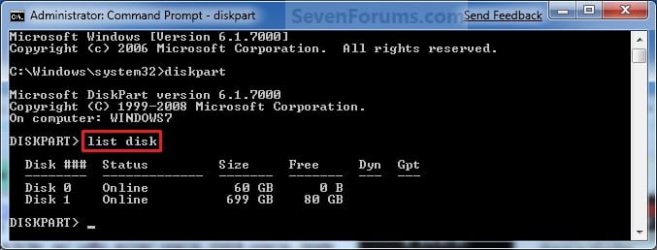
4. In the elevated command prompt, type list disk and press Enter. (See screenshot below)
NOTE: This is to help you ID the disk number that has Free unallocated space that you want to create a new partition with. For example, Disk 1 with 80 GB of free space. CMD_Create_Step2.jpg
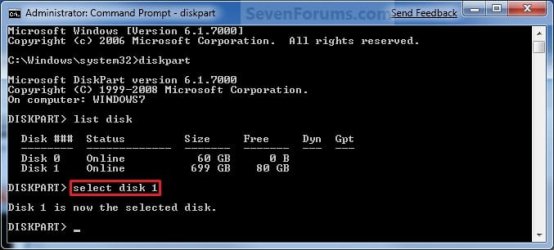
5. In the elevated command prompt, type select disk # and press Enter. (See screenshot below)
NOTE: You would substitute # for the disk number listed that you want to create a new partition with the free unallocated space there. For example, I want to create a new partition with the 80 GB of free space, so I would type select disk 2 and press Enter. CMD_Create_Step3.jpg
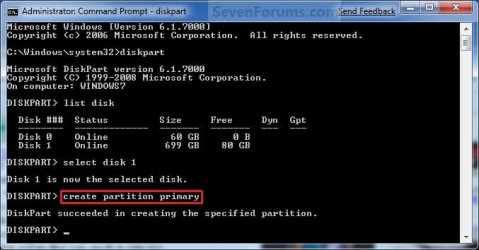
6. In the elevated command prompt, type create partition primary and press Enter. (See screenshot below)
NOTE: This will create a new blank RAW partition with selected disk (step 5) that contains the unallocated partition free space. CMD_Create_Step4.jpg
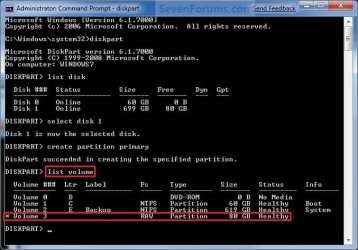
7. In the elevated command prompt, type list volume and press Enter. (See screenshot below)
NOTE: Look for the volume number that has the same Size as from the Free space in step 4. For example, Volume 3. CMD_Create_Step5.jpg
8. To Format the Partition or Disk as a NTFS File System
NOTE: This would be good for using with a HDD as an example. A) In the elevated command prompt, type format fs=ntfs quick and press Enter. (See screenshot below)
NOTE: Having quick added at the end of the command will do a quick format instead of a full format on the new blank RAW partition (step 6) to make it a new partition. CMD_Create_Step6.jpg
B) Go to step 10.
9. To Format the Partition or Disk as a FAT32 File System
NOTE: This would be good for using with a USB key drive as an example. The FAT32 file system has size limitations. You cannot create a FAT32 partition greater than 32 GB. In addition, you cannot store a file larger than 4 GB on a FAT32 partition. For more information, see Comparing NTFS and FAT file systems. A) In the elevated command prompt, type format fs=fat32 quick and press Enter. (See screenshot below)
NOTE: Having quick added at the end of the command will do a quick format instead of a full format on the new blank RAW partition (step 6) to make it a new partition.
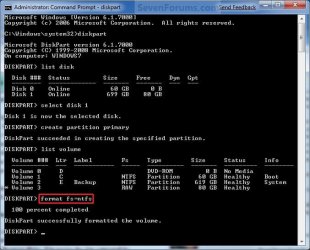
10. When it is finished formatting, type exit in the elevated command prompt and press Enter. (See screenshot below) CMD_Create_Step7.jpg
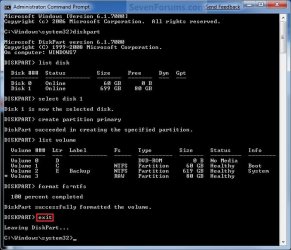
11. Close the elevated command prompt.

12. The new primary partition has now been created. You can now see the new partition in Computer with a drive letter.
That's it,
Shawn


Last edited:
help deleting disks and merging them into 1

Hey there... i don't know if i posted correctly, but here goes nothing!

I have a memory stick and .. i used to install windows 7 from it.
Now my stick has 2 disks.... how do i change it back to normal? it's kinda annoying me. :)
 

Attachments

  • USB.jpg
    USB.jpg
    33 KB · Views: 587

My Computer

OS
Windows 7
Greetings!

Im really not sure if this will work. But can you help me with my concern. I have a 320gb hdd with drive c: only. I want to split it into 2 drives C: and D:. My current disk space free is 120gb. So Im planning to split it with C: = 100gb and D: = (remaining space).

Will I be able to create a partition without messing up the files thats already inside my hard drive? Or do i still have to create a backup and start fresh (hard drive empty) . .

Hope you can assist me on this concern Brink. Thanks!
 
Last edited:

My Computer

OS
windows 7 Ultimate
Although it is always a good idea to backup the data when you play around with a partition, it should not be necessary if you shrink your partition with Disk Management. I made a little 12 minute tutorial how to do that which you can watch here. I suggest you watch the video and see how it's done and then proceed to the step where it tells you how much you can shrink your partition. Chances are that you will not be able to shrink it as much as you want. Then you can still decide whether you want to proceed or not.
 

My Computer

Computer Manufacturer/Model Number
HP, Dell, Gateway, Toshiba - 4 laptops and 2 desktops
OS
Vista, Windows7, Mint Mate, Zorin, Windows 8
CPU
from 1.6GHz Duo to i7
Monitor(s) Displays
2x HP w2207
Hard Drives
5x HDD, 7x SSD, 12x Externals
Keyboard
with trackball - no mices
Mouse
Trackball mice
Internet Speed
DSL 6000
and no answer for me?


Sorry, I missed that one. Suggest you copy your data off both volumes of your stick. Then delete the second volume and add the unallocated space to the first one. Then you put the data from volume2 back on it.
If you watch the video that I linked in my previuos post, you'll see how to do it with Disk Management.

PS: If the data on the first volume is still intact (it should be), then you can dispose of the backed-up version.
 

My Computer

Computer Manufacturer/Model Number
HP, Dell, Gateway, Toshiba - 4 laptops and 2 desktops
OS
Vista, Windows7, Mint Mate, Zorin, Windows 8
CPU
from 1.6GHz Duo to i7
Monitor(s) Displays
2x HP w2207
Hard Drives
5x HDD, 7x SSD, 12x Externals
Keyboard
with trackball - no mices
Mouse
Trackball mice
Internet Speed
DSL 6000
Although it is always a good idea to backup the data when you play around with a partition, it should not be necessary if you shrink your partition with Disk Management. I made a little 12 minute tutorial how to do that which you can watch here. I suggest you watch the video and see how it's done and then proceed to the step where it tells you how much you can shrink your partition. Chances are that you will not be able to shrink it as much as you want. Then you can still decide whether you want to proceed or not.


will try that. thanks man! :D
 

My Computer

OS
windows 7 Ultimate
and no answer for me?


Sorry, I missed that one. Suggest you copy your data off both volumes of your stick. Then delete the second volume and add the unallocated space to the first one. Then you put the data from volume2 back on it.
If you watch the video that I linked in my previuos post, you'll see how to do it with Disk Management.

PS: If the data on the first volume is still intact (it should be), then you can dispose of the backed-up version.

well it seems that it's not working... any other ideas?
 

My Computer

OS
Windows 7
What exactly is not working? At which step do you get stuck.
 

My Computer

Computer Manufacturer/Model Number
HP, Dell, Gateway, Toshiba - 4 laptops and 2 desktops
OS
Vista, Windows7, Mint Mate, Zorin, Windows 8
CPU
from 1.6GHz Duo to i7
Monitor(s) Displays
2x HP w2207
Hard Drives
5x HDD, 7x SSD, 12x Externals
Keyboard
with trackball - no mices
Mouse
Trackball mice
Internet Speed
DSL 6000
Hello Cristianene, and welcome to Seven Forums.

In addition, if you have already backed up anything that you do not want to lose on the USB memory stick card, then you can use the CLEAN command to wipe it completely clean. Afterwards, just format it again and copy your files back on it to have it back to just one partition on it.

Hope this helps,
Shawn
 

My Computer

Computer type
PC/Desktop
Computer Manufacturer/Model Number
Self built custom
OS
64-bit Windows 11 Pro for Workstations
CPU
Intel i7-8700K OC'd to 5 GHz
Motherboard
ASUS ROG Maximus XI Formula Z390
Memory
64 GB (4x16GB) G.SKILL TridentZ RGB DDR4 3600 MHz
Graphics Card(s)
ASUS ROG-STRIX-GTX1080TI-O11G-GAMING
Sound Card
Integrated
Monitor(s) Displays
2 x Samsung Odyssey G7 27"
Screen Resolution
2560x1440
Hard Drives
1TB Samsung 990 PRO M.2,
4TB Samsung 990 PRO PRO M.2,
TerraMaster F8 SSD Plus NAS
PSU
Seasonic Prime Titanium 850W
Case
Thermaltake Core P3
Cooling
Corsair Hydro H115i
Keyboard
Logitech wireless K800
Mouse
Logitech MX Master 4
Internet Speed
2 Gb/s Download and 100 Mb/s Upload
Antivirus
Malwarebyte Anti-Malware Premium
Browser
Google Chrome
Other Info
Logitech Z625 speaker system,
Logitech BRIO 4K Pro webcam,
HP Color LaserJet Pro MFP M477fdn,
APC SMART-UPS RT 1000 XL - SURT1000XLI,
Galaxy S23 Plus phone
Hey .... good to be here with you guys.


so.... i will explain what i see on my lists:
List disk disk 0 55 gb; d1 1024kb; d2 3813mb
List volume V0 sysreserved (due to win7) healthy; V1 C healthy; v2 d with status unusable; v3 e 3812mb healthy

The thing is that i want the disk d1 and d2 to merge... and i don't know how to do it.
Can you explain like to a NOOB with commands, not print screens how can i do that?

I will add a print screen of windows disk management... to see what i'm talking about.
Please ignore the 36gb unallocated to disk 0. my problem is with disk 1 and disk 2
 

Attachments

  • dskmgmt.png
    dskmgmt.png
    22.7 KB · Views: 563

My Computer

OS
Windows 7
Are disk 1 and 2 on a USB stick? And if disk1 is really only 1MB, why bother.
 

My Computer

Computer Manufacturer/Model Number
HP, Dell, Gateway, Toshiba - 4 laptops and 2 desktops
OS
Vista, Windows7, Mint Mate, Zorin, Windows 8
CPU
from 1.6GHz Duo to i7
Monitor(s) Displays
2x HP w2207
Hard Drives
5x HDD, 7x SSD, 12x Externals
Keyboard
with trackball - no mices
Mouse
Trackball mice
Internet Speed
DSL 6000
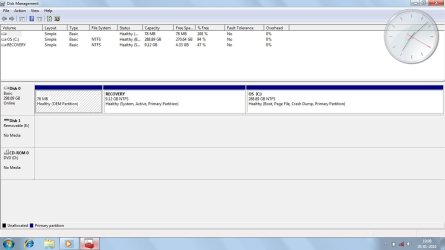
Partition In windows 7

Hi, Can you plaese let me know the answer of my problem. I hv purchased a new dell inspiron laptop. The operating system is windows 7. The os has only C drive of 288gb.Now i want to make a partition,can i do the same.Can u please tell me the paocedure for the same. I will b very greatfull to you.

Thanks
 

My Computer

Computer Manufacturer/Model Number
Dell Inspiron
OS
window 7
Hello Raghs, and welcome to Seven Forums.

Please post a screenshot of your Disk Management window so we can see your drive layout. This way we can be certain as to whether you can or not. :)
 

My Computer

Computer type
PC/Desktop
Computer Manufacturer/Model Number
Self built custom
OS
64-bit Windows 11 Pro for Workstations
CPU
Intel i7-8700K OC'd to 5 GHz
Motherboard
ASUS ROG Maximus XI Formula Z390
Memory
64 GB (4x16GB) G.SKILL TridentZ RGB DDR4 3600 MHz
Graphics Card(s)
ASUS ROG-STRIX-GTX1080TI-O11G-GAMING
Sound Card
Integrated
Monitor(s) Displays
2 x Samsung Odyssey G7 27"
Screen Resolution
2560x1440
Hard Drives
1TB Samsung 990 PRO M.2,
4TB Samsung 990 PRO PRO M.2,
TerraMaster F8 SSD Plus NAS
PSU
Seasonic Prime Titanium 850W
Case
Thermaltake Core P3
Cooling
Corsair Hydro H115i
Keyboard
Logitech wireless K800
Mouse
Logitech MX Master 4
Internet Speed
2 Gb/s Download and 100 Mb/s Upload
Antivirus
Malwarebyte Anti-Malware Premium
Browser
Google Chrome
Other Info
Logitech Z625 speaker system,
Logitech BRIO 4K Pro webcam,
HP Color LaserJet Pro MFP M477fdn,
APC SMART-UPS RT 1000 XL - SURT1000XLI,
Galaxy S23 Plus phone
screenshot.jpg

Hi Mr. Brink. i am attaching the screen shot of disk managemnet. please guide me.
 

My Computer

Computer Manufacturer/Model Number
Dell Inspiron
OS
window 7
You can easily shrink space off the C partition and create a new partition. Follow the guidance in the above tutorial or watch this Video tutorial that I made for the purpose. Note: the video also covers how to move your data to the new partition. But that part you may, or may not want to do.
 
Last edited:

My Computer

Computer Manufacturer/Model Number
HP, Dell, Gateway, Toshiba - 4 laptops and 2 desktops
OS
Vista, Windows7, Mint Mate, Zorin, Windows 8
CPU
from 1.6GHz Duo to i7
Monitor(s) Displays
2x HP w2207
Hard Drives
5x HDD, 7x SSD, 12x Externals
Keyboard
with trackball - no mices
Mouse
Trackball mice
Internet Speed
DSL 6000
Raghs,

As WHS posted, yes you can shrink the C: drive using this tutorial with no problems. Since you already have 3 primary partitions on that disk, the shrunken partition will be a logical partition instead. It behaves the same as the others though. :)
 

My Computer

Computer type
PC/Desktop
Computer Manufacturer/Model Number
Self built custom
OS
64-bit Windows 11 Pro for Workstations
CPU
Intel i7-8700K OC'd to 5 GHz
Motherboard
ASUS ROG Maximus XI Formula Z390
Memory
64 GB (4x16GB) G.SKILL TridentZ RGB DDR4 3600 MHz
Graphics Card(s)
ASUS ROG-STRIX-GTX1080TI-O11G-GAMING
Sound Card
Integrated
Monitor(s) Displays
2 x Samsung Odyssey G7 27"
Screen Resolution
2560x1440
Hard Drives
1TB Samsung 990 PRO M.2,
4TB Samsung 990 PRO PRO M.2,
TerraMaster F8 SSD Plus NAS
PSU
Seasonic Prime Titanium 850W
Case
Thermaltake Core P3
Cooling
Corsair Hydro H115i
Keyboard
Logitech wireless K800
Mouse
Logitech MX Master 4
Internet Speed
2 Gb/s Download and 100 Mb/s Upload
Antivirus
Malwarebyte Anti-Malware Premium
Browser
Google Chrome
Other Info
Logitech Z625 speaker system,
Logitech BRIO 4K Pro webcam,
HP Color LaserJet Pro MFP M477fdn,
APC SMART-UPS RT 1000 XL - SURT1000XLI,
Galaxy S23 Plus phone
Hi Mr. WHS, Thanks a lot for ur help. In my disk management it is showing three partition,but logically only one drive is visible that is C that consist of OS. So Why its showing 3 partition? My little doubt is,do i hv to do the shrink process on C that is of 288gb,bcz in that video its showing 5 partition alraedy,so am confuse little bit.
Thnks.
 

My Computer

Computer Manufacturer/Model Number
Dell Inspiron
OS
window 7
Raghs,

You would want to shrink your C: drive by how much you want your new partition to be, then create a new simple volume from the unallocated space. This will be your new partition. You can use the tutorial on the first page for this. :)
 

My Computer

Computer type
PC/Desktop
Computer Manufacturer/Model Number
Self built custom
OS
64-bit Windows 11 Pro for Workstations
CPU
Intel i7-8700K OC'd to 5 GHz
Motherboard
ASUS ROG Maximus XI Formula Z390
Memory
64 GB (4x16GB) G.SKILL TridentZ RGB DDR4 3600 MHz
Graphics Card(s)
ASUS ROG-STRIX-GTX1080TI-O11G-GAMING
Sound Card
Integrated
Monitor(s) Displays
2 x Samsung Odyssey G7 27"
Screen Resolution
2560x1440
Hard Drives
1TB Samsung 990 PRO M.2,
4TB Samsung 990 PRO PRO M.2,
TerraMaster F8 SSD Plus NAS
PSU
Seasonic Prime Titanium 850W
Case
Thermaltake Core P3
Cooling
Corsair Hydro H115i
Keyboard
Logitech wireless K800
Mouse
Logitech MX Master 4
Internet Speed
2 Gb/s Download and 100 Mb/s Upload
Antivirus
Malwarebyte Anti-Malware Premium
Browser
Google Chrome
Other Info
Logitech Z625 speaker system,
Logitech BRIO 4K Pro webcam,
HP Color LaserJet Pro MFP M477fdn,
APC SMART-UPS RT 1000 XL - SURT1000XLI,
Galaxy S23 Plus phone
Hi Mr. WHS, Thanks a lot for ur help. In my disk management it is showing three partition,but logically only one drive is visible that is C that consist of OS. So Why its showing 3 partition? My little doubt is,do i hv to do the shrink process on C that is of 288gb,bcz in that video its showing 5 partition alraedy,so am confuse little bit.
Thnks.


Sorry to confuse you with all these partitions in my Disk Management. But I have 2 physical disks (one HDD and one SSD) and 2 operating systems (Vista and Windows 7). In addition there is a seperate data partition that both systems use.
But as Brink said, in your case you should shrink C and go from there.
 

My Computer

Computer Manufacturer/Model Number
HP, Dell, Gateway, Toshiba - 4 laptops and 2 desktops
OS
Vista, Windows7, Mint Mate, Zorin, Windows 8
CPU
from 1.6GHz Duo to i7
Monitor(s) Displays
2x HP w2207
Hard Drives
5x HDD, 7x SSD, 12x Externals
Keyboard
with trackball - no mices
Mouse
Trackball mice
Internet Speed
DSL 6000
Thanks a lot Mr. Brink & Mr. WHS for your help. I have successfully done the partition. Again thanks a lot. This forum is very useful & you both are genius. I will recommend my colleagues to visit this forum for any help.
 

My Computer

Computer Manufacturer/Model Number
Dell Inspiron
OS
window 7
Back
Top