| | Welcome to Windows 7 Forums. Our forum is dedicated to helping you find solutions with any problems, errors or issues you are experiencing with Windows 7. The Windows 7 forum also covers news and updates and has an extensive Windows 7 tutorial section that covers a wide range of tips and tricks. | Windows 7 - Convert a Dynamic Disk to a Basic Disk
Convert a Dynamic Disk to a Basic Disk How to Convert a Dynamic Disk to a Basic Disk
Published by Brink
09-29-2009
| Convert a Dynamic Disk to a Basic Disk How to Convert a Dynamic Disk to a Basic Disk  Information A disk is a separate physical hard drive. This will show you how to convert a dynamic, also known as "software RAID", disk to a basic disk in Windows Disk Manager or in a command prompt. By default Windows uses Basic disks.
Basic and dynamic disks both support using MBR and GPT partition (volume) styles.
For more detailed information on basic and dynamic disks, see: Basic and Dynamic Disks (Windows)  Note Differences Between Basic and Dynamic Disks:- Basic disks are supported (readable) by all Windows operating systems since MS-DOS.
- Dynamic disks are only supported (readable) by Windows 2000, XP Professional, Windows Server 2003, Vista Ultimate, Vista Enterprise, Windows 7, and Windows Server 2008.
- Basic disks can have up to 128 GPT primary partitions, or 4 MBR primary partitions or 3 MBR primary partitions and 1 extended partition with up to 128 logical volumes in the extended partition.
- Dynamic disks can have up to 2000 dynamic volumes that function like a primary partition used in basic disks.
- Basic disks cannot share or split data with other primary or logical partitions, or basic disks. Each partitiion on a basic disk is treated as if it was a separate hard disk on the basic disk.
- Separate dynamic disks can be combined into a single dynamic volume (spanning), split data among several dynamic disks (striping) for increased performance, or duplicate data among several dynamic disks (mirroring) for increased reliability.
- Hard disks are basic disks by default, including removable disks and disks on a laptop (notepad).
- Removable disks cannot be converted to a dynamic disk.
 Warning VERY IMPORTANT, PLEASE READ THIS FIRST. - You must be a administrator to do this in Windows.
- Before you convert a dynamic disk to a basic disk, be sure to backup anything that you do not want to lose on that dynamic disk. Converting the dynamic disk back to a basic disk requires that all dynamic volumes are deleted on the disk first.
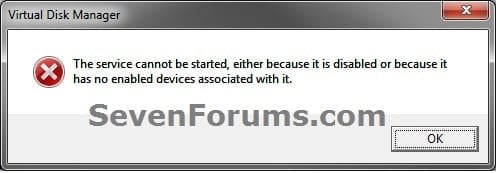
- If you disable the Disk Defragmenter service, then you will get the error below when you try to do anything in Disk Management. If you get this error, then make sure that the Disk Defragmenter service is set to only Manual.

OPTION ONE
Using Disk Management
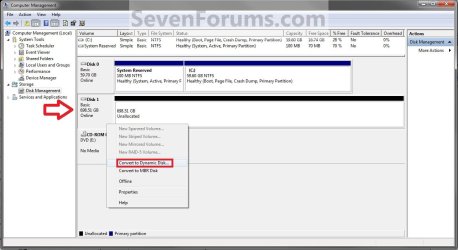
WARNING: Be sure to read the red WARNING box above, and backup any data on the dynamic disk that you wish to keep first. See OPTION FOUR below if you wanted to be able to convert a dynamic disk back to a primary disk without losing the data on it. 1. Open the Control Panel (All Items view), and click on the Administrative Tools icon, then close the Control Panel window. 2. Click on Computer Management in Administrative Tools, then close the Administrative Tools window. 3. If prompted by UAC, click on Yes. 4. In the left pane under Storage, click on Disk Management. (See screenshot below) 5. In the dynamic disk (ex: Disk 1) that you want to convert to a basic disk, right click on each volume on the disk and click on Delete Volume until the whole disk is unallocated space. (See screenshot above) NOTE: If prompted, click on Yes to continue deleting the volume(s). 6. If the disk (ex: Disk 1) that you want to convert to a basic disk is still displayed has being Dynamic (left side under Disk #), then right click on the disk (ex: Disk 1) and click on Convert to Basic Disk if available. (See screenshot below) 7. You can also confirm that the disk is a basic disk if it's displayed has being Basic (left side under Disk #), or if you right click on the disk # and it has Convert to Dynamic Disk instead now. (See screenshot below) 8. You can now create partitions on the now basic disk if you like. 9. When done, close Disk Management. OPTION TWO
Using the "Clean" Command in Elevated Command Prompt
WARNING: Be sure to read the red WARNING box above, and backup any data on the dynamic disk that you wish to keep first. See OPTION FOUR below if you wanted to be able to convert a dynamic disk back to a primary disk without losing the data on it. 1. Use the Clean command in the tutorial below on the dynamic disk that you want to wipe out and convert to be a basic disk. NOTE: You could also use the Clean all command for this as well, but it will take much longer to do since it also does a secure erase.How to Clean or Clean All a Disk with the Diskpart Command 2. You can now create partitions on the now basic disk if you like. OPTION THREE
Using the "Delete Volume" Command in Elevated Command Prompt
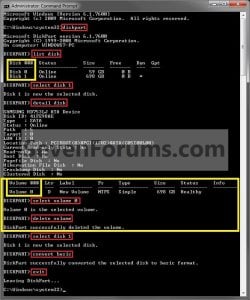
WARNING: Be sure to read the red WARNING box above, and backup any data on the dynamic disk that you wish to keep first. See OPTION FOUR below if you wanted to be able to convert a dynamic disk back to a primary disk without losing the data on it. 1. Open a elevated command prompt.A) Go to step 3. OR 2. Open a command prompt at boot. 3. In the command prompt, type diskpart and press enter. (See screenshot above) 4. Type list disk and press enter. NOTE: Make note of the disk number (ex: Disk 1) that you want to convert to a basic disk. 5. Type select disk # and press enter. NOTE: Substitute # with the actual disk number that you want to convert to a dynamic disk. For example, select disk 1. 6. Type detail disk and press enter. NOTE: This will give you a list of all the volume numbers on the selected disk number that you will need to delete in steps 7 and 8 below.A) If you do not have any volumes listed, then you can go to step 10. 7. Type select volume # and press enter. NOTE: Substitute # with a volume number listed in step 6. For example, select volume 3. 8. Type delete volume and press enter. 9. Repeat steps 7 an 8 for each volume # listed in step 6 until you have deleted all volume #'s. 10. When done, type select disk # and press enter. NOTE: You would use the same one from step 5 above. For example, select disk 1. 11. Type convert basic and press enter. 12. When done, type exit and press enter. 13. Close the command prompt. 14. You can now create partitions on the now basic disk if you like. NOTE: Restart the computer if you did step 2 instead. OPTION FOUR
Using Free Partition Wizard Home Edition
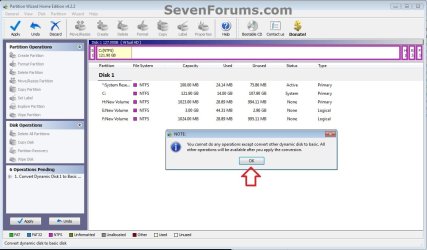
WARNING: Even though you will not lose the data when you use this option to convert a dynamic disk back to a primary disk, be sure backup any data on the dynamic disk that you wish to keep first just to be safe in case something happens. Say a power outage while in the middle of converting the disk. 1. Open the Control Panel (All Items view), and click on the Administrative Tools icon, then close the Control Panel window. 2. Click on Computer Management in Administrative Tools, then close the Administrative Tools window. 3. If prompted by UAC, click on Yes. 4. In the left pane under Storage, click on Disk Management. (see screenshot below) 5. In the dynamic disk (ex: Disk 0) that you want to convert to a basic disk, right click on each volume on the disk and click on Delete Volume until the whole disk is unallocated space. (see screenshot above) NOTE: If prompted, click on Yes to continue deleting the volume(s).  Warning DO NOT DELETE this dyanamic disk if this disk contains the currently running Windows 7, and is the only operating system you have installed on your computer.
In this case, you would have to use a "pay for" version of Partition Wizard Professional Edition or some other program that has the feature to convert a dynamic disk to basic disk without losing data included.
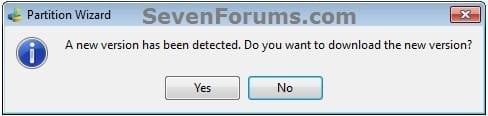
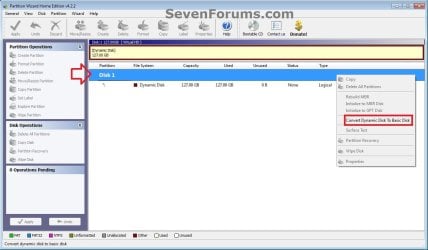
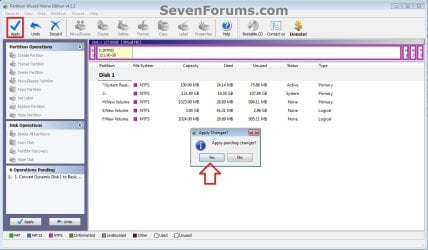
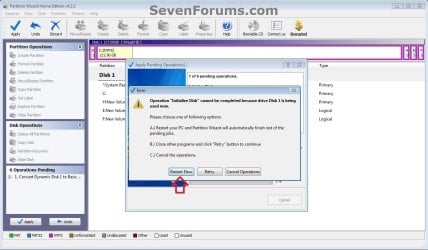
6. When finished, close Disk Management.  Warning It is extremely important to not save anything on this now deleted "unallocated space" disk. If you do, you risk not being able to recover the data on it. 7. If you have not already, you will need to download and install the free Partition Wizard Home Edition program. 8. Open Partition Wizard Home Edition, and click on the Partition Recovery Wizard link in the right pane. (see screenshot below) 9. Click on Next. (see screenshot below) 10. Select the Unallocted disk that use to be the dynamic disk, and click on Next. (see screenshot below) 11. Select (dot) Full Disk, and click on Next. (see screenshot below) 12. Select (dot) Quick Scan, and click on Next. (see screenshot below) 13. When it's finished, check all found partition boxes, and click on Finish. (see screenshot below) 14. At the bottom left corner of the left pane, click on the Apply button. (see screenshot below) 15. Click on Yes. (see screenshot below) 16. When it's finished, click on OK. (see screenshot below) 17. Close Partition Wizard Home Edition. 18. Restart the computer to have the deleted dynamic disk restored as a primary disk now with all of the data still on it. That's it,
Shawn |  Published by | | Administrator Join Date: Oct 2008 Location: Texas Posts: 34,826 | |
 Tutorial Tools | | | | | | | | | |
01-11-2010
|
#1 | | Windows 7 Ultimate x64 SP1 |
Hello Anigoni, and welcome to Seven Forums.
If you have not already, while you have Windows 7 started, see if you are still able to create a set of HP Windows 7 Recovery Disks from the "HP Recovery Manager". The instructions for how are in the HP link below if needed. Using HP Backup and Recovery Manager in Vista - HP Customer Care (United States - English)
If successfull, you can boot from this recovery disc to format your hard drive back to a BASIC disk again. Be sure to backup anything that you do not want to lose first though.
Hope this helps,
Shawn | My System Specs | | System Manufacturer/Model Number Self built custom OS Windows 7 Ultimate x64 SP1 CPU Intel i7-980X 3.3 Ghz (3.48 Ghz OC'd) Motherboard ASUS P6X58D Premium Memory 12 GB (2GBx6) DDR3 PC3-16000 2000 MHz Kingston HyperX Graphics Card Sapphire HD5870 Eyefinity 6 2GB Sound Card Realtek HD Audio ALC889 Integrated Chip Monitor(s) Displays 3x 27" Asus VE278Q Screen Resolution 1920x1080 Keyboard Logitech Cordless Desktop MX 5500 Revolution Mouse Logitech Cordless Desktop MX 5500 Revolution PSU OCZ Series Gold OCZZ1000M 1000W Case Corsair Obsidian 800D Cooling Thermalright Ultra 120 Extreme Copper CPU heat sink w/120 MM Hard Drives 160GB OCZ RevoDrive X2
** 2 x 1TB Samsung HDD HD154UI SATA Internet Speed 50 Mb/s Download and 2 Mb/s Upload Other Info Microsoft LifeCam Cinema
** Lite-On iHBS212 12x BD Writer
** Samsung CLX-3175FW Printer
** Netgear WNDR3800 Router
** Motorola SBG6580 Cable Modem
** 2x APC Back-UPS XS 1500 |
01-12-2010
|
#2 | | |

Quote: Originally Posted by Brink Hello Anigoni, and welcome to Seven Forums.
If you have not already, while you have Windows 7 started, see if you are still able to create a set of HP Windows 7 Recovery Disks from the "HP Recovery Manager". The instructions for how are in the HP link below if needed. Using HP Backup and Recovery Manager in Vista - HP Customer Care (United States - English)
If successfull, you can boot from this recovery disc to format your hard drive back to a BASIC disk again. Be sure to backup anything that you do not want to lose first though.
Hope this helps,
Shawn Hello,
after created new partition and after Windows 7 changed disk to Dynamic type, I can't create Recovery Disk. When I start "HP Recovery Manager" and try to burn CD or DVD, this error message appears: "Unable to create Recovery Disk System. Parameter not correct. (0x80070057)"
If I press "f11" or "f8" at the booting of the system, Windows doesn't start and I have the following state error: "state: 0xc0000225".
I can see, in Disk Manager of Windows 7, all the partitions: HP_RECOVERY, HP_TOOLS, SYSTEM, C.\....
I have seen in some technical forum that a way to reverse back dynamic disk to basic without data loss is change, with a partition table editor, the partition type from "42" value to "07" value ...
What do you think about?
Andrea. | My System Specs | | |
01-13-2010
|
#3 | | Windows 7 Ultimate x64 SP1 |
Andrea,
I have not tried that before myself, but I would strongly advise backing up anything that you do not want to lose to be safe before trying it. Also, if you do not have a way to reinstall Windows 7 afterwards, you may need to either contact HP to see about getting a set of HP Windows 7 Recovery Discs, or purchasing a retail upgrade copy of Windows 7.
If you have a friend that has the same model of computer that you do, then you can use their recovery disc to reinstall Windows 7 on your computer with you using your product key number instead. | My System Specs | | System Manufacturer/Model Number Self built custom OS Windows 7 Ultimate x64 SP1 CPU Intel i7-980X 3.3 Ghz (3.48 Ghz OC'd) Motherboard ASUS P6X58D Premium Memory 12 GB (2GBx6) DDR3 PC3-16000 2000 MHz Kingston HyperX Graphics Card Sapphire HD5870 Eyefinity 6 2GB Sound Card Realtek HD Audio ALC889 Integrated Chip Monitor(s) Displays 3x 27" Asus VE278Q Screen Resolution 1920x1080 Keyboard Logitech Cordless Desktop MX 5500 Revolution Mouse Logitech Cordless Desktop MX 5500 Revolution PSU OCZ Series Gold OCZZ1000M 1000W Case Corsair Obsidian 800D Cooling Thermalright Ultra 120 Extreme Copper CPU heat sink w/120 MM Hard Drives 160GB OCZ RevoDrive X2
** 2 x 1TB Samsung HDD HD154UI SATA Internet Speed 50 Mb/s Download and 2 Mb/s Upload Other Info Microsoft LifeCam Cinema
** Lite-On iHBS212 12x BD Writer
** Samsung CLX-3175FW Printer
** Netgear WNDR3800 Router
** Motorola SBG6580 Cable Modem
** 2x APC Back-UPS XS 1500 |
01-14-2010
|
#4 | | |

Quote: Originally Posted by Brink Andrea,
I have not tried that before myself, but I would strongly advise backing up anything that you do not want to lose to be safe before trying it. Also, if you do not have a way to reinstall Windows 7 afterwards, you may need to either contact HP to see about getting a set of HP Windows 7 Recovery Discs, or purchasing a retail upgrade copy of Windows 7.
If you have a friend that has the same model of computer that you do, then you can use their recovery disc to reinstall Windows 7 on your computer with you using your product key number instead. Brink,
I will back up HP_RECOVERY, HP_TOOLS and SYSTEM partitions that I have preinstalled from HP in my HDD... but ... what do you suggest?
Simple file backup or create image for each partition?
Then, I will try to convert dynamic disc to basic disc, but, if everything goes wrong, could I restore my data?
Form simple back up file or from image created before?
I'm not sure of that or... better... what I mean is that HP_RECOVERY and HP_TOOLS and HP_SYSTEM partitions are "special" partition by HP and I don't know exactly how to backup them in the right way...
What do you suggest me about?
Many thanks in advance,
Best Regards,
Andrea | My System Specs | | |
01-14-2010
|
#5 | | Windows 7 Ultimate x64 SP1 |
Andrea,
Since you can no longer create a set of Windows 7 recovery discs of your own, then it would be best to get a copy from HP first for your computer model number since you will not be able to convert it back to basic without losing the recovery partitions and your Windows 7. This way you have a recovery disc to reinstall Windows 7 with after you convert the disk back to basic. | My System Specs | | System Manufacturer/Model Number Self built custom OS Windows 7 Ultimate x64 SP1 CPU Intel i7-980X 3.3 Ghz (3.48 Ghz OC'd) Motherboard ASUS P6X58D Premium Memory 12 GB (2GBx6) DDR3 PC3-16000 2000 MHz Kingston HyperX Graphics Card Sapphire HD5870 Eyefinity 6 2GB Sound Card Realtek HD Audio ALC889 Integrated Chip Monitor(s) Displays 3x 27" Asus VE278Q Screen Resolution 1920x1080 Keyboard Logitech Cordless Desktop MX 5500 Revolution Mouse Logitech Cordless Desktop MX 5500 Revolution PSU OCZ Series Gold OCZZ1000M 1000W Case Corsair Obsidian 800D Cooling Thermalright Ultra 120 Extreme Copper CPU heat sink w/120 MM Hard Drives 160GB OCZ RevoDrive X2
** 2 x 1TB Samsung HDD HD154UI SATA Internet Speed 50 Mb/s Download and 2 Mb/s Upload Other Info Microsoft LifeCam Cinema
** Lite-On iHBS212 12x BD Writer
** Samsung CLX-3175FW Printer
** Netgear WNDR3800 Router
** Motorola SBG6580 Cable Modem
** 2x APC Back-UPS XS 1500 |
01-14-2010
|
#6 | | |
Hi Anigoni,
You should be able to convert a Dynamic disk to Basic disk without data loss , using a partition manager.
Paragon PM 10 Pro can certainly do it - an excellent program , but it is not free.
There is free one that claims to do it - I haven't tried the function , but because you have a simple Dynamic disk - it will probably be fine: How to convert dynamic disk to basic disk with Partition Wizard? Free Download Partition Wizard
You would need to download the bootable disc .iso and burn as an image to cd. Then boot the cd on the sick machine ( make sure NUM LOCK is on when it asks about screen resolution - press1, press enter).
It is a good idea to back up your drive first , to be safe.
I would make an image.
I am not sure how free imaging programs will handle it - but you can try this one: Paragon Backup & Recovery 10 Free Edition
You need to install it on a working machine - you can run off the bootable disc - boot that on your sick machine , select Normal Mode - then make images of the volumes ( or the whole drive ). If you select normal compression - the image will smaller. You will need to have an external drive attached, or lots of dvd's to store the image.
Hope it helps. | My System Specs | | OS Vista x64 / 7 X64 CPU E8400 Motherboard ASRock 1333 GLAN R2.0 Memory 2x1 gb 800mhz Graphics Card 9500gt 1gb Case Coolermaster Cooling Winpower 500w Hard Drives Maxtor 160gb-2mb cache |
01-14-2010
|
#7 | | Windows 7 Ultimate x64 SP1 |
Thank you SIW. | My System Specs | | System Manufacturer/Model Number Self built custom OS Windows 7 Ultimate x64 SP1 CPU Intel i7-980X 3.3 Ghz (3.48 Ghz OC'd) Motherboard ASUS P6X58D Premium Memory 12 GB (2GBx6) DDR3 PC3-16000 2000 MHz Kingston HyperX Graphics Card Sapphire HD5870 Eyefinity 6 2GB Sound Card Realtek HD Audio ALC889 Integrated Chip Monitor(s) Displays 3x 27" Asus VE278Q Screen Resolution 1920x1080 Keyboard Logitech Cordless Desktop MX 5500 Revolution Mouse Logitech Cordless Desktop MX 5500 Revolution PSU OCZ Series Gold OCZZ1000M 1000W Case Corsair Obsidian 800D Cooling Thermalright Ultra 120 Extreme Copper CPU heat sink w/120 MM Hard Drives 160GB OCZ RevoDrive X2
** 2 x 1TB Samsung HDD HD154UI SATA Internet Speed 50 Mb/s Download and 2 Mb/s Upload Other Info Microsoft LifeCam Cinema
** Lite-On iHBS212 12x BD Writer
** Samsung CLX-3175FW Printer
** Netgear WNDR3800 Router
** Motorola SBG6580 Cable Modem
** 2x APC Back-UPS XS 1500 |
01-15-2010
|
#8 | | |
Can't see any partitions with Partitoin Wizard... 
Quote: Originally Posted by SIW2 Hi Anigoni,
You should be able to convert a Dynamic disk to Basic disk without data loss , using a partition manager.
Paragon PM 10 Pro can certainly do it - an excellent program , but it is not free.
There is free one that claims to do it - I haven't tried the function , but because you have a simple Dynamic disk - it will probably be fine: How to convert dynamic disk to basic disk with Partition Wizard? Free Download Partition Wizard
You would need to download the bootable disc .iso and burn as an image to cd. Then boot the cd on the sick machine ( make sure NUM LOCK is on when it asks about screen resolution - press1, press enter).
It is a good idea to back up your drive first , to be safe.
I would make an image.
I am not sure how free imaging programs will handle it - but you can try this one: Paragon Backup & Recovery 10 Free Edition
You need to install it on a working machine - you can run off the bootable disc - boot that on your sick machine , select Normal Mode - then make images of the volumes ( or the whole drive ). If you select normal compression - the image will smaller. You will need to have an external drive attached, or lots of dvd's to store the image.
Hope it helps. Dear SIW2,
first of all, thanks for all kind suggestions. I have already tried to boot with Partition Wizard CD, but I can't see partitions on my HDD, it recognize only the physical Hard Disk Drive ad dynamic disk.
I have already ordered DVD set for Recovery all the system from HP Support. I'm waiting for it. Right now, I think the only way to convert dynamic disk in basic disk type is to change partition type from "42" to "07", as I have seen in some other forum... Did you see my previous post where I say:
"I have seen in some technical forum that a way to reverse back dynamic disk to basic without data loss is change, with a partition table editor, the partition type from "42" value to "07" value ..."
What do you think about?
I will try this way ... before, I would like to back-up SYTEM, HP_TOOLS and HP_RECOVERY partitions... I have a doubt referring to this: if I make an image cloning of each of these partition, after, if everything goes wrong, could I format the HDD, create the partition as they are now and restore everything form images of partitions created before?
Sorry for my english ... I hope to be clear enought in explaining my intentions...
Many thanks in advance for your precious suggestions,
Andrea | My System Specs | | |
01-15-2010
|
#9 | | |
Hi Anigoni,
Yes I am aware of the manual method changing 42 to 07 for the partition type. I used to suggest it to people when less software was available to do the job.
It can work - or not. It is easy for the user to make an error, and you need to change all the 42 references, not just one.
Partition Wizard is supposed to only see the whole Dynamic disk. If you click the Disk itself , and select convert to basic ( that is a virtual operation - it will not do the job until you click Apply). Then you will see the volumes.
If it looks right, click Apply.
You can see that in the instructions : How to convert dynamic disk to basic disk with Partition Wizard?
Good idea to make an image before trying to convert.
Try Paragon B&R Free - no need to "clone" , just make an image. You can restore if necessary. | My System Specs | | OS Vista x64 / 7 X64 CPU E8400 Motherboard ASRock 1333 GLAN R2.0 Memory 2x1 gb 800mhz Graphics Card 9500gt 1gb Case Coolermaster Cooling Winpower 500w Hard Drives Maxtor 160gb-2mb cache Convert a Dynamic Disk to a Basic Disk problems? All times are GMT -5. The time now is 12:49 AM. |  |