Solved Best method/tool for cloning a failing HDD for Data Recovery?

jumanji

New member
Guru
Gold Member
VIP
Local time
4:51 PM
Messages
5,915
I have been brooding over this subject "Which method/tool is best for cloning a failing HDD - including the system drive - for data recovery from the clone.

Has anyone tried cloning for this specific purpose and achieved any results?

I would be interested if they can share their experience or even air their views on the subject.
 

My Computer My Computer

At a glance

Windows 7 Home Premium 32 bit
OS
Windows 7 Home Premium 32 bit
I use Macrium Reflect to backup my drives (all partitions). I use the paid version, but there is a free version that will probably do what you want. Acronis True Image will also do that but I dont' think there is a free version.

Macrium is a popular backup/clone program.

I use the backup feature, not the clone. If I restore a drive, with all the partitions, that is equivalent to cloning.

Macrium Reflect FREE Edition - Information and download
 

My Computer My Computer

At a glance

Windows 10 64 bitIntel i7 6700K16GB Corsair DominatorIntel CPU Graphics
Computer type
PC/Desktop
Computer Manufacturer/Model Number
My Own Build
OS
Windows 10 64 bit
CPU
Intel i7 6700K
Motherboard
ASUS ROG Maximus VIII Hero
Memory
16GB Corsair Dominator
Graphics Card(s)
Intel CPU Graphics
Sound Card
RealTek
Monitor(s) Displays
27" Dell S2719dgf
Screen Resolution
2560X1440
Hard Drives
1 TB Samsung 850 EVO SSD for Win 10 Pro
500GB Samsung 850 EVO SSD for Win 10 Insider
2 TB drive for backup
PSU
EVGA Supernova 750G2
Case
BeQuiet Silent Base 600
Cooling
Deepcool Captain 120EX
Keyboard
Microsoft Wireless 2000
Mouse
Microsoft wireless
Internet Speed
100 MB/sec (Cable)
Antivirus
Microsoft Defender and Malwarebytes
Browser
Edge/Firefox
Other Info
Cakewalk (Sonar) by BandLab and Studio One 4.1 Pro recording studio software. MOTU 896Mk3 Hybrid recording interface, Frontier Tranzport wireless control unit, Behringer X-Touch Control Surface.
Five USB connected optical drives for CD Audio production using Nero BurningROM

My Computer My Computer

At a glance

Windows 10, Home Clean InstallIntel Core2 processsor Q8200(2.33Ghz 1333FSB)...6 gbATI Radeon 256MB HD3650
Computer type
PC/Desktop
Computer Manufacturer/Model Number
Dell XPS 420
OS
Windows 10, Home Clean Install
CPU
Intel Core2 processsor Q8200(2.33Ghz 1333FSB) Quad Core Tech
Motherboard
Dell
Memory
6 gb
Graphics Card(s)
ATI Radeon 256MB HD3650
Sound Card
Intergrated 7.1 Channel Audio
Monitor(s) Displays
Dell SP2009W 20"
Hard Drives
640 GB Serial ATA Hard drive
Cooling
Fan
Keyboard
Dell USB Keyboard
Mouse
Dell Premium Optical USB
Internet Speed
DSL 2.85
The point one should note here is that here we are interested in cloning a failing hard drive and not a conventional imaging software for backing up a normally working HDD or cloning to transfer the OS from a platter drive to SSD or another HDD.

In most cases where we notice or suspect the rot has set in and the HDD is failing fast, it is recommended that use of the HDD be stopped forthwith and any data recovery be attempted on a cloned drive the intention being that taxing a failing HDD for data recovery may only invite further detrioration resulting in data loss.( We very well know that this does not apply to those users who routinely back up their drives but there are countless many who don't backup and then come up with pleas for data recovery on a failing hard drive.)

The question is has any one tried data recovery on a cloned drive of a failing HDD. And if so what tool they used to clone such a failing HDD at that moment or what tool they would suggest for cloning under such circumstances.

My own impression is that conventional imaging software may fumble and tumble in the case of a HDD with large number of bad sectors and may even refuse to image the drive. I have personally experienced that Paragon Imaging software refused to image my drive unless the errors were corrected.In my case these were non-fatal errors which were then corrected. I am sure that if these errors were fatal and non-correctable it wouldn't have imaged the drive or cloned the drive. The vendors' image :) is at stake.More of a safety mechanism is in action not to image or clone a bad disk.
 
Last edited:

My Computer My Computer

At a glance

Windows 7 Home Premium 32 bit
OS
Windows 7 Home Premium 32 bit
Hi

Macrium is indeed a very good program and can image a drive with only a few bad sectors. However it is not designed to rescue data from failing drive and using a regular disk imaging software may cause more issues. In my experience the best tool to clone or image a failing drive is Linux command line tool "DDRescue". When it came to image a failing drive, "DDRescue" is the best as it is specifically designed for data recovery from drive with bad sectors.

Guide to using ddrescue - Technibble Forums
 

My Computer My Computer

At a glance

Windows 7 Ultimate x64
Computer type
PC/Desktop
OS
Windows 7 Ultimate x64
Hi

Macrium is indeed a very good program and can image a drive with only a few bad sectors. However it is not designed to rescue data from failing drive and using a regular disk imaging software may cause more issues. In my experience the best tool to clone or image a failing drive is Linux command line tool "DDRescue". When it came to image a failing drive, "DDRescue" is the best as it is specifically designed for data recovery from drive with bad sectors.

Guide to using ddrescue - Technibble Forums

Inline with my thinking.:thumbsup:
Needless to say that I had already seen and read that reference but the author seems to have gone about in a seemingly complicated way on using it that would make it look like best suited for Linux Geeks.( Atleast I felt so.)

Nonetheless I had already come to that conclusion that ddrescue may be the best tool but wanted to feel the pulse of the clan here to ascertain whether there can be a better alternative (without getting biosed with my thinking..) So I shall wait for some more time for some more alternatives before I dish out what I have already cooked with ddrescue or still cooking - in spite of my limited Linux touch.

You said "in my experience". Do I take that you had actually used it to clone a failing drive based on the procedure laid out in that article? Or is it only in your perception as it is in my perception?
 

My Computer My Computer

At a glance

Windows 7 Home Premium 32 bit
OS
Windows 7 Home Premium 32 bit
You said "in my experience". Do I take that you had actually used it to clone a failing drive based on the procedure laid out in that article? Or is it only in your perception as it is in my perception?

Strictly speaking, "DDrescue" helped me cloning partitions of two failing hard drives and i must say i am impressed with it. Since i am also not a Linux geek, i did some searching over internet to know whether there is an alternative ( preferably GUI based ) which can do the same job. Here is my conclusion.

1. Windows will always try to mount drives connected to the system. If we connect a failing HDD as a slave drive, most times Windows will stuck forever in the splash screen. This behavior also present in "WinPE" so using either a Windows based or "WinPE" based tool is out of question.

2. Some Linux distros like "Ubuntu" live CD may also may not boot if it encounter a failing HDD. On the other hand "Parted Magic" will boot most times. It is the tool i used to copy data from failing drives when Windows and live discs like Hiren's refuses to boot. There is also a "DDrescue GUI" in "Parted Magic".

3. While most Linux command line tools are very hard to use, "DDRescue" is comparatively simple to use.
 

My Computer My Computer

At a glance

Windows 7 Ultimate x64
Computer type
PC/Desktop
OS
Windows 7 Ultimate x64
Before "DDrescue" cam to my attention, "Acronis" Linux CD was my tool of choice for cloning hard drives with bad sectors. If the number of bad sectors are low ( two or three), "Acronis" may clone the disk successfully. When i tried to clone a failing drive with "Macrium", it showed an error message and stopped the cloning process when it encountered the bad sector. Then i used "Acronis" Linux CD which also showed an error message but prompted for an option to skip cloning bad sectors. When i used that option, Acronis managed to clone the drive successfully ( i think it will write zeros when it counters a bad sector ). After that i used "Acronis" successfully quiet a number of times but i don't think it can clone a drive with large number of bad sectors.
 

My Computer My Computer

At a glance

Windows 7 Ultimate x64
Computer type
PC/Desktop
OS
Windows 7 Ultimate x64
Good inputs @ Ansad Edavana in your post #7.

Your point #1: agreed.

Your point #2: A live Linux CD or bootable USB may also not boot.

Have you actually tried a live Linux distro that has ddrescue inside? Forget about Hiren's boot CD. Somehow I am averse to it.

Only yesterday I downloaded Slacko Puppy with the intention of trying the ddrescue in it. Of course I do not have a failing HDD and so I have to try it on a normally working HDD only.:)

As far as Parted Magic is concerned, it is no longer a freeware and has gone commercial since August 2013 though the pre-commercial free versions may still be downloaded. I have just downloaded one such free version.

For the small bit of experiments I carried out, I used ddrescue in SystemRescueCD SystemRescueCd

Your point #3: Agreed.

And that should perhaps make it eminently suitable for even ordinary users to blindly follow a given set of instructions in trying to clone a failing HDD successfully. And that is what I am actually aiming at.

EDIT: I just saw your post #8. Call it personal prejudice I don't touch Acronis.
 

My Computer My Computer

At a glance

Windows 7 Home Premium 32 bit
OS
Windows 7 Home Premium 32 bit
Have you actually tried a live Linux distro that has ddrescue inside? Forget about Hiren's boot CD. Somehow I am averse to it.

No, i didn't tired a full blown Linux distro which came with "DDRescue". All i can say is "Ubuntu" is not suitable for the job as it may fail to boot in to the "Desktop" ( my personal experience ). There is "Ubuntu Rescue Remix" but i never tried it personally.

Ubuntu Rescue Remix | The Rescue Remix provides a Free-Libre Open-Source data recovery software toolkit based on Ubuntu

As far as Parted Magic is concerned, it is no longer a freeware and has gone commercial since August 2013 though the pre-commercial free versions may still be downloaded. I have just downloaded one such free version.

"Parted magic" is till based on Linux Kernel and the use of which requires GNU/GPL licence. Although you may need to pay for the download, GNU licence grant you the right to study, redistribute and modify the software. Basically you can download latest version of "Parted Magic" from any other site or torrent and you are not committing piracy.

The same applies to "Redhat" Linux. They are charging you for technical support. If you copied "RedHat" and installed in your server or PC, you are not committing piracy but rather you won't get any support from the company.


If your moral side is against downloading "Parted Magic" from torrents, either use the old free version or use an alternative like "System Rescue CD" or "Trinity Rescue Kit"

Trinity Rescue Kit | CPR for your computer

I have a copy of "Trinity Rescue Kit" but never got a chance to test "DDrescue" from it.


One of the biggest advantage of "DDrescue" is that it doesn't require the file system to be recognizable. It can image RAW type partition and the resulting image file can be used for data recovery. Almost all major data recovery tools like "R-Studio" , "PhotoRec" etc support working with "DDrescue" images.
 
Last edited:

My Computer My Computer

At a glance

Windows 7 Ultimate x64
Computer type
PC/Desktop
OS
Windows 7 Ultimate x64
One question. If a drive is failing, corrupted data, etc., wouldn't "cloning" the drive result in the same corrupted data on the new drive?
 

My Computer My Computer

At a glance

Windows 10 64 bitIntel i7 6700K16GB Corsair DominatorIntel CPU Graphics
Computer type
PC/Desktop
Computer Manufacturer/Model Number
My Own Build
OS
Windows 10 64 bit
CPU
Intel i7 6700K
Motherboard
ASUS ROG Maximus VIII Hero
Memory
16GB Corsair Dominator
Graphics Card(s)
Intel CPU Graphics
Sound Card
RealTek
Monitor(s) Displays
27" Dell S2719dgf
Screen Resolution
2560X1440
Hard Drives
1 TB Samsung 850 EVO SSD for Win 10 Pro
500GB Samsung 850 EVO SSD for Win 10 Insider
2 TB drive for backup
PSU
EVGA Supernova 750G2
Case
BeQuiet Silent Base 600
Cooling
Deepcool Captain 120EX
Keyboard
Microsoft Wireless 2000
Mouse
Microsoft wireless
Internet Speed
100 MB/sec (Cable)
Antivirus
Microsoft Defender and Malwarebytes
Browser
Edge/Firefox
Other Info
Cakewalk (Sonar) by BandLab and Studio One 4.1 Pro recording studio software. MOTU 896Mk3 Hybrid recording interface, Frontier Tranzport wireless control unit, Behringer X-Touch Control Surface.
Five USB connected optical drives for CD Audio production using Nero BurningROM
I just had a quick run-through with Trinity Rescue kit. It will perhaps be too much for a non-Linux user. That is my first impression.

So then, I have come to the best way to clone a failing HDD sector by sector atleast for now :))

Tool: ddrescue Source: SystemRescueCD

1. Download the SystemRescueCD from Download - SystemRescueCd systemrescuecd-x86-4.2.0.iso 380MB and create a bootable pendrive with that ISO using Rufus Rufus - Create bootable USB drives the easy way

2. Boot your computer with that pen drive with your source disk (your failing disk) and a destination disk (formatted empty disk of capacity not less than that of your source disk) plugged in.

3.Against the command prompt type: fdisk -l [ENTER] This will list all your drives. Note the nomenclature of your source disk and destination disk.

4. Next against the command prompt type: ddrescue -r3 -n -S -v /dev/sdb /dev/sdc recovery.log [ENTER]

Note: Replace sdb and sdc with the correct device nomenclature of Source disk and Destination disk as obtained in step 3.

5. Sit back and relax. The cloning process may take days depending upon how bad your Source disk is. If your data is important patience is the key and the wait worth it. The saving grace is you can stop the process any time with Ctrl -C and then restart. It will take the cue from the log file and start from where it left.

In the cloning process itself it will go through cloning all the good sectors first and then try to recover the bad sectors one by one trying it 3 times (r3 option) before giving up on it.

I have actually tried it cloning an 8GB pen drive with bootable Peppermint Linux ( that was created sometime back on a request from Golden to try it and report ) onto a 32GB freshly formatted pen drive. It took about half an hour. At the end of the cloning I was able to boot into Peppermint from that cloned drive which signified successful sector by sector cloning including the boot sector/s.

May be Anshad Edavana will be able to polish it and improve upon it as one who had actually tried it on a failing disk. ( As indicated already I had no failing disk.)

 

My Computer My Computer

At a glance

Windows 7 Home Premium 32 bit
OS
Windows 7 Home Premium 32 bit
As you stated, a sector by sector copy will take several hours to complete. If the drive surface is really bad, probably it will take days. I might have some spare failed drives to experiments further. I will report back once my attempt to duplicate a real bad drive is finished.
 

My Computer My Computer

At a glance

Windows 7 Ultimate x64
Computer type
PC/Desktop
OS
Windows 7 Ultimate x64
One question. If a drive is failing, corrupted data, etc., wouldn't "cloning" the drive result in the same corrupted data on the new drive?

The logic behind disk cloning and attempting data recovery on that cloned drive:

When a disk starts failing, further deterioration can be fast and it can die any moment. Subjecting it to a data recovery process straight away may accelerate it. Also if one data recovery process fails, we recommend another data recovery procedure. This repeated use may further accelerate the deterioration. So the normal recommendation is use it only once and that to clone the drive so that one catches as much good data as possible. Also the algorithm of these data rescue cloners is entirely different than the algorithm used by the conventional imaging/cloning software used for back up or so we are told. Anyway that should be evident the way ddrescue works. During the first run it grabs all the good and readable sectors ensuring no further data loss. Next it tries to read the bad sectors one by one and retrieve the data in it. But generally if within three passes no data on it can be recovered it is given up as irrecoverable. The option r3 defines that 3 passes. With r1 it will be infinite number of bad sector recovery passes.So it is actually a clone+recovery process. On a cloned drive one can try any number of data recovery process to retrieve whatever data it could without any fear since it is a good drive.

As you stated, a sector by sector copy will take several hours to complete. If the drive surface is really bad, probably it will take days. I might have some spare failed drives to experiments further. I will report back once my attempt to duplicate a real bad drive is finished.

OK, I do know that a failing drive has to show up first if you want to clone. If you have one such drive you may try. Also since my "failed drive" was in fact a good drive, I did not find any recovery.log file in the root directory of the drive from which I ran the System Rescue. So I haven't tried Stop and restart process.
 

My Computer My Computer

At a glance

Windows 7 Home Premium 32 bit
OS
Windows 7 Home Premium 32 bit
Hi

For anyone interested, i will share my experience in cloning a failing 80 GB HDD to a 160 one. My first experiment is to check whether "Macrium" can clone this drive successfully but as i expected "Macrium" failed to clone.


2tefp.jpg


Then i booted the system using "Parted magic" and issued fdisk -l command to list the connected disk's details. sda is the 80 GB source drive, sdb is the target drive and sdc is the USB flash drive to store the log file ( The drive connected to SATA port 1 will be named "sda" , second one will be "sdb" ).

f4mupw.png


I used the command line ddrescue -d -f -r3 /dev/sda /dev/sdb /media/sdc1/Log/rescue.logfile

Option d is to tell DDrescue to use direct disk access, option r3 is for specifying the maximum number of read attempts when it encounter a bad sector and f is to specify block copy operation.

The cloning operation took roughly 45 minutes which is not bad for a sector to sector copy. In the end "DDrescue" managed to clone everything except 3584 bytes which is around 3.5 KB.

swr22o.png


If the drive surface contain hundreds of bad sectors, cloning operation may take several hours and the total read error ( total number of bytes which can't be copied ) will be bigger. However we may be able to rescue a portion of the data without much damage.
 

My Computer My Computer

At a glance

Windows 7 Ultimate x64
Computer type
PC/Desktop
OS
Windows 7 Ultimate x64
That's a good show and proves beyond doubt that ddrescue is the best tool to clone a failing hard drive.

Can you now try running ddrescue from Systemrescuecd (my post #12) and with this command set?

root# ddrescue -r3 -n -S -v /dev/sda /dev/sdb recovery.log

-r3 = retry the damaged areas in 3 passes
-n = Skip the splitting pass. Avoids spending a lot of time trying to rescue the most difficult parts of the file.
-S = Sparse mode. May save a lot of disk space in some cases.
-v = Verbose mode. Shows all the details about what's happening.
/dev/sda = the source drive
/dev/sdb = the destination drive
recovery.log = The name of the log file.

EDIT:In this case the recovery.log file should be available in the root directory of the drive from which ddrescue is run and would not require a third drive. In such a case it will be easy for the user to stop and then restart the cloning procedure and there will be no need for the user to search and plug in any third drive on which the log file will reside.

When I ran this command to clone my failing disk ( in fact a good pen drive :D)I had some problem with -S option, so I think I went ahead with the same command set but without the -S option that resulted in successful cloning. I still do not know the significance of -S.I did notice the direct disk access option -d but did not involve it.Also you may put a screenshot of the recovery.log file.
Thank you for trying it out on a failing disk (the real life situation) and sharing the information.

May be it will now be necessary to decide upon the best options (command set for an effective recovery) What we now know is it works and it will be safe to use.
 
Last edited:

My Computer My Computer

At a glance

Windows 7 Home Premium 32 bit
OS
Windows 7 Home Premium 32 bit
Hi jumanji

Unfortunately i returned the 80GB failing HDD to it's customer. However it is not difficult for me to find another one. There are some other command line options i also wanted to experiment with. I will report back with the result later ( may take a couple of days ).
 

My Computer My Computer

At a glance

Windows 7 Ultimate x64
Computer type
PC/Desktop
OS
Windows 7 Ultimate x64
You may take your time. No problems.:)

In the meanwhile, I have marked this thread as solved and in future ddrescue will be the tool that we will recommend ( atleast I will recommend with confidence :)) in the case of failing hard drives to clone and then run any data recovery procedures.
 

My Computer My Computer

At a glance

Windows 7 Home Premium 32 bit
OS
Windows 7 Home Premium 32 bit
Just a few minutes ago I stumbled on this and am surprised :

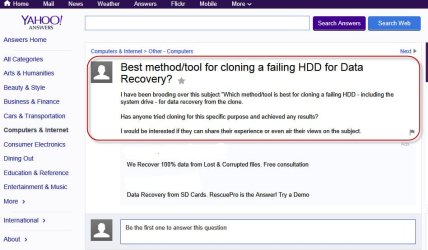
The very same question I had asked in my first post, appears verbatim in Yahoo! answers https://ph.answers.yahoo.com/question/index?qid=20140520235401AAWGH3E and without a name or person who raised the query and seeking answers.

This seems to have been posted about two hours ago when I was busy shopping groceries in a nearby department stores.

21-05-2014 14-37-19.jpg

I am surprised how this could happen and hours prior to that I had marked it as solved in this Forum.
 

My Computer My Computer

At a glance

Windows 7 Home Premium 32 bit
OS
Windows 7 Home Premium 32 bit
Hi

Finally got two more drives to play with "ddrescue" but unfortunately both of them are severely damaged and far beyond the capability of "ddrescue". However i spend a lot of time lurking through various forums and read opinions of those who are using "ddrescure" for years. Here is my conclusion.

1. Generally it is not advised to directly clone a failing HDD to another one.Different hard drives may have different sector sizes ( 512 native, 512e, 4096 native etc ) which may cause issues. It is always better to take an image of the source disk - sector size of target disk won't matter. Almost all data recovery tools available today supports directly working with disk images ( including TestDisk, Photorec , Getdataback , R-Studio etc ).

2. Cloning an MBR partitioned disk to a similar or larger capacity drive will work as long as sector sizes are equal. If in doubt, use HDParam which is included with almost all Linux based rescue discs to obtain the details of connected hard drives.

3. Directly cloning a GPT partitioned disk requires the target disk to be with same exact LBA numbers.For example if the source disk has 1000 sectors, the target drive should be a 1000 sector drive - a 1001 sector drive won't work. This is because GPT stores a backup partition table on the very last sector and if that is absent, disk will be shown as unpartitioned in most cases. Creating disk image is the best practice when dealing with a GPT partitioned disk.

4. Avoid using USB enclosure and connect disk drives directly. If the source disk or destination disk is a proprietary external drive which can't be dissembled and directly connected to an internal port, avoid cloning and always take a full disk image.
 
Last edited:

My Computer My Computer

At a glance

Windows 7 Ultimate x64
Computer type
PC/Desktop
OS
Windows 7 Ultimate x64
Back
Top