Solved Drive Letter is Already Taken, but I Can't See it or Change It

KaiserSoze

New member
Local time
8:43 AM
Messages
5
After a Reboot, while using Easeus Partition Master, my D drive disappeared. I assigned the D letter to it in Disk Management and when I rebooted again, the D letter was taken. I was forced to assign letter Z until I figure out what to do.

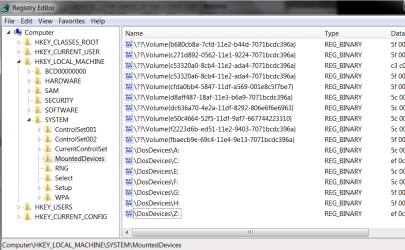
The device D letter is assigned to now, does not exist in either Registry of Disk manager (check screenshots)

The only place where I can see the culprit occupying D is in My Computer. I checked Deamon Tools or similar programs and neither of them uses such a drive. Can you please help me sorting this one out? I can't switch back to D: with any of the three possible methods (Disk Management, Regedit or diskpart command in CMD). This letter simply deosn't exist for the computer.

P.S.: I have 2 more partitions but the are containing Linux and they are not touched for quite a while. It can't be them.
 

Attachments
  • no_d.png
    no_d.png
    35.3 KB · Views: 3
  • regedit.png
    regedit.png
    28.2 KB · Views: 1
  • D-fucker.png
    D-fucker.png
    23.7 KB · Views: 1

My Computer My Computer

At a glance

Windows 7 Enterprise
Computer type
PC/Desktop
OS
Windows 7 Enterprise
Below is my section of the Registry, I show the A: floppy drive but there is no A: drive in the computer although it can be enabled in the BIOS. Most newer BIOSes don't list the A: and B: options although Windows reserves those 2 drive letters for floppy drives. A USB floppy drive will show differently, take an available letter.

Z: is usually assigned to the first Networked drive such as a NAS/Network Attached Storage drive, mine is although it's not showing on the list.

I do have several drives listed but not all show in Disk Management or Windows Explorer as they are memory card slots/card reader in the computer and won't show until a card is inserted and some are External USB drives.
 

Attachments

  • Drives.png
    Drives.png
    15.6 KB · Views: 7

My Computer My Computer

At a glance

Windows 7 Ultimate 64-bit, Windows 8.1 64-bit...
Computer type
PC/Desktop
Computer Manufacturer/Model Number
Customs, Dell, Gateway, HP, Toshiba, Acer, ASUS
OS
Windows 7 Ultimate 64-bit, Windows 8.1 64-bit, Mac OS X 10.10, Linux Mint 17, Windows 10 Pro TP
Keyboard
Microsoft
Mouse
Microsoft
Below is my section of the Registry, I show the A: floppy drive but there is no A: drive in the computer although it can be enabled in the BIOS. Most newer BIOSes don't list the A: and B: options although Windows reserves those 2 drive letters for floppy drives. A USB floppy drive will show differently, take an available letter.

Z: is usually assigned to the first Networked drive such as a NAS/Network Attached Storage drive, mine is although it's not showing on the list.

I do have several drives listed but not all show in Disk Management or Windows Explorer as they are memory card slots/card reader in the computer and won't show until a card is inserted and some are External USB drives.
Thank you for sharing that, but my issue has nothing to do with it. :) Z was just a random choice in a moment of irritation. The core of the problem is that letter D is occupied by some kind of virtual device (which is not a network drive or a USB drive), that does not appear in registry, thus it cannot be renamed.
 

My Computer My Computer

At a glance

Windows 7 Enterprise
Computer type
PC/Desktop
OS
Windows 7 Enterprise
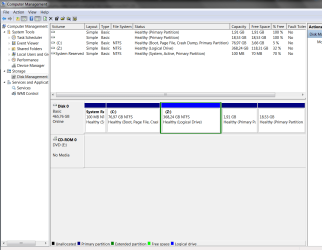
I don't understand how your drive got to look the way it looks. There are FOUR primary partitions defined, along with a LOGICAL partition (Z). The logical Z partition is correctly shown in bright blue, surrounded by a dark green outline which indicates the "extended partition" containing your one or more logical partitions inside of it.

But logical partitions exist inside of what's called an "extended partition", which is actually one of the four maximum primary partitions allowed on a BASIC drive which has been re-purposed into a "extended partition" (to support one or more logical partitions inside of it). Since it actually is a primary partition to begin with, re-purposing it to be an "extended partition" leaves only THREE remaining primary paritions possible.

That means a BASIC drive that has one (or more) logical partitions defined as you do MUST have an "extended partition" defined to hold those one (or more) logical partitions, as you do. And that also means a BASIC drive that has one (or more) logical partitions defined cannot have more than THREE primary partitions on it, since the required extended partition (which is one of the FOUR maximum primary partitions allowed) has been defined.

So your screenshot appears to show an impossible situation, with FOUR defined primary partitions along with an "extended partition". You mention Linux present, and it's likely this is somehow related to the mystery. But Windows DISKMGMT is definitely seeing a total of FIVE primary partitions (one of which is simply the re-purposed "extended partition" holding your logical partition).

This would seem to be impossible, and is no doubt causing the inconsistent presentations of your drive.

I would like to see a screenshot of what Partition Wizard thinks of your drive. Please install (if you don't already have it) and post a screenshot.
 

My Computer My Computer

At a glance

Windows 7 Pro x64 (1), Win7 Pro X64 (2)i5-3350p 3.1Ghz/6MB-cache (1); E8400 3.0Ghz/6...8GB PC3-12800 DDR3 (1); 4GB PC3-10600 DDR3 (2)ATI HD7750 (1), (see TV cards); ATI R7 250 (2)
Computer type
PC/Desktop
Computer Manufacturer/Model Number
Home-built, two systems (1) and (2)
OS
Windows 7 Pro x64 (1), Win7 Pro X64 (2)
CPU
i5-3350p 3.1Ghz/6MB-cache (1); E8400 3.0Ghz/6MB-cache (2)
Motherboard
ASUS P8Z77-V Pro (1); ASUS P5Q3 (2)
Memory
8GB PC3-12800 DDR3 (1); 4GB PC3-10600 DDR3 (2)
Graphics Card(s)
ATI HD7750 (1), (see TV cards); ATI R7 250 (2)
Sound Card
Realtek ALC892 HD Audio (1); Realtek ALC1200 HD Audio (2)
Monitor(s) Displays
Eizo HD2441W LCD, Eizo S2433W (1); Eizo 24" S2433W (2)
Screen Resolution
1920x1200, 1920x1200 (1); 1920x1200 (2)
Hard Drives
(1) 1TB SATA-II (7200RPM), 2x2TB SATA-III (7200RPM), 250GB SATA-III (10000RPM) for OS; 2x2TB external USB 3.0

(2) 320GB SATA-II (7200RPM), 750GB SATA-II (7200RPM), 150GB SATA-II (10000RPM) for OS; 2TB external USB 3.0
PSU
Nesteq ECS-6001 600W (1); Nesteq ECS-5001 500W (2)
Case
Acousti-Case 360 (1) and (2)
Cooling
Noctua NH-U12P SE2 for CPU, 2x120mm case fans (1) and (2)
Keyboard
IBM PS/2 (1) and (2)
Mouse
Logitech MX Revolution wireless (1); Microsoft wired (2)
Internet Speed
100mbps down / 10mbps up
Antivirus
Microsoft Security Essentials; Malwarebyte Anti-Malware Pro
Browser
Firefox
Other Info
Ceton InfiniTV 4-tuner cablecard-enabled TV card as well as Hauppauge HVR-2250 OTA/ATSC 2-tuner TV card in (1), running under Win7 WMC
Hi KaiserSoze,

Open Device Manager, and find out which program's Virtual CDROM drive is listed under DVD/CDROM drives.

Run that program, get into its Settings, and disable creation of Virtual CDROM drive.

That should release your drive letter D.

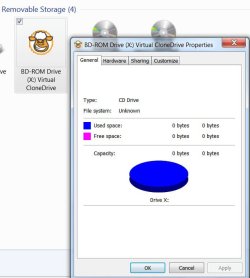
[In the screenshots here, it is my Elby CloneDrive (Slysoft ) and I have set it to run one drive always. My "Computer" always shows it as BDROM Drive ( X: ) apart from the two physical optical drives Y: and Z:]

02-02-2015 23-28-14.jpg

03-02-2015 00-05-16.jpg
 

My Computer My Computer

At a glance

Windows 7 Home Premium 32 bit
OS
Windows 7 Home Premium 32 bit
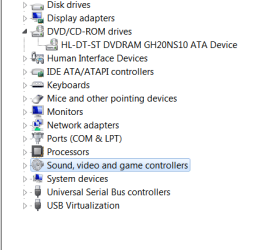
Unfortunately this drive is not listed in my Device Manager. :( I only have the physical one available.
 

Attachments

  • vrit_drive.png
    vrit_drive.png
    10.4 KB · Views: 18

My Computer My Computer

At a glance

Windows 7 Enterprise
Computer type
PC/Desktop
OS
Windows 7 Enterprise
OK, I was expecting this :) but wanted to make sure that it was not one of your Virtual drive creating programs. You told you have many apart from Daemon Tools.

Now get going with the drive cleanup schedule.

Download v 0.8.1 of the drivecleanup.zip from Drive Tools for Windows.

Unzip it to a folder, say drivecleanup.

You will have two folders Win32 and x64 each containing DriveCleanup.exe for 32 bit and 64 bit respectively.

Remove all USB storage devices from your system (except your Keyboard and mouse) and reboot.

Right click on the DriveCleanup.exe and run as administrator. (Use the DriveCleanup.exe file appropriate for your bit version of Windows.).

After the clean up act, reboot and check whether your system still shows the Virtual D drive.

The drive cleanup will erase all non-existent drives from Windows memory alongwith the drive letters and the associated registry entries and now you will be starting with a new slate. As you plug-in your USB drives those will be installed afresh. Your phantom drive holding drive letter D should be gone.

Let us know if it did indeed.

EDIT: This is end of the day post. I shall be retiring now and will check only after another 10hours. So do not keep waiting for me. In case my suggestion does not work, it will be for other sxperts to indulge in. My quiver is empty.:)
 

My Computer My Computer

At a glance

Windows 7 Home Premium 32 bit
OS
Windows 7 Home Premium 32 bit
OK, I was expecting this :) but wanted to make sure that it was not one of your Virtual drive creating programs. You told you have many apart from Daemon Tools.

Now get going with the drive cleanup schedule.

Download v 0.8.1 of the drivecleanup.zip from Drive Tools for Windows.

Unzip it to a folder, say drivecleanup.

You will have two folders Win32 and x64 each containing DriveCleanup.exe for 32 bit and 64 bit respectively.

Remove all USB storage devices from your system (except your Keyboard and mouse) and reboot.

Right click on the DriveCleanup.exe and run as administrator. (Use the DriveCleanup.exe file appropriate for your bit version of Windows.).

After the clean up act, reboot and check whether your system still shows the Virtual D drive.

The drive cleanup will erase all non-existent drives from Windows memory alongwith the drive letters and the associated registry entries and now you will be starting with a new slate. As you plug-in your USB drives those will be installed afresh. Your phantom drive holding drive letter D should be gone.

Let us know if it did indeed.

EDIT: This is end of the day post. I shall be retiring now and will check only after another 10hours. So do not keep waiting for me. In case my suggestion does not work, it will be for other sxperts to indulge in. My quiver is empty.:)

The tool cleaned up about a dozen of drives, but that sucker is stubbornly appearing several seconds after each reboot. I mean, the physical CD ROM is there and the faulty D appears a few seconds after that.

MiniTool Partition Wizard Free is also clueless about this drive and it doesn't exist for it.

Thank you for the tips, though. :)

[Resolved]: I ran a resizing of the problematic patrition, moving some bits here and there and the letter was freed. It got even better since I managed to take some free Gigs, moving them to the C drive.
 
Last edited:

My Computer My Computer

At a glance

Windows 7 Enterprise
Computer type
PC/Desktop
OS
Windows 7 Enterprise
OK, your problem got resolved by manipulating the problem partition and removing some data from it. So it could make one believe that there was something in it that was creating a virtual CDROM drive that was starting with Windows. That would also explain why that VCD drive was not a non-present leftover that could have been eliminated by the drive cleanup.

Without examining the contents in that partition and knowing what exactly you removed from that partition, there is no clue of what it is.

As dsperber noted in his post#4, four primary partitions and one extended is indeed surprising and you should investigate it. Notably the two primary partitions do not have a drive letter in Windows nor do they show NTFS. Perhaps those two are in a different format and Windows is not counting those. His desire to see the drive with Partition Wizard is relevant and could have thrown more light perhaps.
 

My Computer My Computer

At a glance

Windows 7 Home Premium 32 bit
OS
Windows 7 Home Premium 32 bit
OK, your problem got resolved by manipulating the problem partition and removing some data from it. So it could make one believe that there was something in it that was creating a virtual CDROM drive that was starting with Windows. That would also explain why that VCD drive was not a non-present leftover that could have been eliminated by the drive cleanup.

Without examining the contents in that partition and knowing what exactly you removed from that partition, there is no clue of what it is.

As dsperber noted in his post#4, four primary partitions and one extended is indeed surprising and you should investigate it. Notably the two primary partitions do not have a drive letter in Windows nor do they show NTFS. Perhaps those two are in a different format and Windows is not counting those.

Those two are used by my Ubuntu (swap and OS) and they have always been fine. My Windows did not have any conflict with them. My best guess is that there must have been some bytes left out as unallocated and resizing has moved them to the good partitions.
 

My Computer My Computer

At a glance

Windows 7 Enterprise
Computer type
PC/Desktop
OS
Windows 7 Enterprise
Back
Top