Dual Boot Installation with Windows 7 and XP

How to Setup a Dual Boot Installation with Windows 7 and XP


   Information
This will show you how to install Windows 7 and XP to dual boot with when you already have either Windows 7 or XP installed first.
   Note
With a dual boot installaton, you will have two operating systems (OS) installed. When you start the computer, you will have the choice to choose which OS you would like to start up to. This method is the easiest way of doing a dual boot with these two operating systems.
   Tip
When dual booting with another OS (ex: Vista or XP), you may not always have that OS partition show up in Computer with a driver letter in Windows 7. If this happens, then you will just need to add a drive letter to the OS (ex: Vista or XP) partition in Windows 7 Disk Management for it to show up in Computer with a driver letter.
   Warning
To stop XP from deleting your Windows 7 System Restore Points everytime XP is started, then see System Restore Points - Stop XP Dual Boot Delete to hide Windows 7 from XP.

Windows 7 Minimum Hardware Requirements


NOTE: For more information on this, see: Windows 7 system requirements
  • 1 GHz 32-bit or 64-bit processor
  • 1 GB RAM for 32-bit Windows 7 OR 2 GB RAM for 64-bit Windows 7
  • 16 GB available disk space 32-bit Windows 7 OR 20 GB for 64-bit Windows 7
  • Support for DirectX 9 graphics with 128 MB memory (in order to enable Aero theme)
  • DVD-R/W Drive
  • Internet or phone access to activate Windows 7.
Windows XP Minimum Hardware Requirements

NOTE: For more information on this, see: System requirements for Windows XP operating systems
  • PC with 300 megahertz (MHz) or higher processor clock speed recommended; 233-MHz minimum required;* Intel Pentium/Celeron family, AMD K6/Athlon/Duron family, or compatible processor recommended
  • 128 megabytes (MB) of RAM or higher recommended (64 MB minimum supported; may limit performance and some features)
  • 1.5 gigabyte (GB) of available hard disk space.*
  • Super VGA (800 × 600) or higher resolution video adapter and monitor
  • CD-ROM or DVD drive
  • Keyboard and Microsoft Mouse or compatible pointing device
EXAMPLE: Windows Boot Manager
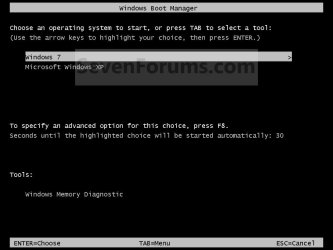
NOTE: This is the boot screen where you select what operating system that you would like to start. By default, you have 30 seconds to choose another operating system before the default operating system will start automatically.
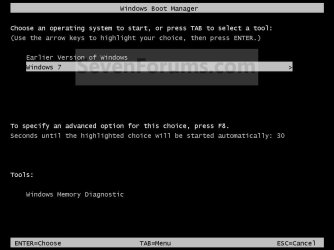
Example.jpg


OPTION ONE

When XP is Installed First


NOTE: If you have a RAID setup, you will need to have the Windows 7 RAID drivers on a USB flash drive available to select and load while installing Windows 7.
1. Do step 2 or 3 below for where you wanted to install Windows 7 at.

2. To Create a New Partition from the XP Hard Disk Drive
A) With your Windows 7 installation disc boot into the Command Prompt from the System Recovery Options screen.
NOTE: Make sure that the CD/DVD drive is selected first in the boot order in the BIOS.

B) In the command prompt, select and shrink the XP volume by how many MB (1024 MB = 1 GB) you want to have for this Windows 7 partition. (See screenshot below)
NOTE: You would do steps 2 to 9 in METHOD TWO at that link. Windows 7 will need a minimum of 16 GB (16384 MB).
XP-W7_1.jpg
C) Click on the X at the top right corner to close the command prompt. (See screenshot above)

D) Click on the X at the top right corner to close System Recovery Options. (See screenshot below)
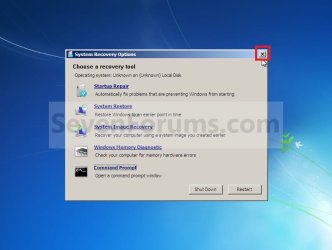
XP-W7_2.jpg
E) Go to step 4.
3. To Use a Separate Hard Disk Drive than the XP Drive
A) Boot from your Windows 7 installation disc.
NOTE: Make sure that the CD/DVD drive is selected first in the boot order in the BIOS.
4. Click on the Install now button. (See screenshot below)
XP-W7_3.jpg
5. When you get to this point, select the partition (step 2) or hard drive to install Windows 7 on. (See screenshot below)
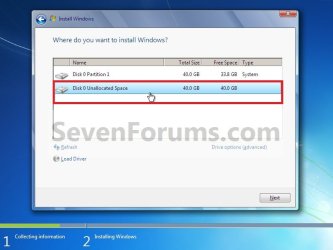
XP-W7_4.jpg
6. Finish installing Windows 7.
NOTE: You would start at step 9 in that link to finish installing Windows 7.

7. When finished, restart the computer to have the option to boot from XP (Earlier Verision of Windows) or Windows 7. (See screenshot below)

   Note
If you are only booting into Windows 7 and do not have XP listed in the Windows Boot Manager, then you can install only EasyBCD (step 8 Option Two below) to add XP (or Windows 7) while started in Windows 7 the same way to the boot list.

Example.jpg


OPTION TWO

When Windows 7 is Installed First


   Warning

1. To Create a New Partition from the Windows 7 Hard Disk Drive
NOTE: If you want to install XP on a separate internal hard drive instead, then skip this step and go to step 2.
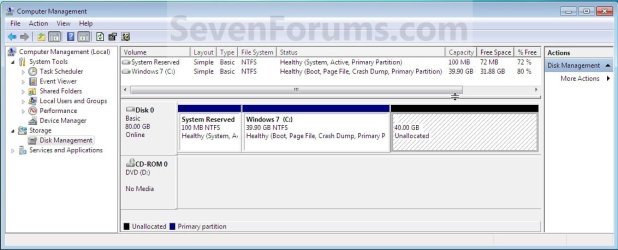
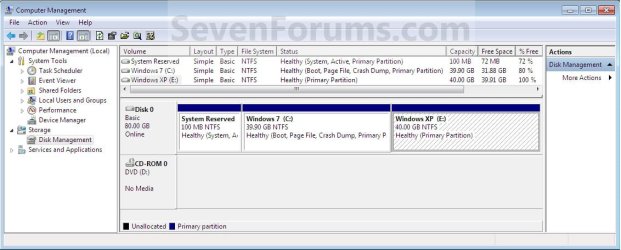
A) In Windows 7, select and shrink the Windows 7 volume in Disk Management by how many MB (1024 MB = 1 GB) you want to have for this XP partition. (See screenshots below)
NOTE: You would do all of Method One at that link.
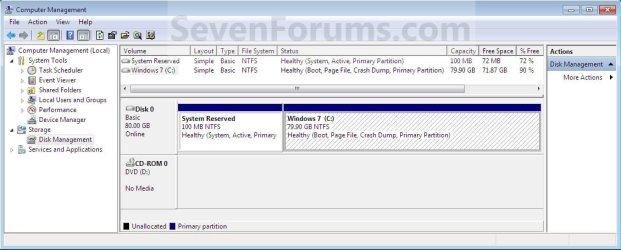
W7-XP-1.jpg

W7-XP-2.jpg

W7-XP-3.jpg
2. Insert your XP installation disc, then restart the computer and press any key to boot from it when prompted. (See screenshot below)
NOTE: Make sure that the CD/DVD drive is selected first in the boot order in the BIOS.

Step1.jpg
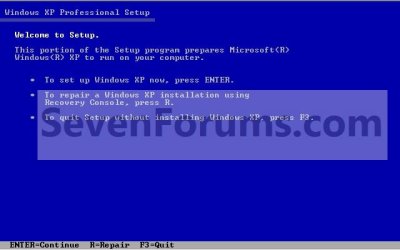
3. From XP Setup, Press Enter. (See screenshot below)


   Warning

W7-XP-4.jpg
4. Press F8. (See screenshot below)
NOTE: On some multimedia keyboards, you may need to press the F-Lock or Function key before pressing F8.
W7-XP-5.jpg
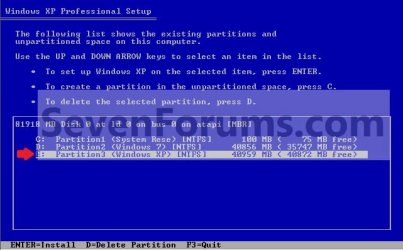
5. Select the partition (step 1) or hard drive that you want to install XP on using the arrow keys and press Enter.
W7-XP-6.jpg
6. Finish installing XP.


   Tip
If you get Error loading Operating System after XP restarts:
  • Using your Windows 7 installation disc, boot to the command prompt at startup.
  • Type in these comands below, and press enter after each one.
    • bootrec /FixMbr
    • bootrec /FixBoot
    • bootrec /RebuildBcd
  • Exit the command prompt and restart the computer.
  • At this point, Windows 7 should boot up the same way before trying to install XP.
  • Continue to step 8 below and run EasyBCD from Windows 7 instead.

7. In XP, download and install .Net Framework 2.0 (32-bit) version or .Net Framework 2.0 (64-bit) version first, and EasyBCD (free version) for your 32-bit (x86) or 64-bit (x86) XP.
NOTE: In XP, Net Framework is required to be installed to run EasyBCD. After you click on Register (at bottom of link) for the free EasyBCD, registration is not required to download it.

8. Run EasyBCD (free version).
NOTE: This is required to repair the Windows 7 boot file and add XP to the Windows Boot Manager list.

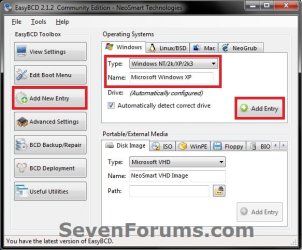
9. On the left side of EasyBCD, click on the Add New Entry button. (See screenshot below)
A) In the top section under Operating Systems, click on the Windows tab. (See screenshot below)
B) To the right of Type, select Windows NT/2k/XP/2k3 from the drop down menu. (See screenshot below)
:warn:WARNING: Be sure to leave the Automatically detect correct drive box checked.

C) To the right of Name, you can leave the default Microsoft Windows XP as the name to be displayed in the Windows Boot Manager, or you can type whatever name you would like to have instead. (See screenshot below)
D) Click on the Add Entry button. (See screenshot below)
W7-XP-7.jpg
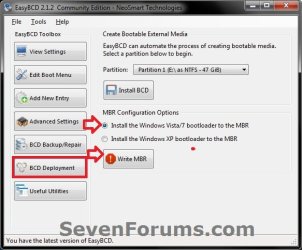
10. On the left side of EasyBCD, click on the BCD Deployment button, select (dot) the Install the Windows Vista/7 bootloader to the MBR option, and click on the Write MBR button. (See screenshot below)
W7-XP-9.jpg
11. Close EasyBCD.

12. Restart the computer to have the option to boot from Microsoft Windows XP or Windows 7. (See screenshot below)
Example2.jpg
   Tip
If Windows 7 will not start up when selected, then use your Windows 7 installation DVD to do a Startup Repair.

That's it,
Shawn


Last edited:
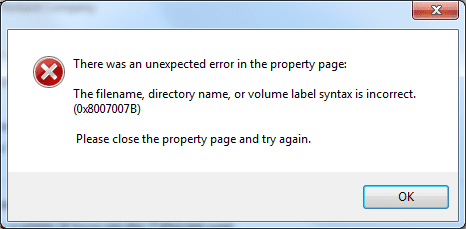
OK, everything seems to be working smoothly with my dual boot. I also followed the "How to Stop System Restore Points from being Deleted..." tutorial but when I went back into System Protection to turn it back on I saw that Protection was Off on all drives. When I tried to turn it on I got the error screen below which I had to X out of. But the System Properties screen said that Protection was now On. I was then able to create a restore point and when I went back in and out of XP I didn't lose the restore point. But what was that error screen all about? Should I just ignore it since everything seems to be working fine?

Another concern is that I have one of those 100 MB System Boot partitions and after performing all the dual boot and stop system restore points from being deleted actions I see that this partition now is only 3.14 MB short of being full.

Should I do anything more or just be happy everything seems to be working fine?
 

Attachments

  • System protect snip.PNG
    System protect snip.PNG
    28.8 KB · Views: 226

My Computer

Computer Manufacturer/Model Number
HP/p6267c
OS
Windows 7 Home
CPU
Intel Q8300
Memory
8 GB
Hey dude Brink very nice stuff you got here very usefull but i need you help i got some problem i can't figure the source but what i did was this

Normally i have Windows 7 Ultimate was installed:..

#1.i did the [method 2] with empty partation after restarted and BIOS info flashes now i receive some message like i need to changed a location i don't have a single clue what should i type so i put " D: " which a empty partation

Problem:

#A..everything is black and got stuck can't continue to desktop or none of XP logos appears..


#2.i reinstall the XP/reformat the driver D i got the same thing, i did this 3x


#3.i revert back to Windows 7 / reformat the Driver C and i successfully login to desktop to complete and continue the fully installation to desktop


Problem:

#B. a new problem it always takes me to Boot menu where there is a dead OS of XP


#4.now everything is fine, i've checked the drive D: there's worth 600MB used , i think its the XP file and i reformatted the drive D

#5.i tried again installed XP as second boot and still it didn't give me a chance it gives me a problem (#A)


#6.i did the (#3) again back to normal again i also fix the Dead OS on Boot menu and i got tired for 5 hours so i never do it again for while..


..that's all i did i don't have a single clue on how to install a XP as 2nd boot or what causing the problem or probably i should delete the dead OS of XP after failing at (#1) and do the (#3 and #5) ? ..is the #A is the main issue? cause after failing on #1 it leaves a dead XP on boot menu
 
Last edited:

My Computer

OS
Windows 7
CPU
E7400
Motherboard
P5Q SE
Memory
4GB
Graphics Card(s)
GTS 250
Sound Card
SoundMAX Full HD 7.1 Channel
Monitor(s) Displays
Sonic 24" LCD
Hard Drives
1.5 TB Seagate
PSU
CORSAIR 850 Watts
Case
Unknown
Cooling
Thermaright Xtreme
Hello Coco, and welcome to Seven Forums.

Have you installed XP before using that installation disc? You may have a bad or corrupted XP installation disc since it will not let you or finish installing from it.
 

My Computer

Computer type
PC/Desktop
Computer Manufacturer/Model Number
Self built custom
OS
64-bit Windows 11 Pro for Workstations
CPU
Intel i7-8700K OC'd to 5 GHz
Motherboard
ASUS ROG Maximus XI Formula Z390
Memory
64 GB (4x16GB) G.SKILL TridentZ RGB DDR4 3600 MHz
Graphics Card(s)
ASUS ROG-STRIX-GTX1080TI-O11G-GAMING
Sound Card
Integrated
Monitor(s) Displays
2 x Samsung Odyssey G7 27"
Screen Resolution
2560x1440
Hard Drives
1TB Samsung 990 PRO M.2,
4TB Samsung 990 PRO PRO M.2,
TerraMaster F8 SSD Plus NAS
PSU
Seasonic Prime Titanium 850W
Case
Thermaltake Core P3
Cooling
Corsair Hydro H115i
Keyboard
Logitech wireless K800
Mouse
Logitech MX Master 4
Internet Speed
2 Gb/s Download and 100 Mb/s Upload
Antivirus
Malwarebyte Anti-Malware Premium
Browser
Google Chrome
Other Info
Logitech Z625 speaker system,
Logitech BRIO 4K Pro webcam,
HP Color LaserJet Pro MFP M477fdn,
APC SMART-UPS RT 1000 XL - SURT1000XLI,
Galaxy S23 Plus phone
Hello Coco, and welcome to Seven Forums.

Have you installed XP before using that installation disc? You may have a bad or corrupted XP installation disc since it will not let you or finish installing from it.

yes that's what i'm using for year since i got a new system built with a motherboard of "Windows 7 Ready" i didn't tried to installing my XP there instead i install Windows 7
 

My Computer

OS
Windows 7
CPU
E7400
Motherboard
P5Q SE
Memory
4GB
Graphics Card(s)
GTS 250
Sound Card
SoundMAX Full HD 7.1 Channel
Monitor(s) Displays
Sonic 24" LCD
Hard Drives
1.5 TB Seagate
PSU
CORSAIR 850 Watts
Case
Unknown
Cooling
Thermaright Xtreme
OK, everything seems to be working smoothly with my dual boot. I also followed the "How to Stop System Restore Points from being Deleted..." tutorial but when I went back into System Protection to turn it back on I saw that Protection was Off on all drives. When I tried to turn it on I got the error screen below which I had to X out of. But the System Properties screen said that Protection was now On. I was then able to create a restore point and when I went back in and out of XP I didn't lose the restore point. But what was that error screen all about? Should I just ignore it since everything seems to be working fine?

Another concern is that I have one of those 100 MB System Boot partitions and after performing all the dual boot and stop system restore points from being deleted actions I see that this partition now is only 3.14 MB short of being full.

Should I do anything more or just be happy everything seems to be working fine?
Does anyone have an answer to these questions?
 

My Computer

Computer Manufacturer/Model Number
HP/p6267c
OS
Windows 7 Home
CPU
Intel Q8300
Memory
8 GB
Kirb,

Nothing should be save to the 100 MB System Reserved partition. You might check to see if you selected it (if listed) by mistake to have System Protection turned on is and not just the partition that Windows 7 is on.

http://www.sevenforums.com/tutorials/330-system-protection-turn-off.html

If everything else is running fine, then I would mess with anything else other than trying to find out what is being saved onto the System Reserved partition.
 

My Computer

Computer type
PC/Desktop
Computer Manufacturer/Model Number
Self built custom
OS
64-bit Windows 11 Pro for Workstations
CPU
Intel i7-8700K OC'd to 5 GHz
Motherboard
ASUS ROG Maximus XI Formula Z390
Memory
64 GB (4x16GB) G.SKILL TridentZ RGB DDR4 3600 MHz
Graphics Card(s)
ASUS ROG-STRIX-GTX1080TI-O11G-GAMING
Sound Card
Integrated
Monitor(s) Displays
2 x Samsung Odyssey G7 27"
Screen Resolution
2560x1440
Hard Drives
1TB Samsung 990 PRO M.2,
4TB Samsung 990 PRO PRO M.2,
TerraMaster F8 SSD Plus NAS
PSU
Seasonic Prime Titanium 850W
Case
Thermaltake Core P3
Cooling
Corsair Hydro H115i
Keyboard
Logitech wireless K800
Mouse
Logitech MX Master 4
Internet Speed
2 Gb/s Download and 100 Mb/s Upload
Antivirus
Malwarebyte Anti-Malware Premium
Browser
Google Chrome
Other Info
Logitech Z625 speaker system,
Logitech BRIO 4K Pro webcam,
HP Color LaserJet Pro MFP M477fdn,
APC SMART-UPS RT 1000 XL - SURT1000XLI,
Galaxy S23 Plus phone
HI All
My system is already installed with windows 7
Now I am trying to install WIndows XP..
I dont have any SATA drives on my system..all are IDEs

When I started installing XP...
First it will copy all the files to the harddisk and restart then it starts installing slowly..
But in my case its copying all the files after the restart it giving the following error

A Disk Read Error Occurred
press ctrl+alt+del to restart
 

My Computer

OS
windows 7
Windows 7 pre-installed, dual booting Windows XP

All,

The tutorials on this site are outstanding, as they are extremely easy to follow, so I wanted to thank you guys first for offering this service to everyone putting in the hard work necessary to make those nice modifications.

Now onto the nitty gritty. I wish to install some important software that's incompatible with Windows 7 (Home, Pro, or Ultimate), even in XP mode (nice try Microsoft). I want to provide a true Windows XP environment for what I'm trying to use, but I'm still having tons of trouble trying install Windows XP SP3 for dual booting with my pre-installed Windows 7 64-bit OS.

I've followed Method 2 to the letter, but after creating the partition to 40GB, assigning it a proper letter recommended by the system, and even assigning the System partition a letter as well (K:), I rebooted the system with the original Windows XP boot disk, and instead of seeing a text screen which should grant me the option of which partition to use for installing Windows XP, it goes straight to a blue set-up screen, attempts to install all of it's firmware, and attempts to start Windows XP, but thankfully there's an error 0x0000000007B or something to that effect (because of the existing Windows 7 OS). I even tried not formatting the partition and then restarting and booting the disc, but the outcome is the same. I never used Partition Wizard, only the partition tool in Windows 7.

After doing a hard reboot, I'm still able to operate Windows 7 with no problem.

After some additional research, I created a modified Windows XP boot disc with the appropriate NVIDIA nForce Serial ATA controller driver I downloaded from HP's website and the free software nLite. After successfully creating a bootable XP disc with the appropriate SATA drivers, the system still goes directly into trying to download the Windows XP software without the text set-up screen, but at the end, instead of the usual error, it states:

"NVGTS64.SYS" is corrupted"
"Press any key to continue"

From here I remove the disc and do another hard reboot. The system is still fine in Windows 7.

I own a HP Pavillion p6210f computer with a NVIDIA nForce Serial ATA controller, but I did upgrade the graphics card to a Radeon HD 4350 (1 GB capability) and added another 2 GB of RAM (brings the total to 8 GB), if this means anything.

I've read every thread on this particular forum relating to the issue, and there's a couple that's specifies my exact predicament, but I'm still having trouble. It all boils down to not seeing that all important set-up screen outlined in Method 2, Step 3, which gives you the option of which partition to set Windows XP on. Without this all important step, nothing can be done.

Instead of providing a hard boot disc like previous times, Microsoft now provides a "Factory_Image", (D:), a separate partition that holds approximately 2 GB worth of data for recovery purposes. I've created a back-ups for everything, including this data, but I don't trust the idea of reformatting the harddrive, installing XP, then Windows 7. I see nothing but disaster following that method. I'm not an IT guy or computer guru, just a regular guy trying to get some important stuff done on his PC. Any further guidance / advice would be extremely appreciated. Thanks.
 

My Computer

Computer Manufacturer/Model Number
HP Pavillion p6210f
OS
Windows 7
CPU
QuadCore AMD Athlon II X4 620, 2600 MHz (13 x 200)
Motherboard
Asus M2N78-LA (Violet) (3 PCI-E x1, 1 PCI-
Memory
650 gig SATA harddrive, 8-gig DIMM RAM
Graphics Card(s)
ATI Radeon HD 4300/4500 Series (1024 MB)
Sound Card
ATI Radeon HDMI @ ATI RV710/730/740 - High Def
Monitor(s) Displays
HP 2009 [20" LCD] (3CQ9430G5C)
Kirb,

Nothing should be save to the 100 MB System Reserved partition. You might check to see if you selected it (if listed) by mistake to have System Protection turned on is and not just the partition that Windows 7 is on.

http://www.sevenforums.com/tutorials/330-system-protection-turn-off.html

If everything else is running fine, then I would mess with anything else other than trying to find out what is being saved onto the System Reserved partition.
There was no option to turn System Protection on to the 100 MB System Reserved partition--so I guess I'll just hope everything is well! Thanks for the help. I couldn't have done it by myself!
 

My Computer

Computer Manufacturer/Model Number
HP/p6267c
OS
Windows 7 Home
CPU
Intel Q8300
Memory
8 GB
You're welcome Kirb. If you have any further problems with it, then just let us know. :)
 

My Computer

Computer type
PC/Desktop
Computer Manufacturer/Model Number
Self built custom
OS
64-bit Windows 11 Pro for Workstations
CPU
Intel i7-8700K OC'd to 5 GHz
Motherboard
ASUS ROG Maximus XI Formula Z390
Memory
64 GB (4x16GB) G.SKILL TridentZ RGB DDR4 3600 MHz
Graphics Card(s)
ASUS ROG-STRIX-GTX1080TI-O11G-GAMING
Sound Card
Integrated
Monitor(s) Displays
2 x Samsung Odyssey G7 27"
Screen Resolution
2560x1440
Hard Drives
1TB Samsung 990 PRO M.2,
4TB Samsung 990 PRO PRO M.2,
TerraMaster F8 SSD Plus NAS
PSU
Seasonic Prime Titanium 850W
Case
Thermaltake Core P3
Cooling
Corsair Hydro H115i
Keyboard
Logitech wireless K800
Mouse
Logitech MX Master 4
Internet Speed
2 Gb/s Download and 100 Mb/s Upload
Antivirus
Malwarebyte Anti-Malware Premium
Browser
Google Chrome
Other Info
Logitech Z625 speaker system,
Logitech BRIO 4K Pro webcam,
HP Color LaserJet Pro MFP M477fdn,
APC SMART-UPS RT 1000 XL - SURT1000XLI,
Galaxy S23 Plus phone
Great instructions ... very easy to follow. This is the first time I've attempted to dual boot. I followed all the steps in method 2 but have run into a little snag. After installing and configuring EasyBCD I rebooted and it goes directly to Windows 7 with no option displayed to go to Windows XP. Here is my setup ... Windows 7 is C: (hard drive 1), Data is D: (hard drive 2 partition 1), Windows XP is F: (hard drive 2 partition 2).
 

My Computer

OS
Windows 7
Hello Canislupus, and welcome to Seven Forums.

While in Windows 7, double check using EasyBCD to see if there is a entry for XP listed on the same drive letter (ex: C: ) as Windows 7 is on. If not, add it like in steps 8 to 16 in METHOD TWO.

Hope this helps,
Shawn
 

My Computer

Computer type
PC/Desktop
Computer Manufacturer/Model Number
Self built custom
OS
64-bit Windows 11 Pro for Workstations
CPU
Intel i7-8700K OC'd to 5 GHz
Motherboard
ASUS ROG Maximus XI Formula Z390
Memory
64 GB (4x16GB) G.SKILL TridentZ RGB DDR4 3600 MHz
Graphics Card(s)
ASUS ROG-STRIX-GTX1080TI-O11G-GAMING
Sound Card
Integrated
Monitor(s) Displays
2 x Samsung Odyssey G7 27"
Screen Resolution
2560x1440
Hard Drives
1TB Samsung 990 PRO M.2,
4TB Samsung 990 PRO PRO M.2,
TerraMaster F8 SSD Plus NAS
PSU
Seasonic Prime Titanium 850W
Case
Thermaltake Core P3
Cooling
Corsair Hydro H115i
Keyboard
Logitech wireless K800
Mouse
Logitech MX Master 4
Internet Speed
2 Gb/s Download and 100 Mb/s Upload
Antivirus
Malwarebyte Anti-Malware Premium
Browser
Google Chrome
Other Info
Logitech Z625 speaker system,
Logitech BRIO 4K Pro webcam,
HP Color LaserJet Pro MFP M477fdn,
APC SMART-UPS RT 1000 XL - SURT1000XLI,
Galaxy S23 Plus phone
It's working!

I installed the EasyBCD in Windows 7. It did have an entry for XP in there but it didn't have any path info. I removed it and did the steps to add it again. This time it added the path info. A reboot produced a prompt for 7 or xp. YAY! The only quirk is that sometimes when I reboot the xp side, at least that is where I've noticed it, the BIOS will come up at the very beginning and say that POST or boot was interrupted ... F1 to continue or Del for the BIOS and load defaults. Not really a problem but just a little annoying.
 

My Computer

OS
Windows 7
Great tutorial...

thank you very much for this....

helped a lot...was worried to go into Windows 7 again after installing XP...

tutorial works great....thx...
 

My Computer

OS
windows 7 ultimate 64bit
CPU
Intel Core 2 Duo @2.93GHz
Motherboard
Gigabyte
Memory
2 GB DDR2
Hard Drives
500 GB SATA
I get the same thing as Snakedoctor has outlined above and I added a post to which no one bothered to reply as well. Can anyone respond to his post??
 

My Computer

Computer Manufacturer/Model Number
gateway fx6000
OS
windows 7
CPU
i7
Motherboard
56
Memory
6gig
Graphics Card(s)
atix2
Probably because nobody who saw the post has come across that issue.

I haven't either - I don't use XP . It's not that they didn't bother. No point in guessing.

Googling might throw up the answer.
 

My Computers

System One System Two

  • Computer type
    PC/Desktop
    OS
    7 X64
    CPU
    i5 8400
    Motherboard
    gigabyte b365m ds3h
    Memory
    2x8gb 3200mhz
    Hard Drives
    various
    PSU
    pure power 11 400w cm
    Case
    Coolermaster
    Cooling
    cryorig m9i
  • Computer type
    PC/Desktop
    OS
    7x64
    CPU
    g5400
    Motherboard
    ga b365m ds3h
    Memory
    8gb ddr4 2400
    PSU
    xfx pro 450w
Stupidity or something i have missed ?


Situation


  • : 2 hard disks- 500 gig and a 250 gig ,both sata ,bios boot order is 1, dvd drive,2, 500 gig sata with XP pro .


  • disk 0 has 4 partitions with two having names attached along side the letters, C:windows XP boot files(97 gig (partition active)) D: (97 gig) E:windows xp(97 gig) F: 172 gig)


  • c:has my XP pro boot files in the root, e: has my windows XP pro installation .


  • disk 1 has 5 partitions,two having names attached along side the letters H:I:J:L:K: H:windows 7 installation(31 gig(partition active)) ,L:W7 backup (is a logical drive ).

..............................................................................

XP pro was already (slip stream) installed before i installed windows 7 ultimate, also W7 installed a boot folder onto disk 0 ,in the root of the drive !Using this standard method of install ,(with both disks still attached )gave me a working dual boot,with both OS's working as normal ,and with everything in the bios left as is (dvd drive as 1 boot and disk 0 (which holds my XP pro) as boot 2).

But when i went to back up my H:windows 7 drive ,onto the L:W7 drive ,using w7's back up ,i was unable to do this ,as along with the 10 gig H:windows 7 drive ,it also wanted to backup the whole partition which had the boot folder on,on disk 0 , the :windows XP boot files partition , all 97 gigs of it .

So the only way i could back up W7 was by removing the boot folder from disk0 ,disconnecting disk 0 (windows XP pro ),changing bios boot to see disk 1 as 2nd boot and repairing W7 using the W7 install disc.

But doing that then gave me access to W7 to back up the one drive/partition ,but XP pro wouldn't start ,missing ntldr,( now obvious as W7 repair couldn't see the disk with XP pro on it if it' was disconnected ).XP pro would start with the bios set back to disk 0 as 2nd boot ,but no W7 dual boot was there ,as expected .

Tried the easybcd ,but just loaded XP pro ,if i switched disks in the bios to disk 1,i get the OS choice screen ,but XP pro starts with missing hal.dll ,ntldr .

........................................................................................................

So at this stage ,i am now back to the beginning, having formatted the W7 partition.I just have XP pro running on disk 0 and a back up of W7 on the second disk .All i want is a way to install ,dualboot and backup windows 7 ultimate onto the second hard disk,leaving XP pro on the first hard disk .

The problem i see that caused this mess to follow,is that when the boot folder was silently installed and hidden onto my XP pro hard disk,this prevented my back up,and i was not going to back up nearly 100 gigs ,when the total W7 files needed came to just over 10 gig in total,.

edit: should i have removed the dvd drive as a boot option and just left both hard disks as the first and second boot devices?

edit: with easybcd and when i checked my XP pr boot.ini, there was only an instance of XP pro!
 

My Computer

OS
xp
Hi,

It's a common issue.

Restore the 7 image to the 250 gb HD.

Set the 250gb drive first in boot order and run startup repair 3 times ( unless you already did that before creating the image).

You should now boot into 7 - but not XP.

Add the ability to boot into XP with EasyBCD 2.0 Beta

Install Easy on 7.

Click Add/Remove entries - select Windows 2K/NT/XP/2K3 in the drop down ( drive letter is auto determined).

Click Add entry - let Easy autoconfigure.

You will then boot thru the 7 partition - you will have a boot menu choice of 7 or XP , and you will be able to image just the 7 partition.

NOTE: If you reinstall 7 onto the 250 gb drive ( instead of restoring the image) - you will end up with an additional 100mb system reserved partition - UNLESS you have created an active partition on the HD first - then just install 7 onto it
 

My Computers

System One System Two

  • Computer type
    PC/Desktop
    OS
    7 X64
    CPU
    i5 8400
    Motherboard
    gigabyte b365m ds3h
    Memory
    2x8gb 3200mhz
    Hard Drives
    various
    PSU
    pure power 11 400w cm
    Case
    Coolermaster
    Cooling
    cryorig m9i
  • Computer type
    PC/Desktop
    OS
    7x64
    CPU
    g5400
    Motherboard
    ga b365m ds3h
    Memory
    8gb ddr4 2400
    PSU
    xfx pro 450w
Well i found the problem,i was using the wrong version of easyBCD, instead of version 2.0 :o .

So now i have xp pro on one sata hard disk ,then with the XP pro hard disk unplugged ,(changed bios to have dvd drive as 1st boot device and windows 7's HD as the 2nd boot device). i installed windows 7 ultimate from my backup onto the second hard disk,copied ntldr and ntdetect.com from XP pro's root of the active partion,to the root of windows 7's active partition.

Then use the latest easyBCD ,in my case i didn't need to touch the "Manage Bootloader" option and i just left my motherboard bios boot settings as they are.Easy when you read the instructions.
 

My Computer

OS
xp
Hi,

Glad you got it working. :D
 

My Computers

System One System Two

  • Computer type
    PC/Desktop
    OS
    7 X64
    CPU
    i5 8400
    Motherboard
    gigabyte b365m ds3h
    Memory
    2x8gb 3200mhz
    Hard Drives
    various
    PSU
    pure power 11 400w cm
    Case
    Coolermaster
    Cooling
    cryorig m9i
  • Computer type
    PC/Desktop
    OS
    7x64
    CPU
    g5400
    Motherboard
    ga b365m ds3h
    Memory
    8gb ddr4 2400
    PSU
    xfx pro 450w
Back
Top