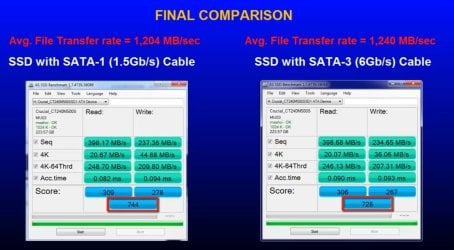
I read an article stating there’s very little difference between SATA cables. So I tried it for myself.
This screenshot shows the slight differences in speed; likely most of you already knew this. In testing, an 11GB file transferred in 10 seconds using either cable. Vid link shows detail of test for those interested. May not want to toss old cables.
I have noticed the same. MaximumPC magazine did an exhaustive test and came to the same conclusion, a SATA cable is a SATA cable. SATA III cables have a (sometimes annoying) latch on them.
Ahhhh.... you noticed that pesky latch also. I mounted my drives vertically in case, therefore some of the SATA connects have the latch facing away from me (so you can't see the latch). One day I was swapping out a drive and not noticing the latch, nearly pulled the guts out of the SSD trying to pull out the SATA cable connector. Now I always feel for the latch first. It's part of my new "damage control" program.
I'm seriously considering dismantling the latch clip since I doubt an SSD will vibrate the cable loose (since SSDs are low voltage, those electrons flying around between cells don't vibrate the drive much) My drives are so close together, it's difficult to get my paw in between them to release the latch.
P.S. - Nice spirited sig displays you have for the holidays! You must have Photoshop or the like.
I agree! I found one more tidbit before we put this thread to bed.
According to the SATA-IO spec group (excerpt): “By allowing SATA 6Gb/s systems the ability to utilize the same connectors and cables as SATA 3Gb/s systems, most of the modifications required to achieve 6Gb/s are confined to the PHY layer. Except for doubling the data rate, the PHY is no more complex than that defined by the SATA Revision 2.6 specification. Changes to the protocol itself are minor, and the physical connectors and cables remain unchanged.”
From the specs I read, it seems to me that the magic (data rate doubling) occurs in the PHY layer (core) of the Host/Controller circuits/protocol, and not in the SATA cable itself. According to the SATA-3 (6Gb) specs from the SATA-IO specification group, the physical cable, size, and composition remains essentially the same from SATA-1 (1.5Gb/s) through SATA-3 (6Gb/s). It’s only the PHY layer and/or protocol that changes, which is confined to the electrical circuit, and not the physical cable characteristics. This seems to validate why the testing reports on the net indicate the SATA cables are (mostly) all the same. [As one philosopher once put it: “a SATA cable is a SATA cable”] Because the manufacturers are not obligated to change the cables according to SATA-IO specs. Cable length seems to be the only factor causing degradation of signal speed/quality, likely due to resistance.



 My drives are so close together, it's difficult to get my paw in between them to release the latch.