
dhruv17singhal
New member
Hi,
I have a retail copy of Windows & Home Premium installed on an old Compaq laptop (that originally came with Windows XP OEM, which I, fortunately, chose not to upgrade). The laptop is now so old and slow that I have decided to install Linux on it and use its retail license for VirtualBox.
I would like to know how VirtualBox presents the hardware to the guest OS; does it present or emulate the underlying hardware itself, so that, at any time, a guest OS (i.e. Windows 7) running on VirtualBox on a particular computer (with any host OS), produces the same hardware hash (for identifying unique activations)? If not, then does it generate a unique virtual hardware every time it is installed on a host?
Basically, I have a multi-boot system on one of my desktops with Fedora, Ubuntu and Windows 7 (Ultimate). Each has VirtualBox installed on it. What I want is to have a single copy of Windows 7 (Home Premium, from the Laptop) installed on a vdi file, which I can share on the same desktop among the three OSes (by creating new virtual machine on the different hosts, and associating each with the same vdi file). I'll use Windows for testing new software as well as (on Linux) to run Windows-only softwares. I know that I can transfer the retail license from the Laptop to a virtual OS, but can the same guest OS be used with different hosts on the same "real" hardware, legally (i.e., without activation problems)?
I have a retail copy of Windows & Home Premium installed on an old Compaq laptop (that originally came with Windows XP OEM, which I, fortunately, chose not to upgrade). The laptop is now so old and slow that I have decided to install Linux on it and use its retail license for VirtualBox.
I would like to know how VirtualBox presents the hardware to the guest OS; does it present or emulate the underlying hardware itself, so that, at any time, a guest OS (i.e. Windows 7) running on VirtualBox on a particular computer (with any host OS), produces the same hardware hash (for identifying unique activations)? If not, then does it generate a unique virtual hardware every time it is installed on a host?
Basically, I have a multi-boot system on one of my desktops with Fedora, Ubuntu and Windows 7 (Ultimate). Each has VirtualBox installed on it. What I want is to have a single copy of Windows 7 (Home Premium, from the Laptop) installed on a vdi file, which I can share on the same desktop among the three OSes (by creating new virtual machine on the different hosts, and associating each with the same vdi file). I'll use Windows for testing new software as well as (on Linux) to run Windows-only softwares. I know that I can transfer the retail license from the Laptop to a virtual OS, but can the same guest OS be used with different hosts on the same "real" hardware, legally (i.e., without activation problems)?
My Computer
- OS
- Windows 7 Ultimate x64
- CPU
- Intel Core 2 Quad Q9650 3.00 GHz
- Motherboard
- Intel DQ45CB
- Memory
- 6 GB
- Monitor(s) Displays
- LCD
- Screen Resolution
- 1360 x 768
- Hard Drives
- Seagate Barracuda 7200.12 1TB x3;
Western Digital Cavaire Green 1TB x1
- PSU
- Seasonic 620W Power Supply (S12II-620)
- Case
- Cooler Master Elite 430 With Side Panel Window
- Cooling
- Cooler Master Hyper N620 CPU Cooler
- Keyboard
- Logitech Wireless Keyboard (MK250)
- Mouse
- Logitech Wireless Mouse (MK250)
- Internet Speed
- 2 Mbps


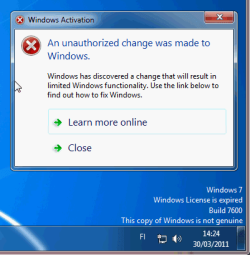
 ) but I need constantly to know everything I'm doing with my computers is 100% "kosher", valid and legal so I do nothing to try to work around this kind of obstacles. I'd rather have a valid license for every rig or vm than try to keep them activated using workarounds.
 Well said.