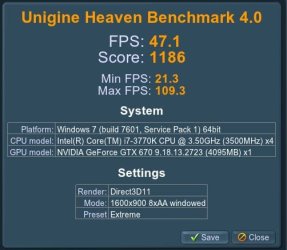
Show us your Unigine Heaven benchmark scores!

Good going mate, That didn't take you long :D
 

My Computer My Computer

At a glance

Win7 Home Premium x64 SP1i7 4770k8Gb Kingston HyperX Beast 2400MHz @2133MHz 11...MSI GTX 780ti Gaming Oc x2
Computer type
PC/Desktop
Computer Manufacturer/Model Number
Custom build
OS
Win7 Home Premium x64 SP1
CPU
i7 4770k
Motherboard
Asus maximus VI Hero
Memory
8Gb Kingston HyperX Beast 2400MHz @2133MHz 11-12-11-30
Graphics Card(s)
MSI GTX 780ti Gaming Oc x2
Sound Card
Onboard ROG SupremeFX
Monitor(s) Displays
Asus VG248QE
Screen Resolution
3840X1080 144Hz
Hard Drives
Samung Evo 256Gb, OCZ Agility4 128Gb
1x1TB hitachi storage
PSU
EVGA Supernova 1000w Platinum
Case
Corsair Air 540
Cooling
Corsair H100i
Keyboard
Coolermaster Quickfire Pro
Mouse
Corsair M65 RGB
Internet Speed
74mb dwn/16up
Antivirus
MSE,Malwarebytes
Browser
Chrome
Good going mate, That didn't take you long :D

It didn't but, I am sad I can't use Ghz values anymore I feel like selling these off and getting some other cards like some 780's or wait to see how the new 9970 performs
 

My Computer My Computer

At a glance

Windows 10 Home Premium 64bit sp1Intel I7-6700K @ 4.6 Ghz 1.344 volts everyday OC32GB G-Skill TridentZ 3200mhz 16-18-18-38 DDR4Sli Gigabyte Windforce GTX 980 G1
Computer type
PC/Desktop
Computer Manufacturer/Model Number
CoreI7-6700K MrFingerIII Special Builds
OS
Windows 10 Home Premium 64bit sp1
CPU
Intel I7-6700K @ 4.6 Ghz 1.344 volts everyday OC
Motherboard
Asrock Fatality K6 Z170 Socket 1151
Memory
32GB G-Skill TridentZ 3200mhz 16-18-18-38 DDR4
Graphics Card(s)
Sli Gigabyte Windforce GTX 980 G1
Sound Card
AC97 Creative Rage Tactic 3D Headphones Bluetooth
Monitor(s) Displays
27" Asus ROG Swift PG278Q G-Sync 48" Vizio Smart HD TV
Screen Resolution
2560x1440p 27"- 48" Currently Gaming at 2560x1440p Res 2K
Hard Drives
250GB Samsung Evo840SSD Seagate baracuda 500 GB WD Mybook 500Gb 1TB Seagate Barracuda
PSU
HX1050w Corsair Silver 80plus certified crosfire/sli
Case
Enthod Pro Full Tower
Cooling
Corsair H110i GT 280 mm High Performance WaterBlock
Keyboard
Logitech wireless keyboard
Mouse
Logitech wireless mouse
Internet Speed
Cox Cable 100+ mb
Antivirus
WebRoot Spysweeper with Antivirus
Browser
IE-10, Chrome, Opera
Other Info
My Other Rig is a AMD FX8320E @4.6Ghz 16GB Ballistic Sport Ram
Mobo Asrock Fatality 990FX 120GB OCZ SSD 1TB Seagate Barracuda Corsair H75 Cooling PSU Corsair CX750
GPU GTX Gigabyte 970G1
Aaaah don't be sad ;)
I'd wait untill AMD have shown their cards chap, If they don't come up with something to compete with the 780 then atleast prices may drop again.
 

My Computer My Computer

At a glance

Win7 Home Premium x64 SP1i7 4770k8Gb Kingston HyperX Beast 2400MHz @2133MHz 11...MSI GTX 780ti Gaming Oc x2
Computer type
PC/Desktop
Computer Manufacturer/Model Number
Custom build
OS
Win7 Home Premium x64 SP1
CPU
i7 4770k
Motherboard
Asus maximus VI Hero
Memory
8Gb Kingston HyperX Beast 2400MHz @2133MHz 11-12-11-30
Graphics Card(s)
MSI GTX 780ti Gaming Oc x2
Sound Card
Onboard ROG SupremeFX
Monitor(s) Displays
Asus VG248QE
Screen Resolution
3840X1080 144Hz
Hard Drives
Samung Evo 256Gb, OCZ Agility4 128Gb
1x1TB hitachi storage
PSU
EVGA Supernova 1000w Platinum
Case
Corsair Air 540
Cooling
Corsair H100i
Keyboard
Coolermaster Quickfire Pro
Mouse
Corsair M65 RGB
Internet Speed
74mb dwn/16up
Antivirus
MSE,Malwarebytes
Browser
Chrome
Hi, I'd like some explanation about FPS. On LCD and LED monitors the refresh rate is commonly 60 Hz or 120 Hz, so 60 or 120 times per second that the monitor can show a new frame. How does a FPS higher than these be helpful?
 

My Computer My Computer

At a glance

Windows 7 Ultimate X64 SP1Intel i5-2550K, Differing ~4.4-4.8GHz No buil...16GB G.Skill Sniper 1866MHz @ 2133MHz 2x8GBASUS GTX650TIB-DC2OC-2GD5, (650TI Boost)
Computer type
PC/Desktop
Computer Manufacturer/Model Number
Home Built Desktop By DataTech
OS
Windows 7 Ultimate X64 SP1
CPU
Intel i5-2550K, Differing ~4.4-4.8GHz No built in GPU
Motherboard
ASUS P8Z68-V PRO/GEN3
Memory
16GB G.Skill Sniper 1866MHz @ 2133MHz 2x8GB
Graphics Card(s)
ASUS GTX650TIB-DC2OC-2GD5, (650TI Boost)
Sound Card
Onboard Realtek 5-1
Monitor(s) Displays
Samsung P2570HD
Screen Resolution
1920x1080
Hard Drives
Samsung 840 Pro 256GB SSD for OS, 500GB Seagate Constellation (Enterprise drive) for Data
PSU
Corsair HX650W
Case
Inwin Dragon Rider
Cooling
Hyper 212 EVO w/two Noctua fans, push-pull, @1300 RPM
Keyboard
E-Z Eyes, bright yellow keys with large characters
Mouse
steelseries SENSEI Laser Pro Gaming
Internet Speed
48-51Mbs Mbs down, 11 Mbs up Xfinity Cable
Antivirus
Norton Internet Security 2013
Browser
IE 10, Opera, Pale Moon if needed
Other Info
4 case fans, LG BluRay-RE, ASUS DVD-RW, Mr. Fusion power supply, 1.21 gigawatts.
Hi, I'd like some explanation about FPS. On LCD and LED monitors the refresh rate is commonly 60 Hz or 120 Hz, so 60 or 120 times per second that the monitor can show a new frame. How does a FPS higher than these be helpful?


Difference between 60Hz and 120Hz LCD TV

The monitor I use right now http://www1.viewsonic.com/products/desktop-monitors/lcd/x-series/vx2753mh-led.htm

well I think the article sums it up as in response time and picture quality and even if you have a 60 MHz model it can have a good response time and picture size make it work just as good
 
Last edited:

My Computer My Computer

At a glance

Windows 10 Home Premium 64bit sp1Intel I7-6700K @ 4.6 Ghz 1.344 volts everyday OC32GB G-Skill TridentZ 3200mhz 16-18-18-38 DDR4Sli Gigabyte Windforce GTX 980 G1
Computer type
PC/Desktop
Computer Manufacturer/Model Number
CoreI7-6700K MrFingerIII Special Builds
OS
Windows 10 Home Premium 64bit sp1
CPU
Intel I7-6700K @ 4.6 Ghz 1.344 volts everyday OC
Motherboard
Asrock Fatality K6 Z170 Socket 1151
Memory
32GB G-Skill TridentZ 3200mhz 16-18-18-38 DDR4
Graphics Card(s)
Sli Gigabyte Windforce GTX 980 G1
Sound Card
AC97 Creative Rage Tactic 3D Headphones Bluetooth
Monitor(s) Displays
27" Asus ROG Swift PG278Q G-Sync 48" Vizio Smart HD TV
Screen Resolution
2560x1440p 27"- 48" Currently Gaming at 2560x1440p Res 2K
Hard Drives
250GB Samsung Evo840SSD Seagate baracuda 500 GB WD Mybook 500Gb 1TB Seagate Barracuda
PSU
HX1050w Corsair Silver 80plus certified crosfire/sli
Case
Enthod Pro Full Tower
Cooling
Corsair H110i GT 280 mm High Performance WaterBlock
Keyboard
Logitech wireless keyboard
Mouse
Logitech wireless mouse
Internet Speed
Cox Cable 100+ mb
Antivirus
WebRoot Spysweeper with Antivirus
Browser
IE-10, Chrome, Opera
Other Info
My Other Rig is a AMD FX8320E @4.6Ghz 16GB Ballistic Sport Ram
Mobo Asrock Fatality 990FX 120GB OCZ SSD 1TB Seagate Barracuda Corsair H75 Cooling PSU Corsair CX750
GPU GTX Gigabyte 970G1
Hi, I'd like some explanation about FPS. On LCD and LED monitors the refresh rate is commonly 60 Hz or 120 Hz, so 60 or 120 times per second that the monitor can show a new frame. How does a FPS higher than these be helpful?

Apart from benchmarking I always lock mine at 60 fps in games with vsync Gary to avoid screen tearing.
 

My Computer My Computer

At a glance

Windows 7 Professional 64 bit
OS
Windows 7 Professional 64 bit
Hi, I'd like some explanation about FPS. On LCD and LED monitors the refresh rate is commonly 60 Hz or 120 Hz, so 60 or 120 times per second that the monitor can show a new frame. How does a FPS higher than these be helpful?

It just helps with the overall motion of the game, I`m sure you`ve watched a movie on your pc ( not a dvd ) and you`ve seen it stutter and it sux, same thing with a game, the more fps the better it should look, play and feel :p

But you`re right Gary, the Hz really does affect the outcome, I just bought a 50" Insignia that does 120 Hz. Now apparently ( I`m told ) tv doesn`t broadcast in 120 Hz, but believe me, sports look way better on the 50" then on my Sony Bravia 40" 60 Hz LCD.

And as far as the tv goes, motion pictures are shot at 24 fps, which goes into 120 evenly, but does not go into 60 evenly. That`s why you should always try to get a 120 Hz hdtv. It will just be better.

Bye the way, I see a new nVidia driver is available 327.23, I say if it ain`t broke, leave it alone.
 
Last edited:

My Computer My Computer

At a glance

Windows 10 Pro x64Intel Core i7 6700KGSkill TridentZ RGB 16GB 3600 16-16-16-36EVGA GTX 980 Ti SC x2
Computer type
PC/Desktop
Computer Manufacturer/Model Number
Skylake Special #666
OS
Windows 10 Pro x64
CPU
Intel Core i7 6700K
Motherboard
Asus Sabertooth Z170 Mark 1
Memory
GSkill TridentZ RGB 16GB 3600 16-16-16-36
Graphics Card(s)
EVGA GTX 980 Ti SC x2
Sound Card
Realtek High Definition
Monitor(s) Displays
AOC G2460PG
Screen Resolution
1920 x 1080 144Hz
Hard Drives
Samsung 860 Pro 256GB, Seagate Barracuda 4TB x2
PSU
EVGA 1000 P2, EVGA White Custom Braided Cables
Case
Corsair Vengeance C70 Gunmetal Black
Cooling
Corsair H100i v2, Corsair ML120 x2, Thermal Grizzly Kryonaut
Keyboard
Logitech G910 Orion Spectrum
Mouse
Logitech G700s
Internet Speed
Verizon Fios Quantum Gateway 75/75
Antivirus
Windows Defender, Malwarebytes Free 3.8.3
Browser
Chrome
Other Info
Corsair SP120 x4, LG Blu-ray Drive, Durabrand HT-395 100 Watt Dolby Digital Amp, Corsair H2100 Wireless 7.1 Headset
Thanks everyone, I think I'm getting it now. Brian our US TV is broadcast at 24FPS which is NTSC, Most of Europe uses PAL, I don't know what their standard is.
 

My Computer My Computer

At a glance

Windows 7 Ultimate X64 SP1Intel i5-2550K, Differing ~4.4-4.8GHz No buil...16GB G.Skill Sniper 1866MHz @ 2133MHz 2x8GBASUS GTX650TIB-DC2OC-2GD5, (650TI Boost)
Computer type
PC/Desktop
Computer Manufacturer/Model Number
Home Built Desktop By DataTech
OS
Windows 7 Ultimate X64 SP1
CPU
Intel i5-2550K, Differing ~4.4-4.8GHz No built in GPU
Motherboard
ASUS P8Z68-V PRO/GEN3
Memory
16GB G.Skill Sniper 1866MHz @ 2133MHz 2x8GB
Graphics Card(s)
ASUS GTX650TIB-DC2OC-2GD5, (650TI Boost)
Sound Card
Onboard Realtek 5-1
Monitor(s) Displays
Samsung P2570HD
Screen Resolution
1920x1080
Hard Drives
Samsung 840 Pro 256GB SSD for OS, 500GB Seagate Constellation (Enterprise drive) for Data
PSU
Corsair HX650W
Case
Inwin Dragon Rider
Cooling
Hyper 212 EVO w/two Noctua fans, push-pull, @1300 RPM
Keyboard
E-Z Eyes, bright yellow keys with large characters
Mouse
steelseries SENSEI Laser Pro Gaming
Internet Speed
48-51Mbs Mbs down, 11 Mbs up Xfinity Cable
Antivirus
Norton Internet Security 2013
Browser
IE 10, Opera, Pale Moon if needed
Other Info
4 case fans, LG BluRay-RE, ASUS DVD-RW, Mr. Fusion power supply, 1.21 gigawatts.
All American TV, both analog and digital, cable and OTA, is at a frame rate of 59.94 fps. Commonly, it's called 60 fps.
It was originally 60 fps, but many years ago they squeezed some extra data into the space between frames lowering it to 59.94.

In the motion picture industry, where traditional film stock is used, the industry standard filming and projection formats are 24 frames per second (fps). Historically, 25 fps was used in some European countries. Shooting at a slower frame rate would create fast motion when projected, while shooting at a frame rate higher than 24 fps would create slow motion when projected. Other examples of historical experiments in frame rates that were not widely accepted were Maxivision 48 and Showscan, developed by 2001: A Space Odyssey special effects creator Douglas Trumbull.

There are three main frame rate standards in the TV and digital cinema business: 24p, 25p, and 30p. However, there are many variations on these as well as newer emerging standards.
24p is a progressive format and is now widely adopted by those planning on transferring a video signal to film. Film and video makers use 24p even if their productions are not going to be transferred to film, simply because of the on-screen "look" of the (low) frame rate which matches native film. When transferred to NTSC television, the rate is effectively slowed to 23.976 FPS (24×1000÷1001 to be exact), and when transferred to PAL or SECAM it is sped up to 25 FPS. 35 mm movie cameras use a standard exposure rate of 24 FPS, though many cameras offer rates of 23.976 FPS for NTSC television and 25 FPS for PAL/SECAM. The 24 FPS rate became the de facto standard for sound motion pictures in the mid-1920s.[4] Practically all hand-drawn animation is designed to be played at 24 FPS. Actually hand-drawing 24 unique frames per second "1`s" is costly. Even in big budget films usually hand-draw animation shooting on "2's" (one hand-drawn frame is shown twice, so only 12 unique frames per second) and some animation is even drawn on "4's" (one hand-drawn frame is shown four times, so only six unique frames per second).
25p is a progressive format and runs 25 progressive frames per second. This frame rate derives from the PAL television standard of 50i (or 50 interlaced fields per second). Film and Television companies use this rate in 50 Hz regions for direct compatibility with television field and frame rates. Conversion for 60 Hz countries is enabled by slowing down the media to 24p then converting to 60 Hz systems using pulldown. While 25p captures half the temporal resolution or motion that normal 50i PAL registers, it yields a higher vertical spatial resolution per frame. Like 24p, 25p is often used to achieve "cine"-look, albeit with virtually the same motion artifacts. It is also better suited to progressive-scan output (e.g., on LCD displays, computer monitors and projectors) because the interlacing is absent.
30p is a progressive format and produces video at 30 frames per second. Progressive (noninterlaced) scanning mimics a film camera's frame-by-frame image capture. The effects of inter-frame judder are less noticeable than 24p yet retains a cinematic-like appearance. Shooting video in 30p mode gives no interlace artifacts but can introduce judder on image movement and on some camera pans. The widescreen film process Todd-AO used this frame rate in 1954–1956.
48p is a progressive format and is currently being trialed in the film industry. At twice the traditional rate of 24p, this frame rate attempts to reduce motion blur and flicker found in films. Director James Cameron stated his intention to film the two sequels to his film Avatar at a higher frame rate than 24 frames per second, in order to add a heightened sense of reality. The first film to be filmed at 48 FPS was The Hobbit, a decision made by its director Peter Jackson. At a preview screening at CinemaCon, the audience's reaction was mixed after being shown some of the film's footage at 48p, with some arguing that the feel of the footage was too lifelike (thus breaking the suspension of disbelief).
50i is an interlaced format and is the standard video field rate per second for PAL and SECAM television.
60i is an interlaced format and is the standard video field rate per second for NTSC television (e.g., in the US), whether from a broadcast signal, DVD, or home camcorder. This interlaced field rate was developed separately by Farnsworth and Zworykin in 1934,[11] and was part of the NTSC television standards mandated by the FCC in 1941. When NTSC color was introduced in 1953, the older rate of 60 fields per second was reduced by a factor of 1000/1001 to avoid interference between the chroma subcarrier and the broadcast sound carrier. (Hence the usual designation "29.97 fps" = 30 frames(60 fields)
50p/60p is a progressive format and is used in high-end HDTV systems. While it is not technically part of the ATSC or DVB broadcast standards yet, reports suggest that higher progressive frame rates will be a feature of the next-generation high-definition television broadcast standards. In Europe, the EBU considers 1080p50 the next step future proof system for TV broadcasts and is encouraging broadcasters to upgrade their equipment for the future.
72p is a progressive format and is currently in experimental stages. Major institutions such as Snell have demonstrated 720p72 pictures as a result of earlier analogue experiments, where 768 line television at 75 FPS looked subjectively better than 1150 line 50 FPS progressive pictures with higher shutter speeds available (and a corresponding lower data rate). Modern cameras such as the Red One can use this frame rate to produce slow motion replays at 24 FPS. Douglas Trumbull, who undertook experiments with different frame rates that led to the Showscan film format, found that emotional impact peaked at 72 FPS for viewers. 72 FPS is the maximum rate available in the WMV video file format.
120p (120.00 Hz exactly) is a progressive format and is standardized for UHDTV by the ITU-R BT.2020 recommendation. It will be the single global "double-precision" frame rate for UHDTV (instead of using 100 Hz for PAL-based countries and 119.88 Hz for NTSC-based countries).
300 FPS, interpolated 300 FPS along with other high frame rates, have been tested by BBC Research for use in sports broadcasts. 300 FPS can be converted to both 50 and 60 FPS transmission formats without major issues.

PAL vs. NTSC
PAL has 576 visible line compared with 480 lines with NTSC, meaning that PAL has a 20% higher resolution. Both PAL and NTSC have a higher frame rate than film, 24 frames per second, offering flicker free motion. Most TV output for PAL and NTSC user Interlaced frames meaning that even lines update on one frame and odd lines update on the next frame. Interlacing frames gives a smoother motion with half the frame rate, the downside is with scene changes. NTSC is used with a fps of 60i or 30p whereas PAL generally uses 50i or 25p; both use a high enough frame rate to give the illusion of fluid motion. This is due to the fact that NTSC is generally used in countries with a Utility frequency of 60-Hz and PAL in countries with 50Hz, although there are many exceptions. PAL has a closer frame rate to film and is less likely to suffer from issues caused during frame rate conversion. Artefacts caused by frame rate conversion required when video has been recorded at the wrong rate for the display can be severe.
NTSC receivers have a tint control to perform colour correction manually. If this is not adjusted correctly, the colours may be faulty. The PAL standard automatically cancels hue errors by phase reversal, so a tint control is unnecessary. Chrominance phase errors in the PAL system are cancelled out using a 1H delay line resulting in lower saturation, which is much less noticeable to the eye than NTSC hue errors.
However, the alternation of colour information—Hanover bars—can lead to picture grain on pictures with extreme phase errors even in PAL systems, if decoder circuits are misaligned or use the simplified decoders of early designs (typically to overcome royalty restrictions). In most cases such extreme phase shifts do not occur. This effect will usually be observed when the transmission path is poor, typically in built up areas or where the terrain is unfavourable. The effect is more noticeable on UHF than VHF signals as VHF signals tend to be more robust.
In the early 1970s some Japanese set manufacturers developed decoding systems to avoid paying royalties to Telefunken. The Telefunken license covered any decoding method that relied on the alternating subcarrier phase to reduce phase errors. This included very basic PAL decoders that relied on the human eye to average out the odd/even line phase errors. One solution was to use a 1H analog delay line to allow decoding of only the odd or even lines. For example, the chrominance on odd lines would be switched directly through to the decoder and also be stored in the delay line. Then, on even lines, the stored odd line would be decoded again. This method effectively converted PAL to NTSC. Such systems suffered hue errors and other problems inherent in NTSC and required the addition of a manual hue control.
PAL and NTSC have slightly divergent colour spaces, but the colour decoder differences here are ignored.

 
Last edited:

My Computer My Computer

At a glance

Windows 10 Pro x64Intel Core i7 6700KGSkill TridentZ RGB 16GB 3600 16-16-16-36EVGA GTX 980 Ti SC x2
Computer type
PC/Desktop
Computer Manufacturer/Model Number
Skylake Special #666
OS
Windows 10 Pro x64
CPU
Intel Core i7 6700K
Motherboard
Asus Sabertooth Z170 Mark 1
Memory
GSkill TridentZ RGB 16GB 3600 16-16-16-36
Graphics Card(s)
EVGA GTX 980 Ti SC x2
Sound Card
Realtek High Definition
Monitor(s) Displays
AOC G2460PG
Screen Resolution
1920 x 1080 144Hz
Hard Drives
Samsung 860 Pro 256GB, Seagate Barracuda 4TB x2
PSU
EVGA 1000 P2, EVGA White Custom Braided Cables
Case
Corsair Vengeance C70 Gunmetal Black
Cooling
Corsair H100i v2, Corsair ML120 x2, Thermal Grizzly Kryonaut
Keyboard
Logitech G910 Orion Spectrum
Mouse
Logitech G700s
Internet Speed
Verizon Fios Quantum Gateway 75/75
Antivirus
Windows Defender, Malwarebytes Free 3.8.3
Browser
Chrome
Other Info
Corsair SP120 x4, LG Blu-ray Drive, Durabrand HT-395 100 Watt Dolby Digital Amp, Corsair H2100 Wireless 7.1 Headset
All American TV, both analog and digital, cable and OTA, is at a frame rate of 59.94 fps. Commonly, it's called 60 fps.
It was originally 60 fps, but many yeaers ago they squeezed some extra data into the space between frames lowering it to 59.94.

In the motion picture industry, where traditional film stock is used, the industry standard filming and projection formats are 24 frames per second (fps). Historically, 25 fps was used in some European countries. Shooting at a slower frame rate would create fast motion when projected, while shooting at a frame rate higher than 24 fps would create slow motion when projected. Other examples of historical experiments in frame rates that were not widely accepted were Maxivision 48 and Showscan, developed by 2001: A Space Odyssey special effects creator Douglas Trumbull.

There are three main frame rate standards in the TV and digital cinema business: 24p, 25p, and 30p. However, there are many variations on these as well as newer emerging standards.
24p is a progressive format and is now widely adopted by those planning on transferring a video signal to film. Film and video makers use 24p even if their productions are not going to be transferred to film, simply because of the on-screen "look" of the (low) frame rate which matches native film. When transferred to NTSC television, the rate is effectively slowed to 23.976 FPS (24×1000÷1001 to be exact), and when transferred to PAL or SECAM it is sped up to 25 FPS. 35 mm movie cameras use a standard exposure rate of 24 FPS, though many cameras offer rates of 23.976 FPS for NTSC television and 25 FPS for PAL/SECAM. The 24 FPS rate became the de facto standard for sound motion pictures in the mid-1920s.[4] Practically all hand-drawn animation is designed to be played at 24 FPS. Actually hand-drawing 24 unique frames per second "1`s" is costly. Even in big budget films usually hand-draw animation shooting on "2's" (one hand-drawn frame is shown twice, so only 12 unique frames per second) and some animation is even drawn on "4's" (one hand-drawn frame is shown four times, so only six unique frames per second).
25p is a progressive format and runs 25 progressive frames per second. This frame rate derives from the PAL television standard of 50i (or 50 interlaced fields per second). Film and Television companies use this rate in 50 Hz regions for direct compatibility with television field and frame rates. Conversion for 60 Hz countries is enabled by slowing down the media to 24p then converting to 60 Hz systems using pulldown. While 25p captures half the temporal resolution or motion that normal 50i PAL registers, it yields a higher vertical spatial resolution per frame. Like 24p, 25p is often used to achieve "cine"-look, albeit with virtually the same motion artifacts. It is also better suited to progressive-scan output (e.g., on LCD displays, computer monitors and projectors) because the interlacing is absent.
30p is a progressive format and produces video at 30 frames per second. Progressive (noninterlaced) scanning mimics a film camera's frame-by-frame image capture. The effects of inter-frame judder are less noticeable than 24p yet retains a cinematic-like appearance. Shooting video in 30p mode gives no interlace artifacts but can introduce judder on image movement and on some camera pans. The widescreen film process Todd-AO used this frame rate in 1954–1956.
48p is a progressive format and is currently being trialed in the film industry. At twice the traditional rate of 24p, this frame rate attempts to reduce motion blur and flicker found in films. Director James Cameron stated his intention to film the two sequels to his film Avatar at a higher frame rate than 24 frames per second, in order to add a heightened sense of reality. The first film to be filmed at 48 FPS was The Hobbit, a decision made by its director Peter Jackson. At a preview screening at CinemaCon, the audience's reaction was mixed after being shown some of the film's footage at 48p, with some arguing that the feel of the footage was too lifelike (thus breaking the suspension of disbelief).
50i is an interlaced format and is the standard video field rate per second for PAL and SECAM television.
60i is an interlaced format and is the standard video field rate per second for NTSC television (e.g., in the US), whether from a broadcast signal, DVD, or home camcorder. This interlaced field rate was developed separately by Farnsworth and Zworykin in 1934,[11] and was part of the NTSC television standards mandated by the FCC in 1941. When NTSC color was introduced in 1953, the older rate of 60 fields per second was reduced by a factor of 1000/1001 to avoid interference between the chroma subcarrier and the broadcast sound carrier. (Hence the usual designation "29.97 fps" = 30 frames(60 fields)
50p/60p is a progressive format and is used in high-end HDTV systems. While it is not technically part of the ATSC or DVB broadcast standards yet, reports suggest that higher progressive frame rates will be a feature of the next-generation high-definition television broadcast standards. In Europe, the EBU considers 1080p50 the next step future proof system for TV broadcasts and is encouraging broadcasters to upgrade their equipment for the future.
72p is a progressive format and is currently in experimental stages. Major institutions such as Snell have demonstrated 720p72 pictures as a result of earlier analogue experiments, where 768 line television at 75 FPS looked subjectively better than 1150 line 50 FPS progressive pictures with higher shutter speeds available (and a corresponding lower data rate). Modern cameras such as the Red One can use this frame rate to produce slow motion replays at 24 FPS. Douglas Trumbull, who undertook experiments with different frame rates that led to the Showscan film format, found that emotional impact peaked at 72 FPS for viewers. 72 FPS is the maximum rate available in the WMV video file format.
120p (120.00 Hz exactly) is a progressive format and is standardized for UHDTV by the ITU-R BT.2020 recommendation. It will be the single global "double-precision" frame rate for UHDTV (instead of using 100 Hz for PAL-based countries and 119.88 Hz for NTSC-based countries).
300 FPS, interpolated 300 FPS along with other high frame rates, have been tested by BBC Research for use in sports broadcasts. 300 FPS can be converted to both 50 and 60 FPS transmission formats without major issues.

PAL vs. NTSC
PAL has 576 visible line compared with 480 lines with NTSC, meaning that PAL has a 20% higher resolution. Both PAL and NTSC have a higher frame rate than film, 24 frames per second, offering flicker free motion. Most TV output for PAL and NTSC user Interlaced frames meaning that even lines update on one frame and odd lines update on the next frame. Interlacing frames gives a smoother motion with half the frame rate, the downside is with scene changes. NTSC is used with a fps of 60i or 30p whereas PAL generally uses 50i or 25p; both use a high enough frame rate to give the illusion of fluid motion. This is due to the fact that NTSC is generally used in countries with a Utility frequency of 60-Hz and PAL in countries with 50Hz, although there are many exceptions. PAL has a closer frame rate to film and is less likely to suffer from issues caused during frame rate conversion. Artefacts caused by frame rate conversion required when video has been recorded at the wrong rate for the display can be severe.
NTSC receivers have a tint control to perform colour correction manually. If this is not adjusted correctly, the colours may be faulty. The PAL standard automatically cancels hue errors by phase reversal, so a tint control is unnecessary. Chrominance phase errors in the PAL system are cancelled out using a 1H delay line resulting in lower saturation, which is much less noticeable to the eye than NTSC hue errors.
However, the alternation of colour information—Hanover bars—can lead to picture grain on pictures with extreme phase errors even in PAL systems, if decoder circuits are misaligned or use the simplified decoders of early designs (typically to overcome royalty restrictions). In most cases such extreme phase shifts do not occur. This effect will usually be observed when the transmission path is poor, typically in built up areas or where the terrain is unfavourable. The effect is more noticeable on UHF than VHF signals as VHF signals tend to be more robust.
In the early 1970s some Japanese set manufacturers developed decoding systems to avoid paying royalties to Telefunken. The Telefunken license covered any decoding method that relied on the alternating subcarrier phase to reduce phase errors. This included very basic PAL decoders that relied on the human eye to average out the odd/even line phase errors. One solution was to use a 1H analog delay line to allow decoding of only the odd or even lines. For example, the chrominance on odd lines would be switched directly through to the decoder and also be stored in the delay line. Then, on even lines, the stored odd line would be decoded again. This method effectively converted PAL to NTSC. Such systems suffered hue errors and other problems inherent in NTSC and required the addition of a manual hue control.
PAL and NTSC have slightly divergent colour spaces, but the colour decoder differences here are ignored.

Wow. I'm in the news for buying a new camera. Cannon HF R400 - 1080/60p 1/4" CMOS sensor and for the longest time I was trying to figure out what the p meant. Now you just summed it up. Thanks man!
 

My Computer My Computer

At a glance

Windows 10 ProIntel i7-3770K 4.4GHz8GB G.SKILL Ripjaws 1866 MHzEVGA GTX 980 Classified
Computer type
PC/Desktop
Computer Manufacturer/Model Number
Weekend Warrior Rig
OS
Windows 10 Pro
CPU
Intel i7-3770K 4.4GHz
Motherboard
ASUS P8Z77-V Pro
Memory
8GB G.SKILL Ripjaws 1866 MHz
Graphics Card(s)
EVGA GTX 980 Classified
Monitor(s) Displays
Asus VH238H 23" 2ms
Screen Resolution
1920x1080
Hard Drives
Intel 330 120GB SSD /
WD Blue 1TB /
WD Black 500GB
PSU
Corsair CX750M
Case
NZXT H440
Cooling
Corsair H80i- CPU / Corsair H90- GPU
Keyboard
Logitech K360 LE
Mouse
Logitech G500
Antivirus
Avast
Browser
Chrome
Other Info
1200W 2.1 Surround Sound Audio
It's been a while since I posted. Trying out the new drivers.

heaven post.JPG
 

My Computers My Computers

  • At a glance

    Windows 11 ProRyzen 9 5900X32GB G Skill DDR4-3600EVGA RTX 3080 FTW 3 Ultra
    Computer type
    PC/Desktop
    Computer Manufacturer/Model Number
    ALWAYS UNDER CONSTRUCTION
    OS
    Windows 11 Pro
    CPU
    Ryzen 9 5900X
    Motherboard
    Asus X570 Crosshair Viii Hero
    Memory
    32GB G Skill DDR4-3600
    Graphics Card(s)
    EVGA RTX 3080 FTW 3 Ultra
    Sound Card
    On Board/Sennheiser PC37X Headset
    Monitor(s) Displays
    3 X Asus 27"
    Screen Resolution
    2560x1440
    Hard Drives
    2 X 1 TB NVME drives
    PSU
    EVGA 850
    Case
    Phanteks Eclipse P400A
    Cooling
    EVGA 280 AIO
    Keyboard
    Logitech G510s/ Logitech G13
    Mouse
    Logitech G502
    Internet Speed
    24/1
    Antivirus
    ESET/MBAM Pro/SAS Pro
    Browser
    Chrome/ Firefox/ Edge
  • At a glance

    Windows 11 ProIntel Ultra 9 288V32 GB LPDDR5X 8533
    Computer type
    Laptop
    System Manufacturer/Model Number
    Dell 16 Plus
    OS
    Windows 11 Pro
    CPU
    Intel Ultra 9 288V
    Memory
    32 GB LPDDR5X 8533
    Monitor(s) Displays
    16" Mini-LED HDR600 Touch 90 Hz
    Screen Resolution
    2560X1600
    Hard Drives
    1 TB NVME
Not bad Steve, but I think it's about time you got a new graphics card. I hear the 9970 might be good :)
 

My Computer My Computer

At a glance

Windows 7 Professional 64 bit
OS
Windows 7 Professional 64 bit
I heard that rumor too.
 

My Computers My Computers

  • At a glance

    Windows 11 ProRyzen 9 5900X32GB G Skill DDR4-3600EVGA RTX 3080 FTW 3 Ultra
    Computer type
    PC/Desktop
    Computer Manufacturer/Model Number
    ALWAYS UNDER CONSTRUCTION
    OS
    Windows 11 Pro
    CPU
    Ryzen 9 5900X
    Motherboard
    Asus X570 Crosshair Viii Hero
    Memory
    32GB G Skill DDR4-3600
    Graphics Card(s)
    EVGA RTX 3080 FTW 3 Ultra
    Sound Card
    On Board/Sennheiser PC37X Headset
    Monitor(s) Displays
    3 X Asus 27"
    Screen Resolution
    2560x1440
    Hard Drives
    2 X 1 TB NVME drives
    PSU
    EVGA 850
    Case
    Phanteks Eclipse P400A
    Cooling
    EVGA 280 AIO
    Keyboard
    Logitech G510s/ Logitech G13
    Mouse
    Logitech G502
    Internet Speed
    24/1
    Antivirus
    ESET/MBAM Pro/SAS Pro
    Browser
    Chrome/ Firefox/ Edge
  • At a glance

    Windows 11 ProIntel Ultra 9 288V32 GB LPDDR5X 8533
    Computer type
    Laptop
    System Manufacturer/Model Number
    Dell 16 Plus
    OS
    Windows 11 Pro
    CPU
    Intel Ultra 9 288V
    Memory
    32 GB LPDDR5X 8533
    Monitor(s) Displays
    16" Mini-LED HDR600 Touch 90 Hz
    Screen Resolution
    2560X1600
    Hard Drives
    1 TB NVME
Not to bad at benchmarking the new gear, after it settles in I`ll start cranking it up.
 
Last edited:

My Computer My Computer

At a glance

Windows 10 Pro x64Intel Core i7 6700KGSkill TridentZ RGB 16GB 3600 16-16-16-36EVGA GTX 980 Ti SC x2
Computer type
PC/Desktop
Computer Manufacturer/Model Number
Skylake Special #666
OS
Windows 10 Pro x64
CPU
Intel Core i7 6700K
Motherboard
Asus Sabertooth Z170 Mark 1
Memory
GSkill TridentZ RGB 16GB 3600 16-16-16-36
Graphics Card(s)
EVGA GTX 980 Ti SC x2
Sound Card
Realtek High Definition
Monitor(s) Displays
AOC G2460PG
Screen Resolution
1920 x 1080 144Hz
Hard Drives
Samsung 860 Pro 256GB, Seagate Barracuda 4TB x2
PSU
EVGA 1000 P2, EVGA White Custom Braided Cables
Case
Corsair Vengeance C70 Gunmetal Black
Cooling
Corsair H100i v2, Corsair ML120 x2, Thermal Grizzly Kryonaut
Keyboard
Logitech G910 Orion Spectrum
Mouse
Logitech G700s
Internet Speed
Verizon Fios Quantum Gateway 75/75
Antivirus
Windows Defender, Malwarebytes Free 3.8.3
Browser
Chrome
Other Info
Corsair SP120 x4, LG Blu-ray Drive, Durabrand HT-395 100 Watt Dolby Digital Amp, Corsair H2100 Wireless 7.1 Headset

My Computer My Computer

At a glance

Win7 Home Premium x64 SP1i7 4770k8Gb Kingston HyperX Beast 2400MHz @2133MHz 11...MSI GTX 780ti Gaming Oc x2
Computer type
PC/Desktop
Computer Manufacturer/Model Number
Custom build
OS
Win7 Home Premium x64 SP1
CPU
i7 4770k
Motherboard
Asus maximus VI Hero
Memory
8Gb Kingston HyperX Beast 2400MHz @2133MHz 11-12-11-30
Graphics Card(s)
MSI GTX 780ti Gaming Oc x2
Sound Card
Onboard ROG SupremeFX
Monitor(s) Displays
Asus VG248QE
Screen Resolution
3840X1080 144Hz
Hard Drives
Samung Evo 256Gb, OCZ Agility4 128Gb
1x1TB hitachi storage
PSU
EVGA Supernova 1000w Platinum
Case
Corsair Air 540
Cooling
Corsair H100i
Keyboard
Coolermaster Quickfire Pro
Mouse
Corsair M65 RGB
Internet Speed
74mb dwn/16up
Antivirus
MSE,Malwarebytes
Browser
Chrome
Another on Ultra, It`s so smooth with the 4 GBs :D
 
Last edited:

My Computer My Computer

At a glance

Windows 10 Pro x64Intel Core i7 6700KGSkill TridentZ RGB 16GB 3600 16-16-16-36EVGA GTX 980 Ti SC x2
Computer type
PC/Desktop
Computer Manufacturer/Model Number
Skylake Special #666
OS
Windows 10 Pro x64
CPU
Intel Core i7 6700K
Motherboard
Asus Sabertooth Z170 Mark 1
Memory
GSkill TridentZ RGB 16GB 3600 16-16-16-36
Graphics Card(s)
EVGA GTX 980 Ti SC x2
Sound Card
Realtek High Definition
Monitor(s) Displays
AOC G2460PG
Screen Resolution
1920 x 1080 144Hz
Hard Drives
Samsung 860 Pro 256GB, Seagate Barracuda 4TB x2
PSU
EVGA 1000 P2, EVGA White Custom Braided Cables
Case
Corsair Vengeance C70 Gunmetal Black
Cooling
Corsair H100i v2, Corsair ML120 x2, Thermal Grizzly Kryonaut
Keyboard
Logitech G910 Orion Spectrum
Mouse
Logitech G700s
Internet Speed
Verizon Fios Quantum Gateway 75/75
Antivirus
Windows Defender, Malwarebytes Free 3.8.3
Browser
Chrome
Other Info
Corsair SP120 x4, LG Blu-ray Drive, Durabrand HT-395 100 Watt Dolby Digital Amp, Corsair H2100 Wireless 7.1 Headset
Nice scores AddRam :thumbsup:

Extreme Hd is where it's at though ;)
 

My Computer My Computer

At a glance

Win7 Home Premium x64 SP1i7 4770k8Gb Kingston HyperX Beast 2400MHz @2133MHz 11...MSI GTX 780ti Gaming Oc x2
Computer type
PC/Desktop
Computer Manufacturer/Model Number
Custom build
OS
Win7 Home Premium x64 SP1
CPU
i7 4770k
Motherboard
Asus maximus VI Hero
Memory
8Gb Kingston HyperX Beast 2400MHz @2133MHz 11-12-11-30
Graphics Card(s)
MSI GTX 780ti Gaming Oc x2
Sound Card
Onboard ROG SupremeFX
Monitor(s) Displays
Asus VG248QE
Screen Resolution
3840X1080 144Hz
Hard Drives
Samung Evo 256Gb, OCZ Agility4 128Gb
1x1TB hitachi storage
PSU
EVGA Supernova 1000w Platinum
Case
Corsair Air 540
Cooling
Corsair H100i
Keyboard
Coolermaster Quickfire Pro
Mouse
Corsair M65 RGB
Internet Speed
74mb dwn/16up
Antivirus
MSE,Malwarebytes
Browser
Chrome
Ya I know, it won`t let me go full screen on Extreme, and I think it`s killing it :confused:
 
Last edited:

My Computer My Computer

At a glance

Windows 10 Pro x64Intel Core i7 6700KGSkill TridentZ RGB 16GB 3600 16-16-16-36EVGA GTX 980 Ti SC x2
Computer type
PC/Desktop
Computer Manufacturer/Model Number
Skylake Special #666
OS
Windows 10 Pro x64
CPU
Intel Core i7 6700K
Motherboard
Asus Sabertooth Z170 Mark 1
Memory
GSkill TridentZ RGB 16GB 3600 16-16-16-36
Graphics Card(s)
EVGA GTX 980 Ti SC x2
Sound Card
Realtek High Definition
Monitor(s) Displays
AOC G2460PG
Screen Resolution
1920 x 1080 144Hz
Hard Drives
Samsung 860 Pro 256GB, Seagate Barracuda 4TB x2
PSU
EVGA 1000 P2, EVGA White Custom Braided Cables
Case
Corsair Vengeance C70 Gunmetal Black
Cooling
Corsair H100i v2, Corsair ML120 x2, Thermal Grizzly Kryonaut
Keyboard
Logitech G910 Orion Spectrum
Mouse
Logitech G700s
Internet Speed
Verizon Fios Quantum Gateway 75/75
Antivirus
Windows Defender, Malwarebytes Free 3.8.3
Browser
Chrome
Other Info
Corsair SP120 x4, LG Blu-ray Drive, Durabrand HT-395 100 Watt Dolby Digital Amp, Corsair H2100 Wireless 7.1 Headset
I'm not sure why it's doing that then, is there another setting yo have enabled like 3d or something that might stop it?
 

My Computer My Computer

At a glance

Win7 Home Premium x64 SP1i7 4770k8Gb Kingston HyperX Beast 2400MHz @2133MHz 11...MSI GTX 780ti Gaming Oc x2
Computer type
PC/Desktop
Computer Manufacturer/Model Number
Custom build
OS
Win7 Home Premium x64 SP1
CPU
i7 4770k
Motherboard
Asus maximus VI Hero
Memory
8Gb Kingston HyperX Beast 2400MHz @2133MHz 11-12-11-30
Graphics Card(s)
MSI GTX 780ti Gaming Oc x2
Sound Card
Onboard ROG SupremeFX
Monitor(s) Displays
Asus VG248QE
Screen Resolution
3840X1080 144Hz
Hard Drives
Samung Evo 256Gb, OCZ Agility4 128Gb
1x1TB hitachi storage
PSU
EVGA Supernova 1000w Platinum
Case
Corsair Air 540
Cooling
Corsair H100i
Keyboard
Coolermaster Quickfire Pro
Mouse
Corsair M65 RGB
Internet Speed
74mb dwn/16up
Antivirus
MSE,Malwarebytes
Browser
Chrome
Ya I know, it won`t let me go full screen on Extreme, and I think it`s killing it :confused:


Has to be on Custom AddRam :cool:

You also supposed to score higher in window mode

My CF wouldn't work unless I went full screen I got a bad attitude over getting single card numbers knowing I have two of them lol but after some digging that is the case
 

My Computer My Computer

At a glance

Windows 10 Home Premium 64bit sp1Intel I7-6700K @ 4.6 Ghz 1.344 volts everyday OC32GB G-Skill TridentZ 3200mhz 16-18-18-38 DDR4Sli Gigabyte Windforce GTX 980 G1
Computer type
PC/Desktop
Computer Manufacturer/Model Number
CoreI7-6700K MrFingerIII Special Builds
OS
Windows 10 Home Premium 64bit sp1
CPU
Intel I7-6700K @ 4.6 Ghz 1.344 volts everyday OC
Motherboard
Asrock Fatality K6 Z170 Socket 1151
Memory
32GB G-Skill TridentZ 3200mhz 16-18-18-38 DDR4
Graphics Card(s)
Sli Gigabyte Windforce GTX 980 G1
Sound Card
AC97 Creative Rage Tactic 3D Headphones Bluetooth
Monitor(s) Displays
27" Asus ROG Swift PG278Q G-Sync 48" Vizio Smart HD TV
Screen Resolution
2560x1440p 27"- 48" Currently Gaming at 2560x1440p Res 2K
Hard Drives
250GB Samsung Evo840SSD Seagate baracuda 500 GB WD Mybook 500Gb 1TB Seagate Barracuda
PSU
HX1050w Corsair Silver 80plus certified crosfire/sli
Case
Enthod Pro Full Tower
Cooling
Corsair H110i GT 280 mm High Performance WaterBlock
Keyboard
Logitech wireless keyboard
Mouse
Logitech wireless mouse
Internet Speed
Cox Cable 100+ mb
Antivirus
WebRoot Spysweeper with Antivirus
Browser
IE-10, Chrome, Opera
Other Info
My Other Rig is a AMD FX8320E @4.6Ghz 16GB Ballistic Sport Ram
Mobo Asrock Fatality 990FX 120GB OCZ SSD 1TB Seagate Barracuda Corsair H75 Cooling PSU Corsair CX750
GPU GTX Gigabyte 970G1
Back
Top