
Well not for drives, but I did used to work 2015 feet underground at the San Manual, Arizona copper mine - at the time, the world's largest underground copper mine. And I used to set a of bunch dynamite (about 20lbs worth) charges twice a day (at lunch and end of shift). Quite fun - except for the "NG" or "bang heads" - (really horrific nitroglycerin induced headaches) you got every time you handled the stuff. After I was there for awhile I moved to driving an underground train (80 miles of track on that 2015ft level!) and hauled several tons of dynamite every day. Because I handled that stuff, I got hazard pay bonus so I was paid $12/hour - and that was in 1971 - BIG money for a 18 - 19 year old back then.Ever try explosives?
@Mega7User - Thanks for posting that and yeah, I remember seeing that years ago. But it is important to understand it does not apply today or here. First, that was for ancient "ATA" specification drives. That is the legacy drive technology used before EIDE drives. And EIDE drives have since been superseded by today's SATA drives. While all 3 technologies use spinning platters, R/W heads and the alignment of magnetic particles to represent 1s and 0s, the similarities between antique ATA drives and today's SATA drives pretty much ends there.
Second, as noted in that white paper, those hidden areas could only be accessed and used by knowledgeable users (primarily bad guys) and only by using "specific open source tools" to hide data in those locations from forensic investigators. Normal users could not see it.
Therefore, no normal user, no drive maker, no operating system would ever stuff user data into those locations. It could not even be done by accident! So don't worry about destroying your drives to protect your personal data from prying eyes. A simple one-pass wipe is plenty - unless you really do have something "incriminating" to hide from law enforcement!Bad guys are lazy. No bad guy is going to waste his or her time if he or she has to work at it that hard.
Must agree to disagree with you on most of your post. Page 7 'top';The ability to obfuscate evidence makes the HPA and DCO a concern for investigators. When imaging an HDD, the investigator must be aware that any HDD that supports ATA-6 and above can contain HPA and or DCO. However, if the HDD supports ATA-4 or 5, it only has the potential to contain HPA. Given that the majority of current HDDs support ATA-6 and above, it is extremely important for current forensics practitioners to be aware of the HPA and DCO and use appropriate tools.
'So', with that said, SATA drives are only different inasmuch as they are accessed with a serial interface (ATA-6 standard and above, I believe). I am still trying to learn some about AF SATA drives but so far it seems to me they are still ATA drives accessed serially but with much higher cluster sizes allowing much larger capacities. Drives with platters only differ in transfer speed, and the mechanism by which the data is transferred/processed from the computer bus to the platter through the drive interface. In this short research I find ( What is ATA-6? (with picture) ). I am fully aware platter HDD's will, and are, still available (and will be for years to come). I foresee (with MS and others going to remote locations for 'user' data) the slow conversion from user only storage, to this (sic) 'cloud' based storage. As of now, MS doesn't even recognize you owning the MS software, your only licensed to 'use' it. Gone long ago is the OS disk in your hands.
 Why you chose to include a comment on "incriminating" (underlined, as if to imply nefarious intent or other) is beyond me. I stated MS and HDD manufacturers can, and probably do, access these hidden locations. What is stored there (remember access of IS possible, and was possible 10 years ago when the article was written) is any ones guess. I agree generally JQP cannot access this UNLESS they have the tools/access to read such 'information' either gathered, or stored. Just because I cannot demonstrate what is there, does not mean nothing IS being put there. I am sure this (minimum) 10 year old information, has been 'e x p a n d e d' in capability. I for one destroy any HDD that I have used before. One note comparable to this topic, people who are conned into 'donating' used cellphone/flipphones usually have no idea they are giving away a huge amount of their information/data to the 'totally unknown' people they are giving their phones to. I say be aware and err on a side of extreme caution! Especially on a piece of hardware that was in use for as long as it was wherever you visited/did with it.
 My Computer
At a glance
Win 72.6 Intel2 GB
- Computer type
- Laptop
- Computer Manufacturer/Model Number
- Dell
- OS
- Win 7
- CPU
- 2.6 Intel
- Memory
- 2 GB

 Because using secret locations and operatives is so much easier for Seagate and WD than to embed hidden malware on their drives to steal our data and "phone home" with it. And because operatives are easier for Microsoft than embedding undetectable malware in Windows to steal our data and phone home too.
 Even
Even 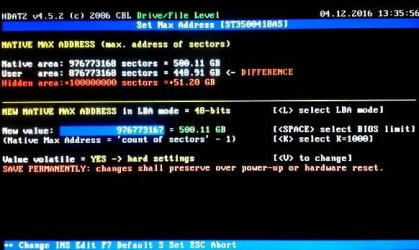
 The both of you burying your heads in the sand and attributing things said as mine reflects the ignorance you have about the human animal. A capability existing (and it does), means it is probably in use a lot more than people would believe (Except you two as a minimum). Most of the statements spewed forth as mine and agreed to by the both of you need your review, they are and were not my words! Denial and ignorance causes quite the character assassination, doesn't it? Read post 66. For the record, I OWN stating MS and HDD manufacturers can store information in hidden areas of the HDD. I don't care if you believe it or not. I also OWN the statement that information is highly coveted, acquired, and sold. What, have you 'donated old cellphone/flip-phones with data on them and got your ID stolen? So, after all the denial that hidden sections of a modern HDD (as referenced) can and do exist (again, read post 66), I'll let you both off the hook for attacking someone because of ignorance. It isn't the first time, and damn sure will not be the last. Careful, breathing sand too much can make you sick. No need to reply, I have to replace my tin foil hat.
  Thank you dg1261, for your demonstrated example denied by one and agreed to by the other that was clearly posted about and sourced on Pg 7 (top) of the referenced .pdf (from over 10 years ago). TTFN!
 Crybaby, passive aggression behavior in chat rooms IS your forte. Forums need a BS icon for 'members' like you. Look in a mirror, change what you do not like about yourself. If you need help call 714-672-9009, if they can't help you call 1-800-662-4357, BUT you have to first admit you have a problem.