
Daily System Imaging

alpha4G9et5

New member
Local time
12:58 AM
Messages
4
Hii..

I have setup a daily system imaging. The first time I did this it took around 1 hour or so. However nowadays, it takes only ~10 mins or so. I had this idea that during a system image backup, the computer does a full backup, rather than incremental backups.
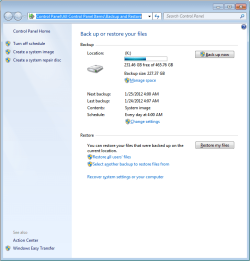
Picture1.png

As you can see it took only 7 mins last time. Because I want to set it up and sort of forget it, I want to make sure that the system is being imaged as I intend it too. However I cannot really know whether the system has been imaged, without doing a full restore.

Is there a way to confirm that this is ok?

Picture2.png

Also do the restore points remain preserved in the system image? If not, is there a way to ensure that?
 

My Computer

Computer type
PC/Desktop
OS
Windows 7 Home
Too bad you are using Windows7 imaging. As far as I can see the reports, half of the time people are not able to recover from those images. So I think you are taking your chances. Have a look at this thread where it took me more than 1 week to get this man back on track.

Use a robust imaging program - anything is better than Windows7 imaging.
 

My Computer

Computer Manufacturer/Model Number
HP, Dell, Gateway, Toshiba - 4 laptops and 2 desktops
OS
Vista, Windows7, Mint Mate, Zorin, Windows 8
CPU
from 1.6GHz Duo to i7
Monitor(s) Displays
2x HP w2207
Hard Drives
5x HDD, 7x SSD, 12x Externals
Keyboard
with trackball - no mices
Mouse
Trackball mice
Internet Speed
DSL 6000
http://www.sevenforums.com/backup-r...allow-multiple-images-windowsimagebackup.html

Click on the above link and at the bottom of the 1st post, download the sysimage.bat OR the sysimage.txt and RENAME to sysimage.BAT.

From a DOS prompt and IN the directory to which you just downloaded the file:

NOTE: have any drive mounted that has system images upon it PRIOR to running.

sysimage.bat /I Y

This will provide everything you wanted to know about your system image backups. Including whether they are incremental and whether they have system state.
 

My Computer

Computer type
PC/Desktop
Computer Manufacturer/Model Number
Custom
OS
Windows 7
CPU
AMD Phenom II X2 (dual-core)
Motherboard
GA-MA785GM-US2H
Memory
4G
Graphics Card(s)
integrated ATI HD 4200
Sound Card
integrated
Monitor(s) Displays
Samsung 24"
Screen Resolution
1920x1080
Hard Drives
1 SSD - Samsung 840 - 500 GB - OS and DATA partitions
1 SSD - Intel 320 - 120 GB (used for backups) - Misc/BACKUP
1 SATA HD - WD, 500 GB - BACKUP
PSU
Ultra X4 500W
Case
Ultra X-blaster
Keyboard
Microsoft Digital Media Pro
Mouse
Logitech WIRED!
Internet Speed
15 Mbps FIOS
Doesn't the native Windows 7 System Imaging Program verify that the created image is good and in order like most third party programs do?

However I strongly support the advise given by whs to use a System Imaging Program other that the one native in Windows 7 so that you don't come to grief when restoring an image.
 

My Computer

Computer Manufacturer/Model Number
Custom Built
OS
Windows 7 Pro with SP1 32bit
Motherboard
Intel D845GVS1 X86-based PC
Memory
2 gigs of RAM
Graphics Card(s)
Intel(R) 82845G/GL/GE/PE/GV Graphics Controller
Sound Card
Realtek AC'97 Audio
Monitor(s) Displays
Samsung SyncMaster 931BF Black 19" LCD Monitor
Screen Resolution
1280X960
Hard Drives
1. SAMSUNG SP0822N ATA Device ~ 80 GigaBytes

2. Seagate FreeAgent Go USB Device ~ 500 GigaBytes
Keyboard
COMPAQ Standard PS/2 Keyboard
Mouse
iBall Laser Precise Speedster
Internet Speed
4 mb/sec
I think one of the problems with many people is that they either have a single partition or have not trimmed their OS down to the essentials so that it takes the least amount of time to do an image. If your OS is as small as you can get it then you are more likely to do regular imaging - mine takes less than 10 minutes for a full image - and backing up other data regularly will also take less time if done almost immediately after data changes. I've never used Widows imaging or backing up but Macrium and Acronis have been totally reliable for me at least.

:huh: :rolleyes: :)
 

My Computer

Computer Manufacturer/Model Number
Compaq desktop
OS
Windows 7 x64 SP1
CPU
Athlon II x2 215
Memory
4.0 GB
Graphics Card(s)
Onboard
Sound Card
Creative SB X-Fi Titanium HD (nice)
Monitor(s) Displays
24" Dell LCD
Screen Resolution
1900 x 1200
Hard Drives
320 GB, 500 GB and 750 GB 7200 rpm
PSU
430w
Keyboard
USB
Mouse
USB
Internet Speed
approx 10 Mbps
My C: partition (which is on a Crucial M4) is appr. 30GBs - and that includes the Ubuntu virtual machine. Imaging that to an internal HDD or the eSata external takes 10 to 12 minutes. But to the USB2 attached external it takes more like 25 minutes. I always take full images with Macrium.

I have tried differentials with Paragon which are a lot faster after the (longer) initial image. But I really prefer full images. They are easier to manage.
 

My Computer

Computer Manufacturer/Model Number
HP, Dell, Gateway, Toshiba - 4 laptops and 2 desktops
OS
Vista, Windows7, Mint Mate, Zorin, Windows 8
CPU
from 1.6GHz Duo to i7
Monitor(s) Displays
2x HP w2207
Hard Drives
5x HDD, 7x SSD, 12x Externals
Keyboard
with trackball - no mices
Mouse
Trackball mice
Internet Speed
DSL 6000
With Acronis, that I use, the image is created copying sector by sector. That means that if the drive has been defragmented and the files moved around then their is not much difference in size between a differential and full image. Therefore I too prefer to take the full image each time.

It takes 25 to 30 minutes to create and verify the image and between 8 to 10 minutes to restore with all the third party programs in place. Since I have started imaging, I have developed greater confidence in fiddling with applications and files because there is always an image to fall back upon and never the need to reinstall Windows or the Third Party Programs.
 

My Computer

Computer Manufacturer/Model Number
Custom Built
OS
Windows 7 Pro with SP1 32bit
Motherboard
Intel D845GVS1 X86-based PC
Memory
2 gigs of RAM
Graphics Card(s)
Intel(R) 82845G/GL/GE/PE/GV Graphics Controller
Sound Card
Realtek AC'97 Audio
Monitor(s) Displays
Samsung SyncMaster 931BF Black 19" LCD Monitor
Screen Resolution
1280X960
Hard Drives
1. SAMSUNG SP0822N ATA Device ~ 80 GigaBytes

2. Seagate FreeAgent Go USB Device ~ 500 GigaBytes
Keyboard
COMPAQ Standard PS/2 Keyboard
Mouse
iBall Laser Precise Speedster
Internet Speed
4 mb/sec
The restore time is really short. With Macrium, it is more like 20 to 25 minutes.
 

My Computer

Computer Manufacturer/Model Number
HP, Dell, Gateway, Toshiba - 4 laptops and 2 desktops
OS
Vista, Windows7, Mint Mate, Zorin, Windows 8
CPU
from 1.6GHz Duo to i7
Monitor(s) Displays
2x HP w2207
Hard Drives
5x HDD, 7x SSD, 12x Externals
Keyboard
with trackball - no mices
Mouse
Trackball mice
Internet Speed
DSL 6000
Back
Top