Driver issue ?

Clawsman

New member
Local time
1:06 AM
Messages
3
Hi
This is my first post.. so welcome me dear friends :)

To the issue...
I have nvidia geforce 8600GS on win 7 64bits
My screen suddenly goes...i dont know how to explain it... but it is somehow like..
When trying to get a old tv in tune...and you are just nearly in tune.. get snowi like.. with some lines blinking in different colours.
When i try to load a game.. the screen goes blinking on and of..i see a sign in windows saying driver issue.. and many times i just get the bluescreen saying memory dump... then it restart.
If i restart.. the fuzzy/snowy problem is gone... then after some minutes it starts again.
i tried the new nvidia driver with no luck.. i tried reformating with no luck.
plz.. any advise will be much apreciated.
 

My Computer

Computer Manufacturer/Model Number
Fujitsu siemens scaleo 2662pa
OS
windows 7 Ultimate 64b
CPU
AMD Athlon 64 x2 dual core 5000+
Memory
2 GB
Graphics Card(s)
Geforce 8600 GS
Sound Card
X-fi Platinum
Have you tried the card in another PC with a different OS? I'm leaning toward the card being the issue not being able to interpret the driver correctly due to something in hardware being the suspect. Another possibility is the cable from your monitor being the culprit, had one happen similar to your experience and it was the cable which was hard wired (soldered) at the time so I purchased a replacement and removed the old one and soldered in the new and the problem was fixed. Today most monitors come with removable cables and you may want to try this as well.
 

My Computer

Computer Manufacturer/Model Number
DELL XPS Studio 435T
OS
Vista 64 Ultimate, Windows 7 64 Ultimate, Ubuntu 9.10
CPU
i7 975 3.3 GHz Extreme (Factory OC'd to 3.6 GHz)
Motherboard
DELL provided
Memory
18 Gb Tri-Channel 1066
Graphics Card(s)
ATI 5970 2048 Mb
Sound Card
X-Fi Extreme Gamer
Monitor(s) Displays
Vizio 37" HD-TV
Screen Resolution
1920 x 1080
Hard Drives
1.5 Tb HDD
1.5 Tb HDD
2.0 Tb Network Drive
512 Gb Crucial SSD
PSU
DELL Provided 475 watts
Case
DELL
Cooling
3 fans
Keyboard
Logitech Performance K350 Wireless
Mouse
Logitech Performance MX Wireless
Internet Speed
3 Mb up 750 Kb down
Other Info
Bamboo Fun Tablet, Belkin N+ Wireless router, Pioneer Dolby System Wireless Headphones, Bose 5.1 Dolby Surround Sound System, LifeCam VX 3000 Webcam, Blu-Ray/Hi Def DVD +RW combo and Blu-ray +RW,l 15 in 1 media card reader, Logitech Rumblepad 2, Hauppauge 2250 DTV Tuner with MS Media Center Remote

Laptop:Alienware M17x, Q9100 CPU, 8Gb RAM, 1920x1200 WUXGA LCD driven by 4870's in CrossFireX, Bl
Hi
This is my first post.. so welcome me dear friends :)

To the issue...
I have nvidia geforce 8600GS on win 7 64bits
My screen suddenly goes...i dont know how to explain it... but it is somehow like..
When trying to get a old tv in tune...and you are just nearly in tune.. get snowi like.. with some lines blinking in different colours.
When i try to load a game.. the screen goes blinking on and of..i see a sign in windows saying driver issue.. and many times i just get the bluescreen saying memory dump... then it restart.
If i restart.. the fuzzy/snowy problem is gone... then after some minutes it starts again.
i tried the new nvidia driver with no luck.. i tried reformating with no luck.
plz.. any advise will be much apreciated.

This is most probably caused by overheating.
Check your temps using GPU-Z :techPowerUp! :: Download TechPowerUp GPU-Z v0.4.2
Nvidia series 8000 are known to have overheating issues
 

My Computer

Computer type
PC/Desktop
Computer Manufacturer/Model Number
Custom Build
OS
Windows 10 Pro x64, Arch Linux
CPU
Intel Core 2 Quad Q8200 OC'd 3.08GHz
Motherboard
Asus Rampage formula LGA775
Memory
8GB DDR2 900Mhz
Graphics Card(s)
MSI GT730 2GB GDDR5 (Kepler)
Sound Card
Supreme FX2
Monitor(s) Displays
Samsung LS22F350 LED
Screen Resolution
1080P
Hard Drives
Kingston SSDNow UV400 120GB, 500GB Hitachi, 2TB Samsung, 500GB Seagate FreeAgent, 640GB Samsung, 160GB Toshiba (Arch)
PSU
AeroCool 500W Bronze
Cooling
Cooler Master V6 + 3X fans
Keyboard
Prolink keyboard
Mouse
Logitech M705
Internet Speed
1MiB/s
Browser
Chrome Beta
Thank you both very much for replying :)

I found out the problem. I took out the GPU and it was covered in thick dust.
So overheating was the problem.
And let me point out... Last 2 weeks... I have suddenly heard a big loud BANG... just like if power circuit shortcuts.
And this was loud... i couldnt figure out what that was. Cuz everything (my equipments) had power..
When i took out my gpu i could see clearly that the big bang nois was those big standing chips on my gpu that had exploded. 4 of them had exploded.. i was amazed that it still was working.
There you go guys... make sure you clean your gpu once in a while with air duster or something.
Now i need to buy a new gpu :)
ATI or Nvidia ? i dont need anything too expensiv...
 

My Computer

Computer Manufacturer/Model Number
Fujitsu siemens scaleo 2662pa
OS
windows 7 Ultimate 64b
CPU
AMD Athlon 64 x2 dual core 5000+
Memory
2 GB
Graphics Card(s)
Geforce 8600 GS
Sound Card
X-fi Platinum
the screen goes blinking on and of..i see a sign in windows saying driver issue.. and many times i just get the bluescreen saying memory dump... then it restart.

Hello Clawsman and welcome to the Forum

What you are dealing with is a TDR error. I hope you did not have any plans for the weekend, because you've got some diagnostic work to do!
Read the following checklist of diagnostics and try and determine what is the cause of your TDR events. I hope it helps.

***********
"Display driver xxxxx stopped responding and was recovered"

Timeout Detection & Recovery (TDR) = "Display Driver Stopped Responding and was Recovered" is a useful feature that started in Vista and is also in W7 that allows the OS to try and recover from a video timeout so that the system does not crash to a bluescreen. Symptoms included a screen flash with the TDR message appearing one or more times or the screen blinking out to black. If the system cannot recover it will crash (Stop Error 116 typical). The issue is that the video card is not responding as expected. The solution is in the: why?

There is no one-size-fits-all solution to TDR errors. But the problem is usually found in the local environment (your computer). Finding the cause is a matter of checking every possible cause and uncovering the culprit through a simple process of elimination. By methodically running down a checklist of diagnostic procedures you should be able to find the cause and can correct it.

There are numerous reports of hardware solutions to TDR's. The most common are:

  • Poor Cooling
  • Problems with the power supply
  • Overclocking Issues
  • Bad System memory or incorrect memory timings
  • Defective PC Components

The order you do the diagnostics is not all that important. My personal strategy is to do the cheap & easy stuff first, the cheap & harder stuff next, and then the stuff that costs last. But whatever order you do it in you need to check or confirm the following:

SOFTWARE
Poorly written software and games will cause TDRs. But if this were the case it would affect lots of people, not just a few. Check the game's website & forums for patches and tips.
See if other people in the forums are having the same problem and if they were able to solve it and how.
You could also be asking too much of your video card. Check to see if your video card is tested and recommended for the game/program. Test the game at reduced settings.

WHAT ACTIONS CAUSE THE PROBLEM
It helps if you can isolate the actions that trigger the TDR. Most often it will be an application using 3D graphics. But if the incidents occur constantly it would point more towards defective hardware. If it happens more specifically (just when running Game X) it points towards overheating, settings, software, or driver issues.

GENERAL SYSTEM PERFORMANCE
You need to eliminate the possibility that your computer has a global problem. You can use a program like Prime95 to stress test your system. Free Software - GIMPS
You can run the "Stress Test" for a few hours or overnight. This will not tell you what the problem is, but it is helpful to uncover any issues your system has with instability and cooling.

OVERHEATING
Running a video intensive game for hours can generate some serious heat and overheating will cause video errors. You can check your temps by looking at your BIOS readings or use a free program like Speedfan SpeedFan - Access temperature sensor in your computer .
A real easy test is to just pull the side panel(s) off your case (You can also blow a house fan directly into the open case) and see if the problem goes away or gets better. If it does then the issue is definitely overheating. If you are overheating you need to look at installing some cooling upgrades. You want to look at ventilating the case (more or bigger fans), Upgrade your case to a larger gaming case (lots of fans, water-cooling), etc.
There are free utilities like BurninTest PassMark BurnInTest software - PC Reliability and Load Testing that you can use to test your system's cooling capability. Caution is recommended using these types of programs.

VIDEO DRIVERS
Bad drivers happen and they can get corrupted. Before installing or reinstalling any video drivers first completely uninstall all video software and the drivers. (Some people say to run a cleaner program from safe mode, some say this is unnecessary). Never rely on the driver package to overwrite the old drivers. Also: Delete the video driver folder (ex: C:\NVIDIA) in Windows Explorer (or windows may install the same drivers again!).
After uninstalling the old drivers and rebooting Windows 7 will install it's own WDDM 1.1 driver. Check for the video problem while using the generic Windows driver.
You can then install the latest drivers for your card (or try older drivers).
See This Tutorial: http://www.sevenforums.com/tutorials/43216-installing-updating-drivers-7-a.html#post414637

DEVICE MANAGER
Look in Device Manager and make sure there are no problem devices (yellow ! icon). Correct these by loading the correct drivers or disable the problem device and see if the video problem goes away.

POOR CONNECTIONS
Reseat video card and memory modules. Make sure the contacts are clean. Check all the electrical connections.

CHECK YOUR MOTHERBOARD VOLTAGES
In BIOS, check the listed voltages against the manufacturer recommended specs. Reset the voltages to factory defaults and see if the video problems disappear.

MEMORY
Memory errors can cause video problems. Run a program like Memtest86+ for at least 3 passes to see if there are any memory errors. Memtest86+ - Advanced Memory Diagnostic Tool .
You can also test for a bad memory module by installing one stick and testing, and then switch it out for the next stick, etc.

OVERCLOCKING
Overclocking can be a trial and error process. The clocks you set or change for CPU, Memory, or GPU could be unstable. Eliminate this as a possibility by resetting the clocks to their defaults to see if that clears the video problems.

BIOS
Check for and install an updated BIOS, particularly if it says the newer BIOS corrects memory errors or bug fixes. You could also try loading the BIOS defaults.
While you are there, check the motherboard manufacturers forums to see if others are having issues with the same board.

WINDOWS POWER MANAGEMENT
Eliminate Power Management settings as a possible cause, especially if you are working with a laptop. These settings could be particularly important if the issue is in playing games.
Go to Control Panel > Hardware & Sound > Power Options. Under "Select a Power Plan" you will find that "Balanced" is the default setting.
At the bottom you will see a Down arrow next to "Show Additional Plans". Click that and select "High Performance". See if the TDR issue is affected.
Alternately, you can click "Change Plan Settings" next to the "Balanced" plan and change the setting to "Never" put the computer to sleep (This is the default on a desktop) and/or change when the display is turned off as a test.

POWER SUPPLY
You need to know that your power supply is delivering sufficient power. Power supply problems are the most common cause of video problems, especially using high end cards.
Check the power supply's amperage ratings. Be sure it has the ample amperage for your video card and the rest of the system.
Test the supply with multimeter to measure for a steady 12v to the card's power connectors. (The only true way to test a power supply would be to use the very expensive diagnostic equipment used in labs). But for us regular folks: I tested my power supply by hooking up my multimeter to the PCI-E connectors that I was using to power my video card (I used a spare pair from the power supply to run the card while I was testing). I then observed the meter while I used the computer, first watching the voltage, then the amps, to see if there was any drop-off or erratic behavior while booting or using the computer. My readings were rock solid. So I declared my power supply good.
Otherwise you need to replace the supply to eliminate this possibility. Or borrow one from another computer.

VIDEO CARD
I suspect that a video card must perform flawlessly to operate in a Windows 7 environment and run the most recent games. If you tried all the above diagnostics and no problems were found then that leaves you with only one possibility: a defective video card. Some brands have the problem more consistently than others. You could check their forums for clues.
You could try your card in another computer running W7 to see if the problem goes along with the card.
You could try a different card in your computer. I bought an inexpensive card to use. My TDR's disappeared using a "lesser" card. Or borrow a card from another computer.
Otherwise RMA or replace the card.

TDR complaints have come from PC owners running virtually every PC configuration. They occur regardless of which video engine, manufacturer, driver, or system used. They are too numerous to write off as a random problem, but at the same time if people are getting their systems to run correctly using the same hardware and software that you are then it follows that your problem must be solvable.

More Info Here:
Timeout Detection and Recovery of GPUs through WDDM
NVIDIA Statement on TDR Errors - NVIDIA Forums
 

My Computer

Computer type
PC/Desktop
Computer Manufacturer/Model Number
Home Built - Jan 2013
OS
Windows 7 64 Bit Home Premium SP1
CPU
i7-3820
Motherboard
Asus P9X79-PRO - Bios 4608
Memory
GSkill F3-14900CL9Q - 16GB
Graphics Card(s)
EVGA GeForce GTX660 - Driver 352.86
Sound Card
On board Realtek ALC898
Monitor(s) Displays
Acer S271HL
Screen Resolution
1920 x 1080
Hard Drives
#1- Samsung 840 Pro Series
#2- Western Digital WD1002FAEX Sata3 Black
#3- Western Digital WD1002FAEX Sata3 Black
PSU
Corsair CMPSU-850TX-V2 - 850 watt (by Seasonic)
Case
Corsair Obsidian 550D
Cooling
Standard 3 120mm case fans, Cooler Master Hyper 212 EVO
Keyboard
MS KC-0405
Mouse
Intellimouse 5-button
Internet Speed
56 Mbits/Sec (on a good day)
Antivirus
Avast & Malwarebytes
Browser
Firefox
Other Info
Asus DVD - DRW-24B1ST 24X
Thank for so detajl tips..
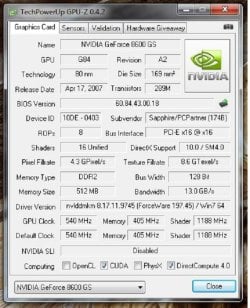
OK.. here is some info..
 

Attachments

  • Gpu.jpg
    Gpu.jpg
    68.8 KB · Views: 15

My Computer

Computer Manufacturer/Model Number
Fujitsu siemens scaleo 2662pa
OS
windows 7 Ultimate 64b
CPU
AMD Athlon 64 x2 dual core 5000+
Memory
2 GB
Graphics Card(s)
Geforce 8600 GS
Sound Card
X-fi Platinum
Back
Top