


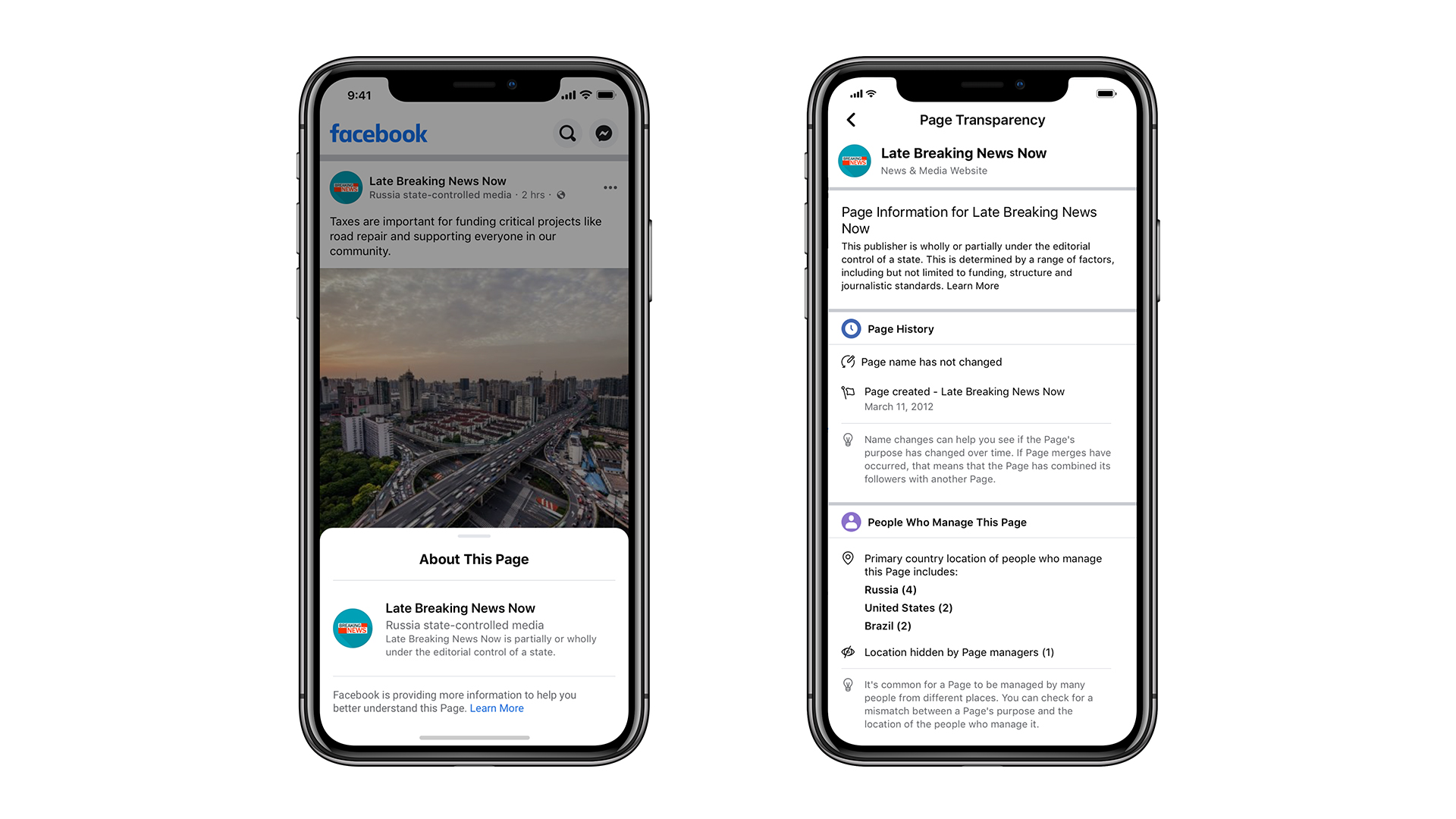
We want to help people better understand who’s behind the news they see on Facebook. Several months ago, we announced our plan to label media outlets that are wholly or partially under the editorial control of their government, and today we’re starting to apply labels to those state-controlled media outlets. We’re providing greater transparency into these publishers because they combine the influence of a media organization with the strategic backing of a state, and we believe people should know if the news they read is coming from a publication that may be under the influence of a government.
And to ensure we’re equally transparent when it comes to paid content from these publishers, we will begin labeling ads from these publishers later this year.
State-controlled media outlets rarely advertise in the US. Nevertheless, later this summer we will begin blocking ads from these outlets in the US out of an abundance of caution to provide an extra layer of protection against various types of foreign influence in the public debate ahead of the November 2020 election in the US.
Where the Labels Will Be Shown
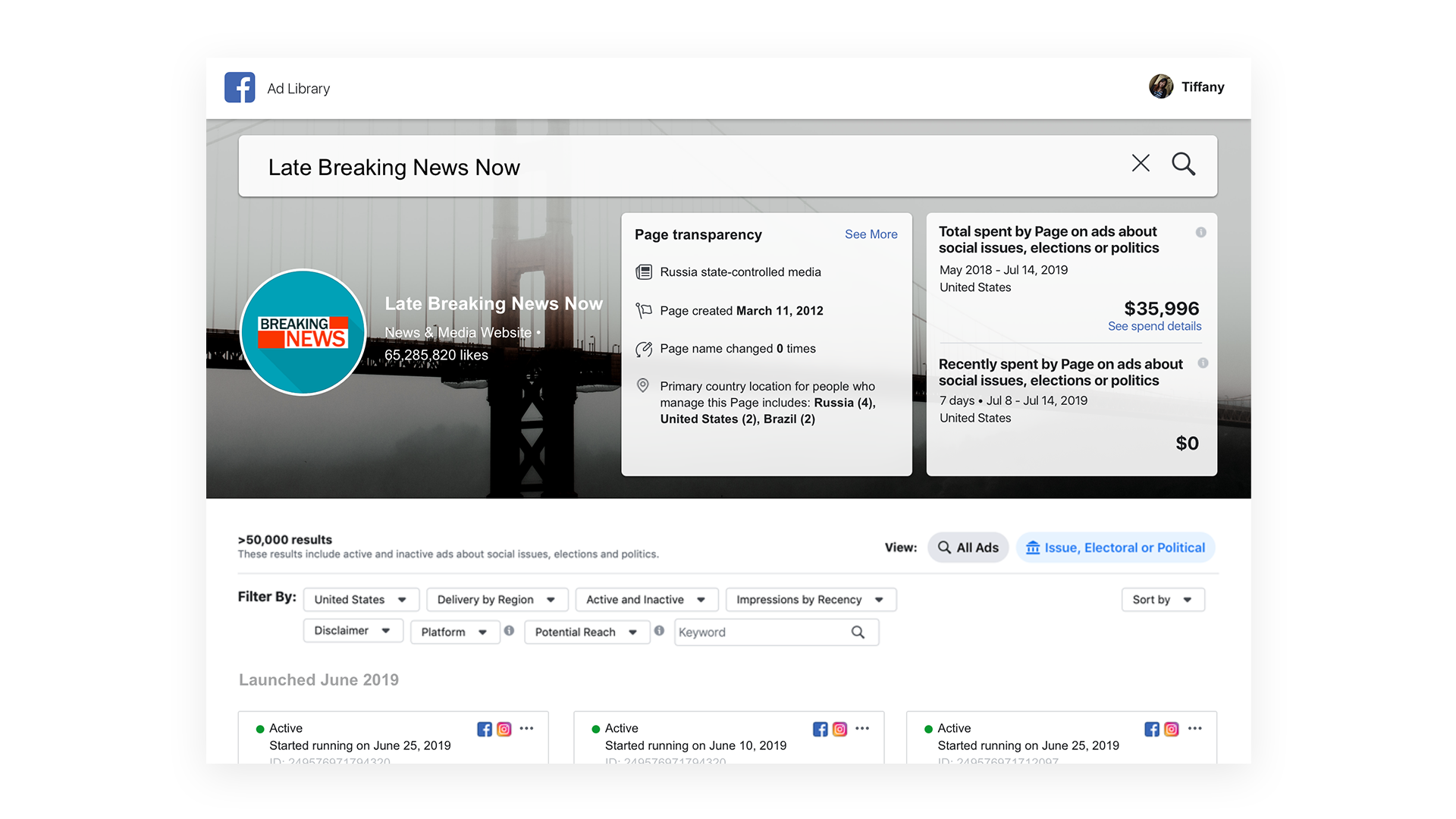
The labels will appear globally in the Ad Library Page view, on Pages, and in the Page Transparency section. In the US, the label will also start to appear on posts in News Feed over the course of the next week.
Later this summer, we’ll apply the label to ads from state-controlled media outlets, starting with a few outlets and adding more over time.
Our Policy Criteria
To inform our policy criteria, we consulted more than 65 experts around the world specializing in media, governance, and human rights and development. The input we received from these organizations was crucial to understanding the different ways and degrees to which governments exert editorial control over media entities. We know that governments continue to use funding mechanisms to control media, but this alone doesn’t tell the full story. That’s why our definition of state-controlled media extends beyond just assessing financial control or ownership and includes an assessment of editorial control exerted by a government.
Based on these consultations and research, we developed our own policy criteria to determine whether a publisher is wholly or partially under the editorial control of a government.
We look at several factors that may indicate editorial control by a government, including:
If we determine that there are enough protections in place to ensure editorial independence, we will not apply the label. Publishers looking to prove their independence must be able to demonstrate at least:
- Mission statement, mandate, and/or public reporting on how the organization defines and accomplishes its journalistic mission
- Ownership structure such as information on owners, stakeholders, board members, management, government appointees in leadership positions, and disclosure of direct or indirect ownership by entities or individuals holding elected office
- Editorial guidelines such as transparency around sources of content and independence and diversity of sources
- Information about newsroom leadership and staff
- Sources of funding and revenue
- Governance and accountability mechanisms such as correctional policies, procedure for complaints, external assessments and oversight boards
We also consider country-specific factors, including press freedom and we consult open-source research conducted by academics and leading experts.
- A statute in the host country that clearly protects the editorial independence of the organization
- Established procedures, processes, and protections at the media organization to ensure editorial independence
- An assessment by an independent, credible, external organization finding that the statute has in fact been complied with and established procedures have been followed
If an organization believes we have applied the label in error, they can submit an appeal. Through the appeal, they can provide additional documentation, which we will review against our definition.
As we roll these labels out to more publishers over time, we welcome feedback and will continue to consult with experts and refine our approach.
Source: Labeling State-Controlled Media On Facebook - About Facebook
My Computer
At a glance
64-bit Windows 11 Pro for WorkstationsIntel i7-8700K OC'd to 5 GHz64 GB (4x16GB) G.SKILL TridentZ RGB DDR4 3600...ASUS ROG-STRIX-GTX1080TI-O11G-GAMING
- Computer type
- PC/Desktop
- Computer Manufacturer/Model Number
- Self built custom
- OS
- 64-bit Windows 11 Pro for Workstations
- CPU
- Intel i7-8700K OC'd to 5 GHz
- Motherboard
- ASUS ROG Maximus XI Formula Z390
- Memory
- 64 GB (4x16GB) G.SKILL TridentZ RGB DDR4 3600 MHz
- Graphics Card(s)
- ASUS ROG-STRIX-GTX1080TI-O11G-GAMING
- Sound Card
- Integrated
- Monitor(s) Displays
- 2 x Samsung Odyssey G7 27"
- Screen Resolution
- 2560x1440
- Hard Drives
- 1TB Samsung 990 PRO M.2,
4TB Samsung 990 PRO PRO M.2,
TerraMaster F8 SSD Plus NAS
- PSU
- Seasonic Prime Titanium 850W
- Case
- Thermaltake Core P3
- Cooling
- Corsair Hydro H115i
- Keyboard
- Logitech wireless K800
- Mouse
- Logitech MX Master 4
- Internet Speed
- 2 Gb/s Download and 100 Mb/s Upload
- Antivirus
- Malwarebyte Anti-Malware Premium
- Browser
- Google Chrome
- Other Info
- Logitech Z625 speaker system,
Logitech BRIO 4K Pro webcam,
HP Color LaserJet Pro MFP M477fdn,
APC SMART-UPS RT 1000 XL - SURT1000XLI,
Galaxy S23 Plus phone