Microsoft: An Open Source Windows Is ‘Definitely Possible’

Brink

Administrator
Staff member
Local time
10:03 AM
Messages
74,823
Location
Oklahoma
Microsoft: An Open Source Windows Is ‘Definitely Possible’

Microsoft’s software empire rests on Windows, the computer operating system that runs so many of the world’s desktop PCs, laptops, phones, and servers. Along with the Office franchise, it generates the majority of the company’s revenues. But one day, the company could “open source” the code that underpins the OS—giving it away for free. So says Mark Russinovich, one of the company’s top engineers.

“It’s definitely possible,” Russinovich says. “It’s a new Microsoft.”

Russinovich is sitting in front of several hundred people who spend their days running thousands of computers. He helped build Windows, and he carries one of the most respected titles at the world’s largest software company: Microsoft Technical Fellow. But here, on stage at a conference in Silicon Valley, he’s perched in front of an audience whose relationship with Microsoft is, at best, complicated.

The conference is called ChefConf. Chef is a tool that helps tech geeks setup and operate the many machines needed to drive a website, smartphone app, or some other piece of business software. It’s an open source tool, which means it’s typically used alongside other open source software. When Russinovich asks how many in the audience use nothing but Windows to run their machines, one guy raises his hand—one guy out of several hundred. Mostly, they run the open source Linux operating system.
But this is what Russinovich expects. “That’s the reality we live in today,” he says. The tech world has changed in enormous ways. So many companies—so many Microsoft customers—are now relying on open source code. And that means Microsoft must embrace it too. As Russinovich points out, the company now allows Linux on its Azure cloud computing service, a way of renting computers over the internet, and today, Linux is running on at least 20 percent of those computers.

It’s quite a change for Microsoft, so long the bete noir of the open source community. But as Russinovich explains, it’s a necessary change. And given how popular Linux has become, Microsoft could go even further, not only allowing open source software on its cloud services, but actually turning Windows into open source software. “Every conversation you can imagine about what should we do with our software—open versus not-open versus services—has happened,” he says.

Read more: Microsoft: An Open Source Windows Is | WIRED
 

My Computer My Computer

Computer type
PC/Desktop
Computer Manufacturer/Model Number
Self built custom
OS
64-bit Windows 11 Pro for Workstations
CPU
Intel i7-8700K OC'd to 5 GHz
Motherboard
ASUS ROG Maximus XI Formula Z390
Memory
64 GB (4x16GB) G.SKILL TridentZ RGB DDR4 3600 MHz
Graphics Card(s)
ASUS ROG-STRIX-GTX1080TI-O11G-GAMING
Sound Card
Integrated
Monitor(s) Displays
2 x Samsung Odyssey G7 27"
Screen Resolution
2560x1440
Hard Drives
1TB Samsung 990 PRO M.2,
4TB Samsung 990 PRO PRO M.2,
TerraMaster F8 SSD Plus NAS
PSU
Seasonic Prime Titanium 850W
Case
Thermaltake Core P3
Cooling
Corsair Hydro H115i
Keyboard
Logitech wireless K800
Mouse
Logitech MX Master 4
Internet Speed
2 Gb/s Download and 100 Mb/s Upload
Antivirus
Malwarebyte Anti-Malware Premium
Browser
Google Chrome
Other Info
Logitech Z625 speaker system,
Logitech BRIO 4K Pro webcam,
HP Color LaserJet Pro MFP M477fdn,
APC SMART-UPS RT 1000 XL - SURT1000XLI,
Galaxy S23 Plus phone
I would say giving Windows for free will kill the classic Windows experience we loves. Since MS is not a charity foundation but a company which should make a profit, it will start charging for every single service they are offering. Basic OS will be free of charge but most of the important functions will be cloud dependent. That is the root MS is currently going - they started with forced MS live account creation in Win 8.x and the upcoming Win 10 is more dependent to net and cloud services than ever. I think most probably MS will give "Win 10" for free to laptop/tablet manufacturers - like the "Windows 8.1 with Bing" version but on a much larger scale to prevent people from exploring and be familiar with open source alternatives.
 

My Computer My Computer

Computer type
PC/Desktop
OS
Windows 7 Ultimate x64
Microsoft will swamp the ship to get on every bodies phone, laptops and tablet.

Just to suck them into Microsoft cloud dependencie. They don't care how you get to their cloud as long as you get there.

Now grab your socks and open you pocket book. Windows operating systems will become a lost leader item for Microsoft and it will suck billions of people into their cloud and app store.
 

My Computer My Computer

Computer type
PC/Desktop
Computer Manufacturer/Model Number
Home made Desktop
OS
Windows 10 Pro. 64/ version 1709 Windows 7 Pro/64
CPU
Intel i7-6800K @ 4.3
Motherboard
ASUS X-99 Deluxe II
Memory
Corsair Platinum 16 gig @2400
Graphics Card(s)
EVGA GTX 1070 OC
Monitor(s) Displays
Asus 27" LED LCD/VE278Q
Screen Resolution
1920-1080 or 1280-720 HDMI
Hard Drives
INTEL SSD 730-240 Gb Sata 3.0/
PSU
EVGA Platium 1200W
Case
Phanteks Luxe Tempered Glass 8 fans/ one radiator
Cooling
XSPC/ Water Cooled CPU
Keyboard
Das 4 Professional
Mouse
Logitech M705/MX Anywhere 2-S
Internet Speed
100 mbits
Antivirus
Microsoft Security Essentials/ Malwarebytes Premium 3.0/ SAS
Browser
I.E. 11 default/Firefox/ ISP Time Warner Cable/Spectrum
Other Info
LG BluRay Burner/
Sound system-KLipsch-THX/
Icy Dock ssd Hot Swap bays.
Stuck In Open Source Land

Here is one cat that isn't going. They will have to outlaw private disks and boards and open source goes away.
 

My Computer My Computer

Computer Manufacturer/Model Number
BGC (Bob's Garage Crew)
OS
win 7 X64 Ultimate SP1
CPU
I3770K
Motherboard
Asus P8Z77-V Deluxe
Memory
G Skill F3-14900CL9-4GBXL x 4
Graphics Card(s)
NVIDIA GeForce GTX670 + Intel 4000
Sound Card
Realtek HD 5.1 (MOB)
Monitor(s) Displays
Asus VW224T (1)
Screen Resolution
1920 x 1080
Hard Drives
SATA Corsair Force GT 2.5" 180GB (System) Sata 3
OCZ Vertex3 120GB
OCZ Vertex 2 120GB 2.5" SATA II
ST31000524AS 1000.2GB
WD15EARS (External)
PSU
CoolerMaster 1000 Watt
Case
CoolerMaster HAF X
Cooling
CPU -- CoolerMaster 520N
Keyboard
MS Wireless 3000 V2
Mouse
MS Wireless 3000 V2
Internet Speed
Cable
Antivirus
Norton Internet Security
Browser
IE9
Other Info
AMI Bios 1805
OC'd 3%
Microsoft will swamp the ship to get on every bodies phone, laptops and tablet.

I looked into Windows Phone this week as my contract runs out in a few months and I'm desperate to get away from iPhone. I looked at the Lumia 930 and convinced myself I liked it, I took the tour on the MS website and eventually thought it would be a good idea.
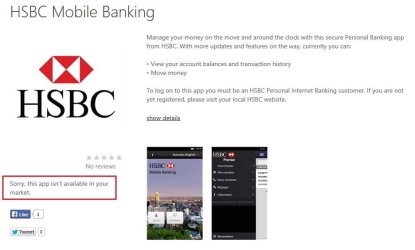
I then looked into apps, I don't use many but my HSBC Mobile banking one is a must. And there isn't one for my region. Pretty unbelievable.
Capture.JPG
I looked further into it and found one thread on the MS Community Forums (for the life of me I can't find it again) and one guy complained about his HSBC app not working, as well as many streaming apps. Apparently MS don't support Silverlight on the phones but the apps require it. The OP was told by a moderator to contact the app developers as MS aren't responsible for keeping apps up to date. So MS aren't responsible for Silverlight on Windows phones.

If MS can't be bothered with Windows Phone, neither can I. Shame as I hate Android so will be stuck with the iPhone which, while deplorable (even if just for the price alone), just works.
 

My Computer My Computer

Computer type
PC/Desktop
Computer Manufacturer/Model Number
Custom Build
OS
W7 Pro x64 SP1 | W10 Pro IP x64 | W8.1 Pro x64 VM | Linux Mint VM
CPU
i7-4790k @ 4GHz (4.4GHz Boost)
Motherboard
ASUS Sabertooth Z87 (BIOS Rev 2004)
Memory
16GB DDR3 Kingston HyperX Fury @ 1600MHz CL 9-9-9-27
Graphics Card(s)
EVGA GTX 980 Classified
Sound Card
Realtek Onboard
Monitor(s) Displays
Samsung S27D390
Screen Resolution
1920 x 1080
Hard Drives
240GB Intel 520 Series SSD |
Samsung 850 EVO 120GB SSD |
2TB WD Caviar Black |
2TB WD Caviar Green
PSU
Corsair HX850-80 Gold Modular
Case
Cooler Master Silencio 650
Cooling
Corsair H80i w/2 x Corsair SP120 | 2 x 120mm Noctua NF-S12B
Keyboard
Microsoft Sidewinder X4
Mouse
Gigabyte M6900 optical
Internet Speed
152mb
Antivirus
F-Secure
Browser
Firefox 38.0
Other Info
Backup Rig: Win 7 Pro 64-bit | AMD A10-5800k | ASUS F2A85-V Pro | 8GB Samsung DDR3 @1600MHz | 120GB Toshiba SDD | 2TB Seagate HDD | Cooler Master Silencio 550
iphones just work :)
 

My Computer My Computer

Computer type
PC/Desktop
Computer Manufacturer/Model Number
Custom assembled by me :}
OS
Win-7-Pro64bit 7-H-Prem-64bit
CPU
i7-5930K 2nd i9-9940x both water blocked VRM's too
Motherboard
ASUS SABERTOOTH X99 2nd ASUS x299 Apex
Memory
Trident-z 3200C14 2nd Trident-z 3600C16
Graphics Card(s)
EVGA 1080ti ftw3 2nd Titan Xp both water blocked
Sound Card
Built-in Realtek
Monitor(s) Displays
1-AOC G2460PG 24"G-Sync 144Hz/ 2nd 1-ASUS VG248QE 24" 144Hz
Screen Resolution
1920 x 1080 144Hz
Hard Drives
2-Samsung M.2 Evo & Evo Plus
2-Samsung 850 EVO 500GB SSD's/ 3-2.5 W.D. Black 1tb-&3-1tb/3-3.5 WD Black 1tb hdd's
PSU
EVGA SuperNOVA 1000-P2 2nd 1200-P2
Case
2-Corsair Obsidian Series 450D Black ATX Mid Tower
Cooling
Custom water loops
Keyboard
Logitech G710+/ 2nd Logitech G910
Mouse
2-RedDragon M901 Perdition 16400 dpi Gaming mouse = wired
Internet Speed
Comcast Ping 19ms 89.31mbps download speed 6.12mbps upload
Antivirus
Malwarebytes Pro/ Superantispyware Pro
Browser
FireFox & Pale moon
Other Info
2nd ASUS X299 Apex/Intel i9-9940x with Custom water loop/7H-Prem-x64/Corsair 450D case/Ram Trident-z 3600C16 4x8gb / Samsung970Evo plus 500gb SSD/Dual ssd EZ swap evo/PSU EVGA SuperNova 1200w-P2 80+Platinum/GPU Titan Xp /8-ML-140 on push-pull on 2-280GTX rads
So does anything else, including android :)

Boozad, if you hate android try a custom rom or something and see if you like it.

What is it you don't like?
 

My Computer My Computer

Computer type
PC/Desktop
Computer Manufacturer/Model Number
Custom Built
OS
Windows 10 Pro
CPU
AMD Ryzen 5 2400G Processor with Radeon RX Vega 11 Graphics
Motherboard
ASRock X470 Master SLI/AC AM4 AMD Promontory X470 SATA 6Gb/s
Memory
G.SKILL Ripjaws V Series 16GB (2 x 8GB) 288-Pin DDR4 SDRAM D
Graphics Card(s)
2047MB NVIDIA GeForce GTX 1060 6GB (EVGA)
Sound Card
Motherboard Built in
Monitor(s) Displays
Acer R240HY bidx 23.8-Inch IPS HDMI DVI VGA (1920 x 1080) Wi
Screen Resolution
1920 x 1080
Hard Drives
1TB Sandisk SSD PLUS (Main drive)
500 GB Seagate 7200 RPM (Games)
500 GB Western Digital 7200 RPM (Virtual Machines)
PSU
CORSAIR TX Series TX650M 650W 80+ Gold Modular Power Supply
Case
CORSAIR CARBIDE SPEC-02 Mid-Tower Gaming Case, Red LED Fan
Cooling
220mm, two 120mm, and four 60mm fans
Keyboard
Wired Dell keyboard
Mouse
Wireless Logitech mouse
Internet Speed
250mb down, 30mb up
Antivirus
Panda Cloud Antivirus
Browser
Chrome-ish x64
Other Info
Your awesome for reading this.
Long story short, I kept getting warning signs in the notification area (Sony Xperia T I think) and I'd discover that my Google account had stopped working. Easy workaround would be to delete my account then add it again. One day it just stopped working altogether and wouldn't accept my password, I signed into my Google account on the PC so knew the password was correct. I changed my details online but still I couldn't sign in on my phone. I tried for two weeks to get it to work with no support offered by either Google or Android so I sold it. I couldn't download anything so it was no good to me.

Also once I found my photos had been duplicated between two different photo apps (or a photo app and file manager) so I deleted one set only to find that it deleted everything. The whole thing just seemed like a mess and was completely convoluted. I have a Droid Player now and I don't like that either. The whole OS seems ridiculously complicated for a phone and there seemed to be stacks of bloatware in the form of multiple apps that did the same thing that you couldn't delete.
 

My Computer My Computer

Computer type
PC/Desktop
Computer Manufacturer/Model Number
Custom Build
OS
W7 Pro x64 SP1 | W10 Pro IP x64 | W8.1 Pro x64 VM | Linux Mint VM
CPU
i7-4790k @ 4GHz (4.4GHz Boost)
Motherboard
ASUS Sabertooth Z87 (BIOS Rev 2004)
Memory
16GB DDR3 Kingston HyperX Fury @ 1600MHz CL 9-9-9-27
Graphics Card(s)
EVGA GTX 980 Classified
Sound Card
Realtek Onboard
Monitor(s) Displays
Samsung S27D390
Screen Resolution
1920 x 1080
Hard Drives
240GB Intel 520 Series SSD |
Samsung 850 EVO 120GB SSD |
2TB WD Caviar Black |
2TB WD Caviar Green
PSU
Corsair HX850-80 Gold Modular
Case
Cooler Master Silencio 650
Cooling
Corsair H80i w/2 x Corsair SP120 | 2 x 120mm Noctua NF-S12B
Keyboard
Microsoft Sidewinder X4
Mouse
Gigabyte M6900 optical
Internet Speed
152mb
Antivirus
F-Secure
Browser
Firefox 38.0
Other Info
Backup Rig: Win 7 Pro 64-bit | AMD A10-5800k | ASUS F2A85-V Pro | 8GB Samsung DDR3 @1600MHz | 120GB Toshiba SDD | 2TB Seagate HDD | Cooler Master Silencio 550
Well if I had that experience I would feel the same way ha.

Have you ever tried any of the nexus phones? There android without any bloatware and have a ton of options if you do not want to mess with roms. If you have a spare android laying around though that you hated, try cyangenmod rom. This way if you do mess it up (hard to do) no harm no foul.

I am pretty confident you would like it.
 

My Computer My Computer

Computer type
PC/Desktop
Computer Manufacturer/Model Number
Custom Built
OS
Windows 10 Pro
CPU
AMD Ryzen 5 2400G Processor with Radeon RX Vega 11 Graphics
Motherboard
ASRock X470 Master SLI/AC AM4 AMD Promontory X470 SATA 6Gb/s
Memory
G.SKILL Ripjaws V Series 16GB (2 x 8GB) 288-Pin DDR4 SDRAM D
Graphics Card(s)
2047MB NVIDIA GeForce GTX 1060 6GB (EVGA)
Sound Card
Motherboard Built in
Monitor(s) Displays
Acer R240HY bidx 23.8-Inch IPS HDMI DVI VGA (1920 x 1080) Wi
Screen Resolution
1920 x 1080
Hard Drives
1TB Sandisk SSD PLUS (Main drive)
500 GB Seagate 7200 RPM (Games)
500 GB Western Digital 7200 RPM (Virtual Machines)
PSU
CORSAIR TX Series TX650M 650W 80+ Gold Modular Power Supply
Case
CORSAIR CARBIDE SPEC-02 Mid-Tower Gaming Case, Red LED Fan
Cooling
220mm, two 120mm, and four 60mm fans
Keyboard
Wired Dell keyboard
Mouse
Wireless Logitech mouse
Internet Speed
250mb down, 30mb up
Antivirus
Panda Cloud Antivirus
Browser
Chrome-ish x64
Other Info
Your awesome for reading this.
I would say giving Windows for free will kill the classic Windows experience we loves. Since MS is not a charity foundation but a company which should make a profit, it will start charging for every single service they are offering. Basic OS will be free of charge but most of the important functions will be cloud dependent.

But see, the advantage of Open Source for me is not how it will affect my use of other Microsoft services (I only use their mail, which I can ditch at any moment). What I want to see happen is the fueling of new life in to projects like React OS. Now you'd be able to have a fully supported, lighter weighted OS that will run Windows binaries without bloat. Now you can have that classic "windows" look and feel on a modern-day supported OS.

That's why I like this news. Who cares about Microsoft?
 

My Computer My Computer

Computer type
PC/Desktop
Computer Manufacturer/Model Number
HP xw8600 Workstation
OS
Windows 8 Pro x64
CPU
Two Xeon Core2 Quad 3.2 GHz Processors
Motherboard
Proprietary
Memory
16 GB DDR2 800 MHz
Graphics Card(s)
nVidia Quadro FX 3800 PCI
Sound Card
Realtek HD Audio
Monitor(s) Displays
Samsung SyncMaster 213T 21" 4x3 Flat Screen
Screen Resolution
1600x1200
Hard Drives
Two Seagate Cheetah 300 GB SAS Disks
PSU
Proprietary
Case
HP xw8600 Workstation Case
Cooling
Two CPU Fans and a Larger Case Fan
Keyboard
PS/2 Keyboard
Mouse
Microsoft USB Optical Mouse
Internet Speed
7 mbps
Antivirus
Windows Defender
Browser
Firefox ESR 102
Other Info
Two LSI 3000 SAS Adapters
I doubt very much it will ever come to reality. It would in the opposite direction MS has always headed and would mean a radical shift in their direction.

For one, it's a good thing for users to have at least Windows as a free software, users at last someone actually listening at them, bugs will at last be fixed and features won't simply go away at each release. It won't be rare to forks to begin appearing, maybe one day to the point to have many Windows "distributions" in the same way Linuxes proliferate.
Another plus is that the NSA backdoors can finally be reliably tracked down and eliminated right away, now we can only rely on the known workarounds.

The obvious downside is, where MS will make money from that? Obviously they won't make it just "because the're good guys" (they aren't). So they most likely will try to force more "cloud" services, subscription based things or ads infected websites that may impact many users or even forced into the OS. While existence of those services is generally a good thing to have as an alternative at least, but trying to force them upon users is certainly bad.
 

My Computer My Computer

Computer type
Laptop
Computer Manufacturer/Model Number
Toshiba Sattelite A665-S6092
OS
Windows 7 Ultimate x64
CPU
Intel Core i7-740QM
Memory
8 GB DDR3
Graphics Card(s)
NVIDIA GeForce 330GT
Screen Resolution
1366x768
Hard Drives
Samsung 840 SSD 500GB
1TB USB3 external HD
Cooling
Coolermaster Notepal U3 notebook cooling pad
Internet Speed
3mbps ASDL
Antivirus
ClamWin 0.98.7
Browser
Opera 12.17 x86 (main), Firefox 38 (sec), IE11 (last resort)
I would say giving Windows for free will kill the classic Windows experience we loves. Since MS is not a charity foundation but a company which should make a profit, it will start charging for every single service they are offering. Basic OS will be free of charge but most of the important functions will be cloud dependent. That is the root MS is currently going - they started with forced MS live account creation in Win 8.x and the upcoming Win 10 is more dependent to net and cloud services than ever. I think most probably MS will give "Win 10" for free to laptop/tablet manufacturers - like the "Windows 8.1 with Bing" version but on a much larger scale to prevent people from exploring and be familiar with open source alternatives.


Not necessarily. If windows goes open source, then according to the GPL your code can be ported, so in a way we could see many different version of windows. So if that happens intel & others will have to make more open source drivers. For example you could use and update windows 98se on a newer computer if you can find the open source drivers that would work for it and fix the memory bug.
 

My Computer My Computer

Computer type
PC/Desktop
Computer Manufacturer/Model Number
Dell All in one Inspiron 2020
OS
W10 32 bit, XUbuntu 18.xx 64 bit
CPU
Intel(R) Celeron(R) CPU G1620T @ 2.40GHz, 2400 Mhz
Motherboard
Dell
Memory
4GB
Graphics Card(s)
Intel HD graphics
Sound Card
High Definition Audio Device
Monitor(s) Displays
20 inch Screen
Screen Resolution
W7=1280 x 720 & Linux Mint Xfce=1360 x 768
Hard Drives
500 GB hard drive
Keyboard
Usb
Mouse
Usb
Internet Speed
High-Speed
Antivirus
MSE
Browser
Main Browser Firefox
Other Info
I have done a clean install of Windows 7 using Dell re-installation disk (Dell sent me one). I also use Free Macrium reflect backup and restore.
Not necessarily. If windows goes open source, then according to the GPL your code can be ported, so in a way we could see many different version of windows. So if that happens intel & others will have to make more open source drivers. For example you could use and update windows 98se on a newer computer if you can find the open source drivers that would work for it and fix the memory bug.

Nobody said that this hypotetical open source Windows will be GPL, it could use any standard license or even a custom one as long as it grants escential freedom to users. And not necesarily it applies to former versions, but maybe only to Win10 or maybe a future version only, who knows really :p
For everything else, I would really like that! I wonder why no more drivers are written right now as open source, even for proprietary Windows.
 

My Computer My Computer

Computer type
Laptop
Computer Manufacturer/Model Number
Toshiba Sattelite A665-S6092
OS
Windows 7 Ultimate x64
CPU
Intel Core i7-740QM
Memory
8 GB DDR3
Graphics Card(s)
NVIDIA GeForce 330GT
Screen Resolution
1366x768
Hard Drives
Samsung 840 SSD 500GB
1TB USB3 external HD
Cooling
Coolermaster Notepal U3 notebook cooling pad
Internet Speed
3mbps ASDL
Antivirus
ClamWin 0.98.7
Browser
Opera 12.17 x86 (main), Firefox 38 (sec), IE11 (last resort)
I wonder why no more drivers are written right now as open source, even for proprietary Windows.

Open source drivers are difficult in Windows world as all 64 bit Windows versions require that the driver should be signed by either MS itself or another certified signing authority - which obviously requires handing over a handsome amount of fee to M$

With "Windows 10", things are more ridiculous. Now on MS will only accepts drivers from companies who are registered under Windows Hardware Developer Center Dashboard. Individuals are not qualified for this as you need to submit Company registration documents etc in addition to the extended fee.

Driver Signing changes in Windows 10 - Windows Hardware Certification blog - Site Home - MSDN Blogs
 

My Computer My Computer

Computer type
PC/Desktop
OS
Windows 7 Ultimate x64
If MS can't be bothered with Windows Phone, neither can I. Shame as I hate Android so will be stuck with the iPhone which, while deplorable (even if just for the price alone), just works.

Two of my friends has "Windows 8" based phones. After got a chance to look at them, i should say that i am impressed. While i almost hate "Windows 8.1" desktop version, i actually liked the phone version. Unlike Android, it seems to be operating super smooth - no occasional freezing or performance issues. I can't say anything about Apple products as they are beyond the reach of common man in my country.
 

My Computer My Computer

Computer type
PC/Desktop
OS
Windows 7 Ultimate x64
I wonder why no more drivers are written right now as open source, even for proprietary Windows.
Open source drivers are difficult in Windows world as all 64 bit Windows versions require that the driver should be signed by either MS itself or another certified signing authority - which obviously requires handing over a handsome amount of fee to M$

With "Windows 10", things are more ridiculous. Now on MS will only accepts drivers from companies who are registered under Windows Hardware Developer Center Dashboard. Individuals are not qualified for this as you need to submit Company registration documents etc in addition to the extended fee.

Driver Signing changes in Windows 10 - Windows Hardware Certification blog - Site Home - MSDN Blogs

If that the case, they just killed windows 10. The reason, are the following programs (Some may not have drivers though)

Macrium
oracle virtualbox
Vmplayer
Dosbox?
MiniTool Partition Wizard Home Edition 8.1.1

There is another problem, my driver ironically provided by windows update may not work in windows 10 after it released. HP Deskjet 3740 Series (LiDiL) and the Epson printer driver.
The Hp driver is actually open source. Currently the Hp driver works in both windows 7 and windows 10.

It would possibly be cheaper for Oems to go with ubuntu or fedora then with Microsoft.
 

My Computer My Computer

Computer type
PC/Desktop
Computer Manufacturer/Model Number
Dell All in one Inspiron 2020
OS
W10 32 bit, XUbuntu 18.xx 64 bit
CPU
Intel(R) Celeron(R) CPU G1620T @ 2.40GHz, 2400 Mhz
Motherboard
Dell
Memory
4GB
Graphics Card(s)
Intel HD graphics
Sound Card
High Definition Audio Device
Monitor(s) Displays
20 inch Screen
Screen Resolution
W7=1280 x 720 & Linux Mint Xfce=1360 x 768
Hard Drives
500 GB hard drive
Keyboard
Usb
Mouse
Usb
Internet Speed
High-Speed
Antivirus
MSE
Browser
Main Browser Firefox
Other Info
I have done a clean install of Windows 7 using Dell re-installation disk (Dell sent me one). I also use Free Macrium reflect backup and restore.
I'm thinking it takes a lot of knowledge and time to create drivers. Then more time to test and get certified.
All those steps cost money that someone has to pay.
 

My Computer My Computer

Computer type
PC/Desktop
Computer Manufacturer/Model Number
Home made Desktop
OS
Windows 10 Pro. 64/ version 1709 Windows 7 Pro/64
CPU
Intel i7-6800K @ 4.3
Motherboard
ASUS X-99 Deluxe II
Memory
Corsair Platinum 16 gig @2400
Graphics Card(s)
EVGA GTX 1070 OC
Monitor(s) Displays
Asus 27" LED LCD/VE278Q
Screen Resolution
1920-1080 or 1280-720 HDMI
Hard Drives
INTEL SSD 730-240 Gb Sata 3.0/
PSU
EVGA Platium 1200W
Case
Phanteks Luxe Tempered Glass 8 fans/ one radiator
Cooling
XSPC/ Water Cooled CPU
Keyboard
Das 4 Professional
Mouse
Logitech M705/MX Anywhere 2-S
Internet Speed
100 mbits
Antivirus
Microsoft Security Essentials/ Malwarebytes Premium 3.0/ SAS
Browser
I.E. 11 default/Firefox/ ISP Time Warner Cable/Spectrum
Other Info
LG BluRay Burner/
Sound system-KLipsch-THX/
Icy Dock ssd Hot Swap bays.
I would actually like to know the answer to Mathiu Silverberg questions. He has good points.

Let's see the cost that we can find for these "EV Code Signing Certificate", for 3 years: $950, $995, and... yes, $1549.

Without speaking of the fact that we are forced to first buy a Symantec certificate (and nothing else!) to register a company account...


So, here is my question: what about developers of free software? These amounts are not a problem for a company that sells hardware. But for an independent developer who sells nothing, this is often prohibitive. So what are the possibilities?

There is a common case where a driver is required even for a simple software: each time a volume is required for managing data. E.g.: encryption software, image file mounting tool, ramdisk...And as long as you will not provide an API for that, a driver will remain required.
 

My Computer My Computer

Computer type
PC/Desktop
Computer Manufacturer/Model Number
Dell All in one Inspiron 2020
OS
W10 32 bit, XUbuntu 18.xx 64 bit
CPU
Intel(R) Celeron(R) CPU G1620T @ 2.40GHz, 2400 Mhz
Motherboard
Dell
Memory
4GB
Graphics Card(s)
Intel HD graphics
Sound Card
High Definition Audio Device
Monitor(s) Displays
20 inch Screen
Screen Resolution
W7=1280 x 720 & Linux Mint Xfce=1360 x 768
Hard Drives
500 GB hard drive
Keyboard
Usb
Mouse
Usb
Internet Speed
High-Speed
Antivirus
MSE
Browser
Main Browser Firefox
Other Info
I have done a clean install of Windows 7 using Dell re-installation disk (Dell sent me one). I also use Free Macrium reflect backup and restore.
Open source drivers are difficult in Windows world as all 64 bit Windows versions require that the driver should be signed by either MS itself or another certified signing authority - which obviously requires handing over a handsome amount of fee to M$

That only gives problems to small companies or independent developers, but not to those big hardware vendors. Those drivers in particular are a great fit for open source development (and they're a commodity for the corporation anyway) so they can benefit with cooperation from independent developers and even give support for some older/newer OSs. Keeping them proprietary only closes their potential market to those OSs who the vendor cares about developing, not to mention the bugs they have.
Other kind of programs might not have this clear advantage as their main revenue source is precisely selling their software.


If that the case, they just killed windows 10. The reason, are the following programs (Some may not have drivers though)

Macrium
oracle virtualbox
Vmplayer
Dosbox?
MiniTool Partition Wizard Home Edition 8.1.1

No idea about Macrium or the Partition Wizard, but DosBox doesn't uses any driver at all (its emulation is entirely implemented in user-mode). Both VirtualBox and VmWare do use drivers for their hardware virtualization, but I doubt they'll be affected at all. Both are backed by big corporations so a few thousand dollars is virtually nothing to them. Besides, their current versions are already signed, so they've already assumed the cost.


I'm thinking it takes a lot of knowledge and time to create drivers. Then more time to test and get certified.
All those steps cost money that someone has to pay.

Certainly driver development is one of the most difficult programming tasks and is even more complex to do it correctly. Testing is made by the developer of course, but certification? Nobody has to "certify" a driver or any other piece of software.
Signing software only requires a certificate (it's a trivial operation once you've got one). Getting a certificate is what cost money, but this doesn't means that anyone will actually review your code. You just buy a certificate from an authority, they do basic verifications on who you are, your history and a few more things, but that's it. Once you've got it, you can sign virtually anything, and nobody really can review the code if you don't want it. MS itself doesn't cares a bit about that and certainly don't check every software for Windows in existence, not even those that are signed. Evidence for this is the vast amount of drivers that clashes with each others, throws BSODs or gives problems in certain circumstances.

MS has a testing site for drivers and they do a "certification" process, but those who pay directly to them so MS itself does the signing. The only "advantage" is that this gives the developer the "approved for Windows 7" logo (don't recall the exact term), which is more a marketing moto rather a quality assurance as reality as shown us numerous times.

Besides, for open source developers there are still people that wants to help them. The ReactOS team has given the chance to use their certificate for signing independient projects' drivers to meet MS policy. See the details here: https://www.reactos.org/wiki/Driver_Signing
In short, open source projects ask ReactOS to sign their drivers, they review and compile the code and sign the binary using their certificate, relieving the small and independent developer of this burden. While it's not for everyone, it certainly helps some projects that could not afford the certificate. An example of those is Process Hacker.
 

My Computer My Computer

Computer type
Laptop
Computer Manufacturer/Model Number
Toshiba Sattelite A665-S6092
OS
Windows 7 Ultimate x64
CPU
Intel Core i7-740QM
Memory
8 GB DDR3
Graphics Card(s)
NVIDIA GeForce 330GT
Screen Resolution
1366x768
Hard Drives
Samsung 840 SSD 500GB
1TB USB3 external HD
Cooling
Coolermaster Notepal U3 notebook cooling pad
Internet Speed
3mbps ASDL
Antivirus
ClamWin 0.98.7
Browser
Opera 12.17 x86 (main), Firefox 38 (sec), IE11 (last resort)
Back
Top