Solved poor SSD write performance

tomluft

New member
Local time
8:37 PM
Messages
7
I just discovered that my Samsung SSD (830 series, MZ-7PC064D/EU) shows a very poor write performance (161 MB) though my read performance is pretty fair (448 MB).
05_11_2012_20_59_46.png


I searched the web for a while now and tried every suggestion anyone wrote - nothing worked, my speed stays low (in comparison to values other users of this SSD get: ~500MB read ~300MB write - without RAID!)

Here are my system specifications:
Mainboard: M4A87TD EVO
CPU: AMD Phenom II X6 1055T
RAM: 8GB 1333 MHz
OS: Windows 7 Ultimate 64bit, up to date

My SSD is plugged into the first SATA connector. All my drivers, my BIOS and the SSD's firmware are the latest ones, TRIM and AHCI are activated, all the usual SSD tweaks have been made (no defragmentation, no search indexing etc.).
I tried:

  • using the Microsoft AHCI driver instead of the AMD SATA one
  • disabling the write cache
  • installing the latest chipset drivers provided on AMD's website
  • installing the latest chipset drivers provided on ASUS' website
  • forcing SATA 6gb/s support in the BIOS
I really don't know what I should try next - any suggestions?
 

My Computer

OS
Windows 7 Ultimate x64
CPU
AMD Phenom II X6 1055T
Motherboard
Asus M4A87TD EVO
Memory
Kingston Hyper X 1333 4 GB
Graphics Card(s)
Ati Radeon 5750 XXX
Sound Card
EMU 0404 USB
Monitor(s) Displays
Samsung P2450
Screen Resolution
1920x1080
Hard Drives
Samsung Spinpoint F3 HD103SJ
PSU
be quiet! 530W
Internet Speed
2,5 MB/s
The write number of 161 is considerably faster than many SSDs.

Are you disappointed only because of the benchmark?

The most important factor is access time and that looks fine.
 

My Computer

Computer type
PC/Desktop
Computer Manufacturer/Model Number
Ignatz Special; 4 speed manual gearbox; factory air conditioning; one of one
OS
Windows 7 Home Premium SP1, 64-bit
CPU
Intel Skylake i5-6600K, not overclocked
Motherboard
AsRock Z170M Extreme 4, micro ATX
Memory
8 GB HyperX DDR4-2666 (2 x 4 GB)
Graphics Card(s)
none; graphics are integrated on CPU
Sound Card
onboard: Realtek ALC1150; external: USB Behringer UF0-202
Monitor(s) Displays
Dell S2340M 23 inch IPS
Screen Resolution
1600 x 900
Hard Drives
System: Crucial MX100 series SSD, 128 GB;
Data: Samsung Spinpoint 103SJ, 1 TB;
Backup: WD Caviar Green WD30EZRX-00D8PB0, 3 TB
PSU
Rosewill SilentNight 500 watt fanless, semi-modular
Case
Antec Solo II
Cooling
Noctua NH-U12S; Noctua F12 intake, Noctua S12A exhaust
Keyboard
Microsoft 200 6JH-00001 USB
Mouse
Dell or Microsoft optical wired; USB
Antivirus
Microsoft Security Essentials and Malwarebytes Premium
Browser
Pale Moon
Other Info
All fans PWM; speeds at idle: CPU circa 500 rpm; intake circa 600 rpm; exhaust circa 600 rpm; CPU temps 27 idle and 47 C load in a warm room (27 C/81 F) when running Intel Extreme Tuning Utility stress test.
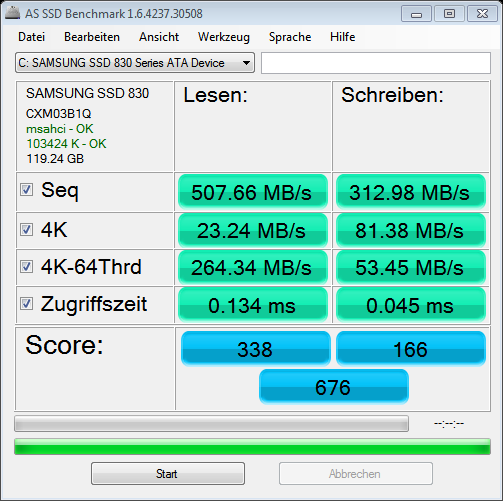
Well I just stumbled upon the following result
67299f2e_as-ssd-benchSAMSUNGSSD83010.5.20126-12-53PM.png


and was wondering why I didn't get those values. There has to be some problem in my configuration, otherwise I would get the same values?!
 

My Computer

OS
Windows 7 Ultimate x64
CPU
AMD Phenom II X6 1055T
Motherboard
Asus M4A87TD EVO
Memory
Kingston Hyper X 1333 4 GB
Graphics Card(s)
Ati Radeon 5750 XXX
Sound Card
EMU 0404 USB
Monitor(s) Displays
Samsung P2450
Screen Resolution
1920x1080
Hard Drives
Samsung Spinpoint F3 HD103SJ
PSU
be quiet! 530W
Internet Speed
2,5 MB/s
For one thing, small SSDs do not have the same performance as larger SSDs. How much difference I'm not sure.

Hard drives don't exist in isolation. If you benchmarked 100 Samsung 830s, I'd expect to see 100 different scores, even if properly configured.

Personally, I wouldn't lose much sleep over it, but that's up to you.
 

My Computer

Computer type
PC/Desktop
Computer Manufacturer/Model Number
Ignatz Special; 4 speed manual gearbox; factory air conditioning; one of one
OS
Windows 7 Home Premium SP1, 64-bit
CPU
Intel Skylake i5-6600K, not overclocked
Motherboard
AsRock Z170M Extreme 4, micro ATX
Memory
8 GB HyperX DDR4-2666 (2 x 4 GB)
Graphics Card(s)
none; graphics are integrated on CPU
Sound Card
onboard: Realtek ALC1150; external: USB Behringer UF0-202
Monitor(s) Displays
Dell S2340M 23 inch IPS
Screen Resolution
1600 x 900
Hard Drives
System: Crucial MX100 series SSD, 128 GB;
Data: Samsung Spinpoint 103SJ, 1 TB;
Backup: WD Caviar Green WD30EZRX-00D8PB0, 3 TB
PSU
Rosewill SilentNight 500 watt fanless, semi-modular
Case
Antec Solo II
Cooling
Noctua NH-U12S; Noctua F12 intake, Noctua S12A exhaust
Keyboard
Microsoft 200 6JH-00001 USB
Mouse
Dell or Microsoft optical wired; USB
Antivirus
Microsoft Security Essentials and Malwarebytes Premium
Browser
Pale Moon
Other Info
All fans PWM; speeds at idle: CPU circa 500 rpm; intake circa 600 rpm; exhaust circa 600 rpm; CPU temps 27 idle and 47 C load in a warm room (27 C/81 F) when running Intel Extreme Tuning Utility stress test.
I just found an answer (after hours of useless surfing because of some useless numbers :rolleyes:) - its definitely just the size of the SSD. All the benchmarks I found refer to bigger versions of my drive.

Now I just regret (a little ;)) I didn't invest a little more.
 

My Computer

OS
Windows 7 Ultimate x64
CPU
AMD Phenom II X6 1055T
Motherboard
Asus M4A87TD EVO
Memory
Kingston Hyper X 1333 4 GB
Graphics Card(s)
Ati Radeon 5750 XXX
Sound Card
EMU 0404 USB
Monitor(s) Displays
Samsung P2450
Screen Resolution
1920x1080
Hard Drives
Samsung Spinpoint F3 HD103SJ
PSU
be quiet! 530W
Internet Speed
2,5 MB/s
I just found an answer (after hours of useless surfing because of some useless numbers :rolleyes:) - its definitely just the size of the SSD. All the benchmarks I found refer to bigger versions of my drive.

Now I just regret (a little ;)) I didn't invest a little more.

Nah.....enjoy the money you didn't spend. Blow it on a good dinner or girlfriend. You likely would never have noticed the difference without a benchmark.

If you need more capacity, that's another question.
 

My Computer

Computer type
PC/Desktop
Computer Manufacturer/Model Number
Ignatz Special; 4 speed manual gearbox; factory air conditioning; one of one
OS
Windows 7 Home Premium SP1, 64-bit
CPU
Intel Skylake i5-6600K, not overclocked
Motherboard
AsRock Z170M Extreme 4, micro ATX
Memory
8 GB HyperX DDR4-2666 (2 x 4 GB)
Graphics Card(s)
none; graphics are integrated on CPU
Sound Card
onboard: Realtek ALC1150; external: USB Behringer UF0-202
Monitor(s) Displays
Dell S2340M 23 inch IPS
Screen Resolution
1600 x 900
Hard Drives
System: Crucial MX100 series SSD, 128 GB;
Data: Samsung Spinpoint 103SJ, 1 TB;
Backup: WD Caviar Green WD30EZRX-00D8PB0, 3 TB
PSU
Rosewill SilentNight 500 watt fanless, semi-modular
Case
Antec Solo II
Cooling
Noctua NH-U12S; Noctua F12 intake, Noctua S12A exhaust
Keyboard
Microsoft 200 6JH-00001 USB
Mouse
Dell or Microsoft optical wired; USB
Antivirus
Microsoft Security Essentials and Malwarebytes Premium
Browser
Pale Moon
Other Info
All fans PWM; speeds at idle: CPU circa 500 rpm; intake circa 600 rpm; exhaust circa 600 rpm; CPU temps 27 idle and 47 C load in a warm room (27 C/81 F) when running Intel Extreme Tuning Utility stress test.
Yes, as you have now found out.

The actual quoted speeds from Samsung are 520/160 for the 64GB, 520/320 for the 128GB and 520/400 for the 256GB
 

My Computer

OS
Windows 7 Professional 64 bit
Back
Top