Suppose you're on a game show, and you're given the choice of three doors: Behind one door is a car; behind the others, goats. You pick a door, say No. 1, and the host, who knows what's behind the doors, opens another door, say No. 3, which has a goat. He then says to you, "Do you want to pick door No. 2?" Is it to your advantage to switch your choice?
Short answer: No.
Long answer:
Base chance of obtaining car:
~33.3333...% (100% / 3)
Chance after door #3 is opened:
50% (100% / 2)
Chance choosing to go through with door #1:
50%
Chance choosing to switch to door #2:
50%
Assuming I have not made any mathematical incorrections, the highest we can get the chance for the car is 50%.
It is true the host knows which door has the car, but we can't scientifically assert that the host is actively trying to deny the car or not, thus we must discount the host's query as nothing more than words at face value.
The problem also does not state that we
must choose door #1 (
"say No. 1", tone is that of an example), further devaluing the host's query as the host might as well have queried with door #1 instead of #2.
---
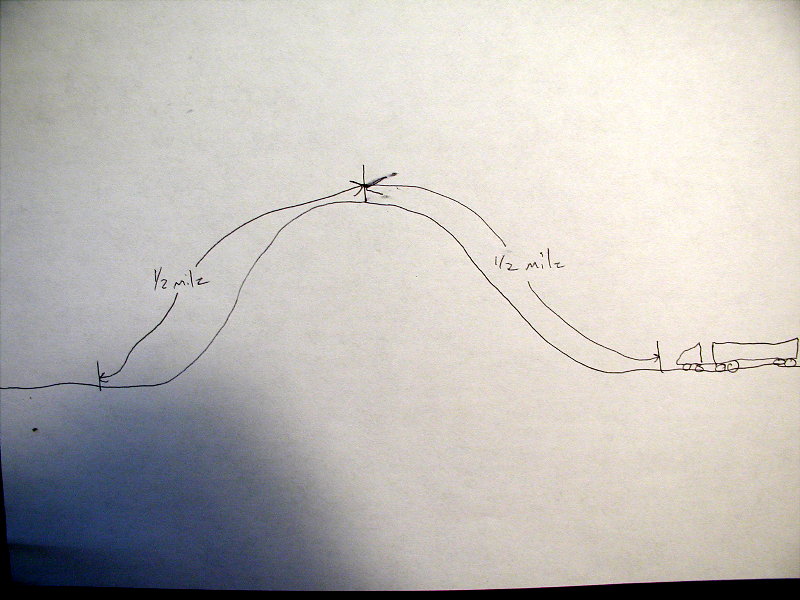
In the diagram below, a car averages 30MPH uphill for the first 1/2 mile. What must be the car's average downhill speed in order to average 60MPH for the entire mile?
Base equation:
(30 + B) / 2 = 60
Solving for B (*2 to both sides):
30 + B = 120
Solving for B (-30 to both sides):
B = 90
Plugging B into base equation:
(30 + 90) / 2 = 60
Solving:
(30 + 90) / 2 = 60
120 / 2 = 60
60 = 60
60
Average velocity needed in latter 1/2mi to achieve average velocity of 60mph over the entire given 1mi span:
90mph
---
And if you're cleverly making us do your homework, may the deities have mercy.