SSD - Install and Transfer the Operating System

How to Physically Install a SSD and Transfer the Operating System


Introduction

If you never owned an SSD, you have missed something. Yes, they are not cheap, but Dollar per Dollar there is no other piece of hardware that can give you as much additional performance than an SSD.

Because SSDs are expensive, their current use is for placing the operating system. That’s how you get the best mileage. Although XP and Vista can be installed on SSDs, it is recommended to use them for Windows7, which is the first system to support Trim.

For desktops, an SSD with a 60GB capacity is usually sufficient. The user data can be moved to the HDD – I will explain the procedure later. Should you have very large programs, e.g., games, you should move their program files during the installation of the game to the HDD too.

For laptops, the situation is more complicated because you usually have only one disk bay. I use 80GB and 90GB SSDs on my laptops. In addition, I use the HDD that I recovered from the laptop after I installed the SSD in an external USB enclosure. But, if you move around a lot with the laptop, that may not be so convenient and a bigger SSD (120GB or 250GB) may be in order (budget allowing).


Hardware Installation

For a desktop, you will need a bracket if it is a 2.5” SSD (like most today). But, there are also 3.5” SSDs that will fit without adaptor brackets into the disk bays. You also need a cable to attach the SSD to the motherboard. For electricity, there is usually an extra plug at the PSU which you can use for the SSD’s.

Once you have all those bits, you can install the SSD in an available disk bay – or if none available, some self-adhesive Velcro will also do. The SSDs are light and do not produce any vibration or heat.

For a laptop, you need an external enclosure that attaches to a USB port. That will allow you to make the initial SSD setups. The one I linked attaches via USB2 and eSata, which may be practical later to use as external drive with the HDD that you recovered from the laptop. Also for hot swapping bare bone HDDs. But there are cheaper enclosures for USB2 only and also some that allow attachment to USB3.

Transfer the Operating System

There are two ways to transfer the operating system from your current HDD to the SSD:
1. The Geeky way which comes for free and
2. The easy way that costs $19.95.

1.The Geeky way requires the following steps:

Prepare the SSD – You first have to initialize the SSD to create the MBR. You can do that with Disk Management or with this program (which you will need later anyhow).

Then you need to align the SSD and define an active partition on it. You use an elevated Command Prompt with the following commands:

Diskpart
List disk
Select disk n (where n is the number that was given for your SSD in List disk)
Clean
Create partition primary align=1024
Format fs=ntfs quick
Active (assuming you want to install an OS)
Exit

Note: If you are more comfortable working with Disk Management, you can also define a primary active partition with Disk Management. On a SSD, the partition will be automatically aligned by 1024.


If you want to verify that the alignment is correct, you use these commands:

Diskpart
List disk
Select disk n
List partition


You should see a result like this:

Partition ### Type Size Offset


------------- ---------------- ------- -------
Partition 1 Primary 59 GB

1024 KB - but 64KB or any number divisible by 4 is also good. The offset has to be divisible by 4.

In Windows7, you may have the 100MB active boot partition. The easiest way to deal with that is to move the bootmgr to the C: partition using EasyBCD. That you do on your HDD before you transfer anything to the SSD. Then you do not have to worry about it and you need only transfer the C: partition to the SSD.


But if you care to keep the 100MB partition, then the partition you just created on the SSD is for that 100MB partition. The next step is to shrink the partition you just created to a 100MB size (make sure it is not any smaller). With Disk Management you will have trouble to do that. I recommend this program for the operation.

From the free space you gained, you create the C: partition for the OS. This partition must not be active and need not be a primary (because the 100MB partition contains the boot manager).

Alternatively and easier is if you first create the 100MB partition with these commands:

Diskpart
List disk
Select disk n (where n is the number that was given for your SSD in List disk)
Clean
Create partition primary size=100 align=1024
Format fs=ntfs quick
Active
Exit

Note: The unit in the size parameter is MB

After this action you can use Disk Management to create the C partition from the remaining unallocated space. That can be a logical partition.

If there is no 100MB partition, things are easy. The partition you created with Command Prompt will receive the C partition including boot manager and all.

There may be more partitions on your factory HDD – e.g., the Recovery partition and a Tools Partition. Those you should not transfer to the SSD because of space constraints. I would back them up – e.g., with an imaging program. The Recovery Partition you can also burn to DVDs.

The OS transfer

This is done with an image. There are a variety of free imaging programs (e.g., the free editions of Macrium, Paragon, Acronis, etc.) that are suitable for the task. You can also use the Windows7 imaging, which has the advantage that it deals with the 100MB active boot partition automatically. Disadvantage is that you never know exactly what it does.

You image your partitions to an external disk (you may have to assign a drive letter to the 100MB partition so that the imaging program can identify it) and then pull the images back in to the SSD (using the bootable recovery program of the imaging program).
The recovery is partition by partition. So you have to make separate runs for the 100MB partition (if any) and the C: partition.

Note: Many free imaging programs cannot shrink the originating partition to fit into the usually much smaller C: partition on the SSD - even if the amount of data in that partition would fit. In that case you will need to shrink the C: partition on the HDD prior to imaging it. The HDD C: partition must be smaller or equal in size to the designated partition on the SSD. For that operation I also recommend this program because Disk Management might not be able to shrink it enough. Note: Free Macrium can image to a smaller disk if the data fits.

It is, of course, understood, that the amount of data on your HDD C: partition must not exceed the capacity of the designated C: partition on the SSD. Should you have more data on your HDD C: partition than the size of the SSD C: partition can hold, I suggest you first create a data partition on the HDD system and move the user data there. Here is my video tutorial that explains how this is done. When you finally are on the SSD system, you then right click on the user folders in the data partition (Documents, Pictures, etc.) and Include them into the appropriate library. That approach does not require you to move the user folders later.

Next step is to change the boot sequence in the BIOS to set the SSD as second boot device (leave the CD/DVD reader as first boot device) and, hopefully, your system will boot.

2.The easy way for transferring the OS requires you to purchase this program. It does everything for you – alignment, deals with the 100MB partition, transfers C:, shrinks the originating partition, etc. All you will have to do is change the boot sequence.

Note: Before you activate the SSD, it is recommended to set the BIOS to AHCI. Best time to do that is just before you change the boot sequence. Once Windows7 is running, you make the corresponding settings in the OS. Here is a tutorial on how to do that.
Many people claim that there is a significant performance gain with AHCI. I, however, did not see that. But it may be different from system to system.

Settings after the OS transfer

Disk Defragmentation makes no sense on an SSD. For a laptop, go into Services, navigate to Disk Defragmenter, right click on it and go to Properties. Here you set the service to Disabled.
For a desktop, you may want to disable defrag in the Disk Defragmenter and only for the SSD so that the remaining HDDs can still be defragmented.

Note: As long as Defrag Service is turned off, you cannot shrink any partition. The partition shrink process requires the Defrag service. If you need to shrink a partition later, turn the Defragmentation Service temporarily on.

Hibernation File – most of us do not use Hibernation, but Sleep instead. But, the hiberfile takes precious space on your SSD – to the same tune as the size as your RAM. To get rid of it, run the following command in elevated Command Prompt: powercfg –h off. If you ever want it back, it is powercfg – h on.

Superfetch – many “experts” suggest to turn Superfetch off. I think that is not appropriate. Fetching a program or data from RAM is still a lot faster than fetching it from a disk – even from an SSD.

There are no other settings that are necessary. On the SSD forums you will find a lot of tweaks. I recommend you stay away from them.


Move the user folders to the HDD

To move the user folders to the HDD is very simple. Create a Data partition on the HDD. Define folders in that partition – e.g., Documents, Music, Pictures, etc. One for each folder you want to move off the SSD. The name of those folders can be anything. The system will rename them anyhow. It is just more obvious if you call them by the same name as the originating folders.

Then, open the Explorer and right click on, e.g., My Documents folder (not the Documents Library) in the left pane. Go to Properties and click on the Location tab. Here you click on Move and navigate to the corresponding folder in your Data Partition on the HDD. Then you Select that folder and Apply it.

Very Important: You must move the SSD folder to the corresponding Data Partition folder – NOT to the root of the partition itself. That would create a mess.


Last edited:
Macrium will do all of that with an image restore to a new drive, formatted or not..
 

My Computer

Computer type
PC/Desktop
Computer Manufacturer/Model Number
Home Built Desktop By DataTech
OS
Windows 7 Ultimate X64 SP1
CPU
Intel i5-2550K, Differing ~4.4-4.8GHz No built in GPU
Motherboard
ASUS P8Z68-V PRO/GEN3
Memory
16GB G.Skill Sniper 1866MHz @ 2133MHz 2x8GB
Graphics Card(s)
ASUS GTX650TIB-DC2OC-2GD5, (650TI Boost)
Sound Card
Onboard Realtek 5-1
Monitor(s) Displays
Samsung P2570HD
Screen Resolution
1920x1080
Hard Drives
Samsung 840 Pro 256GB SSD for OS, 500GB Seagate Constellation (Enterprise drive) for Data
PSU
Corsair HX650W
Case
Inwin Dragon Rider
Cooling
Hyper 212 EVO w/two Noctua fans, push-pull, @1300 RPM
Keyboard
E-Z Eyes, bright yellow keys with large characters
Mouse
steelseries SENSEI Laser Pro Gaming
Internet Speed
48-51Mbs Mbs down, 11 Mbs up Xfinity Cable
Antivirus
Norton Internet Security 2013
Browser
IE 10, Opera, Pale Moon if needed
Other Info
4 case fans, LG BluRay-RE, ASUS DVD-RW, Mr. Fusion power supply, 1.21 gigawatts.

My Computer

Computer type
PC/Desktop
Computer Manufacturer/Model Number
Own build (new) Desk1 / Asus ROG Win 7 / Desk2 1st build
OS
Desk1 7 Home Prem / Desk2 10 Pro / Main lap Asus ROG 10 Pro 2 laptop Toshiba 7 Pro Asus P2520 7 & 10
CPU
Desk1 i5 3750K / Laptop i7 GTX 860M / Desk2 i5 2500
Motherboard
Desk1 Asus P877-V / Desk2 Gigabyte H67 UD3H / Laptop ?
Memory
Desk1 8GB (1866) / Desk2 16GB (1333) / Laptop 8Gb DDR3
Graphics Card(s)
Desk 1& 2NVidia GTX 650 & Laptops on board Intel
Sound Card
Desk 1 & 2 -XONAR DG Realtek High Def audio Laptop
Monitor(s) Displays
Desk 1 Benq HD 2450 / Desk2 Philips 24" / Laptop 17.5"
Screen Resolution
1920x1080 D1 & D2 & Laptop 1
Hard Drives
Desk1 Samsung 120GB 830 SSD
Asus ROG 256GB 850 Pro SSD
Desk2 Samsung 840 256 SSD
Toshiba 120GB EVO
PSU
Desk 1 Corsair HX 1050/ Laptop ? / Desk 2 Corsair HX 650
Case
Desk 1 Cooler HAF XM ? Toshiba laptop / Desk2 Coolermaster
Cooling
Fans on all Desk1 -2 Desk2 - all Coolermasters 5 Laptop ?
Keyboard
Desk 1 MS Sidewinder X6 Desk 2 MS Sidewinder X 4
Mouse
Desk 1&2 - Gigabyte MS 900 gamer - laptop - Logitec wireless
Internet Speed
ADSL2+
Other Info
One other Desktop (tester) and spare Toshba laptop both with SSD's
Running Kaspersky 2016 ISS on all machines config'd identically
Logitec audio stereo systems on each machine (x3)
Canon MG5250MFC
Router/modem TP-Link running WPA2SK
Hi Whs:

Thank you for the detailed guide.

Reading through it to prepare for a geeky laptop transfer in the next few weeks, I thought of a simple question - hopefully not too silly. After creating an MBR on the SSD, and setting up the partitions, checking alignment, for example with partitionwizard, why use a separate program to first create an image to copy the HDD partition containing the system to the SSD? Why not just copy it directly from the HDD to the SSD?

Since your guide was originally written there are new versions of partitionwizard. It now has a copy partition function - I don't know if it had that when you wrote your guide - would that do the copying job?

[Partitionwizard is not showing any separate 100MB partition in this case.]
A simple copy of a partition will not work.
 

My Computer

Computer Manufacturer/Model Number
HP, Dell, Gateway, Toshiba - 4 laptops and 2 desktops
OS
Vista, Windows7, Mint Mate, Zorin, Windows 8
CPU
from 1.6GHz Duo to i7
Monitor(s) Displays
2x HP w2207
Hard Drives
5x HDD, 7x SSD, 12x Externals
Keyboard
with trackball - no mices
Mouse
Trackball mice
Internet Speed
DSL 6000
Thank you for your answer, whs.
What setup would you use if the laptop in question had no CD/DVD writer/player?
 

My Computer

OS
Windows 7 Home Premium 64 bit
Thank you for your answer, whs.
What setup would you use if the laptop in question had no CD/DVD writer/player?
Not really sure I understand your question. But you have to make an image to an external disk and then pull the image back in with the WinPE CD. You can burn the WinPE CD from the .iso that I have uploaded to this Skydrive site.
 

My Computer

Computer Manufacturer/Model Number
HP, Dell, Gateway, Toshiba - 4 laptops and 2 desktops
OS
Vista, Windows7, Mint Mate, Zorin, Windows 8
CPU
from 1.6GHz Duo to i7
Monitor(s) Displays
2x HP w2207
Hard Drives
5x HDD, 7x SSD, 12x Externals
Keyboard
with trackball - no mices
Mouse
Trackball mice
Internet Speed
DSL 6000

My Computer

Computer type
PC/Desktop
Computer Manufacturer/Model Number
Home Built Desktop By DataTech
OS
Windows 7 Ultimate X64 SP1
CPU
Intel i5-2550K, Differing ~4.4-4.8GHz No built in GPU
Motherboard
ASUS P8Z68-V PRO/GEN3
Memory
16GB G.Skill Sniper 1866MHz @ 2133MHz 2x8GB
Graphics Card(s)
ASUS GTX650TIB-DC2OC-2GD5, (650TI Boost)
Sound Card
Onboard Realtek 5-1
Monitor(s) Displays
Samsung P2570HD
Screen Resolution
1920x1080
Hard Drives
Samsung 840 Pro 256GB SSD for OS, 500GB Seagate Constellation (Enterprise drive) for Data
PSU
Corsair HX650W
Case
Inwin Dragon Rider
Cooling
Hyper 212 EVO w/two Noctua fans, push-pull, @1300 RPM
Keyboard
E-Z Eyes, bright yellow keys with large characters
Mouse
steelseries SENSEI Laser Pro Gaming
Internet Speed
48-51Mbs Mbs down, 11 Mbs up Xfinity Cable
Antivirus
Norton Internet Security 2013
Browser
IE 10, Opera, Pale Moon if needed
Other Info
4 case fans, LG BluRay-RE, ASUS DVD-RW, Mr. Fusion power supply, 1.21 gigawatts.
Thank you for your answers. What I meant, whs, is that this laptop has no CD/DVD drive built in, and I also do not have an external one for it. That is why Britten30 made a suggestion of a bootable USB.

However, as the case was I had purchased a Samsung 840 SSD, and it included some cloning software by the name of Clonix. It worked cleanly, first time. I used a diginote external USB 3 enclosure for the SSD. Beforehand I shrunk the C: partition on the HDD to 100GB using [the free] PartitionWizard Home Edition so that it would easily fit on the SSD. I turned off virtual memory so the page file did not have to be cloned. I checked that the disk was being access using an AHCI driver. I also defragmented the HDD.

Now I'll use the data partition of the external HDD for backups.
The only tweaks I've made so far afterwards is to turn off defragmenting, disable the disk caches in my browsers, and to check that TRIM is enabled in the OS.
 

My Computer

OS
Windows 7 Home Premium 64 bit
One more thing you can do is to get rid of the hiberfile. The command is powercfg -h off. You should set the pagefile to 1 or 2GBs
 

My Computer

Computer Manufacturer/Model Number
HP, Dell, Gateway, Toshiba - 4 laptops and 2 desktops
OS
Vista, Windows7, Mint Mate, Zorin, Windows 8
CPU
from 1.6GHz Duo to i7
Monitor(s) Displays
2x HP w2207
Hard Drives
5x HDD, 7x SSD, 12x Externals
Keyboard
with trackball - no mices
Mouse
Trackball mice
Internet Speed
DSL 6000
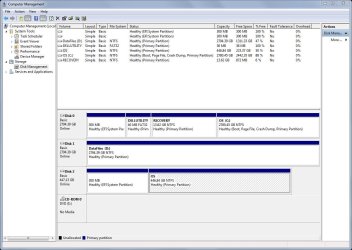
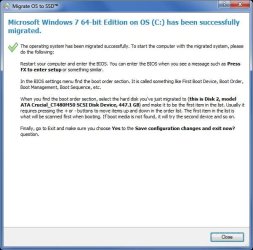
I am moving my OS from a 3TB HD to a 480GB SSD. I bought the Paragon Migrate software and migrated about 370 GB to the SSD. I am not clear on how to proceed. The new SSD appears on my Disk Management without a drive letter. I want to end up with the SSD as the boot drive and I now I need to chage that in the BIOS when I reboot, but how/when do I change drive letters. Do I add a drive letter for the SSD in disk management now? Before I reboot and change the bios boot order. It may be obvious but I'm at that cross road and would like to make sure I do it correctly so I don't screw up the system! Attachments of the disk management window and the completed message from Paragon Migrate. After this I plan to delete all data on the C: drive and place it into a RAID with my D: drive.
 

Attachments

  • Disk Management.JPG
    Disk Management.JPG
    172.9 KB · Views: 695
  • Migrate Complete.JPG
    Migrate Complete.JPG
    70.8 KB · Views: 776

My Computer

Computer type
PC/Desktop
Computer Manufacturer/Model Number
Alienware
OS
Windows 7 home premium x64
CPU
Intel Core i7 3820 @ 3.60GHz Sandy Bridge-E 32nm Techn
Motherboard
Alienware 07JNH0 (CPU 1)
Memory
16.0 GB DDR3 @ 800MHz (11-11-11-28)
Graphics Card(s)
2 each: NVIDIA GeForce GTX 555
Sound Card
Realtek High Definition Audio
Monitor(s) Displays
2 each - ASUS 32" (connected via HDMI)
Screen Resolution
1920 x 1080
Hard Drives
1 Each: Micron M500 SSD 480 GB Drive C: (OS)
2 Each: ATA ST3000DM001-9YN1 SCSI Disk Device
Manufacturer Unknown manufacturer
Interface RAID (not being used as a RAID)
Capacity 2795GB
Real size 3,000,592,982,016 bytes
Drives: D: & F:
Keyboard
Dell/Alienware
Mouse
Logitec M310
Antivirus
Kaspersky Internet Security 2015
Browser
Firefox & Chrome
Other Info
Printer - HP OJ Pro 8600 - USB & Wireless
DVD - LG 24x Super Multi DVD Writer GH24
Looks like your OS and your system partition were transferred to Disk2. That's the one you should set as first boot device in the BIOS.
 

My Computer

Computer Manufacturer/Model Number
HP, Dell, Gateway, Toshiba - 4 laptops and 2 desktops
OS
Vista, Windows7, Mint Mate, Zorin, Windows 8
CPU
from 1.6GHz Duo to i7
Monitor(s) Displays
2x HP w2207
Hard Drives
5x HDD, 7x SSD, 12x Externals
Keyboard
with trackball - no mices
Mouse
Trackball mice
Internet Speed
DSL 6000
Got that but do I just reboot and change the boot order in the BIOS or do I need to assign a drive letter to the SSD? Or does the reboot assign the drive letter?
 

My Computer

Computer type
PC/Desktop
Computer Manufacturer/Model Number
Alienware
OS
Windows 7 home premium x64
CPU
Intel Core i7 3820 @ 3.60GHz Sandy Bridge-E 32nm Techn
Motherboard
Alienware 07JNH0 (CPU 1)
Memory
16.0 GB DDR3 @ 800MHz (11-11-11-28)
Graphics Card(s)
2 each: NVIDIA GeForce GTX 555
Sound Card
Realtek High Definition Audio
Monitor(s) Displays
2 each - ASUS 32" (connected via HDMI)
Screen Resolution
1920 x 1080
Hard Drives
1 Each: Micron M500 SSD 480 GB Drive C: (OS)
2 Each: ATA ST3000DM001-9YN1 SCSI Disk Device
Manufacturer Unknown manufacturer
Interface RAID (not being used as a RAID)
Capacity 2795GB
Real size 3,000,592,982,016 bytes
Drives: D: & F:
Keyboard
Dell/Alienware
Mouse
Logitec M310
Antivirus
Kaspersky Internet Security 2015
Browser
Firefox & Chrome
Other Info
Printer - HP OJ Pro 8600 - USB & Wireless
DVD - LG 24x Super Multi DVD Writer GH24
Don't worry about the drive letter. That should come automatically once booted.
 

My Computer

Computer Manufacturer/Model Number
HP, Dell, Gateway, Toshiba - 4 laptops and 2 desktops
OS
Vista, Windows7, Mint Mate, Zorin, Windows 8
CPU
from 1.6GHz Duo to i7
Monitor(s) Displays
2x HP w2207
Hard Drives
5x HDD, 7x SSD, 12x Externals
Keyboard
with trackball - no mices
Mouse
Trackball mice
Internet Speed
DSL 6000
Thank you. The Paragon software worked great. On the reboot the new SSD became C: and the old C: drive picked up the next open letter. Perfect! You were 100% correct and I appreciate you help.
 

My Computer

Computer type
PC/Desktop
Computer Manufacturer/Model Number
Alienware
OS
Windows 7 home premium x64
CPU
Intel Core i7 3820 @ 3.60GHz Sandy Bridge-E 32nm Techn
Motherboard
Alienware 07JNH0 (CPU 1)
Memory
16.0 GB DDR3 @ 800MHz (11-11-11-28)
Graphics Card(s)
2 each: NVIDIA GeForce GTX 555
Sound Card
Realtek High Definition Audio
Monitor(s) Displays
2 each - ASUS 32" (connected via HDMI)
Screen Resolution
1920 x 1080
Hard Drives
1 Each: Micron M500 SSD 480 GB Drive C: (OS)
2 Each: ATA ST3000DM001-9YN1 SCSI Disk Device
Manufacturer Unknown manufacturer
Interface RAID (not being used as a RAID)
Capacity 2795GB
Real size 3,000,592,982,016 bytes
Drives: D: & F:
Keyboard
Dell/Alienware
Mouse
Logitec M310
Antivirus
Kaspersky Internet Security 2015
Browser
Firefox & Chrome
Other Info
Printer - HP OJ Pro 8600 - USB & Wireless
DVD - LG 24x Super Multi DVD Writer GH24
You are welcome. I am glad it worked so smoothly for you.
 

My Computer

Computer Manufacturer/Model Number
HP, Dell, Gateway, Toshiba - 4 laptops and 2 desktops
OS
Vista, Windows7, Mint Mate, Zorin, Windows 8
CPU
from 1.6GHz Duo to i7
Monitor(s) Displays
2x HP w2207
Hard Drives
5x HDD, 7x SSD, 12x Externals
Keyboard
with trackball - no mices
Mouse
Trackball mice
Internet Speed
DSL 6000
Hello, Herr WHS and other forum members—

I'm making final decisions about exploiting an SSD for my Win7 installation, and I've done my best to read and learn from WHS's tutorials and the many, many posts here. There are some questions about which I'm still uncertain, though.

I need to decide on the size of the SSD to get. My notion at this point is 250GB, to lend itself to smooth migration from the single-partition 640GB HDD that contains Win7 and is my primary system drive...and to afford as much overall system speed as is practical. Is there a specific set of "system files" in a nominal Win7 (x32) installation that must be migrated...and presuming so, what comprises the set? Knowing this will let me confirm before purchase that 250GB will be large enough.

[N.b., I confess that I've never been a fan of Microsoft's "My This" and "My That" default folder structure, and my preference has always been to install applications in folders with titles that I find informative. Similarly, there is very little in the "My Documents" folder on my system—I choose to organize my data files my own way.]

WHS, you have said in several posts that the Paragon Migrate OS application (which I have) takes care of "...alignment, transfer of both partitions, shrink C: and make settings that you otherwise have to do manually." I don't question that, but the bit of experimenting I've done with the application doesn't seem to reveal what must be migrated as a minimum (with the rest being located in appropriate folders/libraries on HDD). How can the Migrate application "shrink" the contents of a mature Win7 C: drive entity without considerable interaction from the user?

An approach that seems to have merit in my situation is to image the current Win7 on 640GB HDD to an available 750GB HDD (possibly using the Migrate application, instead of a traditional method), create a new "data" partition on the 750, and then go through the steps of locating the must-have OS files/folders into one partition, and the rest of the stuff into the "data" partition. Iterations could be done to result in a functioning Win7 that uses a size-limited OS partition suitable for migration to the SSD.

WHS, you have also said in several posts that you favor restricting the size of the "data" to being on the order of 50% the size of the SSD. May I conclude that you mean data in a generic sense, referring to those files and folders that are mandatory for OS operation plus other entities (installed applications, e.g.) that can all fit within the 50% of the SSD size envelope? (E.g., I run XP and Win98 via VMWare emulations and so would probably want to locate those VHDs on the SSD for speed.)

If this approach makes sense, would the use of the Migrate application (from the 640GB to the 750GB HDD) result in an OS partition that does not have an alignment "issue" that would impair migration later from the 750GB to the SSD? If there's any question, I can replicate the 640 drive to the 750 drive the old-fashioned way, partition it, and carry on from there.

I invite comments, advice, and even derision (gently, please).

Regards,

Shen
 

My Computer

Computer type
PC/Desktop
Computer Manufacturer/Model Number
Custom build
OS
Win7 Home Premium X32
CPU
Intel Core i7 860 @2.80 GHz
Motherboard
Asus P7P55D-E Deluxe
Memory
4 GB
Graphics Card(s)
ATI Radeon HD 5500
Hard Drives
640/500/250 GB SATA internal
Antivirus
Eset NOD32
Browser
Firefox
Welcome to Seven Forums Shenzie.

The minimum w7 needs is what's on the install media, that is everything other than data and software you have installed. Here data means personal data, pictures, videos, documents, and music. Personally to achieve your goal I think a fresh clean install would be a good way to proceed.

You can drastically reduce the space used on a SSD by locating your data other than program to a separate physical drive, here in a good way to do it while installing w7. http://www.sevenforums.com/tutorial...uring-windows-7-installation.html#post1070714 I have done this and my w7 install used less than 10GB after all updates, w7 x64 Ultimate.

You can also change the default User folder after install too. http://www.sevenforums.com/tutorials/18629-user-folders-change-default-location.html#post199850
 

My Computer

Computer type
PC/Desktop
Computer Manufacturer/Model Number
Home Built Desktop By DataTech
OS
Windows 7 Ultimate X64 SP1
CPU
Intel i5-2550K, Differing ~4.4-4.8GHz No built in GPU
Motherboard
ASUS P8Z68-V PRO/GEN3
Memory
16GB G.Skill Sniper 1866MHz @ 2133MHz 2x8GB
Graphics Card(s)
ASUS GTX650TIB-DC2OC-2GD5, (650TI Boost)
Sound Card
Onboard Realtek 5-1
Monitor(s) Displays
Samsung P2570HD
Screen Resolution
1920x1080
Hard Drives
Samsung 840 Pro 256GB SSD for OS, 500GB Seagate Constellation (Enterprise drive) for Data
PSU
Corsair HX650W
Case
Inwin Dragon Rider
Cooling
Hyper 212 EVO w/two Noctua fans, push-pull, @1300 RPM
Keyboard
E-Z Eyes, bright yellow keys with large characters
Mouse
steelseries SENSEI Laser Pro Gaming
Internet Speed
48-51Mbs Mbs down, 11 Mbs up Xfinity Cable
Antivirus
Norton Internet Security 2013
Browser
IE 10, Opera, Pale Moon if needed
Other Info
4 case fans, LG BluRay-RE, ASUS DVD-RW, Mr. Fusion power supply, 1.21 gigawatts.
Thank you for your quick reply, Britton.

Shen
 

My Computer

Computer type
PC/Desktop
Computer Manufacturer/Model Number
Custom build
OS
Win7 Home Premium X32
CPU
Intel Core i7 860 @2.80 GHz
Motherboard
Asus P7P55D-E Deluxe
Memory
4 GB
Graphics Card(s)
ATI Radeon HD 5500
Hard Drives
640/500/250 GB SATA internal
Antivirus
Eset NOD32
Browser
Firefox
You're welcome, let us know how it goes.
 

My Computer

Computer type
PC/Desktop
Computer Manufacturer/Model Number
Home Built Desktop By DataTech
OS
Windows 7 Ultimate X64 SP1
CPU
Intel i5-2550K, Differing ~4.4-4.8GHz No built in GPU
Motherboard
ASUS P8Z68-V PRO/GEN3
Memory
16GB G.Skill Sniper 1866MHz @ 2133MHz 2x8GB
Graphics Card(s)
ASUS GTX650TIB-DC2OC-2GD5, (650TI Boost)
Sound Card
Onboard Realtek 5-1
Monitor(s) Displays
Samsung P2570HD
Screen Resolution
1920x1080
Hard Drives
Samsung 840 Pro 256GB SSD for OS, 500GB Seagate Constellation (Enterprise drive) for Data
PSU
Corsair HX650W
Case
Inwin Dragon Rider
Cooling
Hyper 212 EVO w/two Noctua fans, push-pull, @1300 RPM
Keyboard
E-Z Eyes, bright yellow keys with large characters
Mouse
steelseries SENSEI Laser Pro Gaming
Internet Speed
48-51Mbs Mbs down, 11 Mbs up Xfinity Cable
Antivirus
Norton Internet Security 2013
Browser
IE 10, Opera, Pale Moon if needed
Other Info
4 case fans, LG BluRay-RE, ASUS DVD-RW, Mr. Fusion power supply, 1.21 gigawatts.
I used the girly way and got Paragon OS to SSD and it did a fine job. After spending $240 on a SSD another $19.95 was worth it for instant migration. Actually I used it twice. I had to redo it again because I corrupted the OS trying to activate ACHI. I migrated the HDD image exactly like it was with the recovery partition. I ended up leaving it on Raid as it goes faster then ACHI on my Dell E6520. I read the Intel controllers with my system respond to SSD well on this Raid. Everything is faster and works well. And I came from a Hybrid Momentus XT 2nd Gen of 750GB 7200 rpm which is a fast HDD.
Also I migrated the image from the SSD back to a HDD and it works fine as well.

Thanks for the tip.
 

My Computer

Computer type
Laptop
Computer Manufacturer/Model Number
Dell Latitude 6530 Notebook ( 15.6 screen)
OS
Win7 64 Bit
CPU
I-5
Memory
8 GB
Graphics Card(s)
Intel 4000
Monitor(s) Displays
FHD 1980 x 1080
Screen Resolution
1980x1280
Hard Drives
Samsung 840 Pro 256 GB for OS Samsung Pro 840 256 GB for Storage.
Keyboard
Backlit Key's
Internet Speed
DSL 1.5 mbps
Ok, I'm at my wits end. I couldn't make any sense of the directions for the Geeky way to transfer the OS from my Notebook to my new EVO so I looked at Samsung's migration software. All it showed was moving the C: and D: partitions, not the boot partition and the unallocated one that has the recovery software, which made me a bit nervous, so I bought Paragon's software. I wish I had known beforehand that the C: and boot partitions were all that would be transferred because that was all it did; what a waste of time and money! I probably could have done at least that much, if not more, using Samsung's migration program. I can create a partition and copy the data over (which will be a time consuming PITA but, at least, doable) but how the big fat hairy heck can I get the recovery partition over to the SSD?
 

My Computer

Computer type
PC/Desktop
Computer Manufacturer/Model Number
Custom Build
OS
Win 7 Ultimate 64 bit
CPU
Intel i7-3930K
Motherboard
ASUS P9X79 WS
Memory
Kingston HyperX Genesis 32GB Kit (8x4GB Modules) 1600MHz DDR
Graphics Card(s)
MSI R7850 Twin Frozr 2GD5/OC Radeon HD 7850 2GB 256-bit GDDR
Sound Card
Asus Xonar Essence STX
Monitor(s) Displays
3x Asus VG248QE 24", Vizio 32" TV
Screen Resolution
1920 x 1080, ?
Hard Drives
Samsung 128GB 840 Pro SSD (1),
Samsung 4TB 850 EVO SSDs (4)
Samsung 4TB 850 EVO SSDs (16) external backup drives used in 2.5" hot swap bays in the computer.
PSU
Corsair HX750w
Case
Antec Two Hundred v2 (modified)
Cooling
Cooler Master GeminII S524 120mm (fan replaced with a 140mm)
Keyboard
Logitech G510s
Mouse
Logitech M525 (two in use)
Internet Speed
=< 32Mbps down, 8Mbps up
Antivirus
AVAST!, MBAM, SAS, Spybot S&D (all but MBAM free) Glary Util
Browser
IE11
Other Info
LSI 9211-8i HBA card (8 SATA III ports), 2.5" & 3.5" Hot Swap Bays, HooToo HT-CR001 PCI-E to USB 3.0 Internal Hub + 6 Slot Card Reader, and LG Model CH12LS28 BD-ROM Optical Drive. Also, ScanSnap S1500 ADF duplexing scanner, Canon 9000F flat bed scanner, Corsair SP2500 2.1 speakers, Samsung CLP 415nw laser color printer, Cyberpower PP2200SW UPS
Back
Top