System Image Recovery

How to Do a System Image Recovery in Windows 7


   Information
This will show you how to restore your Windows 7 hard disk back to exactly how it was when you created a system image backup.
   Warning

  • You can only do a system image recovery to a HDD that is the same size or larger than the one the system image was created from. You will not be able to do a system image recovery to a smaller HDD.
  • When you restore your computer from a image backup, it is a complete restoration. You can't choose individual items to restore, and all of your current programs, system settings, and files are replaced.
  • If your backup image is on a external device (ex: USB drive), then make sure it is connected before starting. If USB drive, then also make sure that you have your BIOS settings (ex: Legacy USB) set to allow USB devices at boot.
  • A system image recovery will format everything on each hard drive that was included in a system image, and will only restore what is included (see steps 7-9 in STEP TWO below) in the system image back. Be sure to backup anything that you do not want to lose that is not included in the system image backup first.


STEP ONE

Only if You Renamed the "WindowsImageBackup" Folder


   Note
To be able to have multiple versions of system images saved on the same drive or partition, you would need to rename the older WindowsImageBackup folder from the previously created system image as described in the NOTE box at the top of this tutorial.

If you renamed the WindowsImageBackup folder for the system image version that you wanted to restore, then you will need to do the steps below before you will be able to restore that system image.

1. If you are "Able to Boot" into Windows 7 A) In Windows Explorer, navigate to the renamed (drive letter)\WindowsImageBackup folder location of the system image that you want to restore.

B) If you already have a folder named WindowsImageBackup that is not the system image version that you want to restore, then you will need to right click on it, click on Rename, and type in say WindowsImageBackup-Copy-2 as an example.

C) Now, right click on the renamed system image version (ex: WindowsImageBackup-Copy-1) that you did want to restore, click on Rename, type in WindowsImageBackup an press enter.

D) Go to the STEP TWO section below to do the System Image Recovery.
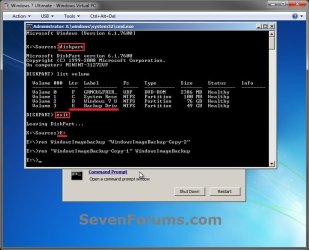
2. If you are "Not Able to Boot" into Windows 7 A) If you have the system image backup save to an external device, be sure that it is connected now.

B) Open a command prompt at boot.

C) In the command prompt, type diskpart and press enter. (see screenshot below)

D) In the command prompt, type list volume and press enter. (see screenshot below)

E) Make note of the drive letter (ex: E: ) that you have the system image backup saved to.

F) In the command prompt, type exit and press enter. (see screenshot below)

G) In the command prompt, type the E: and press enter. (see screenshot below)
NOTE: Subsititute E: for your actual drive letter at step 2E instead.

H) If you already have a folder named "WindowsImageBackup"

NOTE: This is if you already have a folder named WindowsImageBackup that is not the system image version that you want to restore. If so, you would need to rename it to say WindowsImageBackup-Copy-2 as an example.
  • In the command prompt, type the command below and press enter. (see screenshot below)
    NOTE: Substitute WindowsImageBackup-Copy-2 in the command below with any name in quotes that you would like to rename it to instead.
Code:
[B]ren WindowsImageBackup "[COLOR=red]WindowsImageBackup-Copy-2[/COLOR]"[/B]
I) In the command prompt, type the command below and press enter. (see screenshot below)
NOTE: Substitute WindowsImageBackup-Copy-1 in the command below with the actual name of your renamed system image folder in quotes that you want to use to restore instead.
Code:
[B]ren "[COLOR=red]WindowsImageBackup-Copy-1[/COLOR]" WindowsImageBackup[/B]
J) Close the command prompt window. (see screenshot below)

K) Continue on to step 3B in the STEP TWO section below to do the System Image Recovery.
Rename-1.jpg


STEP TWO

To Do the System Image Recovery

1. If you have the system image backup save to an external device, be sure that it is connected and turned on (powered up) now.
A) Start with either step 2 or step 3 below first.
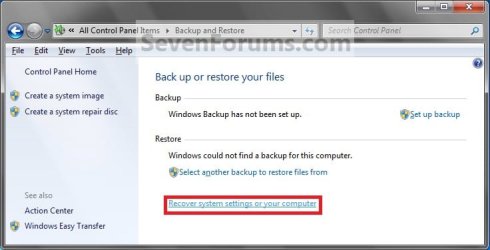
2. From "Backup and Restore" in the Control Panel while in Windows 7 A) Open the Control Panel (icons view), and click on Backup and Restore.

B) Click on the Recover system settings on your computer link. (see screenshot below) Step1.jpg
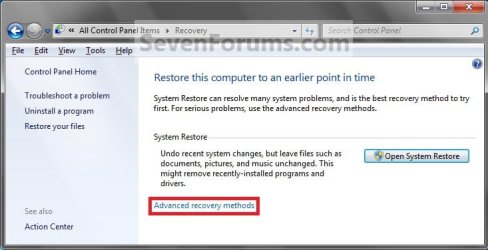
C) Click on the Advanced recovery methods link. (see screenshot below) Step2.jpg
D) Select the Use a system image you created earlier to recover your computer option. (see screenshot below) Step3.jpg
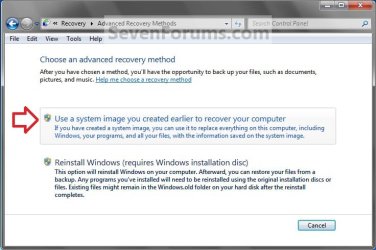
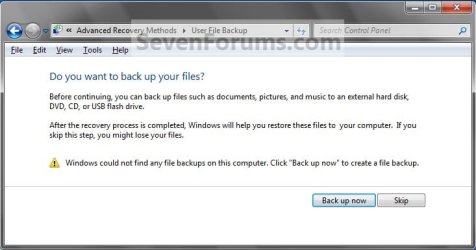
E) Select to either create a Back up now, or to Skip it and continue the system image recovery without backing up any of your current files.
NOTE: If you select Back up now, it will take you to step 6 in this tutorial link to create a User and System File back up of your current files first before continuing to step 1F. (see screenshot below) Step4A.jpg
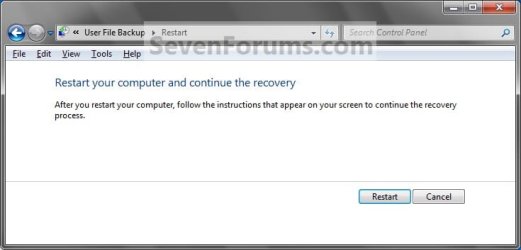
F) Click on Restart. (see screenshot below) Step5A.jpg
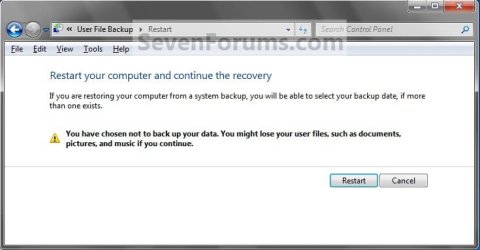
Step5B.jpg

G) Select a languange to be used for your keyboard input and click on Next. (see screenshot below) Step6.jpg
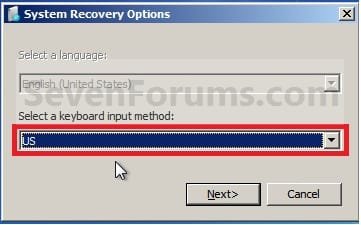
H) Go to step 4.
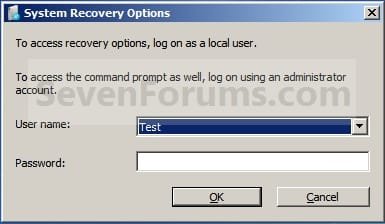
3. From the System Recovery Options Screen at Boot A) Boot to the System Recovery Options screen from your Windows 7 installation DVD/USB, or System Repair Disc.

B) Select the System Image Recovery option. (see screenshot below) System_Recovery_Options.jpg
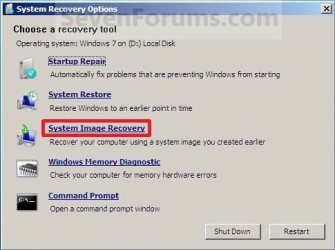
4. If you saved the system image backup to a set of DVDs, then insert the last DVD from the set when prompted. If not, go to step 5 for a system image backup on a hard drive. A) Go to step 7 below.
5. To Use the Latest System Image A) Select (dot) Use the latest available system image and click on Next. (see screenshot below) Step7.jpg
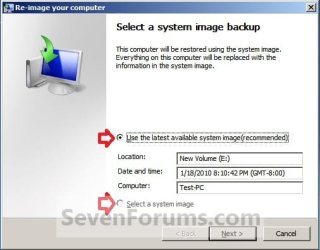
B) Go to step 7.
6. To Select a System Image A) Select (dot) Select a system image, and click on Next. (see screenshot above)
NOTE: This is if the system image that you want to use is not listed here and is at another location that you wish to choose from instead.

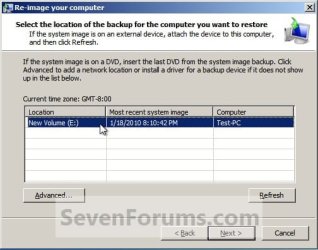
B) Select the location of the backup image for the computer you want to restore from the list, and click on Next. (see screenshot below)

   Note
To add a image from a network location, click on the Advanced button, and on the Search for a system image on the network option.

If the drive cannot be seen to select a system image from, then you may need to use the tutorial below to load your SATA or RAID drivers before it will be seen. You would click on the Advanced button, and on the Install a driver option.

SATA Drivers - Load in Windows 8 System Image Recovery
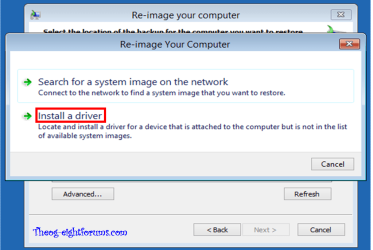
RecoveryBackup004-8.PNG


Step8A.jpg
C) Select the date and time of the system image to restore, and click on Next. (see screenshot below) Step8B.jpg
7. To Do a Full System Image Recovery
NOTE: This option will format everything on each hard disk drive that was included in the system image, then restore them as they were when the system image was created.

   Note
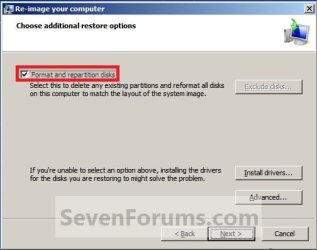
Format and repartition disks box:
NOTE: Special thanks to MJF for this addition. 1) Grayed out and selected
You are forced to have the whole disk formatted and repartitioned to match the partition structure of the disk the image was made from. This can occur when restoring an image to a new disk or the original disk with a modified partition structure. Data on other partitions on the disk you are restoring to will be lost.

2) Grayed out and unselected
You are not given the option to format and repartition the disk. This will occur if you are restoring Windows from a partition on the same disk.

3) Not grayed out and unselected
Here you have the option to select format the whole disk and repartition or not. In this case the disk the image was taken from has a matching partition structure to the disk you are restoring the image to. By not selecting the format and repartition option your image will be restored and other partitions untouched such as valuable data partitions.
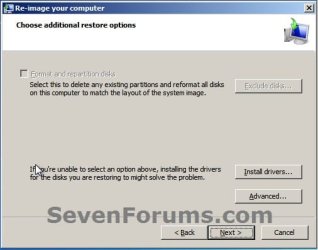
A) Check the Format and repartition disks box (if not grayed out) and uncheck Only restore system drives box (if available), and click on Next. (see screenshots below) Exclude_Disks.jpg
Step9.jpg
System_Drives.jpg
B) Go to step 10.
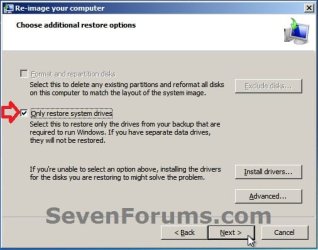
8. To Only Restore System Drives in System Image Recovery
NOTE: When restoring to the same disk containing data partitions, the Format and repartition disks option may format the data partitions as well. If this is the case and you have the option to leave the Format and repartition disks box unchecked, then initially attempt your image recovery with the Format and repartition disks box unchecked. If recovery is unsuccessful, repeat the process with the format box ticked. A) If available, check the Only restore system drives box, and click on Next. (see screenshot below) System_Drives.jpg
B) Go to step 10.
9. To Exclude Restoring Specific Drives in System Image Recovery
NOTE: Since a system image recovery will format everything on each hard disk drive that was included in a system image, this will allow you to exclude specific disks so that specific disk will not be formated or restored. A) Check the Format and repartition disks box , and click on the Exclude disks button (if not grayed out). (see screenshot below)
NOTE: If the Exclude disks button is grayed out, then the HDD that you are restoring to is empty, or you do not have any disks in the system image that are able to be excluded from being restored. Exclude 001.JPG
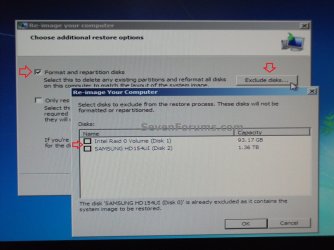
B) Unselect the drives that you want to exclude from being restored.

C) Click on Next.
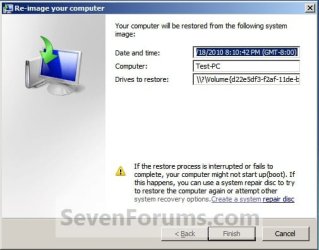
10. Click on Finish. (see screenshot below) Step10.jpg
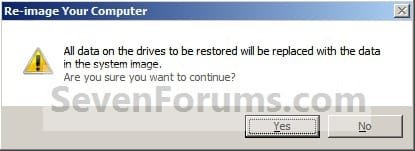
11. Click on Yes. (See screenshot below) Step11.jpg
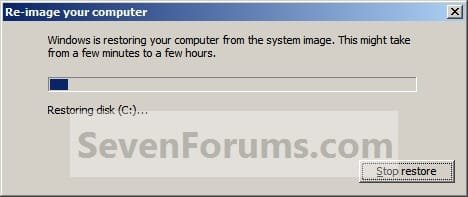
12. You will now see this screenshot below.
NOTE: If you have the backup image on DVDs, have them ready. See step 4 above. Step12.jpg
13. When it is through, click on Restart Now to finish. (see screenshot below)
NOTE: Your computer will restart and the backup image restoration will be done. Step13.jpg
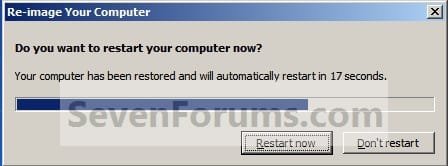
14. If you created a backup in step 1E, then you will now see this option to Restore my files after the computer restarts. (see screenshot below) Step14.jpg
That's it,
Shawn


Attachments

  • Step6A.jpg
    Step6A.jpg
    47.1 KB · Views: 244
Last edited:
It seems that I will have to back up my system and restore to a new laptop, same make, same model. The disks will be the same size - everything will be identical but not exactly the same. Should I expect any problems?


Hello Tomislav,

Other than possibly having to use the new laptop's product key to activate with instead if this was a OEM copy of Windows 7, you shouldn't have any issues since everything is the same as the old laptop.
 
Last edited:

My Computer

Computer type
PC/Desktop
Computer Manufacturer/Model Number
Self built custom
OS
64-bit Windows 11 Pro for Workstations
CPU
Intel i7-8700K OC'd to 5 GHz
Motherboard
ASUS ROG Maximus XI Formula Z390
Memory
64 GB (4x16GB) G.SKILL TridentZ RGB DDR4 3600 MHz
Graphics Card(s)
ASUS ROG-STRIX-GTX1080TI-O11G-GAMING
Sound Card
Integrated
Monitor(s) Displays
2 x Samsung Odyssey G7 27"
Screen Resolution
2560x1440
Hard Drives
1TB Samsung 990 PRO M.2,
4TB Samsung 990 PRO PRO M.2,
TerraMaster F8 SSD Plus NAS
PSU
Seasonic Prime Titanium 850W
Case
Thermaltake Core P3
Cooling
Corsair Hydro H115i
Keyboard
Logitech wireless K800
Mouse
Logitech MX Master 4
Internet Speed
2 Gb/s Download and 100 Mb/s Upload
Antivirus
Malwarebyte Anti-Malware Premium
Browser
Google Chrome
Other Info
Logitech Z625 speaker system,
Logitech BRIO 4K Pro webcam,
HP Color LaserJet Pro MFP M477fdn,
APC SMART-UPS RT 1000 XL - SURT1000XLI,
Galaxy S23 Plus phone
Oh, I possess an Ultimate Retail, this will be the least of my troubles. I was worrying about hardware IDs of the disks. Also, some two weeks will pass between backup & restore. I'm anxious & apprehensive..
 

My Computer

Computer Manufacturer/Model Number
Asus N73SV
OS
Windows 7 x64 Ultimate SP1
CPU
Core i7-2630QM
Motherboard
Intel HM 65
Memory
6 GB DDR3
Graphics Card(s)
Nvidia GT 540M / Intel HD 3000 - Optimus switching
Sound Card
HD Audio (Intel Azalia/Realtek) ALC269
Monitor(s) Displays
LED flat panel
Screen Resolution
1920 x 1080
Hard Drives
2x Seagate Momentus 640 GB - 1,28 TB in total
Internet Speed
4 MB/256 kbps
Other Info
External HDs

WD Elements 1,5 TB
WD MyBook 500 GB
At most you may have to activate by phone. Of course, anything on the laptop after the system image was created will not be included though.
 

My Computer

Computer type
PC/Desktop
Computer Manufacturer/Model Number
Self built custom
OS
64-bit Windows 11 Pro for Workstations
CPU
Intel i7-8700K OC'd to 5 GHz
Motherboard
ASUS ROG Maximus XI Formula Z390
Memory
64 GB (4x16GB) G.SKILL TridentZ RGB DDR4 3600 MHz
Graphics Card(s)
ASUS ROG-STRIX-GTX1080TI-O11G-GAMING
Sound Card
Integrated
Monitor(s) Displays
2 x Samsung Odyssey G7 27"
Screen Resolution
2560x1440
Hard Drives
1TB Samsung 990 PRO M.2,
4TB Samsung 990 PRO PRO M.2,
TerraMaster F8 SSD Plus NAS
PSU
Seasonic Prime Titanium 850W
Case
Thermaltake Core P3
Cooling
Corsair Hydro H115i
Keyboard
Logitech wireless K800
Mouse
Logitech MX Master 4
Internet Speed
2 Gb/s Download and 100 Mb/s Upload
Antivirus
Malwarebyte Anti-Malware Premium
Browser
Google Chrome
Other Info
Logitech Z625 speaker system,
Logitech BRIO 4K Pro webcam,
HP Color LaserJet Pro MFP M477fdn,
APC SMART-UPS RT 1000 XL - SURT1000XLI,
Galaxy S23 Plus phone
Windows uses a mutipoint hardware check for internet activation. Around 8 elements.
ttp://en.wikipedia.org/wiki/Windows_Product_Activation
This sort of information has also been posted on the MS's own answers forum site.

To me, MS try to balance theft against inconvenience to genuine customers who clearly do change hardware elements (inc. serial numbers).
I think you may need a phone call but I'd be surprised if you had other functional problems.

I think transferring between "identical" OEM PCs may be more difficult because of their different activation method.
 

My Computer

Computer type
PC/Desktop
Computer Manufacturer/Model Number
Own build
OS
Windows 7x64 Home Premium SP1
CPU
Intel i7 2600k
Motherboard
ASUS P8Z68 Deluxe
Memory
G.Skill Ripjaws (DDR3-1600) 2x4GB
Graphics Card(s)
Nvidia GeForce GTS 450; Intel HD Graphics 3000(GT2+)
Monitor(s) Displays
Dell Ultrasharp IPS panel U2311H, Samsung SyncMaster P2350
Screen Resolution
1920x1080
Hard Drives
Samsung 850 Pro SSD 256GB, Samsung SSD 840 120GB, Seagates 1TB Barracuda ST31000528AS x2
PSU
Seasonic M12II 520W
Case
Lian Li Lancool PC-K60
Cooling
Case: 1x120mm, 3x140mm CPU: Hyper 212+
Keyboard
Logitech MK520 (wireless)
Mouse
Logitech MK520
Internet Speed
6-7 Mbps
Antivirus
Norton Security Premium, Malwarebytes on 2 (MSE on 3rd PC)
Browser
FireFox
Other Info
Audio: Logitech Z523 2.1
It seems I didn't state my real worries too clearly. :D

I'm worried about the Windows recovery process. Will it behave nicely or will it trouble me when it realizes: ''Whoa, whoa, waitaminute, this is not the same computer! This is not where I came from! You tried to fool me, it all looks the same, but I'm smart, Microsoft made me..I can see right through it! I'm gonna give you trouble now....!''

That sort of thing.
 

My Computer

Computer Manufacturer/Model Number
Asus N73SV
OS
Windows 7 x64 Ultimate SP1
CPU
Core i7-2630QM
Motherboard
Intel HM 65
Memory
6 GB DDR3
Graphics Card(s)
Nvidia GT 540M / Intel HD 3000 - Optimus switching
Sound Card
HD Audio (Intel Azalia/Realtek) ALC269
Monitor(s) Displays
LED flat panel
Screen Resolution
1920 x 1080
Hard Drives
2x Seagate Momentus 640 GB - 1,28 TB in total
Internet Speed
4 MB/256 kbps
Other Info
External HDs

WD Elements 1,5 TB
WD MyBook 500 GB
It seems I didn't state my real worries too clearly. :D

I'm worried about the Windows recovery process. Will it behave nicely or will it trouble me when it realizes: ''Whoa, whoa, waitaminute, this is not the same computer! This is not where I came from! You tried to fool me, it all looks the same, but I'm smart, Microsoft made me..I can see right through it! I'm gonna give you trouble now....!''

That sort of thing.

Unless the system image backup itself is corrupted, you will not have any problems with the recovery since you are restoring the image to an identical computer that the image was created from. This includes your drivers and such.

At most after the recovery is finished, Windows 7 may recognize that it is a different computer, and may have you activate via online or phone again. :)
 

My Computer

Computer type
PC/Desktop
Computer Manufacturer/Model Number
Self built custom
OS
64-bit Windows 11 Pro for Workstations
CPU
Intel i7-8700K OC'd to 5 GHz
Motherboard
ASUS ROG Maximus XI Formula Z390
Memory
64 GB (4x16GB) G.SKILL TridentZ RGB DDR4 3600 MHz
Graphics Card(s)
ASUS ROG-STRIX-GTX1080TI-O11G-GAMING
Sound Card
Integrated
Monitor(s) Displays
2 x Samsung Odyssey G7 27"
Screen Resolution
2560x1440
Hard Drives
1TB Samsung 990 PRO M.2,
4TB Samsung 990 PRO PRO M.2,
TerraMaster F8 SSD Plus NAS
PSU
Seasonic Prime Titanium 850W
Case
Thermaltake Core P3
Cooling
Corsair Hydro H115i
Keyboard
Logitech wireless K800
Mouse
Logitech MX Master 4
Internet Speed
2 Gb/s Download and 100 Mb/s Upload
Antivirus
Malwarebyte Anti-Malware Premium
Browser
Google Chrome
Other Info
Logitech Z625 speaker system,
Logitech BRIO 4K Pro webcam,
HP Color LaserJet Pro MFP M477fdn,
APC SMART-UPS RT 1000 XL - SURT1000XLI,
Galaxy S23 Plus phone
FWIW: and my $0.02 worth.
For $25 you can buy Acronis Home backup imaging software that will allow you to create and restore images easily. One of the problems with microsofts imaging software is that in order to save multiple images you have to put them on a separate drive or use some convoluted method to rename them. (It always wants to store in in the root of a drive.)

With Acronis, you give it the name and where to place it, you can make an image every day and restore is quite fast. I don't have any financial interest in acronis but I buy mine from the user group store at ugr.com and they support it. Best $25 I have spent in a while.

Rich
 

My Computer

Computer type
Laptop
Computer Manufacturer/Model Number
Toshiba Laptop Qosimo X870
OS
Windows 7 Pro x64 SP1
CPU
Intel Core I7
Motherboard
Toshiba Qosmio
Memory
16 Gigs
Graphics Card(s)
NVIDIA GeForce GTX 670M
Monitor(s) Displays
17.7" laptop
Screen Resolution
1600 x 900
Hard Drives
256 Gig SanDisk SSD for C
256 Gig Intel SSD for D
Internet Speed
50/25 FIOS
Antivirus
Vipre (all you can eat for 10 machines)
Browser
IE and FF
Other Info
I have dos 6.22, wfwg 3.11, win98, 2000 and xp VHD's available for testing. MS's Virtual PC works great.
It seems many people find a 3rd party app. easier to use and more flexible.

Rich really likes his 3rd party backup app. - seems to talk about it in most of his posts.

You might want to look into it - and several others - there are plenty to choose from .

Some very good free versions, too.
 

My Computers

System One System Two

  • Computer type
    PC/Desktop
    OS
    7 X64
    CPU
    i5 8400
    Motherboard
    gigabyte b365m ds3h
    Memory
    2x8gb 3200mhz
    Hard Drives
    various
    PSU
    pure power 11 400w cm
    Case
    Coolermaster
    Cooling
    cryorig m9i
  • Computer type
    PC/Desktop
    OS
    7x64
    CPU
    g5400
    Motherboard
    ga b365m ds3h
    Memory
    8gb ddr4 2400
    PSU
    xfx pro 450w
It seems I didn't state my real worries too clearly. :D

I'm worried about the Windows recovery process. Will it behave nicely or will it trouble me when it realizes: ''Whoa, whoa, waitaminute, this is not the same computer! This is not where I came from! You tried to fool me, it all looks the same, but I'm smart, Microsoft made me..I can see right through it! I'm gonna give you trouble now....!''

That sort of thing.
I think we understood your question????
My comments are aligned with Brinks.
ie. The PC should technically/functionally work but the activation process may require a phone reactivation (need for activation will depend on how rigorous the 8 point check is).
Your choice of imaging software is up to you. Spend if you want to.
 

My Computer

Computer type
PC/Desktop
Computer Manufacturer/Model Number
Own build
OS
Windows 7x64 Home Premium SP1
CPU
Intel i7 2600k
Motherboard
ASUS P8Z68 Deluxe
Memory
G.Skill Ripjaws (DDR3-1600) 2x4GB
Graphics Card(s)
Nvidia GeForce GTS 450; Intel HD Graphics 3000(GT2+)
Monitor(s) Displays
Dell Ultrasharp IPS panel U2311H, Samsung SyncMaster P2350
Screen Resolution
1920x1080
Hard Drives
Samsung 850 Pro SSD 256GB, Samsung SSD 840 120GB, Seagates 1TB Barracuda ST31000528AS x2
PSU
Seasonic M12II 520W
Case
Lian Li Lancool PC-K60
Cooling
Case: 1x120mm, 3x140mm CPU: Hyper 212+
Keyboard
Logitech MK520 (wireless)
Mouse
Logitech MK520
Internet Speed
6-7 Mbps
Antivirus
Norton Security Premium, Malwarebytes on 2 (MSE on 3rd PC)
Browser
FireFox
Other Info
Audio: Logitech Z523 2.1
Cannot restore from a selected system image

This tutorial does not work for me.
If I pick the " Select a System Image” (Step 2 #6) rather than use the recommended latest one, I get an error message stating that the system image is on a hard disk but Windows need to format that disk to restore your computer.

Everything works fine when I select the select the recommended latest system image but not when I select one of the older system images. It doesn't get to #7 and I get the error msg " the system image is on a hard disk but Windows need to format that disk to restore your computer". The only option I get is back or cancel.

The images were created in the Windows 7 Pro Backup & Restore utility and I'm running the image restore from the System Recovery disk.
I have 2 internal hard drives. The system images of the primary drive were stored on the secondary drive. And now I'm trying to restore the primary drive system image.
Any suggestions?
 
Last edited:

My Computer

OS
Windows 7 Pro 64bit
This tutorial does not work for me.
If I pick the " Select a System Image” rather than use the recommended latest one, I get an error message stating that the system image is on a hard disk but Windows need to format that disk to restore your computer.
Everything works fine when I select the select the recommended latest system image but not when I select one of the older system images.

The images were created in the Windows 7 Backup & Restore utility and I'm running the image restore from the System Recovery disk.
I have 2 internal hard drives. The system images of the primary drive were stored on the secondary drive. And now I'm trying to restore the primary drive system image.
Any suggestions?

Which method are you following?

Josh
 

My Computer

Computer type
PC/Desktop
Computer Manufacturer/Model Number
Custom Built
OS
Windows 7 Professional x64 SP1 ; Windows Server 2012 R2 Standard
CPU
Intel Core i5 2400 @ 3.10GHz
Motherboard
Foxconn H67MP-S/-V/H67MP
Memory
8.0GB DDR3 @ 665MHz (2GBx4)
Graphics Card(s)
AMD Radeon HD 6870
Sound Card
Realtek High Definition Audio
Monitor(s) Displays
AOC 2243W & SMB1930NW
Screen Resolution
1440x900 & 1920x1080
Hard Drives
977GB Seagate ST31000524AS ATA Drive (SATA)
250GB WD iSCSI attached Drive
PSU
750W Gaming PSU
Case
Novatech Night
Cooling
Fan
Keyboard
Dell Standard PS/2 Keyboard
Mouse
R.A.T 07 Gaming Mouse
Internet Speed
Download: 10 Mbps Ping: 30ms Upload: 0.81 Mbps
Browser
Google Chrome
Other Info
Optiarc DVD RW AD-5260S ATA Device
This tutorial does not work for me.
If I pick the " Select a System Image” (Step 2 #6) rather than use the recommended latest one, I get an error message stating that the system image is on a hard disk but Windows need to format that disk to restore your computer.

Everything works fine when I select the select the recommended latest system image but not when I select one of the older system images. It doesn't get to #7 and I get the error msg " the system image is on a hard disk but Windows need to format that disk to restore your computer". The only optiosn I get is back or close.

The images were created in the Windows 7 Backup & Restore utility and I'm running the image restore from the System Recovery disk.
I have 2 internal hard drives. The system images of the primary drive were stored on the secondary drive. And now I'm trying to restore the primary drive system image.
Any suggestions?

Hello JWrn, and welcome to Seven Forums.

You are getting that error message since the system image you wanted to use is located on the same drive that would be formatted and restored to. You can only select a system image from a drive that is different that the one that is being restored.

Does it give you any other options?

Did you move this system image there? If so, follow STEP ONE in the tutorial to move it back to it's original location.
 
Last edited:

My Computer

Computer type
PC/Desktop
Computer Manufacturer/Model Number
Self built custom
OS
64-bit Windows 11 Pro for Workstations
CPU
Intel i7-8700K OC'd to 5 GHz
Motherboard
ASUS ROG Maximus XI Formula Z390
Memory
64 GB (4x16GB) G.SKILL TridentZ RGB DDR4 3600 MHz
Graphics Card(s)
ASUS ROG-STRIX-GTX1080TI-O11G-GAMING
Sound Card
Integrated
Monitor(s) Displays
2 x Samsung Odyssey G7 27"
Screen Resolution
2560x1440
Hard Drives
1TB Samsung 990 PRO M.2,
4TB Samsung 990 PRO PRO M.2,
TerraMaster F8 SSD Plus NAS
PSU
Seasonic Prime Titanium 850W
Case
Thermaltake Core P3
Cooling
Corsair Hydro H115i
Keyboard
Logitech wireless K800
Mouse
Logitech MX Master 4
Internet Speed
2 Gb/s Download and 100 Mb/s Upload
Antivirus
Malwarebyte Anti-Malware Premium
Browser
Google Chrome
Other Info
Logitech Z625 speaker system,
Logitech BRIO 4K Pro webcam,
HP Color LaserJet Pro MFP M477fdn,
APC SMART-UPS RT 1000 XL - SURT1000XLI,
Galaxy S23 Plus phone
This tutorial does not work for me.
If I pick the " Select a System Image” rather than use the recommended latest one, I get an error message stating that the system image is on a hard disk but Windows need to format that disk to restore your computer.
Everything works fine when I select the select the recommended latest system image but not when I select one of the older system images.

The images were created in the Windows 7 Backup & Restore utility and I'm running the image restore from the System Recovery disk.
I have 2 internal hard drives. The system images of the primary drive were stored on the secondary drive. And now I'm trying to restore the primary drive system image.
Any suggestions?

Which method are you following?

Josh

Sorry Josh, I don't know what you mean "method".
 

My Computer

OS
Windows 7 Pro 64bit
This tutorial does not work for me.
If I pick the " Select a System Image” (Step 2 #6) rather than use the recommended latest one, I get an error message stating that the system image is on a hard disk but Windows need to format that disk to restore your computer.

Everything works fine when I select the select the recommended latest system image but not when I select one of the older system images. It doesn't get to #7 and I get the error msg " the system image is on a hard disk but Windows need to format that disk to restore your computer". The only optiosn I get is back or close.

The images were created in the Windows 7 Backup & Restore utility and I'm running the image restore from the System Recovery disk.
I have 2 internal hard drives. The system images of the primary drive were stored on the secondary drive. And now I'm trying to restore the primary drive system image.
Any suggestions?

Hello JWrn, and welcome to Seven Forums.

You are getting that error message since the system image you wanted to use is located on the same drive that it would be formatted and restored to. You can only select a system image from a drive that is different that the one that is being restored.

Does it give you any other options?

Did you move this system image there? If so, follow STEP ONE in the tutorial to move it back to it's original location.

The system images are located on the secondary drive, let's call it D.
And the system image was of the primary drive C, which is what I'm trying to restore.
So, they are on different drives.
There are no other options when I get the error message.
I didn't move the system images, they were stored (on the secondary drive) by the Windows 7 Pro Backup & Restore utility.
So, I thought everything should work.
Cheers, Jack.
 

My Computer

OS
Windows 7 Pro 64bit
This tutorial does not work for me.
If I pick the " Select a System Image” (Step 2 #6) rather than use the recommended latest one, I get an error message stating that the system image is on a hard disk but Windows need to format that disk to restore your computer.

Everything works fine when I select the select the recommended latest system image but not when I select one of the older system images. It doesn't get to #7 and I get the error msg " the system image is on a hard disk but Windows need to format that disk to restore your computer". The only optiosn I get is back or close.

The images were created in the Windows 7 Backup & Restore utility and I'm running the image restore from the System Recovery disk.
I have 2 internal hard drives. The system images of the primary drive were stored on the secondary drive. And now I'm trying to restore the primary drive system image.
Any suggestions?

Hello JWrn, and welcome to Seven Forums.

You are getting that error message since the system image you wanted to use is located on the same drive that it would be formatted and restored to. You can only select a system image from a drive that is different that the one that is being restored.

Does it give you any other options?

Did you move this system image there? If so, follow STEP ONE in the tutorial to move it back to it's original location.

The system images are located on the secondary drive, let's call it D.
And the system image was of the primary drive C, which is what I'm trying to restore.
So, they are on different drives.
There are no other options when I get the error message.
I didn't move the system images, they were stored (on the secondary drive) by the Windows 7 Pro Backup & Restore utility.
So, I thought everything should work.
Cheers, Jack.

Interesting, I did a test to see what would happen: I picked the " Select a System Image” but then I selected the latest image (rather than one of the older ones that I want). I didn't get the error msg and it's working!
So perhaps the older images are somehow different from the most recent one, even though the same backup routines were used.
When the restore is finished I'm going to try renaming the backups to make one of the older images seem like it's the most recent image and see what happens.
Thx.
I tried everything - still get the error msg. I can only conclude the older images had included something that the most recent image did not. Most likely it's the system partition on the backup drive (even though I haven't changed any of the default settings to include it).
If anybody has a work around for this I would really appreciate it.

If that is the case
 
Last edited:

My Computer

OS
Windows 7 Pro 64bit
That's good news so far JW. My only guess is that the older image may have been corrupted somehow.

Be sure to remember that renaming the backup folders may render them useless until renamed back to the default name as in the STEP ONE section though.
 

My Computer

Computer type
PC/Desktop
Computer Manufacturer/Model Number
Self built custom
OS
64-bit Windows 11 Pro for Workstations
CPU
Intel i7-8700K OC'd to 5 GHz
Motherboard
ASUS ROG Maximus XI Formula Z390
Memory
64 GB (4x16GB) G.SKILL TridentZ RGB DDR4 3600 MHz
Graphics Card(s)
ASUS ROG-STRIX-GTX1080TI-O11G-GAMING
Sound Card
Integrated
Monitor(s) Displays
2 x Samsung Odyssey G7 27"
Screen Resolution
2560x1440
Hard Drives
1TB Samsung 990 PRO M.2,
4TB Samsung 990 PRO PRO M.2,
TerraMaster F8 SSD Plus NAS
PSU
Seasonic Prime Titanium 850W
Case
Thermaltake Core P3
Cooling
Corsair Hydro H115i
Keyboard
Logitech wireless K800
Mouse
Logitech MX Master 4
Internet Speed
2 Gb/s Download and 100 Mb/s Upload
Antivirus
Malwarebyte Anti-Malware Premium
Browser
Google Chrome
Other Info
Logitech Z625 speaker system,
Logitech BRIO 4K Pro webcam,
HP Color LaserJet Pro MFP M477fdn,
APC SMART-UPS RT 1000 XL - SURT1000XLI,
Galaxy S23 Plus phone
Can you post a screen shot of the exact error message.

You can have any number of images you care for on multiple drives/partitions, moved, renamed.....Windows imaging is totally happy with this.

It doesn't make sense that Windows wants to format the drive the image is on except if the image is from a drive with a different partition structure to the drive you want to image to. Then Windows will want to format the drive the image is being returned to.

Clearly, if you store an image on a partition of the same drive - say drive 0 has partitions C: and D: then you store an image on D: then don't change the partition structure of drive 0.
 

My Computer

Computer type
PC/Desktop
Computer Manufacturer/Model Number
Own build
OS
Windows 7x64 Home Premium SP1
CPU
Intel i7 2600k
Motherboard
ASUS P8Z68 Deluxe
Memory
G.Skill Ripjaws (DDR3-1600) 2x4GB
Graphics Card(s)
Nvidia GeForce GTS 450; Intel HD Graphics 3000(GT2+)
Monitor(s) Displays
Dell Ultrasharp IPS panel U2311H, Samsung SyncMaster P2350
Screen Resolution
1920x1080
Hard Drives
Samsung 850 Pro SSD 256GB, Samsung SSD 840 120GB, Seagates 1TB Barracuda ST31000528AS x2
PSU
Seasonic M12II 520W
Case
Lian Li Lancool PC-K60
Cooling
Case: 1x120mm, 3x140mm CPU: Hyper 212+
Keyboard
Logitech MK520 (wireless)
Mouse
Logitech MK520
Internet Speed
6-7 Mbps
Antivirus
Norton Security Premium, Malwarebytes on 2 (MSE on 3rd PC)
Browser
FireFox
Other Info
Audio: Logitech Z523 2.1
Can you post a screen shot of the exact error message.

You can have any number of images you care for on multiple drives/partitions, moved, renamed.....Windows imaging is totally happy with this.

It doesn't make sense that Windows wants to format the drive the image is on except if the image is from a drive with a different partition structure to the drive you want to image to. Then Windows will want to format the drive the image is being returned to.

Clearly, if you store an image on a partition of the same drive - say drive 0 has partitions C: and D: then you store an image on D: then don't change the partition structure of drive 0.


I sorry, I can't get a screen shot - the Windows system image restore process reboots the pc and puts it in a mode where you can't do anything other than follow the steps.

The exact error msg is "The System image is on a hard disk, but Windows needs to format that disk to restore your computer. Choose a different image to restore."
The title of the pop-up window is "Re-image your computer" with a sub-title "Choose additional restore options.

I did a test and it works as you say.
I have Disk 0 with 2 partitions: System reserved (D) & Backup (E).
Also have Disk 1 with 2 partitions: Active System reserved & (C).
Before your post I thought perhaps the problem was (D) was included in the older system image creation processes, but I see now that is not the problem.
Thx.

However that still leaves me with 20+ older system images that I cannot restore from, but really, really want to.

A bit of background in case it helps:
Recently we started to have problems with the pc. After it was on/active for more than 8-10 minutes it would freeze. I thought it was a problem with the primary hard drive especially after I put the hard drive into another similar pc as a secondary drive.
Processes such as Windows Explorer and MS Security Essentials scan would stop after 8-10 mins.
But when I took the pc to the service dept they said it was a Windows problem (based on the fact that when they re-installed OS the problem was gone).
So I got the pc back with a fresh OS install with no apps and data, which I thought I had backed up with the system images.
:(
 

My Computer

OS
Windows 7 Pro 64bit
It's a bit tricky - but you can reinstall your entire o/s from a shadow copy.

You would need to do that from outside windows of course - that means you need another o/s installed on the machine, or a decent boot disc.

Simpler:

If you can find the shadow you want, you can at least copy the data out.

Open an elevated command and type

vssadmin list shadows

(then press enter)
 

My Computers

System One System Two

  • Computer type
    PC/Desktop
    OS
    7 X64
    CPU
    i5 8400
    Motherboard
    gigabyte b365m ds3h
    Memory
    2x8gb 3200mhz
    Hard Drives
    various
    PSU
    pure power 11 400w cm
    Case
    Coolermaster
    Cooling
    cryorig m9i
  • Computer type
    PC/Desktop
    OS
    7x64
    CPU
    g5400
    Motherboard
    ga b365m ds3h
    Memory
    8gb ddr4 2400
    PSU
    xfx pro 450w
I assume you can boot into Windows.
Can you do a screen shot of all the relevant drives
- all internals
- one external if that is where a problem image resides.

Snipping tool with Disk Management.
 

My Computer

Computer type
PC/Desktop
Computer Manufacturer/Model Number
Own build
OS
Windows 7x64 Home Premium SP1
CPU
Intel i7 2600k
Motherboard
ASUS P8Z68 Deluxe
Memory
G.Skill Ripjaws (DDR3-1600) 2x4GB
Graphics Card(s)
Nvidia GeForce GTS 450; Intel HD Graphics 3000(GT2+)
Monitor(s) Displays
Dell Ultrasharp IPS panel U2311H, Samsung SyncMaster P2350
Screen Resolution
1920x1080
Hard Drives
Samsung 850 Pro SSD 256GB, Samsung SSD 840 120GB, Seagates 1TB Barracuda ST31000528AS x2
PSU
Seasonic M12II 520W
Case
Lian Li Lancool PC-K60
Cooling
Case: 1x120mm, 3x140mm CPU: Hyper 212+
Keyboard
Logitech MK520 (wireless)
Mouse
Logitech MK520
Internet Speed
6-7 Mbps
Antivirus
Norton Security Premium, Malwarebytes on 2 (MSE on 3rd PC)
Browser
FireFox
Other Info
Audio: Logitech Z523 2.1
Back
Top