Frequent BSOD crashes : / can really use some helps here ~

krit

New member
my computer is getting frequent BSOD lately, usually after when it went to "sleep mode", but it also happened recently when i was watching random youtube vods or live streams too, can really use some helps here, thanks in advance.

here are some logs from whoCrashed for two recent BSODs
[FONT=Segoe UI, Arial]On Mon 4/2/2012 7:41:58 AM GMT your computer crashed
crash dump file: C:\Windows\Minidump\040212-20545-01.dmp
This was probably caused by the following module: [FONT=Segoe UI, Arial]ntoskrnl.exe[/FONT] (nt+0x7CD40)
Bugcheck code: 0xF4 (0x3, 0xFFFFFA800AF8DB30, 0xFFFFFA800AF8DE10, 0xFFFFF800037C85F0)
Error: [FONT=Segoe UI, Arial]CRITICAL_OBJECT_TERMINATION[/FONT]
file path: C:\Windows\system32\ntoskrnl.exe
product: [FONT=Segoe UI, Arial]Microsoft? Windows? Operating System[/FONT]
company: [FONT=Segoe UI, Arial]Microsoft Corporation[/FONT]
description: NT Kernel & System
Bug check description: This indicates that a process or thread crucial to system operation has unexpectedly exited or been terminated.
This appears to be a typical software driver bug and is not likely to be caused by a hardware problem.
The crash took place in the Windows kernel. Possibly this problem is caused by another driver which cannot be identified at this time.
[/FONT]

[FONT=Segoe UI, Arial]On Mon 4/2/2012 7:41:58 AM GMT your computer crashed
crash dump file: C:\Windows\memory.dmp
This was probably caused by the following module: [FONT=Segoe UI, Arial]ntkrnlmp.exe[/FONT] (nt!KeBugCheckEx+0x0)
Bugcheck code: 0xF4 (0x3, 0xFFFFFA800AF8DB30, 0xFFFFFA800AF8DE10, 0xFFFFF800037C85F0)
Error: [FONT=Segoe UI, Arial]CRITICAL_OBJECT_TERMINATION[/FONT]
Bug check description: This indicates that a process or thread crucial to system operation has unexpectedly exited or been terminated.
This appears to be a typical software driver bug and is not likely to be caused by a hardware problem.
The crash took place in the Windows kernel. Possibly this problem is caused by another driver which cannot be identified at this time.
[/FONT]
 

My Computer

OS
WIN 7

My Computer

Computer Manufacturer/Model Number
HP Pavillion dv-7 1005 Tx
OS
Win 8 Release candidate 8400
CPU
[email protected]
Memory
4 gigs
Graphics Card(s)
Nvidia 9600M
Sound Card
HD built-in
Monitor(s) Displays
17" Wxga
Screen Resolution
1440x900
Cooling
none
Internet Speed
45Mb down 5Mb up

My Computer

OS
WIN 7

just finished a scan, but it says "windows resource protection did not find any integrity violations" : /


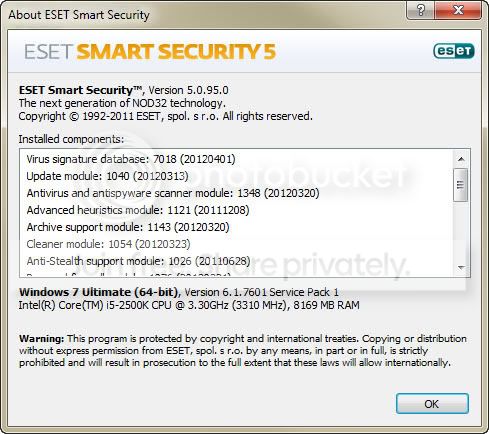
What malware are you using?
 

My Computer

Computer Manufacturer/Model Number
HP Pavillion dv-7 1005 Tx
OS
Win 8 Release candidate 8400
CPU
[email protected]
Memory
4 gigs
Graphics Card(s)
Nvidia 9600M
Sound Card
HD built-in
Monitor(s) Displays
17" Wxga
Screen Resolution
1440x900
Cooling
none
Internet Speed
45Mb down 5Mb up

just finished a scan, but it says "windows resource protection did not find any integrity violations" : /

What malware are you using?

4-2-20129-02-17PM.jpg
 

My Computer

OS
WIN 7
just got another BSOD when i watched a twitchTV stream, its a new one this time...

[FONT=Segoe UI, Arial]On Mon 4/2/2012 9:55:52 AM GMT your computer crashed
crash dump file: C:\Windows\Minidump\040212-17596-01.dmp
This was probably caused by the following module: [FONT=Segoe UI, Arial]ntfs.sys[/FONT] (Ntfs+0xF1CE8)
Bugcheck code: 0x7A (0xFFFFF6FC4000B8F8, 0xFFFFFFFFC000009D, 0x1DAB32860, 0xFFFFF8800171FCE8)
Error: [FONT=Segoe UI, Arial]KERNEL_DATA_INPAGE_ERROR[/FONT]
file path: C:\Windows\system32\drivers\ntfs.sys
product: [FONT=Segoe UI, Arial]Microsoft? Windows? Operating System[/FONT]
company: [FONT=Segoe UI, Arial]Microsoft Corporation[/FONT]
description: NT File System Driver
Bug check description: This bug check indicates that the requested page of kernel data from the paging file could not be read into memory.
The crash took place in a standard Microsoft module. Your system configuration may be incorrect. Possibly this problem is caused by another driver on your system which cannot be identified at this time.
[/FONT]

pls help~~ :cry:
 

My Computer

OS
WIN 7
I just started getting the first problem (Exactly, actually) What are your system specs?

It started for me after I switched to a refurbished hard drive due to my old hard drive failing. (Which, if I'm not mistaken, is likely the problem)
 

My Computer

OS
Windows 7 64 Bit
any1? :huh:

You do realize that if you are having more BSOD's you should be uploading the DMP files right?
 

My Computer

Computer Manufacturer/Model Number
HP Pavillion dv-7 1005 Tx
OS
Win 8 Release candidate 8400
CPU
[email protected]
Memory
4 gigs
Graphics Card(s)
Nvidia 9600M
Sound Card
HD built-in
Monitor(s) Displays
17" Wxga
Screen Resolution
1440x900
Cooling
none
Internet Speed
45Mb down 5Mb up
No DMP files included in upload try this method

We do need the DMP file as it contains the only record of the sequence of events leading up to the crash, what drivers were loaded, and what was responsible.

If you are overclocking STOP


We could also use some system information, which you can get easily by running msinfo32.
To do that go to start>run>type msinfo32>enter

When it is finished running go to file>save>name it and upload to us here.


You may be able to get the DMP files without crashing by booting into safe mode (F8) with networking.

To enable us to assist you with your computer's BSOD symptoms, upload the contents of your "\Windows\Minidump" folder.

The procedure:
* Copy the contents of \Windows\Minidump to another (temporary) location somewhere on your machine.
* Zip up the copy.
* Attach the ZIP archive to your post using the "paperclip" (file attachments) button.
*If the files are too large please upload them to a file sharing service like "Rapidshare" and put a link to them in your reply.


To ensure minidumps are enabled:
* Go to Start, in the Search Box type: sysdm.cpl, press Enter.
* Under the Advanced tab, click on the Startup and Recovery Settings... button.
* Ensure that Automatically restart is unchecked.
* Under the Write Debugging Information header select Small memory dump (256 kB) in the dropdown box (the 256kb varies).
* Ensure that the Small Dump Directory is listed as %systemroot%\Minidump.
* OK your way out.
* Reboot if changes have been made.
 

My Computer

Computer Manufacturer/Model Number
HP Pavillion dv-7 1005 Tx
OS
Win 8 Release candidate 8400
CPU
[email protected]
Memory
4 gigs
Graphics Card(s)
Nvidia 9600M
Sound Card
HD built-in
Monitor(s) Displays
17" Wxga
Screen Resolution
1440x900
Cooling
none
Internet Speed
45Mb down 5Mb up
Back
Top