
free will is like free speech..its an illusion.
Free Speech is an illusion? Tell me more.. :shock:
My Computer
At a glance
Win7 Ultimate x64 SP1 / WCP x64 / Ubuntu 11 x64
- OS
- Win7 Ultimate x64 SP1 / WCP x64 / Ubuntu 11 x64

free will is like free speech..its an illusion.


It evolved from nothingness.But if you go back far enough, where did the hydrogen come from in the first place?


I'm sitting on the fence with this one.
From one philosophical question to another. According to various notions, matter has always existed, though not always in the same form. Given that all elements present on the Earth have originated from within stars at various points in their lives and have been flung through the interstellar medium by the solar winds, it must follow that the raw material to form these elements, namely hydrogen, must have existed (which we know to be true, since our own sun also burns hydrogen at its core transforming it into helium). But if you go back far enough, where did the hydrogen come from in the first place?

But if you go back far enough, where did the hydrogen come from in the first place?
<H4>Big Bang Nucleosynthesis
</H4>One of the primary successes of the Big Bang theory is its explanation for the chemical composition of the universe. Recall that the universe is mostly hydrogen and helium, with very small amounts of heavier elements. How does this relate to the Big Bang?
Well, a long time ago, the universe was hot and dense. When the temperature is high enough (a few thousand degrees), atoms lose all their electrons; we call this state of matter, a mix of nuclei and electrons, a fully-ionized plasma. If the temperature is even higher (millions of degrees), then the nuclei break up into fundamental particles, and one is left with a "soup" of fundamental particles:
Now, if the "soup" is very dense, then these particles will collide with each other frequently. Occasionally, groups of protons and neutrons will stick together to form nuclei of light elements ... but under extremely high pressure and temperature, the nuclei are broken up by subsequent collisions. The Big Bang theory postulates that the entire universe was so hot at one time that it was filled with this proton-neutron-electron "soup."
- protons
- neutrons
- electrons
But the Big Bang theory then states that, as the universe expanded, both the density and temperature dropped. As the temperature and density fell, collisions between particles became less violent, and less frequent. There was a brief "window of opportunity" when protons and neutrons could collide hard enough to stick together and form light nuclei, yet not suffer so many subsequent collisions that the nuclei would be destroyed. This "window" appeared about three minutes after the starting point, and lasted for a bit less than a minute.
Which nuclei would form under these conditions? Experiments with particle colliders have shown us that most of the possible nuclei are unstable, meaning they break up all by themselves, or fragile, meaning they are easily broken by collisions.
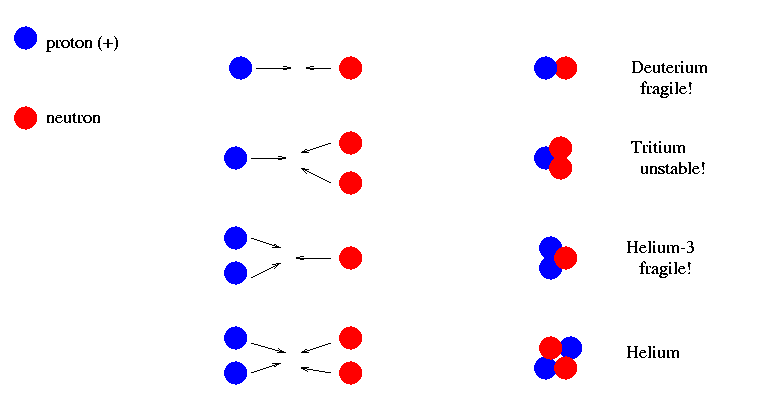
Helium (the ordinary sort, with 2 protons and 2 neutrons) is by far the most stable and robust compound nucleus. Deuterium (one proton and one neutron) is easily destroyed, and so is helium-3 (2 protons, one neutron). So, it seems that this period of hot, dense plasma would create a lot of helium.
Nothing is free, regardless of any laws that might or might not be involved. If a person want to say or do anything, they must weigh the consequences. Those consequences exist at both a personal level and on a governmental level, if one uses their freedoms to do harm to others. If they do good, or at least no harm, then the law has no jurisdiction. It is simply a matter if seeing reality as it truly is.

According to Wikipedia:Free will is the ability of agents to make choices free from certain kinds of constraints.
According to Merriam-Webster:Choice consists of the mental process of judging the merits of multiple options and selecting one of them
Merit; individual significance or justification

I think it comes down to: What is the definition of free will?
Good question, but according to Heisenberg we can never know the answer. At the singularity, Newtonian physics counts for nought (or should that be one? or maybe both?) The quantum world is a strange place..........
Ahh, but 'who/what/why' ignited the Big Bang in the first place?
Was it intentionally lit, or was it random?
Disregarding any theories, quantum or otherwise, where there is an effect, there is a cause. Science may not be able to determine the cause, but it was there, and remains today.

Good question, but according to Heisenberg we can never know the answer. At the singularity, Newtonian physics counts for nought (or should that be one? or maybe both?) The quantum world is a strange place..........
https://en.wikipedia.org/wiki/Uncertainty_principle
Good question, but according to Heisenberg we can never know the answer.
 )
)At the singularity, Newtonian physics counts for nought (or should that be one? or maybe both?) The quantum world is a strange place..........

Disregarding any theories, quantum or otherwise, where there is an effect, there is a cause. Science may not be able to determine the cause, but it was there, and remains today.
Eh?


