XP Mode slow copying to host

newuser

New member
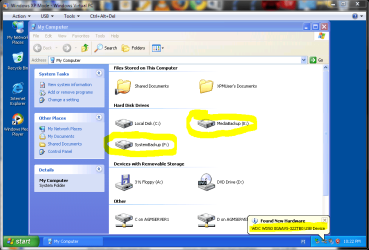
Okay i copied a 100mb file from xp mode virtual hdd to a drive on the host and it took over 3 miuntes, 600mb of files took over 25 minutes. I don't see why copying from the virtual machine to the host is half as slow as it takes me to actually download them lol.
 

My Computer

OS
W7RC
So the speed is around 560kbps, this is typical for a network transfer speed.

To the best of my knowledge, Microsoft XP Mode's file sharing are all based on RDP protocol, so even if your vm is on same PC as your host, it will still go through all TCP/IP traffic between the vm and the host. Even the display itself is through RDP, this is why XP Mode is slow.
 

My Computer

OS
windows 7
So the speed is around 560kbps, this is typical for a network transfer speed.

To the best of my knowledge, Microsoft XP Mode's file sharing are all based on RDP protocol, so even if your vm is on same PC as your host, it will still go through all TCP/IP traffic between the vm and the host. Even the display itself is through RDP, this is why XP Mode is slow.
Exactly. XP Mode acts like any other computer on your network, it is not directly connected to host. You can make copying a little bit faster by attaching an external hd temporarily to XP (XP Mode > USB Menu) and copying the file there.

Kari
 

My Computer

Computer type
Laptop
Computer Manufacturer/Model Number
HP ENVY 17-1150eg
OS
Windows 10 Pro x64 EN-GB
CPU
1.6 GHz Intel Core i7-720QM Processor
Memory
6 GB
Graphics Card(s)
ATI Mobility Radeon HD 5850 Graphics
Sound Card
Beats sound system with integrated subwoofer
Monitor(s) Displays
17" laptop display, 22" LED and 32" Full HD TV through HDMI
Screen Resolution
1600*900 (1), 1920*1080 (2&3)
Hard Drives
Internal: 2 x 500 GB SATA Hard Disk Drive 7200 rpm
External: 2TB for backups, 3TB USB3 network drive for media
Cooling
As Envy runs a bit warm, I have it on a Cooler Master pad
Keyboard
Logitech diNovo Media Desktop Laser (bluetooth)
Mouse
Logitech Performance Mouse MX
Internet Speed
50/10 Mbps VDSL
Antivirus
Windows Defender 4.3.9431.0
Browser
Maxthon 3.5.2., IE11
I think even USB is redirected through RDP.

The fastest way is to mount the image file (base .vhd + snapshot) as virtual disk to the host while the VM is offline. You can then copy large files between vm and host.

We (www.vmlite.com) will provide such free disk tools. Microsoft has a tool called VhdMount, too. However, I am not sure whether it handles snapshots. XP Mode VM consists of a base image, plus a snapshot (the diff file), you will need to mount them as a whole to get the files.
 

My Computer

OS
windows 7
I think even USB is redirected through RDP.
I don't think so. When you mount an external device, it is no longer available to host. It is really installed as a new device directly, and is thereafter seen as an internal drive, not network drive, thus making copying and moving faster. This image tells it better:

mount hd.PNG

Kari
 

My Computer

Computer type
Laptop
Computer Manufacturer/Model Number
HP ENVY 17-1150eg
OS
Windows 10 Pro x64 EN-GB
CPU
1.6 GHz Intel Core i7-720QM Processor
Memory
6 GB
Graphics Card(s)
ATI Mobility Radeon HD 5850 Graphics
Sound Card
Beats sound system with integrated subwoofer
Monitor(s) Displays
17" laptop display, 22" LED and 32" Full HD TV through HDMI
Screen Resolution
1600*900 (1), 1920*1080 (2&3)
Hard Drives
Internal: 2 x 500 GB SATA Hard Disk Drive 7200 rpm
External: 2TB for backups, 3TB USB3 network drive for media
Cooling
As Envy runs a bit warm, I have it on a Cooler Master pad
Keyboard
Logitech diNovo Media Desktop Laser (bluetooth)
Mouse
Logitech Performance Mouse MX
Internet Speed
50/10 Mbps VDSL
Antivirus
Windows Defender 4.3.9431.0
Browser
Maxthon 3.5.2., IE11
I know the USB devices acts as builtin devices, but that still could use tcp/ip as underlying transfer protocol, just like some orher remote USB devices.

Of course, if you check the transfer speed, if it is much faster than network (e.g., a few Mbps), then you are right, and they must be tunnelling through direct vm/host ports.
 

My Computer

OS
windows 7
I know this thread has been inactive a long time, but I am having the same problem. And I am having much, much slower speeds than the OP. Much slower than just network speeds. In my case, I am copying from the host to the virtual machine. I was thinking it may have had something to do with the hard disk of the vm being of dynamic size and having to grow all the time. But I created a fixed second disk, and it was no better. Plus, copying internally from between the to disks is fine. It is taking me 12 minutes for me to copy 25 Mb of data!

Anyone have any thoughts on this?

Thanks
 

My Computer

OS
Windows 7 Unltimate x64
Hi there
Your best bet for this type of stuff is to actually FORGET XP mode -- use vmware player or vbox -- and attach the USB device directly to the GUEST as a "Shared" device"

This way you should get full USB speed access in the Guest VM so copying data to a Virtual disk ON THE VM should be nearly as fast as on the Native HOST. If using VBOX / VMWARE logon to the vm first of course.

(It might work like that too in XP mode -- No idea on that however)

The Host will be able to access it too -- best bet is to use "Host only" Networking -- then the Virtual Network adapter can run as much as 1 GB/s -- much much better than XP mode.

IF you HAVE to use XP mode then I think you are limited to ITS virtual network adapter speed which is as SLOW as Molasses it really does run at "Glacial speed".

I know for some people XP mode is the only option --free copy of XP too but the implementation unfortunately while a great idea leaves a LOT to be desired especially when compared with full featured Virtualisation products from vmware and vbox.

Cheers
jimbo
 

My Computer

Computer type
PC/Desktop
Computer Manufacturer/Model Number
Custom built, several laptops HP/ASUS
OS
Linux CENTOS 7 / various Windows OS'es and servers
CPU
Intel i7 Intel i5
Memory
8GB, 16GB
Graphics Card(s)
On Motherboard
Sound Card
Realtek HD audio
Monitor(s) Displays
Apple Cinema display, Samsung LCD
Screen Resolution
1920 X 1080
Hard Drives
4 X 1TB SATA
Mouse
Toshiba wireless laser
Internet Speed
> 20MB up
Thanks for your reply. I found the answer shortly after I posted on here. I found a post about disabling task offloading in the registry, but I just disabled TCP and UDP Checksum Offloading on the host's NIC and things sped right up.

We do use VMware here a lot, but I figured for the ease of installation (and just to see what it was like) I would try XP mode. It's the first time I've looked at it. Seems OK once the disk access speed issue was cleared up.

Jeff
 

My Computer

OS
Windows 7 Unltimate x64
I just disabled TCP and UDP Checksum Offloading on the host's NIC and things sped right up.
Jeff

I too have the same slowness you spoke of and would like to fix it. I am not familiar with the procedure you mention. I am running Windows 7 and xp mode and my question to you is:
1. Where do I turn these two off?
2. What could be the consequences for the rest of my computer?

Thanks very much
 
Last edited:

My Computer

OS
Windows 7 Pro-64 bit
First I found this, which seemed to work: (the registry change should be done on the host (Win7) machine, not the XP machine)
Workaround for Windows VPC networking slowness between host and guest

Then a coworker showed me how to disable this without the registry edit:
Start->Control Panel->Network and Sharing Center->Chagne Adapter Settings->Dbl-click 'Local Area Connection'->
Properties->Configure->Advanced-> Disable TCP Checksum Offload and UDP Checksum Offload (one each for IPv4 and IPv6)

This worked for me. I hope it helps you.

Jeff
 

My Computer

OS
Windows 7 Unltimate x64
Jeff,
Thanks I will try that. Do you happen to know if it affects anything in Windows 7??
I am not really sure what I am doing when I disable those settings.
 

My Computer

OS
Windows 7 Pro-64 bit
You know, it must effect something. But my coworker says they set it all the time in certain situations. I haven't noticed any ill effects since I made the change. I googled a bit trying to find what it really does and only found others asking the same question!
 

My Computer

OS
Windows 7 Unltimate x64
Thanks, actually I was told by someone who knows a lot more than I do that the setting if disabled will have the cpu do the checksums instead of the nic card. He said in his opinion it would only make a difference in very very large data transfers.

So thanks I am going to do it and I can always change it back if I see any problems.
 

My Computer

OS
Windows 7 Pro-64 bit
Back
Top