Partition / Extended : Logical Drives

How to Create Extended Partition / Logical Drives Where Needed

The Windows Master Boot Record (MBR) partition structure supports a total of only four (4) partitions per Hard Disk Drive / Solid State Drive, they can be either 4 Primary partitions or three (3) Primary partitions and a single (1) Extended partition.
This shows the different methods to create an Extended partition wherever you need one so you can create as many Logical drives as there are available drive letters that can be used to install a Windows Operating System or for data storage.
   Warning

As with anything that makes changes to the Windows structure there is always the chance for an error to occur, it would be advisable to make reliable backups to the external media of your choice of any important data, i.e. pictures, music or documents, that you would not want to lose before you make any changes to your system, it is always better to be safe than sorry.

Let's get started!
If there are 3 existing Primary partitions on the HDD / SSD already, the fourth partition created using Windows disk management will be an Extended partition by default.

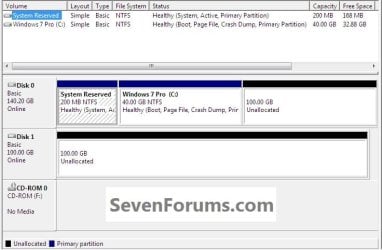
To view the relevant information on the partition structure, type diskmgmt.msc in the Windows start menu search box, then right click the entry and click "Run as Administrator" if you should get a User Account Control (UAC) prompt enter your user credentials and click Yes.


Method One

This is what I'll be starting with.
click any image to enlarge
Start.jpg
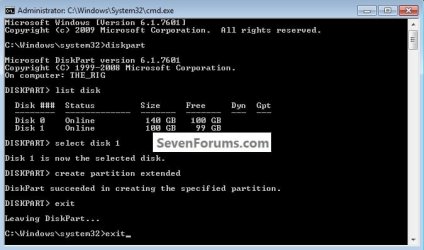
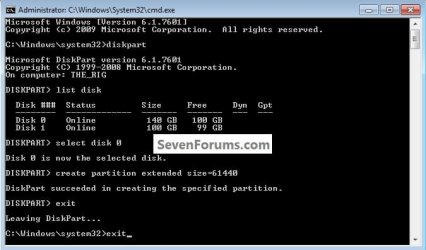
1) Open an elevated command prompt, in the command window that opens type diskpart and hit the <enter> key, all commands are followed by <enter>.

Here are the commands, click the images below to see how they are implemented.
list disk

select disk # (# = target disk number)

create partition extended

exit (2 times to close the command window)
If you need to create a specific size Extended partition, use this command.
create partition extended size=61440 <- 60GB
It has to be entered as MB and 1024MB = 1GB so 1024x60 = 61440

You can create any size you need using the formula above.
disko_size.jpg
disk1.jpg
disk0_size_2.jpg
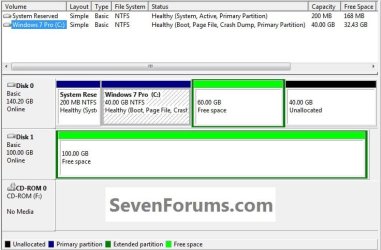
2) Now in Windows disk management right click the Extended partition Free Space to create Logical drive(s) as needed, anything created within an Extended will be a Logical drive by default.

You can create as many Logical drives within an Extended partition as there are available drive letters; you can create and name the drives in any way you like, this is just an example.
Logical.jpg


Method Two

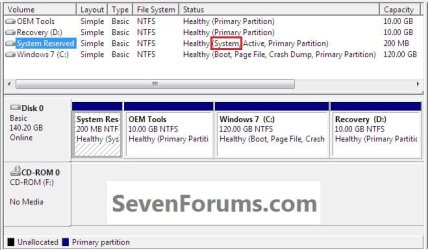
Here's the situation a lot of people are finding themselves in when purchasing a factory built PC these days, a single HDD and all the partitions taken by the manufacturer, leaving no chance of creating any additional partitions.
The fortunate side of a layout like this is the use of the new Windows 7 System Reserved partition and it being the System Volume, where the Windows boot files are stored.

If this is the situation you're in, after you have made back-ups of the data you need to save to external media and created the set of factory recovery disks or better still, created a complete image of the entire HDD to external media that can be restored if the need ever arises, have a look at the information below.
click image to enlarge
2.1.jpg
   Warning

If you do not have the Windows System Reserved or a System Primary partition completely separate from the Windows 7 partition present that is marked as the "System" partition in disk management do not attempt this, if you do Windows will not boot as Windows will not/is not able to boot / start independently from an Extended partition Logical drive, the system boot files must be stored on a Primary partition to execute.

Windows XP users, do not do this or XP will not boot at all.

Start by downloading the Partition Wizard Bootable ISO file from either link below then use the Windows 7 USB/DVD Download Tool to create a bootable DVD or USB flash drive.

Partition Wizard Free Bootable CD

OR

Partition Wizard Bootable Flash Drive
To boot the disk, in the BIOS set the PC boot order to boot first from the CD/DVD or USB drive, insert the PWBD and restart the PC, it'll take a few minutes for it to setup with no input at all from the user needed.
Once the program has started you can remove the CD/DVD or USB if you like.

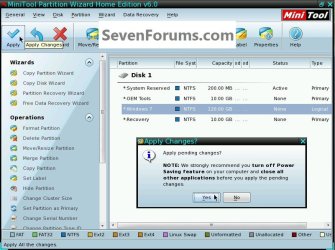
1) In the Partition Wizard program, right click the Windows 7 partition and click Modify then Set as Logical; then at the top left Action bar click Apply; then click Yes for the conformation dialog box.
click any image to enlarge
2.2.jpg
2.3.jpg
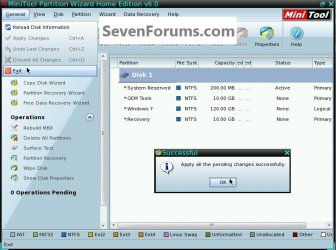
2) You will get a Pending window but that just takes seconds to complete and then click OK for the Successful dialog box.

Then remove the PWBD from the CD/DVD or USB drive and at the upper left corner click General then Exit to close the Partition Wizard program and restart Windows 7.
2.8.1.jpg
Restart Windows a couple times before you proceed to make sure all is well.

In the Windows 7 start menu search box type diskmgmt.msc then right click the entry and click "Run as Administrator" if you get a User Account Control (UAC) prompt enter your user credentials and click Yes.

3) In disk management right click the Windows 7 partition and click Shrink Volume you can accept the offered size or you can create a specific size, don't make Windows 7 too small so installed programs/apps have the needed room.
click any image to enlarge
2.5.jpg
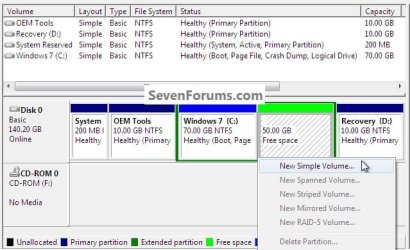
4) Now right click the new Extended partition Free Space and click New Volume to create the Logical drive(s) one at a time as needed.
2.6.jpg
It is suggested to restart Windows every time you make a change to let Windows 7 accept the changes to the system without issue.
2.7.jpg
Enjoy! :)


Last edited by a moderator:
Dear all,

Please advice how to put back a partition into primary partition. I need to have it all back to disk 0

Hello Yousef, and welcome to Seven Forums.

Please go ahead and post back with a screenshot showing the full layout of your Disk Management window first. This way we will be able to give you an accurate answer. :)


Dear Brink, Thank you for immediate reply...attached screen shot.
 

Attachments

  • disk mgnt..png
    disk mgnt..png
    12.2 KB · Views: 261
Last edited by a moderator:

My Computer

OS
Ultimate Win7 32bit
And what exactly do you want to do ??
 

My Computer

Computer Manufacturer/Model Number
HP, Dell, Gateway, Toshiba - 4 laptops and 2 desktops
OS
Vista, Windows7, Mint Mate, Zorin, Windows 8
CPU
from 1.6GHz Duo to i7
Monitor(s) Displays
2x HP w2207
Hard Drives
5x HDD, 7x SSD, 12x Externals
Keyboard
with trackball - no mices
Mouse
Trackball mice
Internet Speed
DSL 6000
Dear Brink, Thank you for immediate reply...attached screen shot.

Yousef,

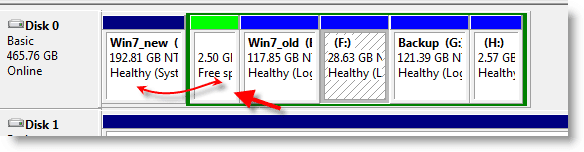
You'll need to use a free program like MiniTool Partition Wizard Free to be able to extend the Win7-new (192.81 GB) partition into the 2.50 GB partition.

The instructions at the program's links below can help show you how to.

First delete the 2.50 GB partition:
How to Delete Partition with partition manager? Partition Wizard Help

Next, extend Win7-new (192.81 GB) partition into the 2.50 GB partition.
Extend partition with partition magic software ? MiniTool Partition Wizard.

Hope this helps. :)
 

My Computer

Computer type
PC/Desktop
Computer Manufacturer/Model Number
Self built custom
OS
64-bit Windows 11 Pro for Workstations
CPU
Intel i7-8700K OC'd to 5 GHz
Motherboard
ASUS ROG Maximus XI Formula Z390
Memory
64 GB (4x16GB) G.SKILL TridentZ RGB DDR4 3600 MHz
Graphics Card(s)
ASUS ROG-STRIX-GTX1080TI-O11G-GAMING
Sound Card
Integrated
Monitor(s) Displays
2 x Samsung Odyssey G7 27"
Screen Resolution
2560x1440
Hard Drives
1TB Samsung 990 PRO M.2,
4TB Samsung 990 PRO PRO M.2,
TerraMaster F8 SSD Plus NAS
PSU
Seasonic Prime Titanium 850W
Case
Thermaltake Core P3
Cooling
Corsair Hydro H115i
Keyboard
Logitech wireless K800
Mouse
Logitech MX Master 4
Internet Speed
2 Gb/s Download and 100 Mb/s Upload
Antivirus
Malwarebyte Anti-Malware Premium
Browser
Google Chrome
Other Info
Logitech Z625 speaker system,
Logitech BRIO 4K Pro webcam,
HP Color LaserJet Pro MFP M477fdn,
APC SMART-UPS RT 1000 XL - SURT1000XLI,
Galaxy S23 Plus phone
You're welcome Yousef. Glad it was able to help. :)
 

My Computer

Computer type
PC/Desktop
Computer Manufacturer/Model Number
Self built custom
OS
64-bit Windows 11 Pro for Workstations
CPU
Intel i7-8700K OC'd to 5 GHz
Motherboard
ASUS ROG Maximus XI Formula Z390
Memory
64 GB (4x16GB) G.SKILL TridentZ RGB DDR4 3600 MHz
Graphics Card(s)
ASUS ROG-STRIX-GTX1080TI-O11G-GAMING
Sound Card
Integrated
Monitor(s) Displays
2 x Samsung Odyssey G7 27"
Screen Resolution
2560x1440
Hard Drives
1TB Samsung 990 PRO M.2,
4TB Samsung 990 PRO PRO M.2,
TerraMaster F8 SSD Plus NAS
PSU
Seasonic Prime Titanium 850W
Case
Thermaltake Core P3
Cooling
Corsair Hydro H115i
Keyboard
Logitech wireless K800
Mouse
Logitech MX Master 4
Internet Speed
2 Gb/s Download and 100 Mb/s Upload
Antivirus
Malwarebyte Anti-Malware Premium
Browser
Google Chrome
Other Info
Logitech Z625 speaker system,
Logitech BRIO 4K Pro webcam,
HP Color LaserJet Pro MFP M477fdn,
APC SMART-UPS RT 1000 XL - SURT1000XLI,
Galaxy S23 Plus phone
Oh Thank you! This MiniTool Partition Wizard is excellent! I downloaded it and it fixed all my partitioning problems. I made 4 huge partitions immediately without an problem. I have been spending my whole day trying every method I read in forums but none of them work. but this Partition Wizard solved all of them at once. It is incredible. I donated money to their website immediately. Since this software solved my problem in 10 minutes while I have been searching on Microsoft.com, using their live chat support,

applying hundreds of other solutions in forums for hours. Thank you very much for introducing this software. I love it. Thank you!
 

My Computer

Computer type
PC/Desktop
OS
Oklahoma
Oh Thank you! This MiniTool Partition Wizard is excellent! I downloaded it and it fixed all my partitioning problems. I made 4 huge partitions immediately without an problem. I have been spending my whole day trying every method I read in forums but none of them work. but this Partition Wizard solved all of them at once. It is incredible. I donated money to their website immediately. Since this software solved my problem in 10 minutes while I have been searching on Microsoft.com, using their live chat support,

applying hundreds of other solutions in forums for hours. Thank you very much for introducing this software. I love it. Thank you!
Hello emoallem, welcome to Seven Forums; glad we could be a help.
 

My Computer

Computer Manufacturer/Model Number
* BFK Customs *
OS
W 7 64-bit Ultimate
CPU
Intel Q9550 Yorkfield
Motherboard
ASUS P5Q Pro
Memory
8GB Dominator 8500C5D
Graphics Card(s)
ATI : XFX 5870
Sound Card
Realtek HD Audio 7-1
Monitor(s) Displays
1x 47" LCD HDMI & 3x 26" LCD HDMI
Screen Resolution
1920x1080P & 1920x1200
Hard Drives
1x 80GB Intel X25-M G2 SSD : 1x 500GB & 1x 640GB WD Caviar Black(s)
PSU
Corsair 620HX
Case
Cooler Master RC-690
Cooling
Tuniq Tower 120, 2x 140mm and 3x 120mm case fans
Keyboard
Microsoft 500
Mouse
Razer Diamondback 3G
Internet Speed
14 Mb/s
Other Info
1x Koutech 3Gb/s SATA HDD Hot Swap Rack
Hi

First off sorry for reawakening the thread, but I really need help.

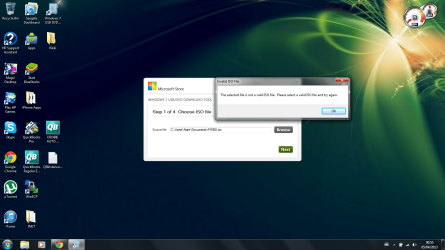
Ok so i have downloaded all the necissary things including PWBD ISO file but when I attempt to use Windows 7 USB/DVD Download Tool to create a bootable USB i get an error saying that I have an invalid ISO file?
Please see the Screenshot
 

Attachments

  • Invalid ISO.png
    Invalid ISO.png
    863.6 KB · Views: 134

My Computer

Computer type
Laptop
Computer Manufacturer/Model Number
HP
OS
Windows 7 Home Premium x64
You have the CD version. For the USB version you need PW Pro. I am sure it will burn to CD.
 

My Computer

Computer Manufacturer/Model Number
HP, Dell, Gateway, Toshiba - 4 laptops and 2 desktops
OS
Vista, Windows7, Mint Mate, Zorin, Windows 8
CPU
from 1.6GHz Duo to i7
Monitor(s) Displays
2x HP w2207
Hard Drives
5x HDD, 7x SSD, 12x Externals
Keyboard
with trackball - no mices
Mouse
Trackball mice
Internet Speed
DSL 6000
yes but thats not the main issue..because I thought of that but u select the ISO file before u select the medium(CD/USB) so it gives me that error before I even get a chance to choose USB...

Is there something wrong with the file? or maybe I need to use a different application to create the bootable cd from the ISO
 

My Computer

Computer type
Laptop
Computer Manufacturer/Model Number
HP
OS
Windows 7 Home Premium x64
yes but thats not the main issue..because I thought of that but u select the ISO file before u select the medium(CD/USB) so it gives me that error before I even get a chance to choose USB...

Is there something wrong with the file? or maybe I need to use a different application to create the bootable cd from the ISO


Hello Nate, and welcome to Seven Forums.

Did you use this to create the USB with?

Boot partition manager from USB Flash disk directly to manage disk partition - Partition Wizard Bootable Flash Drive.
 
Last edited:

My Computer

Computer type
PC/Desktop
Computer Manufacturer/Model Number
Self built custom
OS
64-bit Windows 11 Pro for Workstations
CPU
Intel i7-8700K OC'd to 5 GHz
Motherboard
ASUS ROG Maximus XI Formula Z390
Memory
64 GB (4x16GB) G.SKILL TridentZ RGB DDR4 3600 MHz
Graphics Card(s)
ASUS ROG-STRIX-GTX1080TI-O11G-GAMING
Sound Card
Integrated
Monitor(s) Displays
2 x Samsung Odyssey G7 27"
Screen Resolution
2560x1440
Hard Drives
1TB Samsung 990 PRO M.2,
4TB Samsung 990 PRO PRO M.2,
TerraMaster F8 SSD Plus NAS
PSU
Seasonic Prime Titanium 850W
Case
Thermaltake Core P3
Cooling
Corsair Hydro H115i
Keyboard
Logitech wireless K800
Mouse
Logitech MX Master 4
Internet Speed
2 Gb/s Download and 100 Mb/s Upload
Antivirus
Malwarebyte Anti-Malware Premium
Browser
Google Chrome
Other Info
Logitech Z625 speaker system,
Logitech BRIO 4K Pro webcam,
HP Color LaserJet Pro MFP M477fdn,
APC SMART-UPS RT 1000 XL - SURT1000XLI,
Galaxy S23 Plus phone

My Computer

Computer type
Laptop
Computer Manufacturer/Model Number
HP
OS
Windows 7 Home Premium x64

My Computer

Computer type
PC/Desktop
Computer Manufacturer/Model Number
Golden Mk. I.4
OS
Windows 10 Pro x64 ; Xubuntu x64
CPU
Intel i7 860 @ 2.80 GHz O/C'ed to 4.0GHz
Motherboard
Gigabyte P55A-UD3R Rev.1. Award BIOS F13
Memory
16GB Corsair Vengance DDR3 @ 661 MHz Dual Channel (9-9-9-24)
Graphics Card(s)
EVGA NVidia GTX 560 1024MB
Sound Card
Realtek Integrated
Monitor(s) Displays
Dual Samsung SyncMaster 2494HS
Screen Resolution
1920*1080 and 1920*1080
Hard Drives
1*Samsung 840 EVO 120GB SSD;
1*OCZ Vertex 2 60GB SSD;
2*Samsung F3 SpinPoint 1TB in RAID0;
1*Samsung F1 SpinPoint 1TB;
2*Western Digital 1TB External USB 3.0
1*Western Digital 500GB External USB 3.0
1*Seagate 500GB External USB 2.0
PSU
Thermaltake ToughPower QFan 750W
Case
Thermaltake Element S VK60001W2Z
Cooling
Corsair H60 Water Cooling, 2*230mm and 2*80mm case fans
Keyboard
Logitech G110
Mouse
Logitech MX518
but u have to buy pro for that dont u?
 

My Computer

Computer type
Laptop
Computer Manufacturer/Model Number
HP
OS
Windows 7 Home Premium x64
Mmm. Im not sure .... I always thought it was free.

Nevermind, use FREE YUMI to write the ISO to a flash drive and make it bootable. That definitely works. Use the "Unlisted ISO" option of YUMI.
 

My Computer

Computer type
PC/Desktop
Computer Manufacturer/Model Number
Golden Mk. I.4
OS
Windows 10 Pro x64 ; Xubuntu x64
CPU
Intel i7 860 @ 2.80 GHz O/C'ed to 4.0GHz
Motherboard
Gigabyte P55A-UD3R Rev.1. Award BIOS F13
Memory
16GB Corsair Vengance DDR3 @ 661 MHz Dual Channel (9-9-9-24)
Graphics Card(s)
EVGA NVidia GTX 560 1024MB
Sound Card
Realtek Integrated
Monitor(s) Displays
Dual Samsung SyncMaster 2494HS
Screen Resolution
1920*1080 and 1920*1080
Hard Drives
1*Samsung 840 EVO 120GB SSD;
1*OCZ Vertex 2 60GB SSD;
2*Samsung F3 SpinPoint 1TB in RAID0;
1*Samsung F1 SpinPoint 1TB;
2*Western Digital 1TB External USB 3.0
1*Western Digital 500GB External USB 3.0
1*Seagate 500GB External USB 2.0
PSU
Thermaltake ToughPower QFan 750W
Case
Thermaltake Element S VK60001W2Z
Cooling
Corsair H60 Water Cooling, 2*230mm and 2*80mm case fans
Keyboard
Logitech G110
Mouse
Logitech MX518
alrdy found another program that worked but TY very much for the help guys
 

My Computer

Computer type
Laptop
Computer Manufacturer/Model Number
HP
OS
Windows 7 Home Premium x64
When i create the partition (new logical drive) should i format it? or should i say dont format now?
P.S. i want to install an OS on the new partition.. also i dont want to loose any data...
 

My Computer

Computer type
Laptop
Computer Manufacturer/Model Number
HP
OS
Windows 7 Home Premium x64

My Computer

Computer type
PC/Desktop
Computer Manufacturer/Model Number
Golden Mk. I.4
OS
Windows 10 Pro x64 ; Xubuntu x64
CPU
Intel i7 860 @ 2.80 GHz O/C'ed to 4.0GHz
Motherboard
Gigabyte P55A-UD3R Rev.1. Award BIOS F13
Memory
16GB Corsair Vengance DDR3 @ 661 MHz Dual Channel (9-9-9-24)
Graphics Card(s)
EVGA NVidia GTX 560 1024MB
Sound Card
Realtek Integrated
Monitor(s) Displays
Dual Samsung SyncMaster 2494HS
Screen Resolution
1920*1080 and 1920*1080
Hard Drives
1*Samsung 840 EVO 120GB SSD;
1*OCZ Vertex 2 60GB SSD;
2*Samsung F3 SpinPoint 1TB in RAID0;
1*Samsung F1 SpinPoint 1TB;
2*Western Digital 1TB External USB 3.0
1*Western Digital 500GB External USB 3.0
1*Seagate 500GB External USB 2.0
PSU
Thermaltake ToughPower QFan 750W
Case
Thermaltake Element S VK60001W2Z
Cooling
Corsair H60 Water Cooling, 2*230mm and 2*80mm case fans
Keyboard
Logitech G110
Mouse
Logitech MX518
I don't understand why, in method 2, I wouldn't just start at 3) without downloading the tool. Let's say I want to make a separate drive to store restore points from C: (the boot drive) because I keep getting volsnap error 25 and deletion of all points. I have a systems drive, C: and D: (recovery). Why not just shrink C: and create a separate drive to store restore points that way? Not that I quite understand how to move where I store them yet but I'm reading up on it. Just wondering.
 

My Computer

Computer Manufacturer/Model Number
HP Pavilion p6745f
OS
Microsoft Windows 7 Home Premium 64-bit 7601 Multiprocessor Free Service Pack 1
CPU
Intel(R) Core(TM) i5-2300 CPU @ 2.80GHz
Motherboard
PEGATRON CORPORATION 2AB6
Memory
6 GB
Graphics Card(s)
Radeon 6750 1gb
Sound Card
(1) IDT High Definition Audio CODEC (2) Intel(R) Display A
Monitor(s) Displays
Acer x193w
Hard Drives
(1) WDC WD15EARS-60MVWB0 (2) Generic- Compact Flash USB Device (3) Generic- MS/MS-Pro USB Device (4) Generic- SD/MMC USB Device (5) Generic- SM/xD-Picture USB Device (6) WD My Book 1110 USB Device
PSU
Internal 500W (100V-240V)
Case
Mid-size ATX
Cooling
unknown
Keyboard
HP usb multimedia keyboard
Mouse
HP usb compliant mouse
Internet Speed
256 kbps
Other Info
Ver: CHI_713.bin vCHI7.13
I don't understand why, in method 2, I wouldn't just start at 3) without downloading the tool. Let's say I want to make a separate drive to store restore points from C: (the boot drive) because I keep getting volsnap error 25 and deletion of all points. I have a systems drive, C: and D: (recovery). Why not just shrink C: and create a separate drive to store restore points that way? Not that I quite understand how to move where I store them yet but I'm reading up on it. Just wondering.

Hello pxfragonard,

I'm afraid that restore points can only be stored on the drive letter they are for. :(
 

My Computer

Computer type
PC/Desktop
Computer Manufacturer/Model Number
Self built custom
OS
64-bit Windows 11 Pro for Workstations
CPU
Intel i7-8700K OC'd to 5 GHz
Motherboard
ASUS ROG Maximus XI Formula Z390
Memory
64 GB (4x16GB) G.SKILL TridentZ RGB DDR4 3600 MHz
Graphics Card(s)
ASUS ROG-STRIX-GTX1080TI-O11G-GAMING
Sound Card
Integrated
Monitor(s) Displays
2 x Samsung Odyssey G7 27"
Screen Resolution
2560x1440
Hard Drives
1TB Samsung 990 PRO M.2,
4TB Samsung 990 PRO PRO M.2,
TerraMaster F8 SSD Plus NAS
PSU
Seasonic Prime Titanium 850W
Case
Thermaltake Core P3
Cooling
Corsair Hydro H115i
Keyboard
Logitech wireless K800
Mouse
Logitech MX Master 4
Internet Speed
2 Gb/s Download and 100 Mb/s Upload
Antivirus
Malwarebyte Anti-Malware Premium
Browser
Google Chrome
Other Info
Logitech Z625 speaker system,
Logitech BRIO 4K Pro webcam,
HP Color LaserJet Pro MFP M477fdn,
APC SMART-UPS RT 1000 XL - SURT1000XLI,
Galaxy S23 Plus phone
Back
Top