From my perspective (and I suspect some other people's) they are wasting time (and presumably money) on this Metro UI.
They could be using that time (and money) fixing up various glitches, performance lags and security vulnerabilities that exist in Windows 7 (i.e. so they don't exist in Windows 8).
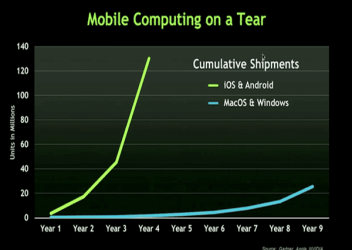
From the MS perspective that is not so. The mobile market is a huge business opportunity that grows 10 times faster than the PC market. And up to now, MS is not really present in this market because they lack ARM support that 99% of the mobile devices require.
With Windows8, they will change the whole landscape. Apart from new users, they will chew a big portion of today's Android and Apple market. Plus, the ARM processors will migrate into the Netbook and laptop market which again is an excellent opportunity.
Qualcom alone makes 1 million ARM chips every day - and that is not counting Nvidea and the other manufacturers. Why would MS stand on the side and let the others take that share.
This is a graph that shows the growth of mobile devices in the first 4 years (Android and Apple only) versus the growth of the PC market in the first 9 years (Windows and Mac). And don't confuse inventory with growth. It is in the growth where the money is being made.
Hi there
Why is it so many companies make the SAME mistake over and over again. MS I think will avoid this particular issue however.
In the beginning the growth market is HUGE -- so they go all out and spend shed loads of money grossly expanding the business -- then surprise surprise -- the market has matured and growth drops from 85% to a more realistic 3 or 4% -- but this isn't making up for the initial HUGE investment incurred -- investors panic, stock falls and company possibly even goes out of business.
These companies never think about what do we do AFTER a market matures.
It's the same in retail -- in shopping malls and towns all over the place there were literally HUGE numbers of Mobile Phone outlets --- now every man and his dog has at least one and possibly 2 mobiles half these outlets are shutting down -- the replacement and upgrade market isn't a patch on the initial flurry when these devices were largely new and unknown.
Even some of the brand names sound rather pedantic nowadays --- such as "The Car Phone warehouse"--what's so special about a phone in a car -- these days it actually has a NEGATIVE connotation -- using mobiles in Cars even Hands free is in some countries and backed up by most University research programs considered to be at least as dangerous as driving TWO times over the standard European legal drink drive limit (2 times over 50 mg).
There's always a rush to hit to hit the market first, flood it to become an almost monopoly and then wonder why a year or two down the road the company goes bust because it's not making money anymore.
I LIKE innovation etc but some of our modern business models are MUCH TOO SHORT TERM. It's good to see MS looking for new revenue streams since windows and MS office products good though they are can't produce mega cash indefinitely.
You only have to look at the once mighty Kodak relying on the wrong product (printers now --total disaster to base any sort offuture on these as more and more documents - even LEGAL stuff is becoming electronic and Canon and Epson do printers much better anyway than Kodak.
Even IBM had to switch from making hardware "Big Blue" to providing services to continue as a top notch company.
Other companies beginning to get into trouble are : HMV (people are moving away from CD/DVD's and the market for Vinyl while there and is STABLE believe it or not) is specialized and very small,
WH SMITH -- large bookseller / stationer / etc etc. Nobody actually knows what this chain really stands for any more -- it's largely kept alive by its commercial news division (WH SMITH News) - media distribution / advertising contracts etc based in Swindon UK -- but I'll bet 99% of customers going into a WH Smith branch in the UK will never have heard of it.
Comet - part of Kingfisher -- sells basically White goods and lower end PC's -- this end of the market is hugely tapped by the Internet - people don't need expensive retail space as these Internet stores only have to ship when a customer orders. This end of the market too is now saturated and only supplying basically people who are upgrading their old machines / computers.
cheers
jimbo