

On March 12, 2018, AMD received a communication from CTS Labs regarding research into security vulnerabilities involving some AMD products. Less than 24 hours later, the research firm went public with its findings. Security and protecting users’ data is of the utmost importance to us at AMD and we have worked rapidly to assess this security research and develop mitigation plans where needed. This is our first public update on this research, and will cover both our technical assessment of the issues as well as planned mitigation actions.
The security issues identified by the third-party researchers are not related to the AMD “Zen” CPU architecture or the Google Project Zero exploits made public Jan. 3, 2018. Instead, these issues are associated with the firmware managing the embedded security control processor in some of our products (AMD Secure Processor) and the chipset used in some socket AM4 and socket TR4 desktop platforms supporting AMD processors.
As described in more detail below, AMD has rapidly completed its assessment and is in the process of developing and staging the deployment of mitigations. It’s important to note that all the issues raised in the research require administrative access to the system, a type of access that effectively grants the user unrestricted access to the system and the right to delete, create or modify any of the folders or files on the computer, as well as change any settings. Any attacker gaining unauthorized administrative access would have a wide range of attacks at their disposal well beyond the exploits identified in this research. Further, all modern operating systems and enterprise-quality hypervisors today have many effective security controls, such as Microsoft Windows Credential Guard in the Windows environment, in place to prevent unauthorized administrative access that would need to be overcome in order to affect these security issues. A useful clarification of the difficulties associated with successfully exploiting these issues can be found in this posting from Trail of Bits, an independent security research firm who were contracted by the third-party researchers to verify their findings.
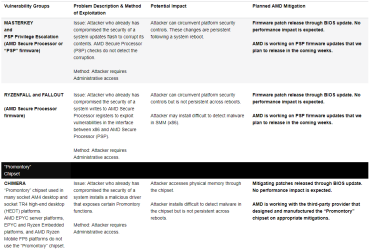
The security issues identified can be grouped into three major categories. The table below describes the categories, the AMD assessment of impact, and planned actions.
AMD will provide additional updates on both our analysis of these issues and the related mitigation plans in the coming weeks.
Mark Papermaster,
Senior Vice President and Chief Technology Officer
Source: AMD Corporate: Initial AMD Technical Assessment... | Community
My Computer
- Computer type
- PC/Desktop
- Computer Manufacturer/Model Number
- Self built custom
- OS
- 64-bit Windows 11 Pro for Workstations
- CPU
- Intel i7-8700K OC'd to 5 GHz
- Motherboard
- ASUS ROG Maximus XI Formula Z390
- Memory
- 64 GB (4x16GB) G.SKILL TridentZ RGB DDR4 3600 MHz
- Graphics Card(s)
- ASUS ROG-STRIX-GTX1080TI-O11G-GAMING
- Sound Card
- Integrated
- Monitor(s) Displays
- 2 x Samsung Odyssey G7 27"
- Screen Resolution
- 2560x1440
- Hard Drives
- 1TB Samsung 990 PRO M.2,
4TB Samsung 990 PRO PRO M.2,
TerraMaster F8 SSD Plus NAS
- PSU
- Seasonic Prime Titanium 850W
- Case
- Thermaltake Core P3
- Cooling
- Corsair Hydro H115i
- Keyboard
- Logitech wireless K800
- Mouse
- Logitech MX Master 4
- Internet Speed
- 2 Gb/s Download and 100 Mb/s Upload
- Antivirus
- Malwarebyte Anti-Malware Premium
- Browser
- Google Chrome
- Other Info
- Logitech Z625 speaker system,
Logitech BRIO 4K Pro webcam,
HP Color LaserJet Pro MFP M477fdn,
APC SMART-UPS RT 1000 XL - SURT1000XLI,
Galaxy S23 Plus phone


