Please do not thread bump -
http://www.sevenforums.com/general-discussion/8-forum-rules-info-please-read.html
It also shows impatience and rudeness.
=======================================
Here's my analysis of the latest dump file:
Code:
[COLOR="Red"]BugCheck 1E[/COLOR], {0, 0, 0, 0}

Probably caused by : dxgmms1.sys ( dxgmms1!VidSchDdiNotifyDpcWorker+36 )
Code:
0: kd> [COLOR=SeaGreen]!stack[/COLOR]
Call Stack : [COLOR=Red]14 frames[/COLOR]
## Stack-Pointer    Return-Address   Call-Site
00 fffff80000b9b708 fffff800032855be nt!KeBugCheck+0
01 fffff80000b9b710 fffff800032b875d nt!KiKernelCalloutExceptionHandler+e
02 fffff80000b9b740 fffff800032b7535 nt!RtlpExecuteHandlerForException+d
03 fffff80000b9b770 fffff800032c84c1 nt!RtlDispatchException+415
04 fffff80000b9be50 fffff8000328d242 nt!KiDispatchException+135
05 fffff80000b9c4f0 fffff8000328bb4a nt!KiExceptionDispatch+c2
06 fffff80000b9c6d0 fffff80003285bd6 [COLOR=Red]nt!KiGeneralProtectionFault[/COLOR]+10a
07 fffff80000b9c860 fffff8800fd40caa [COLOR=Red]nt!ExpInterlockedFlushSList[/COLOR]+26
08 fffff80000b9c870 fffff8800fd40c58 dxgmms1!VidSchDdiNotifyDpcWorker+36
09 fffff80000b9c8c0 fffff8800fc471cf dxgmms1!VidSchDdiNotifyDpc+94
0a fffff80000b9c910 fffff8800f0d4120 dxgkrnl!DxgNotifyDpcCB+77
0b fffff80000b9c940 fffffa8008a8f000 [COLOR=Red]nvlddmkm[/COLOR]+c7120 (leaf)
The problem within the stack seems to be quite simple, a exception occurred with the
InterlockedFlushSList routine, leading to a General Protection Fault. I'm guessing the exception was due to some alignment error with the MEMORY_ALLOCATION_ALIGNMENT boundary which is 16 on x64 systems.
Since the linked list, was most likely built with a SLIST_ENTRY data structure (represents a entry in a singly linked list), then memory alignment is meant to be extra important, since a x64 system is meant to take advantage of guaranteed to be zero bits.
Good article explains how the exception happened -
If you're going to write your own allocator, you need to respect the MEMORY_ALLOCATION_ALIGNMENT - The Old New Thing - Site Home - MSDN Blogs
Code:
fffff80000b9c628 -- ([COLOR="SeaGreen"].exr 0xfffff80000b9c628[/COLOR])
ExceptionAddress: fffff80003285bd6 (nt!ExpInterlockedFlushSList+0x0000000000000026)
   ExceptionCode: [COLOR="Red"]c0000005 (Access violation)[/COLOR]
  ExceptionFlags: 00000000
NumberParameters: 2
   Parameter[0]: 0000000000000000
   Parameter[1]: ffffffffffffffff
Attempt to read from address ffffffffffffffff
Code:
0: kd> [COLOR=SeaGreen].frame 7[/COLOR]
07 fffff800`00b9c860 fffff880`0fd40caa nt!ExpInterlockedFlushSList+0x26
This routine is used to flush or delete all the entries within a singly linked list.
Code:
0: kd> [COLOR="SeaGreen"]lmvm nvlddmkm[/COLOR]
start             end                 module name
fffff880`0f00d000 fffff880`0fc44000   nvlddmkm T (no symbols)
    Loaded symbol image file: nvlddmkm.sys
    Image path: \SystemRoot\system32\DRIVERS\nvlddmkm.sys
    Image name: nvlddmkm.sys
    Timestamp:       [COLOR="Red"] Wed Oct 23 07:21:50 2013[/COLOR] (52676AFE)
    CheckSum:         00C0CF0F
    ImageSize:        00C37000
    Translations:     0000.04b0 0000.04e4 0409.04b0 0409.04e4
Please ensure you have updated to the latest WHQL driver, which is available from here -
http://www.sevenforums.com/graphic-cards/602-latest-nvidia-forceware-video-drivers-windows-7-a.html
Version: 331.65
Release Date for Desktops and Notebooks : October 28th 2013
In Device Manager: 9.18.13.3165
Remove:
Code:
Start Menu\Programs\DAEMON Tools Lite
Download SPTD standalone installer from
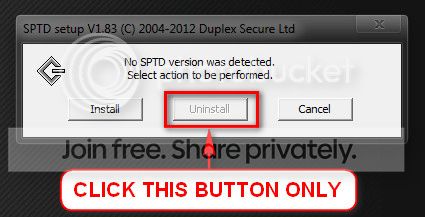
Disk-Tools.com, and execute the downloaded file as guided below :
- Double click to open it.
- Click this button only:
-
- If it is grayed out, as in the picture, there is no more SPTD in your system, and you just close the window.
Daemon Tools uses a driver called
sptd.sys, which is known to cause BSODs with Windows 7. It is recommend you remove this program, and use Windows own in-built features or ImgBurn.