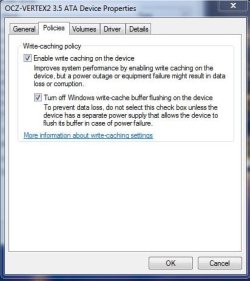
Look at it as an academic exercise - most of those do not yield anything.My only question is (and this is not meant to be sarcastic) If in practical use, you can tell no difference, what difference does it really make. Mine is on and my WEI is 7.7 . I'm not sure I can improve on that.

My Computer
At a glance
Vista, Windows7, Mint Mate, Zorin, Windows 8from 1.6GHz Duo to i7
- Computer Manufacturer/Model Number
- HP, Dell, Gateway, Toshiba - 4 laptops and 2 desktops
- OS
- Vista, Windows7, Mint Mate, Zorin, Windows 8
- CPU
- from 1.6GHz Duo to i7
- Monitor(s) Displays
- 2x HP w2207
- Hard Drives
- 5x HDD, 7x SSD, 12x Externals
- Keyboard
- with trackball - no mices
- Mouse
- Trackball mice
- Internet Speed
- DSL 6000


 I am not as technically astute as you, so I cannot indulge in an acedemic exercise on this subject. My only knowledge of caching is that in a worse case if a power outage were to occur during a write operation, without cashing your data would become corrupted. I am sure ther are other reasons also. But, with an SSD which is only an OS drive, according to Microsoft reads outnumber writes by 40:1. and something like 80% of writes are 4kb or less. It would seem that an SSD is fast enough to write 4kb in an extremely short time as in ms. And due to the fact that writes are a quite infrequent, is write caching necessary? I am sure that there are many more implications of write caching, but the last sentence of Happyman's last post leaves me out of the discussion.
 My write caching is turned on. At least it's on when my computer is running. My MB is RMA'd right now.
 :mad2: