or no virtual memory at all.
Probably the most asked question, which I hope I'm asking from a different angle
In one sentence, it should be very logical, when 8 GB RAM is sufficient + adding 8 GB RAM extra= no need for slow HDD swapping.
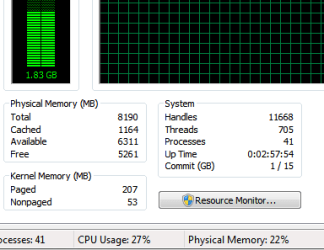
That is, I have on my W7x64 PC 8 GB of RAM and virtual memory rotating on HD disk. Everything is fine, or for a Windows 7 at least, while I'm suffering of some impatience always, when W7 swaps Lightroom catalog to and from HDD...
But when I add another 8 GB of fresh memory, how to tell windows 7, that no need to use slow HDD as instead there is another 8 GB of extra memory, which Windows could eat or at least to move it's page file to this extra RAM memory?
Probably the most asked question, which I hope I'm asking from a different angle
In one sentence, it should be very logical, when 8 GB RAM is sufficient + adding 8 GB RAM extra= no need for slow HDD swapping.
That is, I have on my W7x64 PC 8 GB of RAM and virtual memory rotating on HD disk. Everything is fine, or for a Windows 7 at least, while I'm suffering of some impatience always, when W7 swaps Lightroom catalog to and from HDD...
But when I add another 8 GB of fresh memory, how to tell windows 7, that no need to use slow HDD as instead there is another 8 GB of extra memory, which Windows could eat or at least to move it's page file to this extra RAM memory?
My Computer
At a glance
Windows 7 Enterprise 64 bitIntel I5-7608 GBCLUB 3D HD5450 1GB GDDR3 CGAX-54524LI
- OS
- Windows 7 Enterprise 64 bit
- CPU
- Intel I5-760
- Motherboard
- INTEL P55 S1156 DDR3 GLAN RAID BLKDP55WB
- Memory
- 8 GB
- Graphics Card(s)
- CLUB 3D HD5450 1GB GDDR3 CGAX-54524LI
- Hard Drives
- WD150HFLS 150GB/10000rpm
WD10EALS Blue 1TB