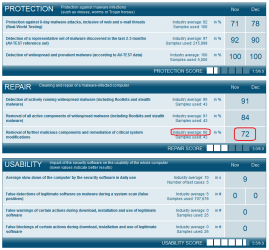
Sure there will always be new attacks, but don't you think that an AV programs previous track record is important as well? If an AV program has always done poorly, surely it is important info? Just as if an AV program is historically good, then at least in the present, that is indicative of what you can expect? I use Windows 7, not Windows 8, so I have my current OS to protect

A Guy
Hi there
this is one of those cases where PAST TRACK record is 100% irrelevant -- the New threat could be something that's never happened before or so works in a totally different way to previous attacks that the AV code needs to be re-written from SCRATCH. The writer of the OS in this case MS has a much better chance of finding a fix than a 3rd party supplier who by the nature of the exercise has to delve into and "reverse engineer" all sorts of Windows functions to
a) see exactly how the threat behaves.
b) find an effective cure.
c) develop and test the code.
e) ship it out of the door.
Until relatively recently Viruses and Malware worked on fairly well understood principles - even things like rootkits. I'm not saying they were easy to prevent but the base principles were mainly technical and therefore could have "Algorithmic" solutions -- so a few geeks in a backroom somewhere could devise AV software and sell it.
These days attacks include things like "drive by infections" and all sorts of things we probably don't know about. User behaviour is also a necessary component in providing satisfactory protection -- and this requires a completely different set of skills to analyse than the pure "technical solution" which can be managed by the geeks in the AV company.
A big company like Ms can analyse 1000's of "bog standard users" etc, and probably has decent behavorial scientists at its disposal so is able to devise some sort of heuristic method for predicting a users pattern and dynamically providing a way of preventing infection.
For example I'm sure you'll agree that a user who downloads 100's of files a week from torrent sites needs a different type of protection than someone who might only use the internet twice a week and logon to somewhere like the BBC's site.
That's basically my reasons for saying in the case of AV software the previous track record of companies isn't relevant in this scenario -- these types of attacks are relatively recent and whichever way you cut it there isn't enough reliable data to use as decent statistics.
If you really want to get SOME type of AV protection effectiveness in "The REAL World" you would need to get say at least 1000 random teenagers preferably -- give them laptops to use for say two weeks with no Internet access restrictions and all fitted with different AV software and then see which laptops succumbed to any viruses/malware / spyware etc.
Getting a few scientists in a lab checking what could be possible might be fine for testing say aircraft components but you need to test HUMANS in an environment where they are actually working naturally -- and they all do it differently.
The reason I mentioned W8 in this thread (it IS relevant to W7) is that W8 security will protect things like Mobile phones --these DO need massive protection --there's almost NO security on these at the moment and as the vehicle being used for this is essentially MSE then it's good news for MSE users in W7 as they will get the updates too where possible.
MSE is being developed in W8 to be as secure as is humanely possible so of course advantages will accrue in W7 too -- the point being is that unlike some AV suppliers working on a diminishing market -- W7 while excellent has probably now (apart from corporates) hit it's maximum HOME user base won't have the incentive or resources to keep working on security solutions for W7 when MSE is improving all the time and there isn't a future market for them in W8.
If they really want to do something good then these AV suppliers could make money by developing security for ANDROID smart phones --there's enough of them around.
I say also that W7 has probably hit its maximum user base for HOME users (NOT COMPANIES please note) as :
a) a lot of people are buying things like tablets and other mobile devices which need better touch type screens so are using Android or the new W8 tablets.
b) most new PC's (which although a large market is a falling one) pre-installed with W8.
Some (like they did with VISTA ==> XP) will downgrade (if "downgrade" is what it is) to W7 but the vast majority will just stick with whatever is on the computer when they bought it.
Even people on this very Forum probably at times don't use a PC nearly as much as they used to when just casually surfing the net, reading emails, using things like face book or playing music. Smart phones / tablets work fine for this -- I'm not a tablet lover but I find at times using a smart phone enough for what I need and there are days (excluding work) where I don't use a PC at all -- I can even send stuff (short --not posts like these though) to these Forums from a phone too
Please note - nothing on this thread means that I prefer W8 to W7 -- I'm just stating observed and technical facts here.
Cheers
jimbo