Optimize Windows 7

How to Optimize Windows 7


   Information
This is a list of suggestions that will help show you how to optimize Windows 7 by speeding up and improving it's performance.

You can pick and choose which ones you would like to do, or feel comfortable doing. If you do not notice an increase in performance or have a problem with the suggestion, then you can always go back and undo the suggestion at it's provided tutorial link.

If you have a question about one of the options, then please feel free to post a question here. We'll be happy to help.

This list of suggestions will continue to be ongoing. I will be adding and updating suggestions to this list every so often, so you may would like to check back from time to time for anything new.

If you like, please feel free to post any of your own suggestions that you find to help the performance of Windows 7.


   Note
Windows 7 Minimum Hardware Requirements:
  • 1 GHz 32-bit or 64-bit processor
  • 1 GB RAM for 32-bit Windows 7 OR 2 GB RAM for 64-bit Windows 7
  • 16 GB available disk space 32-bit Windows 7 OR 20 GB for 64-bit Windows 7
  • Support for DirectX 9 graphics with 128 MB memory (in order to enable Aero theme)
  • DVD-R/W Drive
  • Internet or phone access to activate Windows 7.


Here we go:

1. Use a Solid State Drive (SSD)
Installing Windows 7 onto a solid state hard drive (SSD) instead of a normal SATA or IDE hard drive will dramatically increase your computer's performance.
2. Install the Latest BIOS and Device Drivers
Make sure that you have the latest available drivers installed for all of your devices and BIOS version for your motherboard. These will often have updated that correct new bugs, bug from the previous version, and may add new features, and increase performance. Check at the device's website for them. Be sure to have the correct versions for your 32 bit or 64 bit Windows 7. If you do not have Windows 7 drivers available, then you can often times use Vista drivers instead with sometimes having to use Compatibility Mode on the driver installation file with Vista selected.
3. Install More RAM
The more you have the better your performance can be up to a point. Usually 4 GB (32-bit) or 8 GB (64-bit) will be the most that you will need though unless you do memory intensive actions such as video editing.

Better memory (RAM) performance will depend on fast the bandwidth MHZ rating (higher the better) is, and if you are using faster dual (DDR2) or tripple (DDR3) channel memory in that mode instead of just one stick in single channel mode. It's best to have all of your RAM sticks with the exact same specs.
4. Upgrade to a Better Video Graphics Card
If you're a gamer, then upgrading your video card to a better one can give you much better FPS (frames per second) and performance. In some situations, better video cards can be a huge benefit even without heavy onscreen video work, because certain applications can leverage the GPUs for calculations. If your current card and motherboard support SLI or CrossFireX, adding a second card and bridging them will be a good option as well.
5. Turn Transparency Off
The glass transparency effect uses the most resources from the Aero feature. You can disable it without disabling Aero.
6. Turn Off Unneeded Visual Effects
Uncheck the visual effect options that you do not want or need, or select the Adjust for best performance option, to increase the speed. You can optimize performance by changing how menus and windows appear. The most common visual effects to uncheck are:

  • Animate windows when minimizing and maximizing
  • Animations in the taskbar and Start Menu
  • Enable transparent glass
  • Fade or slide menus into view
  • Fade or slide ToolTips into view
  • Fade out menu items after clicking
  • Show shadows under windows
  • Slide open combo boxes
7. Turn off all unnecessary animations
If animation effects, such as fade windows when closed visual effects, run slow or sluggish on your computer, then using Turn off all unnecessary animations can help improve your computer's performance.
8. Enable Write Caching for Storage Devices
This option is usually the best choice for storage devices that must provide the highest possible performance and that you intend to not remove from the system frequently, such as internal hard disk drives.
9. Disable or Remove Unwanted or Unneeded Startup Programs
Double check through your startup programs and disable or remove the ones you do not want to have start when Windows 7 starts. It is a good idea to check these every once in awhile to help make sure that some unknown program or malware has not placed itself to startup with Windows 7.
10. Set Unused Services to Manual
Services use processes that run in the background using part of your computer's resources. Check through your services with the help of the guide provided in this link, and stop and set to manual the services that affects features that you do not use or need to gain a tiny bit more performance. WARNING: Disabling the wrong service could hurt performance, or even cripple Windows 7. If you do not truly know what you are doing, then it's not recommended to do this.
11. Turn Off Unneeded Windows Features
Windows 7 includes many features. You can review the list of features and turn off the ones that you do not want or need.
12. Turn Off or Change Disk Defragmenter Schedule
By default Disk Defragmenter is scheduled to run in the background automatically every so often in Windows 7. Having this running in the background can cause a slight slow down and extra hard drive activity. You should either set the schedule to run at a time when you are not using the computer while it is on, or turn it off and run Disk Defragmenter manually when it is convenient for you instead.
13. Defragment Your Hard Drive
Fragmentation makes your hard disk do extra work that can slow down your computer. This will show you how to open and use Disk Defragmenter to manually analyze and defragment your disks and drives in Windows 7. Do not do this on a SSD though.
14. Disable Hibernate
If you do not use hibernate, then disabling it will save you a GB size file from being saved on your hard drive when you put the computer into hibernation mode. When hibernate is disabled, the shut down time will be shorter by not having to save memory to the hiberfil.sys file, but you will no longer be able to resume from hibernate for a quicker startup. If you like, using sleep instead of hibernate will allow a faster resume.
15. Turn Off System Protection
If hard drive space is at a high premium for you, then turning System Restore off will free up some hard drive space. When disabled it will also not run in the background anymore while it creates restore points. However, disabling System Restore will mean that there will be no restore points available to go back to quickly fix Windows 7 in the event of a problem with your Windows 7 system files instead of having to reinstall Windows 7. You will need to create backups or system images if you disable System Restore instead incase you need to reinstall.
16. Speed Up the Menu Show Time
This will allow you to reduce the amount of time it takes for a menu in Windows 7 to pop, fade, or slide open when you run the mouse pointer over it.
17. Enable High Performance in the Power Plan
This power plan maximizes system performance and responsiveness. However, if you use a mobile PC running on battery power, then you will notice that your battery doesn't last as long when using this plan.
18. Speed Up Mouse Hover Time
This will show you how to change the delay time, in milliseconds, that the mouse pointer has to stay hovered on a item before it is selected or opens a pop-up in Windows 7.
19. Reduce Time to Display Operating Systems at Boot
This will show you how to change the amount of time to display a list of operating systems in the Windows Boot Manager screen at boot and wait for you to select a OS to start before the default OS starts automatically. If you do not dual boot with another operating sytem on your computer, then you can uncheck, or reduce the time as low as it will go, to save on how long it takes to boot your computer.
20. Add or Remove Gadgets
Gadgets can be handy to offer information at a glance and provide easy access to frequently used tools from your dekstop. However, since each gadget added will take up some of your system resources. You can see how much memory is being used by the gadgets in Task Manager (Ctrl+Shift+Esc) under the Processes tab with the sidebar.exe process.
21. Run Disk Cleanup
Running Disk Cleanup every so often will help find and remove unnecessary files on your hard disk to free up disk space and help your computer run faster.
22. Speed Up Shut Down Time
This will allow you how to set the AutoEndTasks, HungAppTimeout, WaitToKillAppTimeout, and/or WaitToKillServiceTimeout values that Windows waits for programs to save data and close before shutting down.
23. Add COPY TO FOLDER and MOVE TO FOLDER to Context Menu
This will allow you how to add Copy To Folder and Move To Folder to the context menu to make copying and moving files faster and easier in Windows 7.
24. Log On Automatically to a User Account at Startup
This will show you how to select a user account to have Windows 7 automatically log on to at startup so that you do not have to spend time manually logging on to the user account everytime you start or restart the computer.
25. Disable Require a Password on Wakeup
If you use sleep, hybrid, or hibernate mode, then you may wish to disable the option to have your computer require you to enter a password everytime you wakeup the computer.
26. Use Sleep Mode
If your computer does not run primarily off of a battery, then using sleep mode will allow you to put your computer to sleep and wake it up quickly instead of completely shutting down and starting the computer.
27. Decrease How Long Windows 7 Notifications Stay Open
This will allow you to change how long notifications or messages are displayed in the Windows 7 taskbar notification area before they close automatically.
28. Disable Thumbnail Previews in Windows Explorer
If there are a lot of thumbnails in a Windows Explorer window, then it can slow down your computer while you wait for the thumbnails to load. If this happens or you prefer icons instead of thumbnails, then disabling thumbnails will speed up how fast a Windows Explorer window will open by displaying only icons instead of thumbnails.
29. Turn On ReadyBoost
You can use ReadyBoost in Windows 7 with USB flash drives and flash memory cards to help speed up your computer if it is low on RAM (memory).
30. Uninstall the Bloatware Programs from Your Computer
Most computers that you buy, at a retail store (OEM), have a ton of software installed on it. Some of these can take up a lot of resources. Uninstall the programs that you do not want to use from Programs and Features.
31. Disable Program Compatibility Assistant
If you are a system administrator who requires faster performance and are aware of the compatibility of the applications you are using, then disabling Program Compatibility Assistant (PCA) can be useful.
32. Scan your Computer for Malware or Spyware
If your computer has been infected with spyware or malware, then this they can cause all sorts of issues including slowing your computer down to a crawl. Be sure to scan your system with a good program like the free Windows Defender Offline, MSE, and Malwarebytes Free for malware (ex: virus) and spyware, and allow the program to remove any that may be found.
33. Move the "Page File" to be on a Separate Hard Disk
Moving the page file to a second physical hard drive instead of the same C: drive that Windows is on can help improve the performance of Windows 7 if the other hard drive is at least as fast or faster than the Windows drive.. Doing this allows Windows to use the page file on one drive while not having to interrupt reads or writes on the Windows drive. Be sure to let the page file be System Managed. Windows 7 does a great job of keeping your page file in peak condition and performance.
34. Keep your Index Enabled and Updated, or Disable the Index
Your needs for the index, searches, and libraries will determine what will be best for you. By default the index is enabled in Windows 7. If you do a lot of searches in specific locations or for specific file types, then searching using the index with these locations and file types added to be included in the index could help give you faster search results than doing non index searches. If you find that the index search results are not accurate, then rebuilding the index will update the index for accurate search results afterwards. If you like to only do non index searches to always have accurate search results, then you could either disable the index or set your Search options to not use the index when searching in file folders for system files. Non index searches will take a bit longer to give search results. If you disable the index, then this will help your HDD not run as much while the index (if enabled) automatically updates itself in the background when your computer is idle. If you disable the index, you will also no longer be able to search within libraries.
35. Set to Have "No GUI Boot"
Disabling GUI Boot can help reduce the amount of time it takes to startup Windows by a few seconds or so.
36. Set "Turn off hard disk after" to Never or Increase Time
While having your HDDs turn off after set x amount of idle minutes can help save energy, it can also cause your PC to pause while waiting for the HDD to spin back up when needed. You could either set this to never turn off the HDDs, or increase the amount of idle minutes before turning off the HDDs to avoid it being turned off while you may still use it and having to wait for it to spin back up as often.
37. Uninstall or Disable Unneeded Internet Explorer Add-ons and Toolbars
This is to only help with the performance of Internet Explorer (IE) than Windows, but disabling any unneeded installed add-ons and toolbars will help IE load and perform faster.
38. Clean Your Computer
Keeping the fans and inside of your computer clean and dust free can help prevent performance issues. Dust acts as an insulator, making it harder for your hardware to dissipate the buildup of heat. When this problem becomes significant enough for your computer to overheat, certain components such as your processor or graphics card may temporarily throttle back their clock speeds in order to prevent damage to your hardware.
39. Performance Optimization Guidelines for Windows 7 Desktop Virtualization
This downloadable .docx guide describes important tuning parameters and settings that you can adjust to improve the performance and energy efficiency of the Windows 7 operating system.
40. Use a Faster DNS Server
Most ISPs like to brag about how much bandwidth they are giving you, but they don't mind letting the rest of their infrastructure slowly get overwhelmed or deteriorate. Among the biggest offenders are the DNS servers our ISPs use. If you want to know why things seem to take forever to start loading, slow DNS servers are often the cause. You might consider adding or using a fast DNS server like Google Public DNS as your primary DNS server in your TCP/IP settings to see how it compares to your ISP.
41. Change Maximum Download Connections per Server Limit in Internet Explorer

Internet Explorer has a limit for the amount of simultaneously downloads per website or server.
  • Internet Explorer 7 and earlier versions limit the number of files that you can download at one time to two by default.
  • Internet Explorer 8 and Internet Explorer 9 limit the number of files that you can download at one time to six by default.
  • Internet Explorer 10 and Internet Explorer 11 limit the number of files that you can download at one time to eight by default.
In addition, if you visit a website with lots of images (and supporting files like CSS styles and Javascript), then you could have a slower browsing experience. On average, your browser could have to make several requests to the site's server before it can finish loading the page. Requesting all the files needed to download with the default 8 (ex: IE11) at a time is going to be slower than requesting say 16 files at a time.

As internet connection speeds increase, the default number of simultaneous downloads to a single website or server may be to restrictive and not meet your needs.
I hope these help you,
Shawn


Last edited:
It's a 2.5" SATA drive, so you may be able to use it in your laptop. You will have to look at your laptop's manual to see how to change the hard drive though.
 

My Computer

Computer type
PC/Desktop
Computer Manufacturer/Model Number
Self built custom
OS
64-bit Windows 11 Pro for Workstations
CPU
Intel i7-8700K OC'd to 5 GHz
Motherboard
ASUS ROG Maximus XI Formula Z390
Memory
64 GB (4x16GB) G.SKILL TridentZ RGB DDR4 3600 MHz
Graphics Card(s)
ASUS ROG-STRIX-GTX1080TI-O11G-GAMING
Sound Card
Integrated
Monitor(s) Displays
2 x Samsung Odyssey G7 27"
Screen Resolution
2560x1440
Hard Drives
1TB Samsung 990 PRO M.2,
4TB Samsung 990 PRO PRO M.2,
TerraMaster F8 SSD Plus NAS
PSU
Seasonic Prime Titanium 850W
Case
Thermaltake Core P3
Cooling
Corsair Hydro H115i
Keyboard
Logitech wireless K800
Mouse
Logitech MX Master 4
Internet Speed
2 Gb/s Download and 100 Mb/s Upload
Antivirus
Malwarebyte Anti-Malware Premium
Browser
Google Chrome
Other Info
Logitech Z625 speaker system,
Logitech BRIO 4K Pro webcam,
HP Color LaserJet Pro MFP M477fdn,
APC SMART-UPS RT 1000 XL - SURT1000XLI,
Galaxy S23 Plus phone
HI
brink,
this is arvind v in order to speed up the system performance remove unwanted programs installed on a system and do a clean boot
 

My Computer

Computer Manufacturer/Model Number
zebronics
OS
vista ultimate
CPU
2.8
Motherboard
gigabyte
Memory
2gb
Graphics Card(s)
7800 gforce
Sound Card
reltek
Monitor(s) Displays
benq 19' lcd
Hard Drives
450 gb
Case
atx
Cooling
4fans
Hello Arvind, and welcome to Seven Forums.

Yes, removing bloatware can help. Added. Thank you. :)
 

My Computer

Computer type
PC/Desktop
Computer Manufacturer/Model Number
Self built custom
OS
64-bit Windows 11 Pro for Workstations
CPU
Intel i7-8700K OC'd to 5 GHz
Motherboard
ASUS ROG Maximus XI Formula Z390
Memory
64 GB (4x16GB) G.SKILL TridentZ RGB DDR4 3600 MHz
Graphics Card(s)
ASUS ROG-STRIX-GTX1080TI-O11G-GAMING
Sound Card
Integrated
Monitor(s) Displays
2 x Samsung Odyssey G7 27"
Screen Resolution
2560x1440
Hard Drives
1TB Samsung 990 PRO M.2,
4TB Samsung 990 PRO PRO M.2,
TerraMaster F8 SSD Plus NAS
PSU
Seasonic Prime Titanium 850W
Case
Thermaltake Core P3
Cooling
Corsair Hydro H115i
Keyboard
Logitech wireless K800
Mouse
Logitech MX Master 4
Internet Speed
2 Gb/s Download and 100 Mb/s Upload
Antivirus
Malwarebyte Anti-Malware Premium
Browser
Google Chrome
Other Info
Logitech Z625 speaker system,
Logitech BRIO 4K Pro webcam,
HP Color LaserJet Pro MFP M477fdn,
APC SMART-UPS RT 1000 XL - SURT1000XLI,
Galaxy S23 Plus phone
Thanks for the tips....
Will disable those unnecessary features to speed up peformance :D
 

My Computer

OS
Windows 7
You're welcome Yaya, and welcome to Seven Forums. :)
 

My Computer

Computer type
PC/Desktop
Computer Manufacturer/Model Number
Self built custom
OS
64-bit Windows 11 Pro for Workstations
CPU
Intel i7-8700K OC'd to 5 GHz
Motherboard
ASUS ROG Maximus XI Formula Z390
Memory
64 GB (4x16GB) G.SKILL TridentZ RGB DDR4 3600 MHz
Graphics Card(s)
ASUS ROG-STRIX-GTX1080TI-O11G-GAMING
Sound Card
Integrated
Monitor(s) Displays
2 x Samsung Odyssey G7 27"
Screen Resolution
2560x1440
Hard Drives
1TB Samsung 990 PRO M.2,
4TB Samsung 990 PRO PRO M.2,
TerraMaster F8 SSD Plus NAS
PSU
Seasonic Prime Titanium 850W
Case
Thermaltake Core P3
Cooling
Corsair Hydro H115i
Keyboard
Logitech wireless K800
Mouse
Logitech MX Master 4
Internet Speed
2 Gb/s Download and 100 Mb/s Upload
Antivirus
Malwarebyte Anti-Malware Premium
Browser
Google Chrome
Other Info
Logitech Z625 speaker system,
Logitech BRIO 4K Pro webcam,
HP Color LaserJet Pro MFP M477fdn,
APC SMART-UPS RT 1000 XL - SURT1000XLI,
Galaxy S23 Plus phone
Thanks for the Tips...!
 

My Computer

OS
Windows 7 Ultimate
Thanks for sharing this. I noticed a difference and I created a system restore point before I done the changes that I wanted to apply. I also created a small notepad file putting in the date and the changes that I made so I could refer back to them and see what I done incase I need to in the future.
 

My Computer

OS
Windows 7 Ultimate x64
CPU
i7 CORE 2 QUAD 920 (2.66GHZ, 8MB L2 CACHE, 1066MHZ FSB)
Motherboard
GIGABYTE GA-EX58-UD3R MOTHERBOARD
Memory
3 x CORSAIR 2GB PC12800 DDR3 1600MHZ RAM
Graphics Card(s)
XFX NVIDIA GTS 250 512MB PCI-E GRAPHICS CARD
Sound Card
X-Fi Titanium Fatal1ty Pro 7.1 Soundcard - PCI-Express
Monitor(s) Displays
Samsung SM2343BW 23"
Screen Resolution
2048x1152
Hard Drives
2 x 500GB S-ATA 7200RPM Hard Drive
PSU
NorthQ 850W Dual Rail PSU
Case
Coolermaster Elite 330
Cooling
Noctua CPU Heatsink and Cooler
Keyboard
Microsoft Wireless Laser Keyboard 5000
Mouse
Microsoft Wireless Laser Mouse 5000
I think you should a link to black-vipers services.msc changes -- if its not already there :D Im just bored forum-surfing :)
 

My Computer

Computer Manufacturer/Model Number
HP dv6000t CTO Entertainment Lappy |My Desktop @ Bottom
OS
7 x64/ Back-Track 4
CPU
Intel Core 2 Duo CPU 8300@ 2.4 Ghz
Motherboard
HP's Own
Memory
4096 MB DDR2
Graphics Card(s)
Nvidia 8400M GS
Sound Card
Altec Lansing (The usual on Laptops )
Monitor(s) Displays
Laptop Screen. 17' Wide.
Screen Resolution
1280 x 800
Hard Drives
150 GB HDD.
Cooling
2 External Fans, Undervolted, Coolant
Keyboard
Norm. Cheap Random Keyboard
Mouse
Norm. Cheap Random Mouse
Other Info
This is my Homemade Desktop :)
HDD: Western Digital Caviar Blue 320GB 16MB 7200RPM SATA2
And more to come in a bit! :D
Thanks brink for the list of useful tips given...!:thumbsup:
 

My Computer

Computer Manufacturer/Model Number
D3f's Customs
OS
Win 7 Ultimate SP1 x64
CPU
Intel Pentium Dual Core E5300 OC'd @ 3GHz
Motherboard
Asus P5G41-M LE
Memory
Kingston 2x2GB DDR2-800 Dual Channel SDRAM
Graphics Card(s)
Integrated Intel GMA X4500
Sound Card
Realtek 5.1 HD Audio (ALC887)
Monitor(s) Displays
LG Flatron W1943S @ 60Hz
Screen Resolution
1360 x 768
Hard Drives
Internal - WD Caviar Blue 500GB, External - WD My Passport Essential 500GB
PSU
Headway 450w PSU
Case
Pixxo Slim Black mATX Case
Cooling
Stock Cpu Fan, 1 x Top Case Fan
Keyboard
Logitech K120
Mouse
Logitech LS1 Laser Mouse
Internet Speed
17.66Mb/s Down, 0.82Mb/s Up
Other Info
Creative SBS A300 2.1 Speaker System, LG GH22NS50 22x Internal Super-Multi DVD-RW, 2Wire 5012NV Wireless Modem Router
You're most welcome D3ftOn3Z. :)
 

My Computer

Computer type
PC/Desktop
Computer Manufacturer/Model Number
Self built custom
OS
64-bit Windows 11 Pro for Workstations
CPU
Intel i7-8700K OC'd to 5 GHz
Motherboard
ASUS ROG Maximus XI Formula Z390
Memory
64 GB (4x16GB) G.SKILL TridentZ RGB DDR4 3600 MHz
Graphics Card(s)
ASUS ROG-STRIX-GTX1080TI-O11G-GAMING
Sound Card
Integrated
Monitor(s) Displays
2 x Samsung Odyssey G7 27"
Screen Resolution
2560x1440
Hard Drives
1TB Samsung 990 PRO M.2,
4TB Samsung 990 PRO PRO M.2,
TerraMaster F8 SSD Plus NAS
PSU
Seasonic Prime Titanium 850W
Case
Thermaltake Core P3
Cooling
Corsair Hydro H115i
Keyboard
Logitech wireless K800
Mouse
Logitech MX Master 4
Internet Speed
2 Gb/s Download and 100 Mb/s Upload
Antivirus
Malwarebyte Anti-Malware Premium
Browser
Google Chrome
Other Info
Logitech Z625 speaker system,
Logitech BRIO 4K Pro webcam,
HP Color LaserJet Pro MFP M477fdn,
APC SMART-UPS RT 1000 XL - SURT1000XLI,
Galaxy S23 Plus phone
Readyboost Question

From what I have read here one 7forums is that Readyboost is only good for laptops with limited RAM. However, I also see posts that contradict it.

Is it useful for PC's with more than 3GB of RAM?
 

My Computer

Computer Manufacturer/Model Number
EEE PC 1015PN
OS
Windows 7 Ultimate
CPU
Intel Atom 1.5 GHz
Motherboard
Integrated
Memory
2GB Corsair DDR3
Graphics Card(s)
GMA350/Invidia Ion
Sound Card
Integrated
Monitor(s) Displays
LCD Screen
Screen Resolution
1024x600
Hard Drives
Seagate 500GB SATA3
PSU
Integrated
Case
Integrated
Cooling
Integrated Fan
Keyboard
Integrated
Mouse
Microsoft USB Optical for Notebooks
Internet Speed
Fiber
Hello Jagooch, and welcome to Seven Forums.

It really depends on your needs, but usually Readyboost is not as helpful when you have over 3GB of RAM. It may help reduce HDD activity some by using the USB flash drive more instead, but that will most likely be about it.

Hope this helps,
Shawn
 

My Computer

Computer type
PC/Desktop
Computer Manufacturer/Model Number
Self built custom
OS
64-bit Windows 11 Pro for Workstations
CPU
Intel i7-8700K OC'd to 5 GHz
Motherboard
ASUS ROG Maximus XI Formula Z390
Memory
64 GB (4x16GB) G.SKILL TridentZ RGB DDR4 3600 MHz
Graphics Card(s)
ASUS ROG-STRIX-GTX1080TI-O11G-GAMING
Sound Card
Integrated
Monitor(s) Displays
2 x Samsung Odyssey G7 27"
Screen Resolution
2560x1440
Hard Drives
1TB Samsung 990 PRO M.2,
4TB Samsung 990 PRO PRO M.2,
TerraMaster F8 SSD Plus NAS
PSU
Seasonic Prime Titanium 850W
Case
Thermaltake Core P3
Cooling
Corsair Hydro H115i
Keyboard
Logitech wireless K800
Mouse
Logitech MX Master 4
Internet Speed
2 Gb/s Download and 100 Mb/s Upload
Antivirus
Malwarebyte Anti-Malware Premium
Browser
Google Chrome
Other Info
Logitech Z625 speaker system,
Logitech BRIO 4K Pro webcam,
HP Color LaserJet Pro MFP M477fdn,
APC SMART-UPS RT 1000 XL - SURT1000XLI,
Galaxy S23 Plus phone
Great tutorial Shawn.
 

My Computer

Computer Manufacturer/Model Number
Custom
OS
Windows 7 Professional x64
CPU
Intel i7 2600K OC'd @ 4620 MHz
Motherboard
Asus P8Z68-V Pro
Memory
16GB GSkill Sniper 2133 Mhz (4x4GB)
Graphics Card(s)
EVGA GeForce GTX 480 SuperClocked+
Sound Card
Realtek High Definition Audio
Monitor(s) Displays
2x Acer S273HLbmii 27"
Screen Resolution
2 x 1920x1080
Hard Drives
64GB Crucial M4 SSD

Storage: Hitachi 1TB 5400RPM, Samsung 1.5TB 5400RPM
PSU
Corsair HW Series 750w (modular)
Case
Cooler Master HAF 932 Advanced Blue Edition
Cooling
CM Hyper 212+ CPU cooler, 3x 230mm + 1x 140mm case fans
Keyboard
Logitech MK320 (wireless)
Mouse
Logitech MK320 (wireless)
Internet Speed
30 Mb/s : 2 Mb/s
Good tutorial. One suggestion I would add is to move media, program installers, driver installers and personal files to a separate partition or HDD from Windows 7 and programs, and to shrink the system partition to somewhere between 60-100 GB. This benefits you in two ways: You'll see better startup and shutdown times and overall performance (unless you're using a SSD) and more importantly, if you ever have a problem which can be more easily fixed by reinstalling windows.. well I doubt I need to explain that...
 
Thanks for the tips!
 

My Computer

Computer Manufacturer/Model Number
Dell Inspiron 9300
OS
Windows 7
CPU
Intel Pentium M Processer 1.86Ghz
Memory
2GB Ram
Graphics Card(s)
ATI MOBILITY RADEON X300 64MB
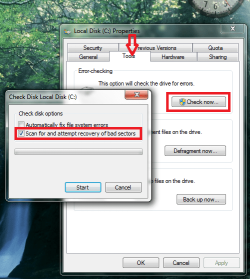
I guess the importance or registry cleaning is not being discussed in this thread. And also the optimizing technique of using disk check which should repair some bad sectors in the disk and somehow improve performance.

When using that tool, go to Computer>right click one of the drives (ex. C:)> choose Properties> hit the Tools tab> click the Check Now button.

Note: If the drive you are to perform disk check is being used such as the partition where your OS is saved, uncheck "Automatically fix file system errors" and check "Scan for and attempt recovery of bad sectors". If you are doing disk check on the main partition, please close all your running desktop programs first.Then Start.

If the drive you are going to perform disk check is not curretly used such as an external hard drive or USB, you may leave the "Automatically fix file system errors" checkbox checked. Anyway, in Windows 7, you will be notified if the particular disk is currently in use.

The time this will take to complete will depend on the size of your drive.
 

Attachments

  • CHK.png
    CHK.png
    235.7 KB · Views: 1,174
Last edited by a moderator:

My Computer

Computer Manufacturer/Model Number
Custom Built
OS
Windows 7 Ultimate 32 Bit, Windows Developer Preview, Linux Mint 9 Gnome 32 Bit
CPU
Intel Pentium Dual CPU E2180@2GHz
Motherboard
Elitegroup 671T-M3
Graphics Card(s)
NVIDIA GeForce 7200 GS
Monitor(s) Displays
AOC TFT1560 15" LCD Monitor
Screen Resolution
1024x768
Keyboard
Logitech USB Keyboard
Note: If the drive you are to perform disk check is being used such as the partition where your OS is saved, uncheck "Automatically fix file system errors" and check "Scan for and attempt recovery of bad sectors". If you are doing disk check on the main partition, please close all your running desktop programs first.Then Start.
Or you can select both boxes on your OS partition, and then reboot to let it do it's thing. That's what I always do.
 

My Computer

Computer Manufacturer/Model Number
NVIDIA
OS
Windows 7 Enterprise x64
CPU
AMD Athlon 64X2 Dual Core 3800+
Motherboard
GeForce 6100-M9
Memory
OCZ Platinum Dual Channel - 4x1Gb
Graphics Card(s)
NVIDIA GeForce 8800 GT PCI Express x16
Sound Card
Creative Audigy Sound Blaster Extreme PCI
Monitor(s) Displays
Compaq 7500
Screen Resolution
1024x768
Hard Drives
C: Seagate ST3250318AS SataII - 250Gb

D: Seagate ST3500418AS SataII - 500Gb
PSU
OCZ 600w Dual 12v Rails
Case
Thermaltake
Cooling
OCZ Heatsinks, Fans, and Thermal Paste on CPU & Chipsets
Keyboard
Logitech
Mouse
Radio Shack PS2
Internet Speed
Cable
Other Info
Dual Pioneer DVD/RW optical drives. LG CD/RW optical drive.
Good tutorial. One suggestion I would add is to move media.
Speaking of moving media. I have a folder on my D:\ drive [internal secondary drive] that I save alot of stuff on. So I make a path in the "send to" right click context menu, and use that. I don't know why, but the send to option is like 10 times faster than just regular moving, or copying files.
 

My Computer

Computer Manufacturer/Model Number
NVIDIA
OS
Windows 7 Enterprise x64
CPU
AMD Athlon 64X2 Dual Core 3800+
Motherboard
GeForce 6100-M9
Memory
OCZ Platinum Dual Channel - 4x1Gb
Graphics Card(s)
NVIDIA GeForce 8800 GT PCI Express x16
Sound Card
Creative Audigy Sound Blaster Extreme PCI
Monitor(s) Displays
Compaq 7500
Screen Resolution
1024x768
Hard Drives
C: Seagate ST3250318AS SataII - 250Gb

D: Seagate ST3500418AS SataII - 500Gb
PSU
OCZ 600w Dual 12v Rails
Case
Thermaltake
Cooling
OCZ Heatsinks, Fans, and Thermal Paste on CPU & Chipsets
Keyboard
Logitech
Mouse
Radio Shack PS2
Internet Speed
Cable
Other Info
Dual Pioneer DVD/RW optical drives. LG CD/RW optical drive.
Good tutorial. One suggestion I would add is to move media.
Speaking of moving media. I have a folder on my D:\ drive [internal secondary drive] that I save alot of stuff on. So I make a path in the "send to" right click context menu, and use that. I don't know why, but the send to option is like 10 times faster than just regular moving, or copying files.

I might be able to add some to this...

First.. I always partition my hard disks. I set up about 15gb for the operating system and software (I don't carry a big program load, mostly just compilers and editors, with a couple of light weight graphics things tossed in). The second partion is about 100gb for project space; it's where most of the mess happens so defragging it is quick. The other 300 or so gb is an archive where I store static files like my music collection, completed projects, pictures etc. (Movies and the major music collection are on a NAS box.) I've found over the years that completely aside from being able to reinstall without losing my data, it's real easy to maintain a system like this.

For tweaks let me suggest you take a peek at the attached zip file... It's got a couple of pages of tweaks and a .reg file I've been putting together. When I did my final install the desktop machine, the reg tweak made a noticeable improvement in the system's behavior. (It also includes the "timestamp" tweak to let the drive spin down)

Finally... I run without a swap file, always have, and I gotta tell you it really does speed things up.
 

Attachments

My Computer

Computer Manufacturer/Model Number
Homebrew
OS
XP Pro SP3 X86 / Win7 Pro X86
CPU
Amd 64 x2 4200 (2.4ghz)
Motherboard
Asus M2N-MX SE Plus
Memory
Kingston DDR2 800 2gb
Graphics Card(s)
Nvidia GF-8400
Sound Card
Realtek on Motherboard
Monitor(s) Displays
Acer x-193bw
Screen Resolution
1440 x 900
Hard Drives
Western Digital 500g
PSU
350watt In-Win
Case
In-Win
Cooling
Air
Keyboard
yes
Mouse
yes
Internet Speed
5mpbs
Other Info
Also ASRock ION 330 as HTPC (on XP).
Acer Aspire as GP netbook (on XP).
First.. I always partition my hard disks.
I always wipe my C:\ drive clean before a clean install [the ONLY way I ever install the OS] and let Windows partition the drive. Then I keep all files that aren't the programs I run on D:\ drive [a physical second disc]. This way I can reformat without losing anything. I also keep my program installation files on D:\ drive, so the reformat process is rather quick. I normally reformat about every 60-90 days, whether it needs it or not. It's not that time consuming, because like you, I think I use about 15GB's with the OS, and all my programs put together. A fresh install keeps the rig running fast, and clutter free.

I'll take a look at the .zip file you included here in a little bit, Bro.


Max
 

My Computer

Computer Manufacturer/Model Number
NVIDIA
OS
Windows 7 Enterprise x64
CPU
AMD Athlon 64X2 Dual Core 3800+
Motherboard
GeForce 6100-M9
Memory
OCZ Platinum Dual Channel - 4x1Gb
Graphics Card(s)
NVIDIA GeForce 8800 GT PCI Express x16
Sound Card
Creative Audigy Sound Blaster Extreme PCI
Monitor(s) Displays
Compaq 7500
Screen Resolution
1024x768
Hard Drives
C: Seagate ST3250318AS SataII - 250Gb

D: Seagate ST3500418AS SataII - 500Gb
PSU
OCZ 600w Dual 12v Rails
Case
Thermaltake
Cooling
OCZ Heatsinks, Fans, and Thermal Paste on CPU & Chipsets
Keyboard
Logitech
Mouse
Radio Shack PS2
Internet Speed
Cable
Other Info
Dual Pioneer DVD/RW optical drives. LG CD/RW optical drive.
Back
Top