SSD / HDD : Optimize for Windows Reinstallation

How to Optimize an SSD / HDD When You're Ready to Reinstall the Operating System

This will show how to remove / over-write all existing data from a Solid State Drive (SSD) or a Hard Disk Drive (HDD), it'll work for both, then how to create a partition and then format that partition before install begins so you have a clean drive to start the installation with.

   Note

Before you start this, in the Windows start menu search box type diskmgmt.msc right click the entry and click "Run as Administrator" if you get a User Account Control (UAC) prompt enter your user credentials and click Yes; make very sure you know the correct drive number of the drive you want to do this to if you have more than one SSD / HDD in the machine, you don't want to do the wrong one.
   Warning

Do not do this to any SSD or HDD that has data on it you don't want to lose, the first thing this does is to mark the drive as "Unallocated Space" and then writes zeroes ( 0's ) to the entire drive, it's known as a "Secure Erase" and it will make data un-recoverable, it cannot be done to just a single partition on a drive, it will do the whole drive.
You have been warned!
   Information

It may be a help to over-write the HDD Master Boot Record (MBR) before you start any other procedure using the diskpart clean command, rather than the clean all; it takes just seconds to complete so you will have "unallocated" space to use either the Windows installer to create and format the partition(s) or use diskpart for that, however you choose.

Let's get started!


Step One

Boot To DISKPART


If need be, view this tutorial at the link below for an out-line of the process.
How to Boot to DISKPART at PC Startup

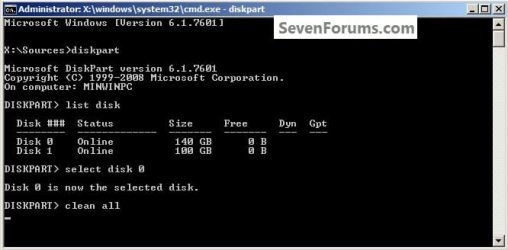
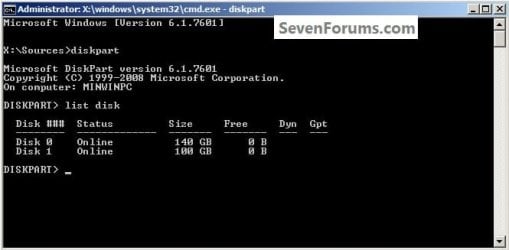
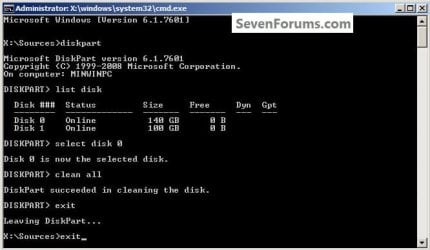
1) In the command window that opens type diskpart then hit the <enter> key then type list disk <enter> if you have more than one SSD / HDD in the machine it'll list them all.

Have a look here to view additional important information on this entire process.
click any image to enlarge
One_1.jpg
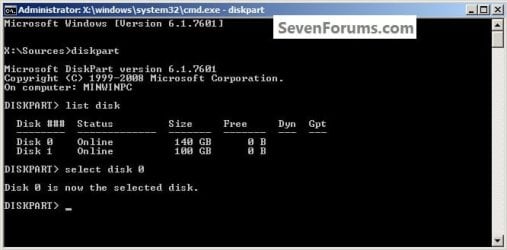
2) Now in the command window type select disk # (# = target disk number) then <enter>, you will get "Disk # is now the selected disk".
One_2.jpg
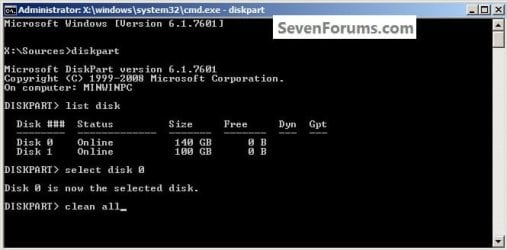
3) Now type clean <enter> you will get a blinking cursor telling you that clean all is working like in the second snip down, just relax and let it work.
One_3.1.jpg
One_3.2.jpg
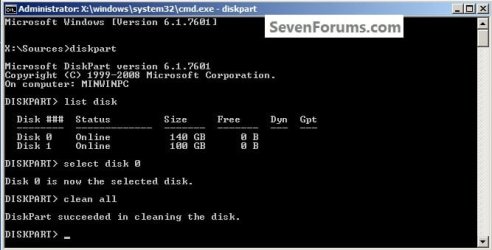
4) When it finishes you'll get "DiskPart succeeded in cleaning the disk" in the command window.
One_4.1.jpg
To leave diskpart at any time and return to the Windows 7 installer type exit two (2) separate times and hit <enter> after each and you will be returned to the installer to continue the installation process.
One_4.2.jpg


Step Two

Create a Partition


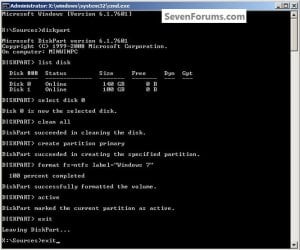
1) Create a single partition of the entire HDD / SSD

Still in the same command window, to create a partition of the entire HDD / SSD, it is suggested if you are using one of the larger, 1 - 2TB HDDs that you use the outline in #2 below to create a single 100GB partition to do the installation to or #3 below if you would like to include the new Windows 7 System Reserved partition, as we're now seeing serious issues with some trying to install to such large partitions.

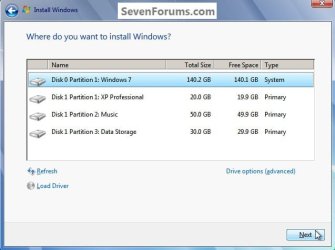
Do not format the created partition(s) with the installer if you create them using this process as the installer will delete all this info, the second snip shows how to select "where to install" during the installation process, click to highlight/select the "Windows 7" partition and click next.

Now skip down to #5 below to start the installation.
click any image to enlarge
Two_1.1.jpg
Two_1.2.jpg
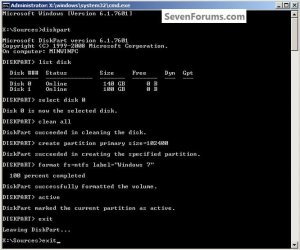
2) Create a specific size partition

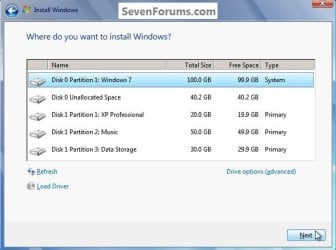
If you wanted to create a specific size partition, say 100GB you would add the size you want to create in MBs like in the command below.
create partition primary size=102400 <enter>
1024MB = 1GB - 1024x100 = 102400, you can use/create any size you like.

You can always extend the Windows partition to include the remaining unallocated space on the HDD / SSD or create additional Primary partitions or an Extended partition after the installation completes if you choose.

Do not format the created partition(s) with the installer if you create them using this process as the installer will delete all this info, the second snip shows how to select "where to install" during the installation process, click to highlight/select the "Windows 7" partition and click next.

Now skip down to #5 below to start the installation.
Two_2.1.jpg
Two_2.2.jpg
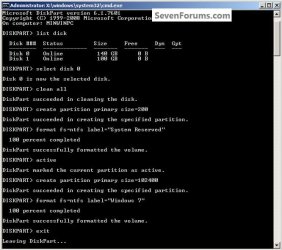
3) Create the System Reserved partition

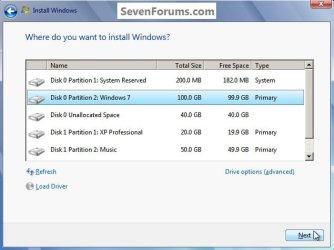
If you should want to add the "System Reserved" partition back after the clean all, see this snip; of course you would have to select to install Windows 7 to the partition labeled as "Windows 7" during the install and do not format either partition with the installer.

The reason for suggesting to create the System Reserved at 200MB instead of the new default of 100MB is an attempt to curb some of the issues we're now seeing with the partition being too small when dual/multi booting and it also being needed for use with the Windows 7 Backup and Restore and BitLocker programs.

You can always extend the Windows partition to include the remaining unallocated space on the HDD / SSD or create additional Primary partitions or an Extended partition after the installation completes if you choose.

The second snip shows how to select "where to install" during the installation process, click to highlight/select the "Windows 7" partition and click next.
Two_3.1.jpg
Two_3.2.jpg
4) See this tutorial for the "align" argument

Align a Solid State Drive for Windows Installation
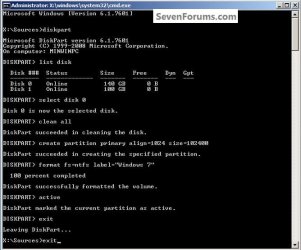
Two_4.1.jpg
5) That's it, you're now done with the command window, type exit <enter> to leave diskpart and exit <enter> again to close the command window; if you're using a Windows 7 full installer it will go to the "Select Language" screen to continue the installation process as usual.

For those using a created repair CD or a Vista installer type exit <enter> to leave diskpart and exit <enter> again to close the command window; at the System Recovery Options dialog box that's still open click Restart to finish the process.
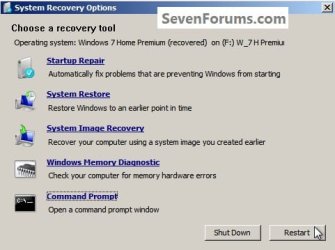
Restart.jpg
Enjoy! :)


Last edited by a moderator:
Hello schandler, welcome to Seven Forums!


Do you have other Hard Disk Drives (HDD) connected during the Windows 7 install?
 

My Computer

Computer Manufacturer/Model Number
* BFK Customs *
OS
W 7 64-bit Ultimate
CPU
Intel Q9550 Yorkfield
Motherboard
ASUS P5Q Pro
Memory
8GB Dominator 8500C5D
Graphics Card(s)
ATI : XFX 5870
Sound Card
Realtek HD Audio 7-1
Monitor(s) Displays
1x 47" LCD HDMI & 3x 26" LCD HDMI
Screen Resolution
1920x1080P & 1920x1200
Hard Drives
1x 80GB Intel X25-M G2 SSD : 1x 500GB & 1x 640GB WD Caviar Black(s)
PSU
Corsair 620HX
Case
Cooler Master RC-690
Cooling
Tuniq Tower 120, 2x 140mm and 3x 120mm case fans
Keyboard
Microsoft 500
Mouse
Razer Diamondback 3G
Internet Speed
14 Mb/s
Other Info
1x Koutech 3Gb/s SATA HDD Hot Swap Rack
Hello, thanks for the welcome! Sorry I forgot to say my name is Stephen.

Should also have mentioned more detail in my earlier question about the other HDDs, so here is the info:-

It is an Alienware ALX desktop, all the drives are internal so they were all connected when I tried the W7 install.

Drive 0 is 2 x 500GB configured as a 1TB RAID - it has Vista Ultimate 32bit installed, that is what the computer currently runs. I haven't touched that as I found the RAID setup on Alienware a bit troublesome so I wanted to leave it alone for now (if possible!)

Drive 1 is a 1TB Hitachi (which I have just cleaned and partitioned using your very nice tutorial)

Drive 2 is also a 1TB Hitachi, with a little data on it but could easily be cleaned.


What I was trying to do was install W7 Ultimate 64bit on Drive 1, so that I could boot from that drive. Then, having safely installed W7 on there, I was was hoping that I could mess around with the other drives with more confidence. I was trying to avoid, at this stage, taking off the Vista from the RAID Drive 0, just in case things went wrong.....

Is the problem something to do with Drive 0 still being on Vista?

Any help enormously appreciated!!!

Kind regards, and thanks again for the good job on the tutorial.

Stephen
 

My Computer

Computer Manufacturer/Model Number
Alienware ALX51
OS
Windows 7 Ultimate x64
CPU
Intel
Motherboard
NVIDIA
Memory
4GB
Graphics Card(s)
NVDIA GeForce dual 8800
Sound Card
Logitech
Monitor(s) Displays
Dell Ultrasharp
Hard Drives
1TB RAID (2 x 500GB) Hitachi
2 x 1TB Hitachi
PSU
Alienware
Case
Alienware
Cooling
Alienware
Hello Stephen, thank you for your kind words.


Can you still boot into the Windows Vista install on the RAID setup?


I have to go to work very soon, so I may have to continue this later today.
 

My Computer

Computer Manufacturer/Model Number
* BFK Customs *
OS
W 7 64-bit Ultimate
CPU
Intel Q9550 Yorkfield
Motherboard
ASUS P5Q Pro
Memory
8GB Dominator 8500C5D
Graphics Card(s)
ATI : XFX 5870
Sound Card
Realtek HD Audio 7-1
Monitor(s) Displays
1x 47" LCD HDMI & 3x 26" LCD HDMI
Screen Resolution
1920x1080P & 1920x1200
Hard Drives
1x 80GB Intel X25-M G2 SSD : 1x 500GB & 1x 640GB WD Caviar Black(s)
PSU
Corsair 620HX
Case
Cooler Master RC-690
Cooling
Tuniq Tower 120, 2x 140mm and 3x 120mm case fans
Keyboard
Microsoft 500
Mouse
Razer Diamondback 3G
Internet Speed
14 Mb/s
Other Info
1x Koutech 3Gb/s SATA HDD Hot Swap Rack
Hello, thanks!

Your replies much appreciated so I look forward to hearing from you later!!

Answer is yes, I can still boot on to the original Vista installation on the RAID drive 0.

Oh, and in case it is relevant, I am trying to install from an original retail Microsoft Windows 7 64bit Ultimate DVD that I purchased specifically for this purpose - so I assume there should be nothing wrong with the DVD :)

Thanks again for your kind help
Stephen
 

My Computer

Computer Manufacturer/Model Number
Alienware ALX51
OS
Windows 7 Ultimate x64
CPU
Intel
Motherboard
NVIDIA
Memory
4GB
Graphics Card(s)
NVDIA GeForce dual 8800
Sound Card
Logitech
Monitor(s) Displays
Dell Ultrasharp
Hard Drives
1TB RAID (2 x 500GB) Hitachi
2 x 1TB Hitachi
PSU
Alienware
Case
Alienware
Cooling
Alienware
Are you planning to dual boot with Vista and Win7?

Or just run them both for a while, when your comfortable with Win7 then remove Vista?

That's what most people do.

How many partitions do you have on the Win7 target HDD?

Any other OS on any of the hard drives besides Vista?

Linux is known to be one of the causes of this issue.

You can disconnect all other HDDs and run the Win7 install.
If you want to Dual boot with Vista, D/L EasyBCD, boot into Vista and add new entry for Win7.

If you are going to remove or not use Vista very much, then don't set up dual boot, just select Win7 HDD in Bios as first boot drive and go to BIOS when you want to boot into Vista.
This will make it easy to remove Vista, as most people do after using Win7 for a while.
 
Last edited:

My Computer

Computer type
PC/Desktop
Computer Manufacturer/Model Number
76~2.0
OS
Windows 7 Ult x64 - SP1/ Windows 8 Pro x64
CPU
Intel Core i5-3570K 4.6GHz
Motherboard
Gigabyte GA-Z77X UD3H, f18
Memory
8GB (2X4GB) DDR3 1600 Corsair Vengeance CL8 1.5v
Graphics Card(s)
Sapphire HD 7770 Vapor-X OC 1GB DDR5
Sound Card
Onboard VIA VT2021
Monitor(s) Displays
22" LCD Dell
Screen Resolution
1680x1050
Hard Drives
Samsung 840Pro 128GB SSD,
Seagate Barracuda 500GB SATA2 7200rpm 32MB cache, Seagate Barracuda 1TB SATA2 7200rpm 32MB cache,
PSU
Corsair HX650W
Case
Cooler Master Storm Scout
Cooling
Corsair H80 2x12cm Noctua NF P12 , 2x14cm case fans
Keyboard
Logitech Wave
Mouse
CM Sentinel
Internet Speed
Dismal
Antivirus
Avast
Browser
Opera Next
Other Info
Haswell laptop: HP Envy 17t-j, i7-4700MQ, GeForce 740M 2GB DDR3, 17.3" Full HD 1920x1080, 16GB RAM, Samsung 840 Pro 128GB, 1TB Hitachi 7200 HDD,
Desktop: eSATA ports,
External eSATA Seagate 500GB SATA2 7200rpm,
External WD USB 500GB
Hi, thanks for the good advice, yes that's exactly what I was planning/trying to do.

Only trouble is, even after following BFK's excellent tutorial and having cleaned and partitioned my disc 1 properly, I still get this error message 0x80300024 when I try to install W7 afterwards. So the outcome is exactly the same as I was describing earlier in the thread.

I believe that error 0x80300024 may apparently be a partition error, so I'm not sure what to do now as I've successfully partitioned according to BFK's instructions.

If you have any other ideas that would be great, I think BFK may also be kindly tryiing to think of some other solutions..... so thanks to all in advance for any help!! :D

Regards

Stephen
 

My Computer

Computer Manufacturer/Model Number
Alienware ALX51
OS
Windows 7 Ultimate x64
CPU
Intel
Motherboard
NVIDIA
Memory
4GB
Graphics Card(s)
NVDIA GeForce dual 8800
Sound Card
Logitech
Monitor(s) Displays
Dell Ultrasharp
Hard Drives
1TB RAID (2 x 500GB) Hitachi
2 x 1TB Hitachi
PSU
Alienware
Case
Alienware
Cooling
Alienware
Hi

Sorry I just noticed the key information slipped out of my reply. To answer your question -

All the drives were only running/formatted with Vista 32 bit Ultimare. Drive 0 is a 1TB RAID, Drive 1 is 1TB and so is Drive 2. 1 and 2 were unpartitioned single drives (for data) and worked fine that way under Vista. Drive 0 obviously has the reserved partition for Vista.

Now, all I have done is follow BFKs instructions in his tutorial. So I've taken Drive 1 (1TB) and cleaned it exactly as per instructions, then made a partition of 40GB exactly as per instrctions. So I guess Drive 1 which is my target for the install, now has a 40GB partition, and about 950GB or so, unallocated> Should I be making other partitions?

Thanks again!

Stephen
 

My Computer

Computer Manufacturer/Model Number
Alienware ALX51
OS
Windows 7 Ultimate x64
CPU
Intel
Motherboard
NVIDIA
Memory
4GB
Graphics Card(s)
NVDIA GeForce dual 8800
Sound Card
Logitech
Monitor(s) Displays
Dell Ultrasharp
Hard Drives
1TB RAID (2 x 500GB) Hitachi
2 x 1TB Hitachi
PSU
Alienware
Case
Alienware
Cooling
Alienware
I have edited my post before your last post.

If you want to keep the dual boot with Vista and Win7, then follow the steps in my previous post.
Disconnect all other HDDs and install Win7, use EasyBCD to set up the dual boot.

Let us know if you have any questions.

Edit:

Should be no need for additional partitions at this stage, you can add them after Win7 is installed.

Just point the installation at the 40GB partition.
 

My Computer

Computer type
PC/Desktop
Computer Manufacturer/Model Number
76~2.0
OS
Windows 7 Ult x64 - SP1/ Windows 8 Pro x64
CPU
Intel Core i5-3570K 4.6GHz
Motherboard
Gigabyte GA-Z77X UD3H, f18
Memory
8GB (2X4GB) DDR3 1600 Corsair Vengeance CL8 1.5v
Graphics Card(s)
Sapphire HD 7770 Vapor-X OC 1GB DDR5
Sound Card
Onboard VIA VT2021
Monitor(s) Displays
22" LCD Dell
Screen Resolution
1680x1050
Hard Drives
Samsung 840Pro 128GB SSD,
Seagate Barracuda 500GB SATA2 7200rpm 32MB cache, Seagate Barracuda 1TB SATA2 7200rpm 32MB cache,
PSU
Corsair HX650W
Case
Cooler Master Storm Scout
Cooling
Corsair H80 2x12cm Noctua NF P12 , 2x14cm case fans
Keyboard
Logitech Wave
Mouse
CM Sentinel
Internet Speed
Dismal
Antivirus
Avast
Browser
Opera Next
Other Info
Haswell laptop: HP Envy 17t-j, i7-4700MQ, GeForce 740M 2GB DDR3, 17.3" Full HD 1920x1080, 16GB RAM, Samsung 840 Pro 128GB, 1TB Hitachi 7200 HDD,
Desktop: eSATA ports,
External eSATA Seagate 500GB SATA2 7200rpm,
External WD USB 500GB
Hi
Thanks for the excellent information. Just to say, I really prefer to just install W7 directly without need for dual boot. Only reason I was thinking of dual boot was failsafe (in case I found myself with a non-working machine!). Now after your advice I'm pretty confident to just go ahead with W7. Sorry one more question just to make sure I understand - this may be a dumb question ? do I need to physically disconnect the other drives before installing W7 on my drive 1 ? The reason I ask is, I am already pointing specifically to the clean 40GB partition on my target W7 drive, drive 1. And the W7 installer is giving me the error all the time as I mentioned.... So actually disconnecting the other drives will fix that?

Sorry for all the basic questions. and thanks again

Stephen
 

My Computer

Computer Manufacturer/Model Number
Alienware ALX51
OS
Windows 7 Ultimate x64
CPU
Intel
Motherboard
NVIDIA
Memory
4GB
Graphics Card(s)
NVDIA GeForce dual 8800
Sound Card
Logitech
Monitor(s) Displays
Dell Ultrasharp
Hard Drives
1TB RAID (2 x 500GB) Hitachi
2 x 1TB Hitachi
PSU
Alienware
Case
Alienware
Cooling
Alienware
The last couple of post were overlapping, so a bit confusing.

This error can be caused by a Linux installation, other Windows installation or an issue with number of partitions.

I would recommend to physically disconnect all other HDDs except the one you want to install Win7 on.
Set this HDD as first in the boot order in BIOS. Your computer will boot to Win7 when you start.

EDIT: Check that AHCI is selected in your BIOS before installation, if you plan to use it.
You will need to keep the setting in RAID to still be able to boot into Vista, which is on an array. This won't affect the non-RAID HDDs.

You can keep Vista for as long as you like. To boot to it you will have to select your boot option as the computer starts the booting sequence. F12 for my computer, yours may be different.

When Win7 is installed and running good. Shut down and re-connect the other HDDs.
Just be sure the Win7 HDD is first in the boot order and you'll be fine.

Let us know if there are any questions.
 
Last edited:

My Computer

Computer type
PC/Desktop
Computer Manufacturer/Model Number
76~2.0
OS
Windows 7 Ult x64 - SP1/ Windows 8 Pro x64
CPU
Intel Core i5-3570K 4.6GHz
Motherboard
Gigabyte GA-Z77X UD3H, f18
Memory
8GB (2X4GB) DDR3 1600 Corsair Vengeance CL8 1.5v
Graphics Card(s)
Sapphire HD 7770 Vapor-X OC 1GB DDR5
Sound Card
Onboard VIA VT2021
Monitor(s) Displays
22" LCD Dell
Screen Resolution
1680x1050
Hard Drives
Samsung 840Pro 128GB SSD,
Seagate Barracuda 500GB SATA2 7200rpm 32MB cache, Seagate Barracuda 1TB SATA2 7200rpm 32MB cache,
PSU
Corsair HX650W
Case
Cooler Master Storm Scout
Cooling
Corsair H80 2x12cm Noctua NF P12 , 2x14cm case fans
Keyboard
Logitech Wave
Mouse
CM Sentinel
Internet Speed
Dismal
Antivirus
Avast
Browser
Opera Next
Other Info
Haswell laptop: HP Envy 17t-j, i7-4700MQ, GeForce 740M 2GB DDR3, 17.3" Full HD 1920x1080, 16GB RAM, Samsung 840 Pro 128GB, 1TB Hitachi 7200 HDD,
Desktop: eSATA ports,
External eSATA Seagate 500GB SATA2 7200rpm,
External WD USB 500GB
Hello again.


Yes disconnect all other drives and only leave the HDD you want to install Windows to connected; if you want to, after W_7 is booting good you can reconnect the other HDDs and use the PC BIOS to choose which you want to start Vista or W_7.

Just keep track which HDD was connected where so you can put them back exactly as they are/were.

As I'm sure the BIOS is set for the RAID configuration you will need to set the "Storage Configuration" to AHCI; I believe this is the reason you are getting errors, you are trying to install W_7 while it's set to RAID and the BIOS is detecting that.
 

My Computer

Computer Manufacturer/Model Number
* BFK Customs *
OS
W 7 64-bit Ultimate
CPU
Intel Q9550 Yorkfield
Motherboard
ASUS P5Q Pro
Memory
8GB Dominator 8500C5D
Graphics Card(s)
ATI : XFX 5870
Sound Card
Realtek HD Audio 7-1
Monitor(s) Displays
1x 47" LCD HDMI & 3x 26" LCD HDMI
Screen Resolution
1920x1080P & 1920x1200
Hard Drives
1x 80GB Intel X25-M G2 SSD : 1x 500GB & 1x 640GB WD Caviar Black(s)
PSU
Corsair 620HX
Case
Cooler Master RC-690
Cooling
Tuniq Tower 120, 2x 140mm and 3x 120mm case fans
Keyboard
Microsoft 500
Mouse
Razer Diamondback 3G
Internet Speed
14 Mb/s
Other Info
1x Koutech 3Gb/s SATA HDD Hot Swap Rack
Hi BFK, please correct me if I'm wrong. He will need to keep the RAID setting if he wants to boot back into Vista, which is on an array.

The AHCI functions will still work in RAID mode. If the other HDDs aren't configured in an array then they will be listed as a non-RAID volume.
 

My Computer

Computer type
PC/Desktop
Computer Manufacturer/Model Number
76~2.0
OS
Windows 7 Ult x64 - SP1/ Windows 8 Pro x64
CPU
Intel Core i5-3570K 4.6GHz
Motherboard
Gigabyte GA-Z77X UD3H, f18
Memory
8GB (2X4GB) DDR3 1600 Corsair Vengeance CL8 1.5v
Graphics Card(s)
Sapphire HD 7770 Vapor-X OC 1GB DDR5
Sound Card
Onboard VIA VT2021
Monitor(s) Displays
22" LCD Dell
Screen Resolution
1680x1050
Hard Drives
Samsung 840Pro 128GB SSD,
Seagate Barracuda 500GB SATA2 7200rpm 32MB cache, Seagate Barracuda 1TB SATA2 7200rpm 32MB cache,
PSU
Corsair HX650W
Case
Cooler Master Storm Scout
Cooling
Corsair H80 2x12cm Noctua NF P12 , 2x14cm case fans
Keyboard
Logitech Wave
Mouse
CM Sentinel
Internet Speed
Dismal
Antivirus
Avast
Browser
Opera Next
Other Info
Haswell laptop: HP Envy 17t-j, i7-4700MQ, GeForce 740M 2GB DDR3, 17.3" Full HD 1920x1080, 16GB RAM, Samsung 840 Pro 128GB, 1TB Hitachi 7200 HDD,
Desktop: eSATA ports,
External eSATA Seagate 500GB SATA2 7200rpm,
External WD USB 500GB
Hi

many thanks for all that. I will try that and get back later to let you know how I got on!!!

Thanks again

Stephen
 

My Computer

Computer Manufacturer/Model Number
Alienware ALX51
OS
Windows 7 Ultimate x64
CPU
Intel
Motherboard
NVIDIA
Memory
4GB
Graphics Card(s)
NVDIA GeForce dual 8800
Sound Card
Logitech
Monitor(s) Displays
Dell Ultrasharp
Hard Drives
1TB RAID (2 x 500GB) Hitachi
2 x 1TB Hitachi
PSU
Alienware
Case
Alienware
Cooling
Alienware
Hi BFK, please correct me if I'm wrong. He will need to keep the RAID setting if he wants to boot back into Vista, which is on an array.

The AHCI functions will still work in RAID mode. If the other HDDs aren't configured in an array then they will be listed as a non-RAID volume.


Hello Dave.


On my motherboard setup it's either AHCI or Raid, don't you feel having it set at RAID and trying to install to a single HDD is causing the errors?


I assumed he'd have to choose AHCI or RAID when he chooses which OS to boot after he has 7 installed and everything reconnected.
 

My Computer

Computer Manufacturer/Model Number
* BFK Customs *
OS
W 7 64-bit Ultimate
CPU
Intel Q9550 Yorkfield
Motherboard
ASUS P5Q Pro
Memory
8GB Dominator 8500C5D
Graphics Card(s)
ATI : XFX 5870
Sound Card
Realtek HD Audio 7-1
Monitor(s) Displays
1x 47" LCD HDMI & 3x 26" LCD HDMI
Screen Resolution
1920x1080P & 1920x1200
Hard Drives
1x 80GB Intel X25-M G2 SSD : 1x 500GB & 1x 640GB WD Caviar Black(s)
PSU
Corsair 620HX
Case
Cooler Master RC-690
Cooling
Tuniq Tower 120, 2x 140mm and 3x 120mm case fans
Keyboard
Microsoft 500
Mouse
Razer Diamondback 3G
Internet Speed
14 Mb/s
Other Info
1x Koutech 3Gb/s SATA HDD Hot Swap Rack
Hi thanks to both for all this wonderful advice.

Just one last question before I go ahead and disconnect everything - since I am now happy that I dont particularly need Vista anymore, would there be any value in trying to install W7 to the RAID config that currently has Vista installed (this is Drive 0 in my configuration)? One reason I didn't do that before was because the W7 installer didn't allow me to (as you know it will just give me a message saying that you can't install it there). A different error message than the other one I keep getting on the single drive.

My other hesitation was I am not too familiar with RAID, but if you guys think that it would be OK to format the RAID config I would be happy to put the W7 on that... which would avoid the need to unplug the other drives and also I wouldn't have to change the BIOS settings? Sorry again for the very basic question but can a RAID config just be formatted in the same way that a single drive can? Namely could I use the BFK tutorial instructions to clean that in the same way? Obviously that would delete all the system restore points and everything...

THANKS AGAIN
 

My Computer

Computer Manufacturer/Model Number
Alienware ALX51
OS
Windows 7 Ultimate x64
CPU
Intel
Motherboard
NVIDIA
Memory
4GB
Graphics Card(s)
NVDIA GeForce dual 8800
Sound Card
Logitech
Monitor(s) Displays
Dell Ultrasharp
Hard Drives
1TB RAID (2 x 500GB) Hitachi
2 x 1TB Hitachi
PSU
Alienware
Case
Alienware
Cooling
Alienware
BFK, It worked on my Dell Desktop.

Only choices were IDE and RAID.

Just lists the HDD as non-RAID volume. Never had any issues with it.
 

My Computer

Computer type
PC/Desktop
Computer Manufacturer/Model Number
76~2.0
OS
Windows 7 Ult x64 - SP1/ Windows 8 Pro x64
CPU
Intel Core i5-3570K 4.6GHz
Motherboard
Gigabyte GA-Z77X UD3H, f18
Memory
8GB (2X4GB) DDR3 1600 Corsair Vengeance CL8 1.5v
Graphics Card(s)
Sapphire HD 7770 Vapor-X OC 1GB DDR5
Sound Card
Onboard VIA VT2021
Monitor(s) Displays
22" LCD Dell
Screen Resolution
1680x1050
Hard Drives
Samsung 840Pro 128GB SSD,
Seagate Barracuda 500GB SATA2 7200rpm 32MB cache, Seagate Barracuda 1TB SATA2 7200rpm 32MB cache,
PSU
Corsair HX650W
Case
Cooler Master Storm Scout
Cooling
Corsair H80 2x12cm Noctua NF P12 , 2x14cm case fans
Keyboard
Logitech Wave
Mouse
CM Sentinel
Internet Speed
Dismal
Antivirus
Avast
Browser
Opera Next
Other Info
Haswell laptop: HP Envy 17t-j, i7-4700MQ, GeForce 740M 2GB DDR3, 17.3" Full HD 1920x1080, 16GB RAM, Samsung 840 Pro 128GB, 1TB Hitachi 7200 HDD,
Desktop: eSATA ports,
External eSATA Seagate 500GB SATA2 7200rpm,
External WD USB 500GB
I assume you could do the "clean all" on the RAID array, in fact that would be best to over-write all the previous data on the system and if that fails you can always set the single HDD to install to; TBH people are finding that RAID is more trouble than it's worth with the price of HDDs any-more.


If I were you I would not create a partition smaller than 100GB to install Windows 7 to, I think you mentioned 40GB earlier, that is way to small.
 

My Computer

Computer Manufacturer/Model Number
* BFK Customs *
OS
W 7 64-bit Ultimate
CPU
Intel Q9550 Yorkfield
Motherboard
ASUS P5Q Pro
Memory
8GB Dominator 8500C5D
Graphics Card(s)
ATI : XFX 5870
Sound Card
Realtek HD Audio 7-1
Monitor(s) Displays
1x 47" LCD HDMI & 3x 26" LCD HDMI
Screen Resolution
1920x1080P & 1920x1200
Hard Drives
1x 80GB Intel X25-M G2 SSD : 1x 500GB & 1x 640GB WD Caviar Black(s)
PSU
Corsair 620HX
Case
Cooler Master RC-690
Cooling
Tuniq Tower 120, 2x 140mm and 3x 120mm case fans
Keyboard
Microsoft 500
Mouse
Razer Diamondback 3G
Internet Speed
14 Mb/s
Other Info
1x Koutech 3Gb/s SATA HDD Hot Swap Rack
More great advice, thanks - I'm virtually all set to go at this now! Will do it this evening when I have enough spare time and I'll let you know how it all goes. I agree with you about RAID - it all sounds fancy but I can't see much or any difference to be honest. And I will try the 100GB partition. I guess I was following your tutorial a bit too lierally and I just copied all the commands to do 40690MB or whatever it was. Is there a specific formula to arrive at exactly a 100GB partition, I noticed that you didn't say exactly SIZE=40000MB but a bigger number? This is just curiosity as I'm guessing it won't matter if I don't have exactly 100GB :)
 

My Computer

Computer Manufacturer/Model Number
Alienware ALX51
OS
Windows 7 Ultimate x64
CPU
Intel
Motherboard
NVIDIA
Memory
4GB
Graphics Card(s)
NVDIA GeForce dual 8800
Sound Card
Logitech
Monitor(s) Displays
Dell Ultrasharp
Hard Drives
1TB RAID (2 x 500GB) Hitachi
2 x 1TB Hitachi
PSU
Alienware
Case
Alienware
Cooling
Alienware
Do remember to keep us informed.


1024MB = 1GB so 1024x100 = 102400 ;)
 

My Computer

Computer Manufacturer/Model Number
* BFK Customs *
OS
W 7 64-bit Ultimate
CPU
Intel Q9550 Yorkfield
Motherboard
ASUS P5Q Pro
Memory
8GB Dominator 8500C5D
Graphics Card(s)
ATI : XFX 5870
Sound Card
Realtek HD Audio 7-1
Monitor(s) Displays
1x 47" LCD HDMI & 3x 26" LCD HDMI
Screen Resolution
1920x1080P & 1920x1200
Hard Drives
1x 80GB Intel X25-M G2 SSD : 1x 500GB & 1x 640GB WD Caviar Black(s)
PSU
Corsair 620HX
Case
Cooler Master RC-690
Cooling
Tuniq Tower 120, 2x 140mm and 3x 120mm case fans
Keyboard
Microsoft 500
Mouse
Razer Diamondback 3G
Internet Speed
14 Mb/s
Other Info
1x Koutech 3Gb/s SATA HDD Hot Swap Rack
Dear BFK and Dave76

Almost there! Thanks so much for all the advice. I'm pretty sure the only thing standing in the way now is Microsoft 9 to 5 opening hours!!

Anyway a quick update ...

I decided to go for broke and cleaned ALL the discs. This fixed the install issue - THANKS!!!

Clear now that the issue was that the BIOS was expecting Disc 0 to be the install location. I decided not to change the BIOS but to just make every disc ready and capable.

Once all the discs were cleaned, I got the same error when trying to install to Disc 1, or disc 2, but it sailed through on Disc 0 - SUCCESS!!!

Only remaining issue - it now is giving me "this is not a valid Windows 7 product key" error. So not QUITE there yet.

I'm pretty sure I know the reason for this - the edition of W7 Ult x64 that I have is genuine but it's an UPGRADE edition. So it's expecting to find the previous O/S still on the computer - which we have just wiped clean......

This shouldn't be an issue, I would hope the folks at MS will fix this when I call them up. I guess they can unlock my product key. So the only frustration I have left is that here in England, for consumer product support the MS helpline is only open Monday - Friday 9 to 5pm!!! So I'll call them on Monday first thing and should be OK.

Unless of course you guys know a miracle solution for fixing MS Product keys?

Thanks again for all your help, you guys have been a blessing!!!

Cheers

Stephen

from Richmond, London, England
 

My Computer

Computer Manufacturer/Model Number
Alienware ALX51
OS
Windows 7 Ultimate x64
CPU
Intel
Motherboard
NVIDIA
Memory
4GB
Graphics Card(s)
NVDIA GeForce dual 8800
Sound Card
Logitech
Monitor(s) Displays
Dell Ultrasharp
Hard Drives
1TB RAID (2 x 500GB) Hitachi
2 x 1TB Hitachi
PSU
Alienware
Case
Alienware
Cooling
Alienware
Back
Top