Volume spiking up randomly

Hydraflux

New member
Local time
4:37 PM
Messages
6
Hello, I've only started encountering this problem after switching to Windows 7 Ultimate 64x. My volume tends to fluctuate randomly, and I'm not sure why. It happens while I'm playing games. It's usually quiet, how I like it, but it will suddenly decide to spike up and hurt my ears :/. Also, when I watch youtube videos, some videos are much louder than others, while being much louder than all other noises on my PC. Note that these are videos I watched before I upgraded and they didn't have this sound problem. This problem occurs very often with people talking on ventrilo. While someone is in the middle of a sentence, their volume will increase 3 fold and I'll have to mute my computer since it sounds like they're screaming. Anyone else get this problem? Patiently awaiting a response, thanks!
 

My Computer

OS
Windows 7 Ultimate x64
Hey again...

Right click the Microsoft speaker icon in the taskbar and select "Playback" devices.

Select the communications tab and try selecting "Do Nothing"

The other problem area can be having the "Loudness Equalization" enable.

Again follow the above and select Playback devices, this time select the Default output device (green check mark), at this point the Properties button should become active. Select properties then the "Enhancements" tab, first select "Immediate Mode" then scroll down and un-check "Loudness Equalization".

May have to reboot... see if that evens things out.

Ap
 

My Computer

Computer Manufacturer/Model Number
Assembled in my workshop
OS
Windows 7 Home Premium
CPU
Intel Core 2 Duo @ 3.00gHz
Motherboard
Gigabyte GA-P35-S3G
Memory
4 GB
Graphics Card(s)
ATI Radeon HD 2600 XT
Sound Card
RME 24/96 Card, Realtek Internal Audio PreSonus FireStudio
Monitor(s) Displays
Acer 1917 (x2)
Screen Resolution
1280 x 1024 on both monitors
Hard Drives
Three 250GB Seagate SATA Barracuda 7200rpm
PSU
Rosewill 500-watt
Case
Rosewill mid-tower
Cooling
Noctua NH-U9B (CPU), PwrSupply fan + single large case Fan
Keyboard
Macally w/2/USB ports.
Mouse
Trackman Wheel
Other Info
Event 20/20 bas studio monitors, Yamaha sub.
Rackmount Korg/Roland/Yamaha synthesizers,
Cubase MIDI/audio recording. Sony Soundforge audio/mastering software. CD Architect Mastering. RME & Presonus audio interfaces.
Haha, hey again, unfortunately, I've tried both of those suggestions prior to making this thread, and not much changed. The "Do Nothing" option didn't affect anything. Loudness Equalization was already unchecked on my headphones. Any other ideas?
 

My Computer

OS
Windows 7 Ultimate x64
Is this ONLY with headphones? Does the sound change when you use the PC's speakers? Or, plug the headset into the GREEN speaker jack on the rear of the PC and see if the sound level changes.
 

My Computer

Computer type
PC/Desktop
Computer Manufacturer/Model Number
My Own Build
OS
Windows 10 64 bit
CPU
Intel i7 6700K
Motherboard
ASUS ROG Maximus VIII Hero
Memory
16GB Corsair Dominator
Graphics Card(s)
Intel CPU Graphics
Sound Card
RealTek
Monitor(s) Displays
27" Dell S2719dgf
Screen Resolution
2560X1440
Hard Drives
1 TB Samsung 850 EVO SSD for Win 10 Pro
500GB Samsung 850 EVO SSD for Win 10 Insider
2 TB drive for backup
PSU
EVGA Supernova 750G2
Case
BeQuiet Silent Base 600
Cooling
Deepcool Captain 120EX
Keyboard
Microsoft Wireless 2000
Mouse
Microsoft wireless
Internet Speed
100 MB/sec (Cable)
Antivirus
Microsoft Defender and Malwarebytes
Browser
Edge/Firefox
Other Info
Cakewalk (Sonar) by BandLab and Studio One 4.1 Pro recording studio software. MOTU 896Mk3 Hybrid recording interface, Frontier Tranzport wireless control unit, Behringer X-Touch Control Surface.
Five USB connected optical drives for CD Audio production using Nero BurningROM
Is this ONLY with headphones? Does the sound change when you use the PC's speakers? Or, plug the headset into the GREEN speaker jack on the rear of the PC and see if the sound level changes.

I've never actually tried using using my speakers yet, so I'm not sure. But I'll try plugging my headphones into the rear end of the computer and see what happens.
 

My Computer

OS
Windows 7 Ultimate x64
I'm also curious if your speakers do this as well?
Are these USB headphones (which are a separate audio device) or plugged into the onboard Realtek?

If plugged into the Realtek, might want to clean the input jack by putting a little alcohol on the headphone plug and working it in an out a few times.

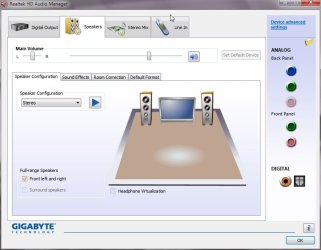
Do you have the Realtek audio manager running? If not, it's probably in the control panel area.

CRTHD.jpg

Do you have the small folder icon in the upper right quadrant? If so click on it, select "Disable Front Panel Jack Detection" un-check the "Enable auto popup dialog..."

If you right click over the colored jack icons there are other options.

Ap
 

My Computer

Computer Manufacturer/Model Number
Assembled in my workshop
OS
Windows 7 Home Premium
CPU
Intel Core 2 Duo @ 3.00gHz
Motherboard
Gigabyte GA-P35-S3G
Memory
4 GB
Graphics Card(s)
ATI Radeon HD 2600 XT
Sound Card
RME 24/96 Card, Realtek Internal Audio PreSonus FireStudio
Monitor(s) Displays
Acer 1917 (x2)
Screen Resolution
1280 x 1024 on both monitors
Hard Drives
Three 250GB Seagate SATA Barracuda 7200rpm
PSU
Rosewill 500-watt
Case
Rosewill mid-tower
Cooling
Noctua NH-U9B (CPU), PwrSupply fan + single large case Fan
Keyboard
Macally w/2/USB ports.
Mouse
Trackman Wheel
Other Info
Event 20/20 bas studio monitors, Yamaha sub.
Rackmount Korg/Roland/Yamaha synthesizers,
Cubase MIDI/audio recording. Sony Soundforge audio/mastering software. CD Architect Mastering. RME & Presonus audio interfaces.
Hm, surprisingly, I don't have the folder you mentioned in my Realtek audio manager. However, I will try the alcohol solution.
 

My Computer

OS
Windows 7 Ultimate x64
I would suggest connecting the speakers in case the problem is the Headset as plugging the headset into the rear jack can produce the same problems as plugging into the front headphone jack.
 

My Computer

Computer type
PC/Desktop
Computer Manufacturer/Model Number
My Own Build
OS
Windows 10 64 bit
CPU
Intel i7 6700K
Motherboard
ASUS ROG Maximus VIII Hero
Memory
16GB Corsair Dominator
Graphics Card(s)
Intel CPU Graphics
Sound Card
RealTek
Monitor(s) Displays
27" Dell S2719dgf
Screen Resolution
2560X1440
Hard Drives
1 TB Samsung 850 EVO SSD for Win 10 Pro
500GB Samsung 850 EVO SSD for Win 10 Insider
2 TB drive for backup
PSU
EVGA Supernova 750G2
Case
BeQuiet Silent Base 600
Cooling
Deepcool Captain 120EX
Keyboard
Microsoft Wireless 2000
Mouse
Microsoft wireless
Internet Speed
100 MB/sec (Cable)
Antivirus
Microsoft Defender and Malwarebytes
Browser
Edge/Firefox
Other Info
Cakewalk (Sonar) by BandLab and Studio One 4.1 Pro recording studio software. MOTU 896Mk3 Hybrid recording interface, Frontier Tranzport wireless control unit, Behringer X-Touch Control Surface.
Five USB connected optical drives for CD Audio production using Nero BurningROM
Back
Top