

Windows 7’s new “play all” decoders, encoders and transcoding capabilities
Windows 7’s new “play all” decoders, encoders and transcoding capabilities
"If you have had any theories Microsoft was conspiring with the media conglomerates to protect their interests and not the user’s, throw them in the bin, pour jet fuel and remotely detonate them since Microsoft can’t be any bolder than building in DivX and Xvid native support in Windows 7. Yes, all your favorite Family Guy episodes will play in Windows Media Player. Yes I’m looking at you. You may have also heard there’s also native H.264 and AAC support. But that’s not all. After all, decoding is only one part of the equation.
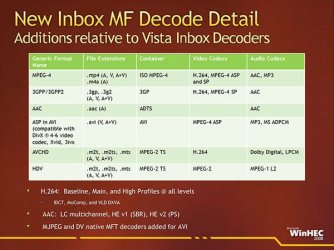
In a presentation titled “Video Improvements In Windows 7” at WinHEC 2008, Microsoft also revealed new encoding and similarly transcoding capabilities in Windows 7. The new “Media Foundation” decoders are as follows,
In Windows 7, encoding is extended to widely adopted MPEG-4 and 3GPP standards with H.264 video and AAC audio encoders built in, on top of the WMV, WMA and MP3 encoders built-in to Vista today - after all, hardly anyone uses Windows Media outside of the Microsoft ecosystem. Speaking of which the Zune even supports H.264 and AAC natively.
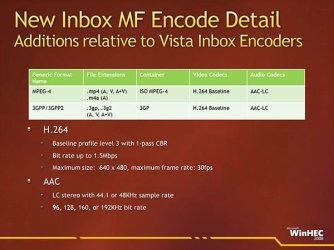
Bear in mind however these encoders are not a replacement for commercial alternatives. The limitations include simple profiles, maximum bitrate and resolutions.
With this new pool of decoders and encoders, Microsoft’s also doing some building in some interesting transcoding (decoding and re-encoding from one format to another) technology in Windows. From what I can at least gather from the presentation, transcoding is actually built right into the Windows 7 shell. That is, if you drag and drop a video from your desktop to your portable media player, the conversion will happen automatically. Personally, anything that removes unnecessary third-party bloatware to add content to portable devices gets my vote.
Microsoft also recognizes that software transcoding is less than ideal - a movie will usually take hours, so Windows 7 will also support a new breed of dedicated hardware transcoders which could ideally become a standard motherboard chipset feature.
Windows 7’s new “play all” decoders, encoders and transcoding capabilities - istartedsomething
"

Windows 7’s new “play all” decoders, encoders and transcoding capabilities
"If you have had any theories Microsoft was conspiring with the media conglomerates to protect their interests and not the user’s, throw them in the bin, pour jet fuel and remotely detonate them since Microsoft can’t be any bolder than building in DivX and Xvid native support in Windows 7. Yes, all your favorite Family Guy episodes will play in Windows Media Player. Yes I’m looking at you. You may have also heard there’s also native H.264 and AAC support. But that’s not all. After all, decoding is only one part of the equation.
In a presentation titled “Video Improvements In Windows 7” at WinHEC 2008, Microsoft also revealed new encoding and similarly transcoding capabilities in Windows 7. The new “Media Foundation” decoders are as follows,
In Windows 7, encoding is extended to widely adopted MPEG-4 and 3GPP standards with H.264 video and AAC audio encoders built in, on top of the WMV, WMA and MP3 encoders built-in to Vista today - after all, hardly anyone uses Windows Media outside of the Microsoft ecosystem. Speaking of which the Zune even supports H.264 and AAC natively.
Bear in mind however these encoders are not a replacement for commercial alternatives. The limitations include simple profiles, maximum bitrate and resolutions.
With this new pool of decoders and encoders, Microsoft’s also doing some building in some interesting transcoding (decoding and re-encoding from one format to another) technology in Windows. From what I can at least gather from the presentation, transcoding is actually built right into the Windows 7 shell. That is, if you drag and drop a video from your desktop to your portable media player, the conversion will happen automatically. Personally, anything that removes unnecessary third-party bloatware to add content to portable devices gets my vote.
Microsoft also recognizes that software transcoding is less than ideal - a movie will usually take hours, so Windows 7 will also support a new breed of dedicated hardware transcoders which could ideally become a standard motherboard chipset feature.
Windows 7’s new “play all” decoders, encoders and transcoding capabilities - istartedsomething
"
My Computer
At a glance
Vista X32. Windows 7 32bitIntel Quad Core 66004096 MB Xtreme-Dark 800mhzZotac Amp Edition 8800GT - 512MB DDR3, O/C 70...
- Computer Manufacturer/Model Number
- Self Built
- OS
- Vista X32. Windows 7 32bit
- CPU
- Intel Quad Core 6600
- Motherboard
- Asus P5B
- Memory
- 4096 MB Xtreme-Dark 800mhz
- Graphics Card(s)
- Zotac Amp Edition 8800GT - 512MB DDR3, O/C 700mhz
- Monitor(s) Displays
- Samsung 206BW
- Screen Resolution
- 1680 X 1024
- Hard Drives
- 4 X Samsung 500GB 7200rpm Serial ATA-II HDD w. 16MB Cache .
- PSU
- 550 w
- Case
- Thermaltake
- Cooling
- 3 x octua NF-S12-1200 - 120mm 1200RPM Sound Optimised Fans
- Keyboard
- Microsoft
- Mouse
- Targus
- Internet Speed
- 1500kbs


 but at least it's there.


