Dual Boot Installation with Windows 7 and XP

How to Setup a Dual Boot Installation with Windows 7 and XP


   Information
This will show you how to install Windows 7 and XP to dual boot with when you already have either Windows 7 or XP installed first.
   Note
With a dual boot installaton, you will have two operating systems (OS) installed. When you start the computer, you will have the choice to choose which OS you would like to start up to. This method is the easiest way of doing a dual boot with these two operating systems.
   Tip
When dual booting with another OS (ex: Vista or XP), you may not always have that OS partition show up in Computer with a driver letter in Windows 7. If this happens, then you will just need to add a drive letter to the OS (ex: Vista or XP) partition in Windows 7 Disk Management for it to show up in Computer with a driver letter.
   Warning
To stop XP from deleting your Windows 7 System Restore Points everytime XP is started, then see System Restore Points - Stop XP Dual Boot Delete to hide Windows 7 from XP.

Windows 7 Minimum Hardware Requirements


NOTE: For more information on this, see: Windows 7 system requirements
  • 1 GHz 32-bit or 64-bit processor
  • 1 GB RAM for 32-bit Windows 7 OR 2 GB RAM for 64-bit Windows 7
  • 16 GB available disk space 32-bit Windows 7 OR 20 GB for 64-bit Windows 7
  • Support for DirectX 9 graphics with 128 MB memory (in order to enable Aero theme)
  • DVD-R/W Drive
  • Internet or phone access to activate Windows 7.
Windows XP Minimum Hardware Requirements

NOTE: For more information on this, see: System requirements for Windows XP operating systems
  • PC with 300 megahertz (MHz) or higher processor clock speed recommended; 233-MHz minimum required;* Intel Pentium/Celeron family, AMD K6/Athlon/Duron family, or compatible processor recommended
  • 128 megabytes (MB) of RAM or higher recommended (64 MB minimum supported; may limit performance and some features)
  • 1.5 gigabyte (GB) of available hard disk space.*
  • Super VGA (800 × 600) or higher resolution video adapter and monitor
  • CD-ROM or DVD drive
  • Keyboard and Microsoft Mouse or compatible pointing device
EXAMPLE: Windows Boot Manager
NOTE: This is the boot screen where you select what operating system that you would like to start. By default, you have 30 seconds to choose another operating system before the default operating system will start automatically.
Example.jpg


OPTION ONE

When XP is Installed First


NOTE: If you have a RAID setup, you will need to have the Windows 7 RAID drivers on a USB flash drive available to select and load while installing Windows 7.
1. Do step 2 or 3 below for where you wanted to install Windows 7 at.

2. To Create a New Partition from the XP Hard Disk Drive
A) With your Windows 7 installation disc boot into the Command Prompt from the System Recovery Options screen.
NOTE: Make sure that the CD/DVD drive is selected first in the boot order in the BIOS.

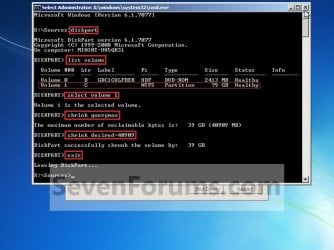
B) In the command prompt, select and shrink the XP volume by how many MB (1024 MB = 1 GB) you want to have for this Windows 7 partition. (See screenshot below)
NOTE: You would do steps 2 to 9 in METHOD TWO at that link. Windows 7 will need a minimum of 16 GB (16384 MB).
XP-W7_1.jpg
C) Click on the X at the top right corner to close the command prompt. (See screenshot above)

D) Click on the X at the top right corner to close System Recovery Options. (See screenshot below)
XP-W7_2.jpg
E) Go to step 4.
3. To Use a Separate Hard Disk Drive than the XP Drive
A) Boot from your Windows 7 installation disc.
NOTE: Make sure that the CD/DVD drive is selected first in the boot order in the BIOS.
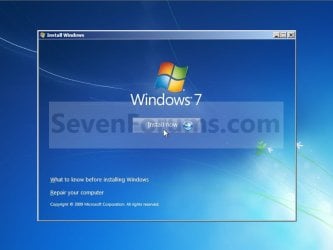
4. Click on the Install now button. (See screenshot below)
XP-W7_3.jpg
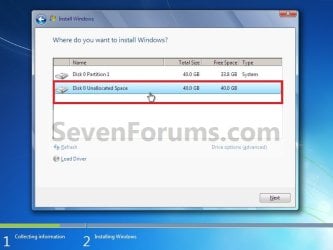
5. When you get to this point, select the partition (step 2) or hard drive to install Windows 7 on. (See screenshot below)
XP-W7_4.jpg
6. Finish installing Windows 7.
NOTE: You would start at step 9 in that link to finish installing Windows 7.

7. When finished, restart the computer to have the option to boot from XP (Earlier Verision of Windows) or Windows 7. (See screenshot below)

   Note
If you are only booting into Windows 7 and do not have XP listed in the Windows Boot Manager, then you can install only EasyBCD (step 8 Option Two below) to add XP (or Windows 7) while started in Windows 7 the same way to the boot list.

Example.jpg


OPTION TWO

When Windows 7 is Installed First


   Warning

1. To Create a New Partition from the Windows 7 Hard Disk Drive
NOTE: If you want to install XP on a separate internal hard drive instead, then skip this step and go to step 2.
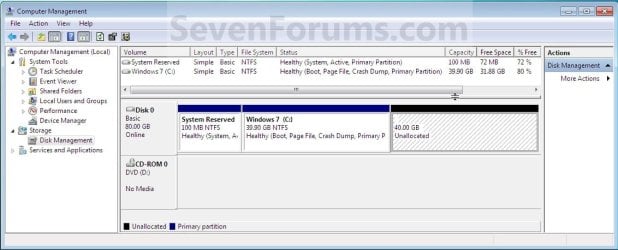
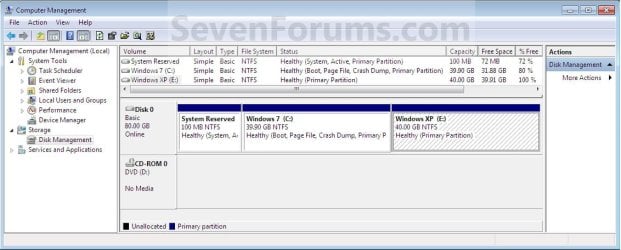
A) In Windows 7, select and shrink the Windows 7 volume in Disk Management by how many MB (1024 MB = 1 GB) you want to have for this XP partition. (See screenshots below)
NOTE: You would do all of Method One at that link.
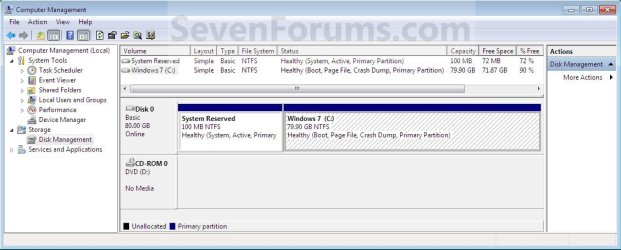
W7-XP-1.jpg

W7-XP-2.jpg

W7-XP-3.jpg
2. Insert your XP installation disc, then restart the computer and press any key to boot from it when prompted. (See screenshot below)
NOTE: Make sure that the CD/DVD drive is selected first in the boot order in the BIOS.

Step1.jpg
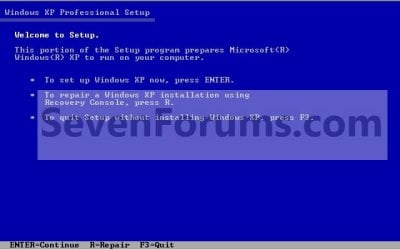
3. From XP Setup, Press Enter. (See screenshot below)


   Warning

W7-XP-4.jpg
4. Press F8. (See screenshot below)
NOTE: On some multimedia keyboards, you may need to press the F-Lock or Function key before pressing F8.
W7-XP-5.jpg
5. Select the partition (step 1) or hard drive that you want to install XP on using the arrow keys and press Enter.
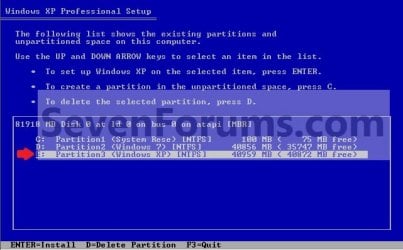
W7-XP-6.jpg
6. Finish installing XP.


   Tip
If you get Error loading Operating System after XP restarts:
  • Using your Windows 7 installation disc, boot to the command prompt at startup.
  • Type in these comands below, and press enter after each one.
    • bootrec /FixMbr
    • bootrec /FixBoot
    • bootrec /RebuildBcd
  • Exit the command prompt and restart the computer.
  • At this point, Windows 7 should boot up the same way before trying to install XP.
  • Continue to step 8 below and run EasyBCD from Windows 7 instead.

7. In XP, download and install .Net Framework 2.0 (32-bit) version or .Net Framework 2.0 (64-bit) version first, and EasyBCD (free version) for your 32-bit (x86) or 64-bit (x86) XP.
NOTE: In XP, Net Framework is required to be installed to run EasyBCD. After you click on Register (at bottom of link) for the free EasyBCD, registration is not required to download it.

8. Run EasyBCD (free version).
NOTE: This is required to repair the Windows 7 boot file and add XP to the Windows Boot Manager list.

9. On the left side of EasyBCD, click on the Add New Entry button. (See screenshot below)
A) In the top section under Operating Systems, click on the Windows tab. (See screenshot below)
B) To the right of Type, select Windows NT/2k/XP/2k3 from the drop down menu. (See screenshot below)
:warn:WARNING: Be sure to leave the Automatically detect correct drive box checked.

C) To the right of Name, you can leave the default Microsoft Windows XP as the name to be displayed in the Windows Boot Manager, or you can type whatever name you would like to have instead. (See screenshot below)
D) Click on the Add Entry button. (See screenshot below)
W7-XP-7.jpg
10. On the left side of EasyBCD, click on the BCD Deployment button, select (dot) the Install the Windows Vista/7 bootloader to the MBR option, and click on the Write MBR button. (See screenshot below)
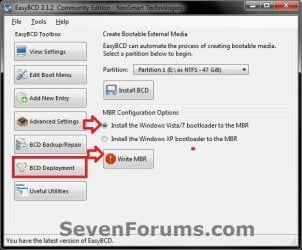
W7-XP-9.jpg
11. Close EasyBCD.

12. Restart the computer to have the option to boot from Microsoft Windows XP or Windows 7. (See screenshot below)
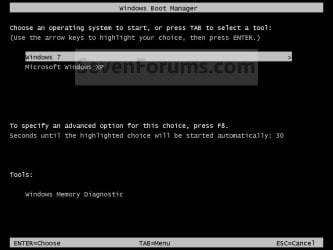
Example2.jpg
   Tip
If Windows 7 will not start up when selected, then use your Windows 7 installation DVD to do a Startup Repair.

That's it,
Shawn


Last edited:

My Computer My Computer

At a glance

64-bit Windows 11 Pro for WorkstationsIntel i7-8700K OC'd to 5 GHz64 GB (4x16GB) G.SKILL TridentZ RGB DDR4 3600...ASUS ROG-STRIX-GTX1080TI-O11G-GAMING
Computer type
PC/Desktop
Computer Manufacturer/Model Number
Self built custom
OS
64-bit Windows 11 Pro for Workstations
CPU
Intel i7-8700K OC'd to 5 GHz
Motherboard
ASUS ROG Maximus XI Formula Z390
Memory
64 GB (4x16GB) G.SKILL TridentZ RGB DDR4 3600 MHz
Graphics Card(s)
ASUS ROG-STRIX-GTX1080TI-O11G-GAMING
Sound Card
Integrated
Monitor(s) Displays
2 x Samsung Odyssey G7 27"
Screen Resolution
2560x1440
Hard Drives
1TB Samsung 990 PRO M.2,
4TB Samsung 990 PRO PRO M.2,
TerraMaster F8 SSD Plus NAS
PSU
Seasonic Prime Titanium 850W
Case
Thermaltake Core P3
Cooling
Corsair Hydro H115i
Keyboard
Logitech wireless K800
Mouse
Logitech MX Master 4
Internet Speed
2 Gb/s Download and 100 Mb/s Upload
Antivirus
Malwarebyte Anti-Malware Premium
Browser
Google Chrome
Other Info
Logitech Z625 speaker system,
Logitech BRIO 4K Pro webcam,
HP Color LaserJet Pro MFP M477fdn,
APC SMART-UPS RT 1000 XL - SURT1000XLI,
Galaxy S23 Plus phone
Thank you
 

My Computer My Computer

At a glance

XP and Win72.92.5
Computer Manufacturer/Model Number
dell
OS
XP and Win7
CPU
2.9
Memory
2.5
Hard Drives
500.GB
Cooling
fan
You're most welcome Tzar. :)
 

My Computer My Computer

At a glance

64-bit Windows 11 Pro for WorkstationsIntel i7-8700K OC'd to 5 GHz64 GB (4x16GB) G.SKILL TridentZ RGB DDR4 3600...ASUS ROG-STRIX-GTX1080TI-O11G-GAMING
Computer type
PC/Desktop
Computer Manufacturer/Model Number
Self built custom
OS
64-bit Windows 11 Pro for Workstations
CPU
Intel i7-8700K OC'd to 5 GHz
Motherboard
ASUS ROG Maximus XI Formula Z390
Memory
64 GB (4x16GB) G.SKILL TridentZ RGB DDR4 3600 MHz
Graphics Card(s)
ASUS ROG-STRIX-GTX1080TI-O11G-GAMING
Sound Card
Integrated
Monitor(s) Displays
2 x Samsung Odyssey G7 27"
Screen Resolution
2560x1440
Hard Drives
1TB Samsung 990 PRO M.2,
4TB Samsung 990 PRO PRO M.2,
TerraMaster F8 SSD Plus NAS
PSU
Seasonic Prime Titanium 850W
Case
Thermaltake Core P3
Cooling
Corsair Hydro H115i
Keyboard
Logitech wireless K800
Mouse
Logitech MX Master 4
Internet Speed
2 Gb/s Download and 100 Mb/s Upload
Antivirus
Malwarebyte Anti-Malware Premium
Browser
Google Chrome
Other Info
Logitech Z625 speaker system,
Logitech BRIO 4K Pro webcam,
HP Color LaserJet Pro MFP M477fdn,
APC SMART-UPS RT 1000 XL - SURT1000XLI,
Galaxy S23 Plus phone
Hi,

I've read through the posts (well, quickly that is!) and wondered if someone can confirm my understanding and to answer some questions.

I got 2 hard drives which I want to install XP and Win 7. I want to dual boot into them but most importantly, I want them to be completely independent of each other and in effect one can't see the other as an OS.

From what I read, the cleanest method to keep each OS completely separate and independent of each other is to install each OS on a separate hard drive. However, each install must be done with only one hard drive connected at a time. So, XP is installed with the Win 7 drive disconnected. This is followed by the Win 7 install with the XP drive disconnected. When both OS have been installed on their separate hard drives, connect both up and power on the PC. I then need to use the one time Boot menu to select which drive to boot into. If this is not done, the default drive as selected in the Bios is booted into. There is no need to use Easy BCD.

Do I still need to worry about the registry update as mentioned in the guide - the one where XP deletes the restore points on Win 7?

I also read about slipstream Sata drives and .Net Framwork being mentioned. Does this also need to be done? My XP drive is IDE and my Win 7 is Sata.

Using the method above, will each OS see the other as purely a normal partition and therefore not interfere with the other at all?

Is there anything else that needs to be done to keep each OS completely independent and separate from each other or is this all that is needed to be done?

Within each hard drive, I'll also be creating partitions. These partitions will contain data files like Word, Excel, text files, jpegs, mpegs etc. Can XP open Win 7 data files (and vice versa) without affecting the file that's been opened? For example, if I open a jpeg or a video file placed by XP and then boot into Win 7 and open the same files, could I corrupt the XP files (and vice versa)? I'm just wondering if each OS might update hidden attributes in a different way or indeed if I edit files, the edit is saved in a different way.

Thanks in advance!
 

My Computer My Computer

At a glance

Windows 7 Home Premium 64bit
OS
Windows 7 Home Premium 64bit
Hi Staffy -

No you dont' need to worry about any interference when you boot independently, which procedure and benefits you seem to understand just fine.

It's entirely possible XP will see the IDE drive especially if it has SP3. If not slipstream the drivers into XP ISO if you don't have a floppy drive to insert them at F6 prompt.

As long as the programs you use to edit mutual files are compatible with the OS then you should have no problems editing files in either OS. You can even make one data partition to share files with both OS's.

Most important is to get a perfect install of each OS, by adapting these tips for WIn7: Reinstalling Windows 7

The drives will relate to each other as data drives only. The boot files will remain on each OS instead of one updating the other which is how interference can happen.
 
Hi gregrocker,

Thanks very much for your quick reply :)

My XP (SP3) is actually on my IDE drive and works fine so does this means I don't need to worry about slipstream drivers I've read about? Howabout the .Net Framework updates that other people have mentioned? My Win 7 install will be on the Sata drive.

Indeed, I will have a couple of partitions to share files between the 2 OS so its good to know that the files can be shared without corruption :)

Also thanks for the link. I'll take a proper read later but I didn't realise there was extra consideration for installing Win 7. Glad you pointed this out.

Thanks.
 

My Computer My Computer

At a glance

Windows 7 Home Premium 64bit
OS
Windows 7 Home Premium 64bit
If you already have XP installed then there are no worries, and then only to provide SATA drives for SATA HD if installing it fresh.

Net Framework 2 is needed only to use EasyBCD to knit the two OS"s together into a Windows-managed Dual Boot which you've wisely decided against, since they interlock the HD's making one harder to remove without surgery.

Win7 goes in easily enough without the steps I gave but they are to get it perfect, based on thousands of installs done here.
 
Nice one. Thanks for your help gregrocker! I read your advice to other people about installing the OS on 2 separate drives and then dual boot via the one time boot menu. It sounded like the best way for me and decided to go with your suggestion :) I just need to find the time now to do it!
 

My Computer My Computer

At a glance

Windows 7 Home Premium 64bit
OS
Windows 7 Home Premium 64bit
Dual boot to many drives PROBLEM

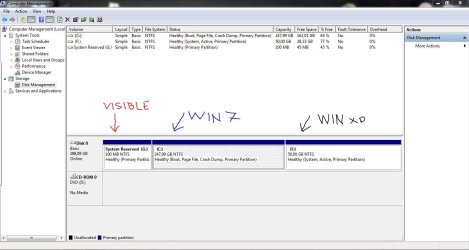
I've got dual booted Win 7 and Win XP but I've got 4 instead of 2 drive partitions. How is it possible that I have "System reserverd" partition shown and declared as "C" and one partition which can't be accessed. This happen when Win XP loads. The C is System reserved, D is Win 7, E is Win XP, and F can't be accessed.

In Win 7 C is Win 7, E can't be accessed, F is Win XP and G is System reserved


Could someone tell me what happend? Iv'got many experiance and working on Hackintosh development but this is little crazy situation.

And when installing XP, then Win 7, everithing works like a charm.

Thank you in advance!

Cheers
 

My Computer My Computer

At a glance

Mac OS X LION 10.7.2
OS
Mac OS X LION 10.7.2
Please post back a screenshot of your maximized Disk management drive map and listings showing all columns, using the SNipping TOol in Start Menu. We can help you sort what's happened.

When installing in order of age, the newer OS correctly configures a Dual Boot, whereas XP when installed last doesn't know what it's doing with the newer OS, steals the boot requiring adding Win7 with EasyBCD, or starting Win7 to add XP easier.

SysReserved should NOT have a drive letter in Win7. Other than that is your problem that XP is not Seen from Win7? This might be solved by installing EasyBCD to 7, deleting the XP entry then Adding it back again, since Easy works better from Win7 and won't allow XP to letter SysReserved if XP is not already corrupted somehow.

But let us see the picture first.
 
Hi Staffy -

No you dont' need to worry about any interference when you boot independently, which procedure and benefits you seem to understand just fine.

The drives will relate to each other as data drives only. The boot files will remain on each OS instead of one updating the other which is how interference can happen.

Hi Gregrocker:

I am trying to achieve an enviornment just like what staffy has outlined - to have win XP and win 7 each installed on separate HDD.

Questions are:
1.) Does the XP auto delete restore point in win 7 still apply here? Do I need to tweak the registry per the guide given?
2.) Can you give a more detail description of this one-time-boot-menu we are talking about here? My understanding of this is to have win XP install on one HDD first (with win 7 HDD disconnected), then install win 7 on another separate HDD (this time with the XP HDD disconnected). No need for the "software" dual boot config setup as the boot will be controlled by BIOS during a restart. During a actual restart, hit the F12 menu and select either the win XP or win 7 HDD to start loading OS. Is my understanding correct?

3.) reference to step 2 above, will this result in any interference? Last thing I need is to do a repair on the win 7 HDD as I don't have admin right.

Thanks for yr help!
 

My Computer My Computer

At a glance

Windows 7
OS
Windows 7
I think that the Restore Point issue is a dead parrot with separate drives. Not to worry.

Every maker has a different one-time BIOS Boot menu key:
Asus - F8
HP/Compaq - Esc
Sony - F2
Acer - F12
Gateway - F10
eMachnes - F10
Toshiba - F12
Dell - F12
IBM/Lenovo - the blue Thinkvantage button

It doesn't matter which OS is installed first, just unplug it and install the other one, plug that back in, set the preferred OS as first to boot in BIOS setup, choose the other one by tapping Boot Menu shortcut key at boot.

If this is not to your liking, install EasyBCD to Win7 to add the other OS to a Windows Dual Boot menu.

You can repair WIn7 with Repair CD or DVD without Admin rights but why are you constructing a Dual Boot on a computer you don't have Admin rights upon anyway?
 
Installing windows xp after windows 7

My accounting program was not working anymore (because MSDE is not working anymore in windows 7) so I wanted windows xp as a second operation system but not easy.

But now it is.

0) Install XP in another partition (windows 7 already installed as first)
1) Place the windows 7 cd and boot your system from cd (change bios first normally with cmd F2)
2) Choose recovery and start the system again and that will be windows 7 of course
3) Download BCD and install (in WINDOWS 7)
4) Add XP to the mbr
5) Restart, and now you can choose between xp and windows 7

If you install BCD in XP you can get registry problems (no authorisation for updating the registry in windows 7 from xp).
The 5 points above are very simple to do ...

Thanks to the creator of BCD, an excellent program ...
 

My Computer My Computer

At a glance

Windows 7 x32
OS
Windows 7 x32
Please post back a screenshot of your maximized Disk management drive map and listings showing all columns, using the SNipping TOol in Start Menu. We can help you sort what's happened.

When installing in order of age, the newer OS correctly configures a Dual Boot, whereas XP when installed last doesn't know what it's doing with the newer OS, steals the boot requiring adding Win7 with EasyBCD, or starting Win7 to add XP easier.

SysReserved should NOT have a drive letter in Win7. Other than that is your problem that XP is not Seen from Win7? This might be solved by installing EasyBCD to 7, deleting the XP entry then Adding it back again, since Easy works better from Win7 and won't allow XP to letter SysReserved if XP is not already corrupted somehow.

But let us see the picture first.

First of all, thank you for very quick response. I don't have problem wih Win XP drive showing from Win 7 OS.

Now there is Disk Management screenshot where is clear visible as I told that "System Reserved" drive is vissible.

Other thing, in EasyBCD I change drive letter for XP from F to D, but it goes back to F even if I run it as admin. So, hope that you have some kind of information to try solve this pormblem.

Thank you in advance!

Cheers
 

Attachments

  • Disk Management.JPG
    Disk Management.JPG
    91.2 KB · Views: 137
  • Computer.JPG
    Computer.JPG
    62.6 KB · Views: 130

My Computer My Computer

At a glance

Mac OS X LION 10.7.2
OS
Mac OS X LION 10.7.2
I think that the Restore Point issue is a dead parrot with separate drives. Not to worry.

Every maker has a different one-time BIOS Boot menu key:
Asus - F8
HP/Compaq - Esc
Sony - F2
Acer - F12
Gateway - F10
eMachnes - F10
Toshiba - F12
Dell - F12
IBM/Lenovo - the blue Thinkvantage button

It doesn't matter which OS is installed first, just unplug it and install the other one, plug that back in, set the preferred OS as first to boot in BIOS setup, choose the other one by tapping Boot Menu shortcut key at boot.

If this is not to your liking, install EasyBCD to Win7 to add the other OS to a Windows Dual Boot menu.

You can repair WIn7 with Repair CD or DVD without Admin rights but why are you constructing a Dual Boot on a computer you don't have Admin rights upon anyway?

Hi Gregrocker.

I tried the method today - two OS in separate HDD and using the one-time-boot menu (for me it's pressing F12 button because my laptop is DELL). It works! I am able to switch between the Win XP and Win 7 OS. I will monitor if there are any other problem and report back here for sharing.

The conculsion that I draw is, if one stay away from using the Microsoft windows software dual boot option and simply just stick to using the one-time-boot menu to toggle between win XP & Win 7, we will have less issues and need not worry about corruption etc. But this method comes with a slight inconvenience as we will need to hit F12 early if you desire to toggle upon a power recycle..
 

My Computer My Computer

At a glance

Windows 7
OS
Windows 7
I'd set Win7 to boot first as you'll likely need to use XP less as you go forward so will be inconvenienced less using the BIOS boot key.

If you still want to try a Windows Dual Boot, You can test this by setting a restore point, install EasyBCD to Win7 to add XP, then see if the issues you fear arise. If they do, choose Edit OS menu on EasyBCD, delete XP from the boot list, and it should be back to where it was.

But with XP fading out pretty quickly in the next year, it's probably best to just come to rely on it less and then one day pull out or format the HD.
 
Goodday,
I wanted to ask what happens to all of the programms / games?
Can i still launch / use them? Or i have to reinstall everything if im adding w7 to my xp?
 

My Computer My Computer

At a glance

64x XPAMD Phenom II x4 3.214GB of ramNvidia geforce 450gts
OS
64x XP
CPU
AMD Phenom II x4 3.21
Memory
4GB of ram
Graphics Card(s)
Nvidia geforce 450gts
Sound Card
Nvidia High definition
Monitor(s) Displays
HP 24"
Hello NaivtaL, and welcome to Seven Forums.

Nothing happens to your XP installation. All you would be doing is installing Windows 7 to another partition or HDD to be able to select at will to start XP or Windows 7 at boot afterwards. :)
 

My Computer My Computer

At a glance

64-bit Windows 11 Pro for WorkstationsIntel i7-8700K OC'd to 5 GHz64 GB (4x16GB) G.SKILL TridentZ RGB DDR4 3600...ASUS ROG-STRIX-GTX1080TI-O11G-GAMING
Computer type
PC/Desktop
Computer Manufacturer/Model Number
Self built custom
OS
64-bit Windows 11 Pro for Workstations
CPU
Intel i7-8700K OC'd to 5 GHz
Motherboard
ASUS ROG Maximus XI Formula Z390
Memory
64 GB (4x16GB) G.SKILL TridentZ RGB DDR4 3600 MHz
Graphics Card(s)
ASUS ROG-STRIX-GTX1080TI-O11G-GAMING
Sound Card
Integrated
Monitor(s) Displays
2 x Samsung Odyssey G7 27"
Screen Resolution
2560x1440
Hard Drives
1TB Samsung 990 PRO M.2,
4TB Samsung 990 PRO PRO M.2,
TerraMaster F8 SSD Plus NAS
PSU
Seasonic Prime Titanium 850W
Case
Thermaltake Core P3
Cooling
Corsair Hydro H115i
Keyboard
Logitech wireless K800
Mouse
Logitech MX Master 4
Internet Speed
2 Gb/s Download and 100 Mb/s Upload
Antivirus
Malwarebyte Anti-Malware Premium
Browser
Google Chrome
Other Info
Logitech Z625 speaker system,
Logitech BRIO 4K Pro webcam,
HP Color LaserJet Pro MFP M477fdn,
APC SMART-UPS RT 1000 XL - SURT1000XLI,
Galaxy S23 Plus phone
Back
Top