Convert a Dynamic Disk to a Basic Disk

How to Convert a Dynamic Disk to a Basic Disk

   Information
A disk is a separate physical hard drive. This will show you how to convert a dynamic, also known as "software RAID", disk to a basic disk in Windows Disk Manager or in a command prompt. By default Windows uses Basic disks.

Basic and dynamic disks both support using MBR and GPT partition (volume) styles.

For more detailed information on basic and dynamic disks, see: Basic and Dynamic Disks (Windows)


   Note
Differences Between Basic and Dynamic Disks:
  • Basic disks are supported (readable) by all Windows operating systems since MS-DOS.
    • Dynamic disks are only supported (readable) by Windows 2000, XP Professional, Windows Server 2003, Vista Ultimate, Vista Enterprise, Windows 7, and Windows Server 2008.
  • Basic disks can have up to 128 GPT primary partitions, or 4 MBR primary partitions or 3 MBR primary partitions and 1 extended partition with up to 128 logical volumes in the extended partition.
    • Dynamic disks can have up to 2000 dynamic volumes that function like a primary partition used in basic disks.
  • Basic disks cannot share or split data with other primary or logical partitions, or basic disks. Each partitiion on a basic disk is treated as if it was a separate hard disk on the basic disk.
    • Separate dynamic disks can be combined into a single dynamic volume (spanning), split data among several dynamic disks (striping) for increased performance, or duplicate data among several dynamic disks (mirroring) for increased reliability.
  • Hard disks are basic disks by default, including removable disks and disks on a laptop (notepad).
    • Removable disks cannot be converted to a dynamic disk.
   Warning
VERY IMPORTANT, PLEASE READ THIS FIRST.
  • You must be logged in as an administrator to do this inside Windows.
  • Before you convert a dynamic disk to a basic disk, be sure to backup anything that you do not want to lose on that dynamic disk. Converting the dynamic disk back to a basic disk using either OPTION 3-5 below requires that all dynamic volumes are deleted on the disk first.
  • See OPTION ONE or OPTION TWO below if you wanted to be able to convert a dynamic disk back to a basic disk without losing the data on it.
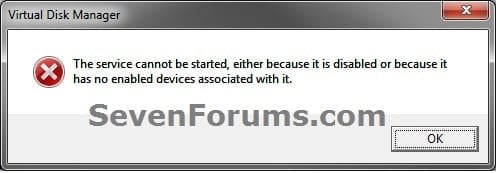
  • If you disable the Disk Defragmenter service, then you will get the error below when you try to do anything in Disk Management. If you get this error, then make sure that the Disk Defragmenter service is set to only Manual.
Error.jpg


OPTION ONE

Convert Dynamic Disk to Basic Disk using "Partition Wizard 4.2 Free"


:warn:WARNING: Even though you will not lose the data on the dynamic disk when you use this option to convert the dynamic disk back to a basic disk, be sure to backup any data on the dynamic disk that you wish to keep first just to be safe in case something happens. Say a power outage while in the middle of converting the disk.1. Do step 2 or 3 below depending on what you are able to do.

2. To Use Partition Wizard 4.2 Free at Boot
NOTE: This option can be helpful if you are unable to startup Windows if your Windows disk was made dynamic.A) Download "pwhe42.iso" file here to your desktop.
NOTE: It will take a moment for the download option to automatically appear at the link.

B) Create either a bootable CD/DVD or USB with the pwhe42.iso file.
NOTE: You could also use a free program like ImgBurn at 4x burn speed to create a bootable CD/DVD with.

C) Boot from the the CD/DVD or USB.

D) Convert the dynamic disk to basic like starting at step 3E below.

3. To Use Partition Wizard 4.2 Free in WindowsA) Download the "Partition_Wizard_4.2_free.zip" file here to your desktop.

B) Open the ZIP file, and extract (drag and drop) the PW folder to your desktop.

C) Open the PW folder, and run the PWIZ.exe file.

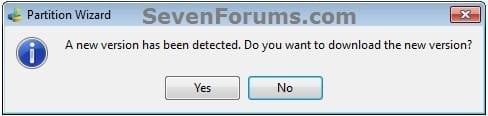
D) Click on No for the new version avialable update. (see screenshot below)PW-1.jpg

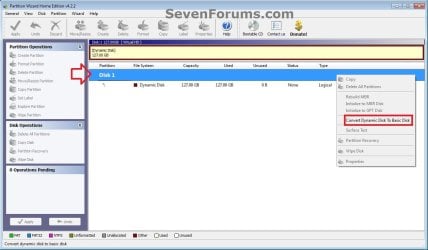
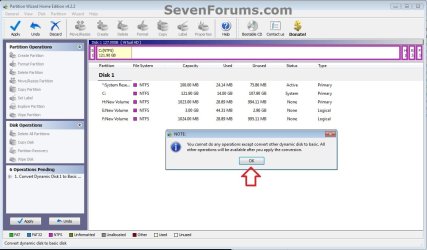
E) Right click on the Disk # (ex: Disk 1) of the dynamic disk you want to convert, then click on Convert Dynamic Disk to Basic Disk. (see screenshot below)PW-2.jpg

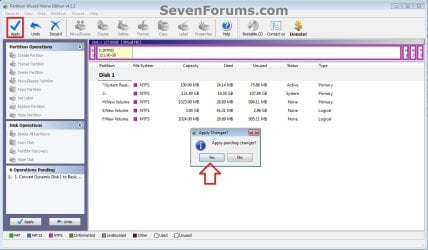
F) Click on OK. (see screenshot below)

G) Click on the blue Apply check mark toolbar button at the top left corner, and click on Yes. (see screenshot below)PW-4.jpg

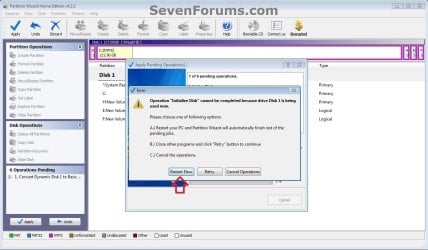
H) If prompted to restart, click on Restart Now. (see screenshot below)
NOTE: This is normal if the dynamic disk you wanted to convert to basic is the disk that the currently running Windows is installed on.PW-5.jpg


4. When finished, the selected dynamic disc will now be converted to a basic disk without losing any data on it.


OPTION TWO

To Convert Dynamic Disk to Basic Disk using Disk Management


:warn:WARNING: Be sure to read the red WARNING box above. You will lose all data on the dynamic disk using this option.1. Open the Control Panel (icons view), and click on the Administrative Tools icon, then close the Control Panel window.

2. Click on Computer Management in Administrative Tools, then close the Administrative Tools window.

3. If prompted by UAC, click on Yes.

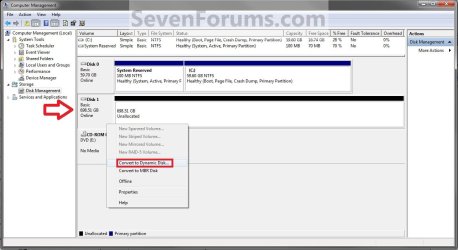
4. In the left pane under Storage, click on Disk Management. (See screenshot below)Step1.jpg

5. In the dynamic disk (ex: Disk 1) that you want to convert to a basic disk, right click on each volume on the disk and click on Delete Volume until the whole disk is unallocated space. (See screenshot above)
NOTE: If prompted, click on Yes to continue deleting the volume(s).

6. If the disk (ex: Disk 1) that you want to convert to a basic disk is still displayed has being Dynamic (left side under Disk #), then right click on the disk (ex: Disk 1) and click on Convert to Basic Disk if available. (See screenshot below)Step2.jpg

7. You can also confirm that the disk is a basic disk if it's displayed has being Basic (left side under Disk #), or if you right click on the disk # and it has Convert to Dynamic Disk instead now. (See screenshot below)Step3.jpg

8. You can now create partitions on the now basic disk if you like.

9. When done, close Disk Management.


OPTION THREE

To Convert Dynamic Disk to Basic Disk using "Clean" Command


:warn:WARNING: Be sure to read the red WARNING box above. You will lose all data on the dynamic disk using this option.1. Use the Clean command in the tutorial below on the dynamic disk that you want to wipe out and convert to be a basic disk.
NOTE: You could also use the Clean all command for this as well, but it will take much longer to do since it also does a secure erase.How to Clean or Clean All a Disk with the Diskpart Command

2. You can now create partitions on the now basic disk if you like.


OPTION FOUR

To Convert Dynamic Disk to Basic Disk using "Delete Volume" Command


:warn:WARNING: Be sure to read the red WARNING box above. You will lose all data on the dynamic disk using this option.1. Open an elevated command prompt, and go to step 3 below.

OR

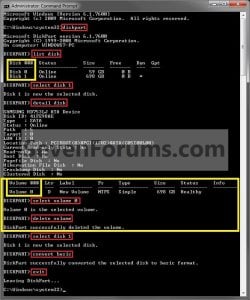
2. Open a command prompt at boot, and go to step 3 below.Command_Basic.jpg

3. In the command prompt, type diskpart and press enter. (See screenshot above)

4. Type list disk and press enter.
NOTE: Make note of the disk number (ex: Disk 1) that you want to convert to a basic disk.

5. Type select disk # and press enter.
NOTE: Substitute # with the actual disk number that you want to convert to a dynamic disk. For example, select disk 1.

6. Type detail disk and press enter.
NOTE: This will give you a list of all the volume numbers on the selected disk number that you will need to delete in steps 7 and 8 below.A) If you do not have any volumes listed, then you can go to step 10.

7. Type select volume # and press enter.
NOTE: Substitute # with a volume number listed in step 6. For example, select volume 3.

8. Type delete volume and press enter.

9. Repeat steps 7 an 8 for each volume # listed in step 6 until you have deleted all volume #'s.

10. When done, type select disk # and press enter.
NOTE: You would use the same one from step 5 above. For example, select disk 1.

11. Type convert basic and press enter.

12. When done, type exit and press enter.

13. Close the command prompt.

14. You can now create partitions on the now basic disk if you like.
NOTE: Restart the computer if you did step 2 instead.

That's it,
Shawn


Attachments

Last edited:
This is what I got running SisparV6

"If your NEW system partition is on the first hard drive in BIOS boot order, no further action is needed.

Otherwise, restart, enter BIOS setup and set the HD containing the NEW system partition first in the hard drive boot order".

I had CD drive as first boot option so I went into BIOS and made Hard drive first to boot.
Ran sisparV6 and got same result as above. There were no other options apart from USB stuff and network in boot start options.

Have you seen that message before? Looks like I'm still stymied!:mad:
 

My Computer

Computer type
Laptop
Computer Manufacturer/Model Number
HP Envy 15
OS
Windows 8.1.1
CPU
AMD A10-5750M APU with Radeon(tm) HD Graphics
Memory
8gb
Hard Drives
1TB Serial ATA 16mb buffer
I don't know what you are trying to say.

When you boot into 7 - does disk management show the 7 partition as "system" ?
 

My Computers

System One System Two

  • Computer type
    PC/Desktop
    OS
    7 X64
    CPU
    i5 8400
    Motherboard
    gigabyte b365m ds3h
    Memory
    2x8gb 3200mhz
    Hard Drives
    various
    PSU
    pure power 11 400w cm
    Case
    Coolermaster
    Cooling
    cryorig m9i
  • Computer type
    PC/Desktop
    OS
    7x64
    CPU
    g5400
    Motherboard
    ga b365m ds3h
    Memory
    8gb ddr4 2400
    PSU
    xfx pro 450w
Sorry, here is the latest screenshot after your fix:
 

Attachments

  • latest.png
    latest.png
    108.4 KB · Views: 496

My Computer

Computer type
Laptop
Computer Manufacturer/Model Number
HP Envy 15
OS
Windows 8.1.1
CPU
AMD A10-5750M APU with Radeon(tm) HD Graphics
Memory
8gb
Hard Drives
1TB Serial ATA 16mb buffer
That is very odd.

If you selected C as the new system partition - then it should be.

You did rt click and RUN AS ADMIN on the .cmd file ?

It won't work if you don't.
 

My Computers

System One System Two

  • Computer type
    PC/Desktop
    OS
    7 X64
    CPU
    i5 8400
    Motherboard
    gigabyte b365m ds3h
    Memory
    2x8gb 3200mhz
    Hard Drives
    various
    PSU
    pure power 11 400w cm
    Case
    Coolermaster
    Cooling
    cryorig m9i
  • Computer type
    PC/Desktop
    OS
    7x64
    CPU
    g5400
    Motherboard
    ga b365m ds3h
    Memory
    8gb ddr4 2400
    PSU
    xfx pro 450w
Yes, it is odd!

I booted into 7 first.

I tried again 5 times. Each time I got the above message straight away. No option to select a disk partition at any time. It gores into UAC mode so I have to click to get further.

It does exactly the same whether I run as admin (which I did 5 times) or not. Apart from the above message in my last post, the program does nothing!

The message seems to be saying 'I'm expecting to see more than one drive so make sure C: is at the top'.

Other than that, I don't know. I'm completely bald now :cry:
 

My Computer

Computer type
Laptop
Computer Manufacturer/Model Number
HP Envy 15
OS
Windows 8.1.1
CPU
AMD A10-5750M APU with Radeon(tm) HD Graphics
Memory
8gb
Hard Drives
1TB Serial ATA 16mb buffer
I don't know if this is any way relevant but HP Advisor just flagged up telling me that System Restore is turned off. This also happened about 3 days and I reported it (I think) in this thread. I thought I had fixed it but it has come back.
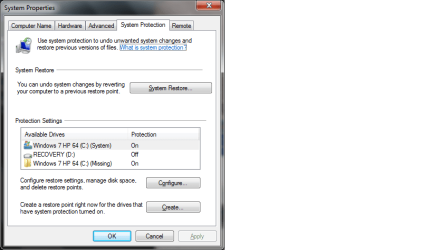
As you can see from the screenshot there are 2 Windows 7 HP 64(C) partitions but one is called (Missing). that is turned on but zero bytes are allocated. When I set say 10% I get 'The system cannot find the path specified (0x80080003)'. If I leave the setting at 0bytes, no error message. It also said that no restore points had been created. That'a lie as I created one and I had seen several reports while installing Win 7 updates that a restore point had been created.

This allowed me to create a restore point 3 days ago but this morning I got the Advisor warning and sure enough, C:\ was off again. What would cause it to turn off like that?

Also, one of the first things I did when I got the laptop last Wed was to install Acronis True Image 2010 and create an image on an external disk. I also created bootable media which failed to boot into Acronis. I created the media from within True Image, ISO and CD, then I downloaded the ISOLinux from their website, a later version that normally works only it didn't! I wrote to Acronis 3 days ago, no response. Each disk I created showed that the loader was starting but then the screen blacked out and just sat there, no disk activity. I can access my image from within Acronis but I'm stuffed if I need to re image from bootable media. I also installed Macrium Reflect, created the boot media and that worked. Same with Partition Wizard, bootable CD worked.

I mention all this in case it is part of the 100 (199 in my case) MB partition saga. What do you reckon?
And, by the way, I appreciate all the assistance!
 

Attachments

  • restore.png
    restore.png
    61.7 KB · Views: 391

My Computer

Computer type
Laptop
Computer Manufacturer/Model Number
HP Envy 15
OS
Windows 8.1.1
CPU
AMD A10-5750M APU with Radeon(tm) HD Graphics
Memory
8gb
Hard Drives
1TB Serial ATA 16mb buffer
It seems to indicate the kernel Acronis uses doesn't work for you.

Bit of a problem if your original image is an Acronis one.

Click Windows7 HP (Missing) to highlight it, then click configure, turn off system restore for that missing partition.


D/l this View attachment bsispar.zip rt click and run as admin on bsispar.cmd.

Enter letter C , then press Enter. That's it.
 
Last edited:

My Computers

System One System Two

  • Computer type
    PC/Desktop
    OS
    7 X64
    CPU
    i5 8400
    Motherboard
    gigabyte b365m ds3h
    Memory
    2x8gb 3200mhz
    Hard Drives
    various
    PSU
    pure power 11 400w cm
    Case
    Coolermaster
    Cooling
    cryorig m9i
  • Computer type
    PC/Desktop
    OS
    7x64
    CPU
    g5400
    Motherboard
    ga b365m ds3h
    Memory
    8gb ddr4 2400
    PSU
    xfx pro 450w
SIW2

That is absolutely marvelous! Your download worked a treat, as you said, 3 seconds, 3 very long seconds though :D

Now I can just delete the SYSTEM partition (199MB) which will allow me to use the now spare MBR slot, then resize C:\ create a logical partition with probably 2 more logicals within that. Have I got that right?

I also set the system restore (missing C:\), it didn't take first time but it did the second time. I haven't checked it, its getting late.

I'm talking to Acronis, they sent me another ISO but that doesn't work either. I will try it again in the morning after I have partitioned the disk, it may be that SYSTEM partition fouling it up.

Thank you again, I was beginning to think I would have to leave the disk as it was but I hadn't allowed for your expertise.

Jonathan, thank you very much as well for your assistance. I will update when I'm happy with these other jobs, then you will both have a bit of peace!
 

Attachments

  • success.png
    success.png
    118.5 KB · Views: 420

My Computer

Computer type
Laptop
Computer Manufacturer/Model Number
HP Envy 15
OS
Windows 8.1.1
CPU
AMD A10-5750M APU with Radeon(tm) HD Graphics
Memory
8gb
Hard Drives
1TB Serial ATA 16mb buffer
Hi Bertie,

Glad it worked for you.


Yes, you should be able to delete the 199mb.

The you can create an extended partition and divide that into several logical drives as you wish.

Keep us updated with your progress.

If the Acronis recovery disc doesn't work for you - better use a different imaging app. in future.

One of the other two apps. will be fine. They are both good.
 

My Computers

System One System Two

  • Computer type
    PC/Desktop
    OS
    7 X64
    CPU
    i5 8400
    Motherboard
    gigabyte b365m ds3h
    Memory
    2x8gb 3200mhz
    Hard Drives
    various
    PSU
    pure power 11 400w cm
    Case
    Coolermaster
    Cooling
    cryorig m9i
  • Computer type
    PC/Desktop
    OS
    7x64
    CPU
    g5400
    Motherboard
    ga b365m ds3h
    Memory
    8gb ddr4 2400
    PSU
    xfx pro 450w
Hi SIW2

I created my logical partitions OK but what I got after I used your little fix was that when it rebooted it gave me an option to use Ramdrive or Windows 7. Ramdrive was setup when I ran the Acronis bootloader, maybe it isn't being cleared out as the loader didn't work. Selecting Ramdrive Options EMS enabled told me me that Windows failed to start, it advised me to run the repair disk, status: 0xc000000f Info:boot selection failed because a required device is inaccessible. I had no external devices connected when I did all this.

I ran the repair disk 3 times but this didn't clear the Ramdrive option on startup. Reboot using repair disk but this time I looked at System Recovery Options:
Windows 7 Partition size 75783MB Location (C: ) Windows...
Windows Setup Partition size 75783MB Location (Unknown) W...

I rebooted again and looked at System Recovery Options\View details, sorry about the long post!

The following option will be repaired: Window Boot Manager
Identifier: {32 characters}

The following startup options will be deleted:
Windows Setup {32 characters}
Path: System.sav\2ndCap\boot.wim
Window Device: Partition=C: (Windows 7 HP 64 (75783 MB)

The following options will be added:
Name: Windows Recovery Environment (recovered)
Path: Recovery\WindowsRE\Winre.wim
Windows Device: Partition=E: (13899MB)

A copy of the current boot configuration data will be saved as C:\\BCD.Backup.0001

I'm assuming that at face value the Windows Setup will be deleted and the rest is just housekeeping but I would appreciate your views.
If you agree, I need to run 'Repair and Restart' rather than Startup Repair from the list of Recovery Tools?
Thanks again.
 

My Computer

Computer type
Laptop
Computer Manufacturer/Model Number
HP Envy 15
OS
Windows 8.1.1
CPU
AMD A10-5750M APU with Radeon(tm) HD Graphics
Memory
8gb
Hard Drives
1TB Serial ATA 16mb buffer
Yes , let it repair and restart.

It will adjust the entry for the HP Recovery partition as well.
 

My Computers

System One System Two

  • Computer type
    PC/Desktop
    OS
    7 X64
    CPU
    i5 8400
    Motherboard
    gigabyte b365m ds3h
    Memory
    2x8gb 3200mhz
    Hard Drives
    various
    PSU
    pure power 11 400w cm
    Case
    Coolermaster
    Cooling
    cryorig m9i
  • Computer type
    PC/Desktop
    OS
    7x64
    CPU
    g5400
    Motherboard
    ga b365m ds3h
    Memory
    8gb ddr4 2400
    PSU
    xfx pro 450w
Hi SIW"

Right again! Thanks for the confirmation, I thought it wise to make sure, rather than guess.

Acronis say I need to take out a support program to get more help. Sounds like a blank cheque to me. I ve tried out Easeus ToDo but that 'lied' to me so I'm not sure about that one.

Just done an image with Macrium Reflect (30GB in 15 mins and restore in 40 mins). Nice and easy, restored OK. looks good.

Just need to create 2 more logicals and then I can stick my data in the respective folders. Looking very good now.
Thanks again.

Best regards.
 

My Computer

Computer type
Laptop
Computer Manufacturer/Model Number
HP Envy 15
OS
Windows 8.1.1
CPU
AMD A10-5750M APU with Radeon(tm) HD Graphics
Memory
8gb
Hard Drives
1TB Serial ATA 16mb buffer
hi.
my disk is converted to dynamic... i have read that article to delete my data first.... but i m having Recovery Drive (10 GB) and 78 MB reserved So what to do with that drive...plz reply...
 

My Computer

Computer Manufacturer/Model Number
dell inspiron 1545
OS
windows 7
CPU
intel core 2 duo T 6600
Memory
3 gb
Hard Drives
320 GB
Hello Patelsc, and welcome to Seven Forums.

I would recommend to create a set of Dell recovery disc before you convert your hard drive back to Basic as a backup and to be able to use instead to be safe.

There are some partition management programs (pay for) that may have the option to convert Dynamic to Basic without data loss.

The free program below offers this feature. It's a link to a older version of the program since the newer versions no longer have this feature. It still works fine though.

partition wizard 4.2 free.zip - Windows Live


Hope this helps,
Shawn
 

My Computer

Computer type
PC/Desktop
Computer Manufacturer/Model Number
Self built custom
OS
64-bit Windows 11 Pro for Workstations
CPU
Intel i7-8700K OC'd to 5 GHz
Motherboard
ASUS ROG Maximus XI Formula Z390
Memory
64 GB (4x16GB) G.SKILL TridentZ RGB DDR4 3600 MHz
Graphics Card(s)
ASUS ROG-STRIX-GTX1080TI-O11G-GAMING
Sound Card
Integrated
Monitor(s) Displays
2 x Samsung Odyssey G7 27"
Screen Resolution
2560x1440
Hard Drives
1TB Samsung 990 PRO M.2,
4TB Samsung 990 PRO PRO M.2,
TerraMaster F8 SSD Plus NAS
PSU
Seasonic Prime Titanium 850W
Case
Thermaltake Core P3
Cooling
Corsair Hydro H115i
Keyboard
Logitech wireless K800
Mouse
Logitech MX Master 4
Internet Speed
2 Gb/s Download and 100 Mb/s Upload
Antivirus
Malwarebyte Anti-Malware Premium
Browser
Google Chrome
Other Info
Logitech Z625 speaker system,
Logitech BRIO 4K Pro webcam,
HP Color LaserJet Pro MFP M477fdn,
APC SMART-UPS RT 1000 XL - SURT1000XLI,
Galaxy S23 Plus phone
Please help for HP Disk Partition Problem!

I am in desperate need for your help.
I just bought a new HP laptop (Envy 14) with Window 7 home on it. The hard drive has 500 GB capacity and has 4 partitions already on it.
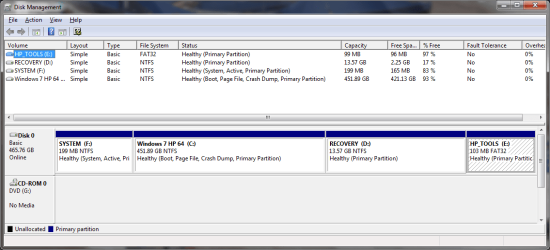
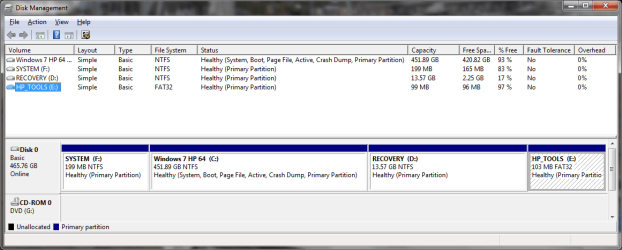
1. System (199 MB, it does not have drive letter)
2. Partition C
3. Recovery (partition D, 16 GB)
4. HP_Tools (partition E, 103 MB)
I want to partition drive C into 2 parts: one small capacity for all system file and program file, the one large capacity for all data files. I have done this in my previous computers with Window XP and without any problems. I used free software “Partition Wizard Home Edition” to do that.
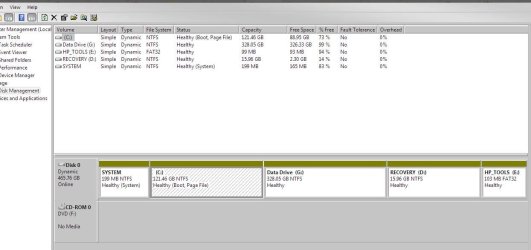
My computer still runs fine except I just realize that all partitions now become dynamic instead of basic. I don’t know how it happened. When I try to run Acronis True Image software to create backup image it won’t even see the disk.
Here is the screen shot of my HD current configuration (see attachment): Partition G is the new one I created for data file.


I read through the posts on this forum and I am still not sure what my options are at this point.
1. If I want to create image backup for the whole system using Acronis True Image or some other software, do I have to converting the dynamic disk to basic disk to do that?
2. I have already installed a lot of software on the computer. I really don’t want to reinstall them if I don’t have to. I only have small amount of data on it now. So back up data is not the problem. But reinstall all the software would be a huge headache. Is there anyway of converting the dynamic disk to basic disk without deleting the file or formatting the disk? If so, please provide instruction.
3. If I understand correctly from the posts in this forum basic disk only allows 3 primary partitions. Since HP has already used up these partitions I need to delete one of these partitions. Which one should I delete and how to do it?
Please Help!!!
 

Attachments

  • Disk Drive.JPG
    Disk Drive.JPG
    95.3 KB · Views: 587

My Computer

OS
window 7
Have you read this thread right from the beginning as you will see I had exactly the same problem with my new HP laptop. The guys here sorted it out for me just fine and I'm sure they will for you too, but read the thread thoroughly as you will probably need to do what I did which was to delete the SYSTEM partition which will give you the partition which you can use as your logical. I suggest you wait for the experts to take you through it though.

It is doable if it is like my system!
 

My Computer

Computer type
Laptop
Computer Manufacturer/Model Number
HP Envy 15
OS
Windows 8.1.1
CPU
AMD A10-5750M APU with Radeon(tm) HD Graphics
Memory
8gb
Hard Drives
1TB Serial ATA 16mb buffer
Have you read this thread right from the beginning as you will see I had exactly the same problem with my new HP laptop. The guys here sorted it out for me just fine and I'm sure they will for you too, but read the thread thoroughly as you will probably need to do what I did which was to delete the SYSTEM partition which will give you the partition which you can use as your logical. I suggest you wait for the experts to take you through it though.

It is doable if it is like my system!

Bertiell,

I read through the entire posts in this forum. It seems to me you had the exact problem as I have now. If I understand correctly these are the two parts how you solved the problem.

1. First you use the Partition Wizard Pro (paid version) to convert the dynamic disk back to basic disk. This procedure won't erase or delete any file on your drive (am I correct on this?). The old version of the Partition Wizard (v. 4.2 ) can do the same thing and it is free. I may wan to try that first.
2. However, even after you converted the disk from dynamic to basic you still can't create additional partition because HP already used up 3 primary partitions with system, recovery and HP_tools. You need to delete the system partition first before you can create any new partition. There is tutorial on this topic that gives step by step instruction. But from your post it seems to me it is not straight forward. This is where I am getting nervous about doing this step.

Can some experts on this forum (SIW2 and others) walk me through this process of deleting system partition with step by step instruction. I did have the HP recovery disks that I made when I first got the laptop. I don't know what is on the disks. I assume Window 7 is on the disk. I don't have any other Window 7 disk.

Your help would be greatly appreciated!
 

My Computer

OS
window 7
If you do not want to touch the system partition (which contains your MBR), I suggest you
1. backup the tools partition and delete that.
2. reconvert you dynamics to primaries as per the above instructions
3. burn the recovery DVDs from the recovery partition and delete that partition too. Now you have 3 primaries.
4. take an image of the system as extra safeguard. I suggest free Macrium - mainly because it is reliable, easy and fast.
5. now you can go about creating an extra partition - but make that an extended partition to keep your options for further partitions open.
 

My Computer

Computer Manufacturer/Model Number
HP, Dell, Gateway, Toshiba - 4 laptops and 2 desktops
OS
Vista, Windows7, Mint Mate, Zorin, Windows 8
CPU
from 1.6GHz Duo to i7
Monitor(s) Displays
2x HP w2207
Hard Drives
5x HDD, 7x SSD, 12x Externals
Keyboard
with trackball - no mices
Mouse
Trackball mice
Internet Speed
DSL 6000
WHS

Thank you so much for the help!

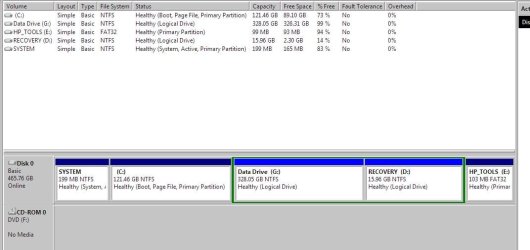
I did the first part by using Partition Wizard 4.2 version to convert the disk from dynamic to basic. It went without any problem. Now I have 5 partitions on my disk. See screenshot here.
New Disk.JPG

I have partition C (120GB, Primary) mainly for window system and program files
Partition G (328 GB, logical) mainly for data files.

I am OK with this. The Acronis True Image can now see the disk and gives me the option to create a image backup for partition C. This is what I want in the first place (make a system image backup). I still have 3 additional partitions that HP installed initially. I probably don't need them but I also don't need to delete them at this point. Your post indicates that MBR is still in the system partition. This means that I need to be careful when I make the image backup; not to make the partition C as active and not to replace the MBR when restore the image. Other than these two points I should be able to create image of partition C (Window file and program file) and restore them back when needed. Am I correct on this? I am still not sure if the window file is on Partition C or is on HP's hidden system partition.

Please confirm that my understanding and plan is sound before I create the actual image file. I want to make sure it will work (restore) when I need it later. I may just use the Macrium software as you suggested.

Thanks so much for your help!
 

My Computer

OS
window 7
Wangy26

I think you are mistaking SYSTEM partition for the Windows operating system partition. SYSTEM (I'm pretty sure) is an HP partition, I'm not sure what is on it but I don't think it should be active. You need the C: Windows to be active.

When I did this, I think I deleted the HP SYSTEM partition so I finished up with C:\Windows64, D:\Recovery, E:\HP_Tools and then my logical partitions that I created from the 'released MBR' partition.

Someone here will confirm (or correct me) about this, so hang fire until you hear.
 

My Computer

Computer type
Laptop
Computer Manufacturer/Model Number
HP Envy 15
OS
Windows 8.1.1
CPU
AMD A10-5750M APU with Radeon(tm) HD Graphics
Memory
8gb
Hard Drives
1TB Serial ATA 16mb buffer
Back
Top