Defraging

enigma1944

New member
Member
VIP
Local time
6:38 PM
Messages
220
Location
Pittsburgh Pa USA Dresden German
I use the W7 defrag setup so is there a freebie I can use that is better.

Thanks
 

My Computer

Computer Manufacturer/Model Number
HP dv7-1247cl
OS
Windows 7 Home Premium x64
CPU
AMD TURION X2 DUAL CORE RM-72 ( 2 -CPU's ) 201 GHZ
Memory
3836 MB
Graphics Card(s)
ATI RADEON HD 3200
Sound Card
IDT HIGH DEFINITION AUDIO CODEC
Other Info
Pittsburgh, Pa

My Computer

Computer type
PC/Desktop
Computer Manufacturer/Model Number
Self built custom
OS
64-bit Windows 11 Pro for Workstations
CPU
Intel i7-8700K OC'd to 5 GHz
Motherboard
ASUS ROG Maximus XI Formula Z390
Memory
64 GB (4x16GB) G.SKILL TridentZ RGB DDR4 3600 MHz
Graphics Card(s)
ASUS ROG-STRIX-GTX1080TI-O11G-GAMING
Sound Card
Integrated
Monitor(s) Displays
2 x Samsung Odyssey G7 27"
Screen Resolution
2560x1440
Hard Drives
1TB Samsung 990 PRO M.2,
4TB Samsung 990 PRO PRO M.2,
TerraMaster F8 SSD Plus NAS
PSU
Seasonic Prime Titanium 850W
Case
Thermaltake Core P3
Cooling
Corsair Hydro H115i
Keyboard
Logitech wireless K800
Mouse
Logitech MX Master 4
Internet Speed
2 Gb/s Download and 100 Mb/s Upload
Antivirus
Malwarebyte Anti-Malware Premium
Browser
Google Chrome
Other Info
Logitech Z625 speaker system,
Logitech BRIO 4K Pro webcam,
HP Color LaserJet Pro MFP M477fdn,
APC SMART-UPS RT 1000 XL - SURT1000XLI,
Galaxy S23 Plus phone

My Computer

Computer Manufacturer/Model Number
HP dv7-1247cl
OS
Windows 7 Home Premium x64
CPU
AMD TURION X2 DUAL CORE RM-72 ( 2 -CPU's ) 201 GHZ
Memory
3836 MB
Graphics Card(s)
ATI RADEON HD 3200
Sound Card
IDT HIGH DEFINITION AUDIO CODEC
Other Info
Pittsburgh, Pa

My Computer

Computer type
PC/Desktop
Computer Manufacturer/Model Number
Self Built
OS
Windows 8.1 Pro
CPU
Intel Core i5-2500K
Motherboard
ASRock Z77 Extreme4
Memory
8GB Corsair Vengeance DDR3
Graphics Card(s)
Sapphire Radeon HD 7970 GHz Vapor-X Edition
Sound Card
Realtek ALC898
Monitor(s) Displays
BenQ XL2411T
Screen Resolution
1920 x 1080 @ 144Hz
Hard Drives
Plextor M3 Pro 128GB
WD Caviar Blue
PSU
Seasonic G Series 650W
Case
Corsair Obsidian 650D
Cooling
Corsair H60 2013 Edition
Keyboard
Cooler Master Quick Fire Rapid
Mouse
Corsair Raptor M45
Other Info
Headphones: Sennheiser HD-515
I use and very much like degraggler as it stays visible and you can see what it is
doing.
 

My Computer

OS
Windows 7 Home Premium x64, Ubuntu 10.04 x64
CPU
Intel Core 2 Quad Q9550(2.83GHz)
Motherboard
MSI G31M3-L V2
Memory
4MB Kingston DDR2
Graphics Card(s)
NVIDIA GeForce 9800 GT 512MB PCI Express
Sound Card
Sound card - Integrated
Monitor(s) Displays
Hanns·G HG-281DPB Black 28" 3ms 1080P LCD HDMI Monitor
Screen Resolution
1920 X 1200
Hard Drives
1) 500GB SATA-II 7200RPM
2) Fantom GreenDrive 1TB External HD - eSATA, USB 2.0
Cooling
Masscool 8W553 CPU Cooling Fan
Other Info
7 fans - 2400-2800 RPM cooling fans: (5 case fans, CPU and GPU)
A question about defragmenting my C: drive:
(this should be addressed to someone who really, really knows Windows 7)

Vista had this user journal file $UsnJrnl which would not defragment no matter what you did.
I remember I had to enter an FSUTIL command to delete it (along with all of my restore points) in order to shrink
my C: drive down enough to create another partition. Without the FSUTIL command, it would not shrink enough.

I do not see that file on Windows 7, however I do see System Volume Information at the end of the drive
(in the same place that $UsnJrnl was). The sectors are visible while defragmenting with Defraggler and one can see
what they contain.

After I installed Windows 7, I didn't worry very much about defragmenting the C: drive, but when I did, I noticed
that it was 27% defragmented. I ran Defraggler for a very long time and it ended up not being able to totally
defragment down to 0%. It only got to 11% as I recall. It would not go any further!

Here is the question, is there anything that can be done to alleviate this? To defragment the C: drive completely
to zero percent fragmentation?

Thanks in advance!
 

My Computer

OS
Windows 7 Home Premium x64, Ubuntu 10.04 x64
CPU
Intel Core 2 Quad Q9550(2.83GHz)
Motherboard
MSI G31M3-L V2
Memory
4MB Kingston DDR2
Graphics Card(s)
NVIDIA GeForce 9800 GT 512MB PCI Express
Sound Card
Sound card - Integrated
Monitor(s) Displays
Hanns·G HG-281DPB Black 28" 3ms 1080P LCD HDMI Monitor
Screen Resolution
1920 X 1200
Hard Drives
1) 500GB SATA-II 7200RPM
2) Fantom GreenDrive 1TB External HD - eSATA, USB 2.0
Cooling
Masscool 8W553 CPU Cooling Fan
Other Info
7 fans - 2400-2800 RPM cooling fans: (5 case fans, CPU and GPU)
Didn't you mean it was 27% FRAGMENTED?
 

My Computer

OS
Win7

My Computer

OS
Windows 7 Home Premium x64, Ubuntu 10.04 x64
CPU
Intel Core 2 Quad Q9550(2.83GHz)
Motherboard
MSI G31M3-L V2
Memory
4MB Kingston DDR2
Graphics Card(s)
NVIDIA GeForce 9800 GT 512MB PCI Express
Sound Card
Sound card - Integrated
Monitor(s) Displays
Hanns·G HG-281DPB Black 28" 3ms 1080P LCD HDMI Monitor
Screen Resolution
1920 X 1200
Hard Drives
1) 500GB SATA-II 7200RPM
2) Fantom GreenDrive 1TB External HD - eSATA, USB 2.0
Cooling
Masscool 8W553 CPU Cooling Fan
Other Info
7 fans - 2400-2800 RPM cooling fans: (5 case fans, CPU and GPU)
Didn't you mean it was 27% FRAGMENTED?
Yes, you are right. My bad!


:) Have you gotten it under 11% yet? That's quite a bit of fragmentation for post-defragging, IMO.

all my windows drives show zero percent fragmentation when I test frag levels.

Well, I guess there are more than one answer to this question. I have used Defraggler for a long time and prefer it.
But, after what I refer to as "wasting" about 5 hours, it went from 10% fragmented to about the same. It could not defragment C:/System Volume Information/ entirely.
I have it scheduled to run every night at 2 AM and 10% is what I first saw.

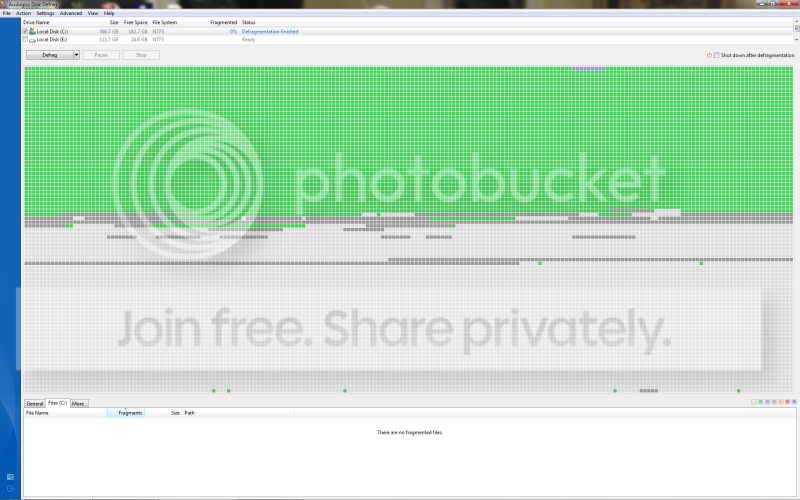
I noticed you gave a +1 to Auslogics program, so I downloaded and ran it. It said 0% fragmentation after I ran it..
But as you can see from this pic, it is not really totally defragmented.

c54723be.png


As you can see there are immovable files that are of course fragmented and towards the end there are several "green" non-fragmented files. However, when I think of defragmented, I see all of the files together at the top with white every where else.
So, defraggler says it is still not defragmented and auslogics does...
I don't know what to make of this info.
 

My Computer

OS
Windows 7 Home Premium x64, Ubuntu 10.04 x64
CPU
Intel Core 2 Quad Q9550(2.83GHz)
Motherboard
MSI G31M3-L V2
Memory
4MB Kingston DDR2
Graphics Card(s)
NVIDIA GeForce 9800 GT 512MB PCI Express
Sound Card
Sound card - Integrated
Monitor(s) Displays
Hanns·G HG-281DPB Black 28" 3ms 1080P LCD HDMI Monitor
Screen Resolution
1920 X 1200
Hard Drives
1) 500GB SATA-II 7200RPM
2) Fantom GreenDrive 1TB External HD - eSATA, USB 2.0
Cooling
Masscool 8W553 CPU Cooling Fan
Other Info
7 fans - 2400-2800 RPM cooling fans: (5 case fans, CPU and GPU)
Those would be System restore Points/ Page File / Hiberfile and possibly a few TEMP files in use. they can not be defragmented while windows is running.

I do not know if that defragmenter has the ability to do offline "system" defrags or not. If so, it should be able to defragment these files before starting Windows.

If not & it bugs you, an alternative you can try (but will be more work):
Do a disk clean up
Delete hyberfile (if you do not hibernate your system)
Delete all system restore points. (may want to leave most current one up to you)
Disable pagefile.
Reboot
Defrag.

When done, Re-enable Pagefile. reboot if needed ( I would make it same min and max)
Re-enable system restore and create restore point.


Going this route will place the PAGEFILE at the end of the defragmented files when it recreated, in one piece.
 

My Computer

Computer Manufacturer/Model Number
Custom (Self Build)
OS
Windows 7 Home Premium 64bit
CPU
Intel Core i7 2700k
Motherboard
eVGA P67 SLI
Memory
8GB Mushkin Redline Ridgebacks @1866
Graphics Card(s)
EVGA GTX570 SC
Sound Card
XiFi Titanium HD
Monitor(s) Displays
LG W2453V
Screen Resolution
1920x1080
Hard Drives
Intel 320 80GB -- Intel X25-V 40GB --WD Black 1TB x2 -- WD Blue 640GB
PSU
Seasonic x750
Case
Corsair 600T SE White
Cooling
eVGA Superclocked CPU Cooler
Keyboard
Saitek Cyborg
Antivirus
Kaspersky
Browser
IE
Other Info
LG BD/DVD
Those would be System restore Points/ Page File / Hiberfile and possibly a few TEMP files in use. they can not be defragmented while windows is running.

I do not know if that defragmenter has the ability to do offline "system" defrags or not. If so, it should be able to defragment these files before starting Windows.

If not & it bugs you, an alternative you can try (but will be more work):
Do a disk clean up
Delete hyberfile (if you do not hibernate your system)
Delete all system restore points. (may want to leave most current one up to you)
Disable pagefile.
Reboot
Defrag.

When done, Re-enable Pagefile. reboot if needed ( I would make it same min and max)
Re-enable system restore and create restore point.


Going this route will place the PAGEFILE at the end of the defragmented files when it recreated, in one piece.

Thanks for this information! I can live with it the way it is I guess. I will keep this in case I ever need to shrink the drive.
Just curious, but a while back I needed to use a restore point and there was only 2 or 3 and I expected many, many more.
Can you tell me what deletes restore points besides manually deleting them (above) and the FSUTIL command (it did on Vista, not sure about windows 7). I never seem to see more than a couple restore points, yet I have reserved enough room for plenty and when an update occurs, I see that it creates a restore point.
Thanks!
 

My Computer

OS
Windows 7 Home Premium x64, Ubuntu 10.04 x64
CPU
Intel Core 2 Quad Q9550(2.83GHz)
Motherboard
MSI G31M3-L V2
Memory
4MB Kingston DDR2
Graphics Card(s)
NVIDIA GeForce 9800 GT 512MB PCI Express
Sound Card
Sound card - Integrated
Monitor(s) Displays
Hanns·G HG-281DPB Black 28" 3ms 1080P LCD HDMI Monitor
Screen Resolution
1920 X 1200
Hard Drives
1) 500GB SATA-II 7200RPM
2) Fantom GreenDrive 1TB External HD - eSATA, USB 2.0
Cooling
Masscool 8W553 CPU Cooling Fan
Other Info
7 fans - 2400-2800 RPM cooling fans: (5 case fans, CPU and GPU)
Manually:
Turning System restore off, or off and back on, will delete ALL restore points.

Using windows built in disk clean up, under More Options tab, & Clean up System Restore/Shadow Copies ...
Deletes all restore points except the most current one.

Automatically: It deletes the oldst on its own, when space is low (the space you allow for restore points)

It should create restore points however, everytime you install something.
 

My Computer

Computer Manufacturer/Model Number
Custom (Self Build)
OS
Windows 7 Home Premium 64bit
CPU
Intel Core i7 2700k
Motherboard
eVGA P67 SLI
Memory
8GB Mushkin Redline Ridgebacks @1866
Graphics Card(s)
EVGA GTX570 SC
Sound Card
XiFi Titanium HD
Monitor(s) Displays
LG W2453V
Screen Resolution
1920x1080
Hard Drives
Intel 320 80GB -- Intel X25-V 40GB --WD Black 1TB x2 -- WD Blue 640GB
PSU
Seasonic x750
Case
Corsair 600T SE White
Cooling
eVGA Superclocked CPU Cooler
Keyboard
Saitek Cyborg
Antivirus
Kaspersky
Browser
IE
Other Info
LG BD/DVD
Manually:
Turning System restore off, or off and back on, will delete ALL restore points.

Using windows built in disk clean up, under More Options tab, & Clean up System Restore/Shadow Copies ...
Deletes all restore points except the most current one.

Automatically: It deletes the oldst on its own, when space is low (the space you allow for restore points)

It should create restore points however, everytime you install something.

I run CCleaner a lot, could that do it? because I haven't turned it off and
I don't use disk cleanup since I use CCleaner. I know I have enough space
allocated, but I only see a couple when I have needed them.
Thanks!
 
Last edited:

My Computer

OS
Windows 7 Home Premium x64, Ubuntu 10.04 x64
CPU
Intel Core 2 Quad Q9550(2.83GHz)
Motherboard
MSI G31M3-L V2
Memory
4MB Kingston DDR2
Graphics Card(s)
NVIDIA GeForce 9800 GT 512MB PCI Express
Sound Card
Sound card - Integrated
Monitor(s) Displays
Hanns·G HG-281DPB Black 28" 3ms 1080P LCD HDMI Monitor
Screen Resolution
1920 X 1200
Hard Drives
1) 500GB SATA-II 7200RPM
2) Fantom GreenDrive 1TB External HD - eSATA, USB 2.0
Cooling
Masscool 8W553 CPU Cooling Fan
Other Info
7 fans - 2400-2800 RPM cooling fans: (5 case fans, CPU and GPU)
As far as I am aware, NO. im fairly certain CCleaner only deletes temp. junk, thumbnails etc ..

I could be mistaken though
 

My Computer

Computer Manufacturer/Model Number
Custom (Self Build)
OS
Windows 7 Home Premium 64bit
CPU
Intel Core i7 2700k
Motherboard
eVGA P67 SLI
Memory
8GB Mushkin Redline Ridgebacks @1866
Graphics Card(s)
EVGA GTX570 SC
Sound Card
XiFi Titanium HD
Monitor(s) Displays
LG W2453V
Screen Resolution
1920x1080
Hard Drives
Intel 320 80GB -- Intel X25-V 40GB --WD Black 1TB x2 -- WD Blue 640GB
PSU
Seasonic x750
Case
Corsair 600T SE White
Cooling
eVGA Superclocked CPU Cooler
Keyboard
Saitek Cyborg
Antivirus
Kaspersky
Browser
IE
Other Info
LG BD/DVD
Some Ideas

I've found that there are a couple of things that you can do to reduce the fragmentation of those system files that refuse to defragment:

1. Take a note from Linux. Create a partition just for the pagefile and hibernation file (if you need the hibernation file). Separating these files from the main partition keeps other files from fragmenting around them. If you have multiple physical hard drives placing those system files on a separate hard drive can possibly increase performance since the system won't have to contend with another program accessing the disk at the same time the system wants to access the pagefile. Placing the pagefile on a separate hard drive will only grant performance benefits if your system has to do a lot of caching in which case, you probably need more ram.

2. To minimize the fragmentation of the pagefile, specify a specific size and not just a min and max range. Specifying the size creates the whole file all at once so that it doesn't fragment itself as it expands and shrinks. If you specify a size make sure that it is big enough. I think most recommendations I've seen is 1.5 times the amount of ram you have. However with my 4GB of ram I rarely see my pagefile usage get much past 1GB. Also something else to note, if you are running 32-bit Windows you will only be able to use a total of about 3.5 GB whether that 3.5GB is in ram or pagefile or both. For example if you have 2GB of ram running 32-bit Windows your pagefile can't get past 1.5 GB in size because Windows can't address past that. 64bit doesn't have that limitation.
 

My Computer

OS
Windows 7 Ultimate x64
CPU
AMD Phenom 9600 Quad 2.3Ghz
Memory
4GB
Graphics Card(s)
Nvidia GeForce 8800GT 512MB
Hard Drives
Western Digital 3x500GB
I've found that there are a couple of things that you can do to reduce the fragmentation of those system files that refuse to defragment:

1. Take a note from Linux. Create a partition just for the pagefile and hibernation file (if you need the hibernation file). Separating these files from the main partition keeps other files from fragmenting around them. If you have multiple physical hard drives placing those system files on a separate hard drive can possibly increase performance since the system won't have to contend with another program accessing the disk at the same time the system wants to access the pagefile. Placing the pagefile on a separate hard drive will only grant performance benefits if your system has to do a lot of caching in which case, you probably need more ram.

2. To minimize the fragmentation of the pagefile, specify a specific size and not just a min and max range. Specifying the size creates the whole file all at once so that it doesn't fragment itself as it expands and shrinks. If you specify a size make sure that it is big enough. I think most recommendations I've seen is 1.5 times the amount of ram you have. However with my 4GB of ram I rarely see my pagefile usage get much past 1GB. Also something else to note, if you are running 32-bit Windows you will only be able to use a total of about 3.5 GB whether that 3.5GB is in ram or pagefile or both. For example if you have 2GB of ram running 32-bit Windows your pagefile can't get past 1.5 GB in size because Windows can't address past that. 64bit doesn't have that limitation.

Thanks! I'll keep this in mind. I already dual boot with Ubuntu and have
used up the 4 partitions for the HD so I could only make a logical. But, I think I am fine right now.
This PC is still fast as lightening as far as I am concerned.
 

My Computer

OS
Windows 7 Home Premium x64, Ubuntu 10.04 x64
CPU
Intel Core 2 Quad Q9550(2.83GHz)
Motherboard
MSI G31M3-L V2
Memory
4MB Kingston DDR2
Graphics Card(s)
NVIDIA GeForce 9800 GT 512MB PCI Express
Sound Card
Sound card - Integrated
Monitor(s) Displays
Hanns·G HG-281DPB Black 28" 3ms 1080P LCD HDMI Monitor
Screen Resolution
1920 X 1200
Hard Drives
1) 500GB SATA-II 7200RPM
2) Fantom GreenDrive 1TB External HD - eSATA, USB 2.0
Cooling
Masscool 8W553 CPU Cooling Fan
Other Info
7 fans - 2400-2800 RPM cooling fans: (5 case fans, CPU and GPU)
Being a large fan of everything open source I've turned to Ultra Defrag and I find it works better than the built in Windows 7 Defrag but I haven't tried Auslogic's yet
 

My Computer

Computer Manufacturer/Model Number
Acer Aspire 5720z
OS
Windows 7
CPU
Intel Pentium Dual-Core
Memory
2 GB
Hard Drives
160 GB HD
Raxco Perfect disk will give the results you're after,by far best defragger imo and i've tried them all
 

My Computer

OS
windows 7
Back
Top