As Saeen mentioned here above, everything you get from the net is counted. When you read a blog, check CNN for news, receive emails, chat with mates over MSN or Skype, when your AV application gets new definition updates etc. Every incoming signal, every bit counts.
I get TV from my native Finland here to Germany over the internet, streaming to the computers and directly over an
IPTV digital receiver. I can also download everything from every channel from the past four weeks. I use this opportunity quite a lot.
When downloading or streaming, I can choose from three different formats. I'm using an episode of C.S.I (55 minutes) as an example (one of my favorites, I'm happy that the network shows couple of old seasons this summer!).
- 1 Mbps Flash quality = 405 MB (file format: .flv)
- 2 Mbps MPEG4 quality = 600 MB (file format: .mp4)
- 8 Mbps HD quality = 1.6 GB (file format: .ts)
Your 70 GB monthly limit, converted to streaming TV in above mentioned file formats and quality would mean:
- about 150 to 160 hours in 1Mbps Flash
- about 100 hours in 2 Mbps MPEG4
- about 40 hours HD
In other words, if your girlfriend streams on average one hour a day, she uses monthly:
- about one fifth of your DL limit in Flash
- about one third of your DL limit in MPEG4
- about three quarters of your DL limit in HD
Hope this helps you to argue with her

At least ask her to choose a low bandwith stream; although difference is clear the networks usually offer a good compromise between file size and quality.
Here's example of the difference between Flash and MPEG4 quality from my IPTV service provider:
Flash:

MPEG4:

Here's something for you to think:
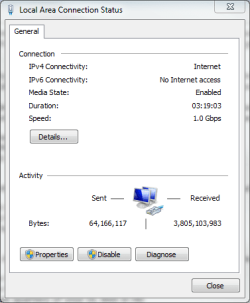
As you can see, this rig has now been connected about 3 hours 20 minutes. Normal surfing, reading my mails, other eye on a film and news in HD quality on secondary display. Completely normal usage to me. The system has received (= downloaded) 3,805,103,983 bytes, which is 3.54378 GB or almost 1.2 GB per hour.
Kari

 So I am wondering, my girlfriend is always watching tv series on the web. Is that downloading? If so, how big is each episode online?


