Dual Boot Installation with Windows 7 and XP

How to Setup a Dual Boot Installation with Windows 7 and XP


   Information
This will show you how to install Windows 7 and XP to dual boot with when you already have either Windows 7 or XP installed first.
   Note
With a dual boot installaton, you will have two operating systems (OS) installed. When you start the computer, you will have the choice to choose which OS you would like to start up to. This method is the easiest way of doing a dual boot with these two operating systems.
   Tip
When dual booting with another OS (ex: Vista or XP), you may not always have that OS partition show up in Computer with a driver letter in Windows 7. If this happens, then you will just need to add a drive letter to the OS (ex: Vista or XP) partition in Windows 7 Disk Management for it to show up in Computer with a driver letter.
   Warning
To stop XP from deleting your Windows 7 System Restore Points everytime XP is started, then see System Restore Points - Stop XP Dual Boot Delete to hide Windows 7 from XP.

Windows 7 Minimum Hardware Requirements


NOTE: For more information on this, see: Windows 7 system requirements
  • 1 GHz 32-bit or 64-bit processor
  • 1 GB RAM for 32-bit Windows 7 OR 2 GB RAM for 64-bit Windows 7
  • 16 GB available disk space 32-bit Windows 7 OR 20 GB for 64-bit Windows 7
  • Support for DirectX 9 graphics with 128 MB memory (in order to enable Aero theme)
  • DVD-R/W Drive
  • Internet or phone access to activate Windows 7.
Windows XP Minimum Hardware Requirements

NOTE: For more information on this, see: System requirements for Windows XP operating systems
  • PC with 300 megahertz (MHz) or higher processor clock speed recommended; 233-MHz minimum required;* Intel Pentium/Celeron family, AMD K6/Athlon/Duron family, or compatible processor recommended
  • 128 megabytes (MB) of RAM or higher recommended (64 MB minimum supported; may limit performance and some features)
  • 1.5 gigabyte (GB) of available hard disk space.*
  • Super VGA (800 × 600) or higher resolution video adapter and monitor
  • CD-ROM or DVD drive
  • Keyboard and Microsoft Mouse or compatible pointing device
EXAMPLE: Windows Boot Manager
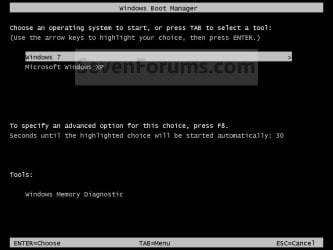
NOTE: This is the boot screen where you select what operating system that you would like to start. By default, you have 30 seconds to choose another operating system before the default operating system will start automatically.
Example.jpg


OPTION ONE

When XP is Installed First


NOTE: If you have a RAID setup, you will need to have the Windows 7 RAID drivers on a USB flash drive available to select and load while installing Windows 7.
1. Do step 2 or 3 below for where you wanted to install Windows 7 at.

2. To Create a New Partition from the XP Hard Disk Drive
A) With your Windows 7 installation disc boot into the Command Prompt from the System Recovery Options screen.
NOTE: Make sure that the CD/DVD drive is selected first in the boot order in the BIOS.

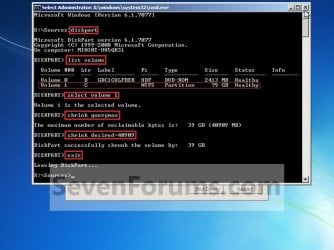
B) In the command prompt, select and shrink the XP volume by how many MB (1024 MB = 1 GB) you want to have for this Windows 7 partition. (See screenshot below)
NOTE: You would do steps 2 to 9 in METHOD TWO at that link. Windows 7 will need a minimum of 16 GB (16384 MB).
XP-W7_1.jpg
C) Click on the X at the top right corner to close the command prompt. (See screenshot above)

D) Click on the X at the top right corner to close System Recovery Options. (See screenshot below)
XP-W7_2.jpg
E) Go to step 4.
3. To Use a Separate Hard Disk Drive than the XP Drive
A) Boot from your Windows 7 installation disc.
NOTE: Make sure that the CD/DVD drive is selected first in the boot order in the BIOS.
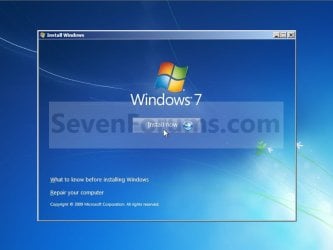
4. Click on the Install now button. (See screenshot below)
XP-W7_3.jpg
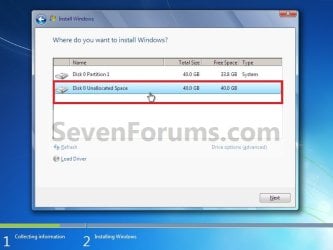
5. When you get to this point, select the partition (step 2) or hard drive to install Windows 7 on. (See screenshot below)
XP-W7_4.jpg
6. Finish installing Windows 7.
NOTE: You would start at step 9 in that link to finish installing Windows 7.

7. When finished, restart the computer to have the option to boot from XP (Earlier Verision of Windows) or Windows 7. (See screenshot below)

   Note
If you are only booting into Windows 7 and do not have XP listed in the Windows Boot Manager, then you can install only EasyBCD (step 8 Option Two below) to add XP (or Windows 7) while started in Windows 7 the same way to the boot list.

Example.jpg


OPTION TWO

When Windows 7 is Installed First


   Warning

1. To Create a New Partition from the Windows 7 Hard Disk Drive
NOTE: If you want to install XP on a separate internal hard drive instead, then skip this step and go to step 2.
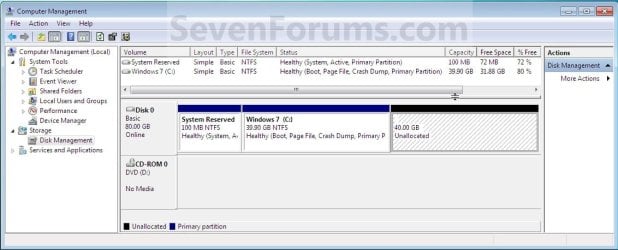
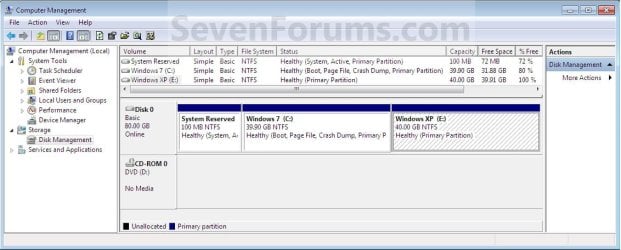
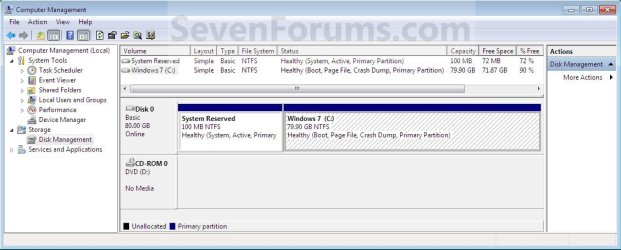
A) In Windows 7, select and shrink the Windows 7 volume in Disk Management by how many MB (1024 MB = 1 GB) you want to have for this XP partition. (See screenshots below)
NOTE: You would do all of Method One at that link.
W7-XP-1.jpg

W7-XP-2.jpg

W7-XP-3.jpg
2. Insert your XP installation disc, then restart the computer and press any key to boot from it when prompted. (See screenshot below)
NOTE: Make sure that the CD/DVD drive is selected first in the boot order in the BIOS.

Step1.jpg
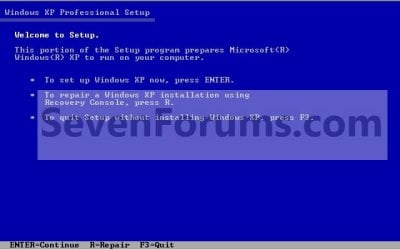
3. From XP Setup, Press Enter. (See screenshot below)


   Warning

W7-XP-4.jpg
4. Press F8. (See screenshot below)
NOTE: On some multimedia keyboards, you may need to press the F-Lock or Function key before pressing F8.
W7-XP-5.jpg
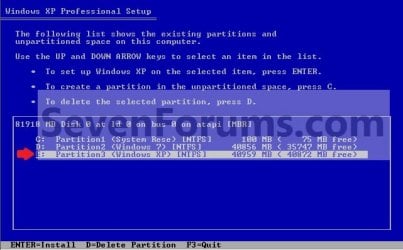
5. Select the partition (step 1) or hard drive that you want to install XP on using the arrow keys and press Enter.
W7-XP-6.jpg
6. Finish installing XP.


   Tip
If you get Error loading Operating System after XP restarts:
  • Using your Windows 7 installation disc, boot to the command prompt at startup.
  • Type in these comands below, and press enter after each one.
    • bootrec /FixMbr
    • bootrec /FixBoot
    • bootrec /RebuildBcd
  • Exit the command prompt and restart the computer.
  • At this point, Windows 7 should boot up the same way before trying to install XP.
  • Continue to step 8 below and run EasyBCD from Windows 7 instead.

7. In XP, download and install .Net Framework 2.0 (32-bit) version or .Net Framework 2.0 (64-bit) version first, and EasyBCD (free version) for your 32-bit (x86) or 64-bit (x86) XP.
NOTE: In XP, Net Framework is required to be installed to run EasyBCD. After you click on Register (at bottom of link) for the free EasyBCD, registration is not required to download it.

8. Run EasyBCD (free version).
NOTE: This is required to repair the Windows 7 boot file and add XP to the Windows Boot Manager list.

9. On the left side of EasyBCD, click on the Add New Entry button. (See screenshot below)
A) In the top section under Operating Systems, click on the Windows tab. (See screenshot below)
B) To the right of Type, select Windows NT/2k/XP/2k3 from the drop down menu. (See screenshot below)
:warn:WARNING: Be sure to leave the Automatically detect correct drive box checked.

C) To the right of Name, you can leave the default Microsoft Windows XP as the name to be displayed in the Windows Boot Manager, or you can type whatever name you would like to have instead. (See screenshot below)
D) Click on the Add Entry button. (See screenshot below)
W7-XP-7.jpg
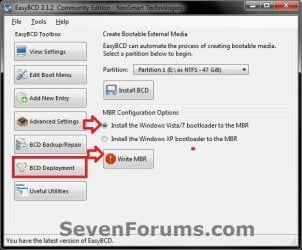
10. On the left side of EasyBCD, click on the BCD Deployment button, select (dot) the Install the Windows Vista/7 bootloader to the MBR option, and click on the Write MBR button. (See screenshot below)
W7-XP-9.jpg
11. Close EasyBCD.

12. Restart the computer to have the option to boot from Microsoft Windows XP or Windows 7. (See screenshot below)
Example2.jpg
   Tip
If Windows 7 will not start up when selected, then use your Windows 7 installation DVD to do a Startup Repair.

That's it,
Shawn


Last edited:
Zinic,

If XP was finished installing when this happens at the restart point, then you might see if using the suggestion in the yellow TIP box under step 6 in METHOD TWO may be able to help with this.

Yes, I have tried that. When I went to test it out, it booted straight to Windows 7. I tried using the repair option from the XP CD, but it didn't show the correct drive letter that I installed XP into. It even asked for a password that I don't know what it is. I tried "Admin"...

I wonder what could be the problem? I do have a guess however. In the yellow TIP box under step 6 in METHOD TWO it says to use EasyBCD in Windows 7. In part 10 it says to dot "Install the Windows Vista/7 bootloader to the MBR". If I am in Windows 7, shouldn't I dot Windows XP bootloader instead?

Thanks for your help Shawn. You helped me earlier when windows 7 first came out and I wanted to do a clean install of it. BTW, my name is Shawn too :).
 

My Computer

Computer Manufacturer/Model Number
Zinic
OS
Windows 7 64bit
CPU
i7
Motherboard
EVGA
Memory
DDR3 6GB
Graphics Card(s)
Zinic
Sound Card
Zinic
Monitor(s) Displays
22"
Hard Drives
500gb & 640gb
PSU
Zinic
Case
Zinic
Cooling
Zinic
Keyboard
Logitech G11
Mouse
Razor DeathAdder
Internet Speed
10mg-20mg
excuse me , i already follow the step one the first page , but why i didn't get the OS selection before boot up ?
i got windows 7 installed first , and i already install easyBCD and follow the steps , but it still not working :(
i always boot to windows 7 without have any selection screen :(
any suggestion ?
 

My Computer

Computer Manufacturer/Model Number
Acer D260
OS
Windows 7 Home Premium x86 Windows XP Pro SP3 Dual Boot
CPU
Intel Atom N455 ( 1.66GHz , 512KB Cache )
Memory
2 GB
Graphics Card(s)
Intel GMA 3150
Sound Card
Realtek HD
Screen Resolution
1024 x 600
Hard Drives
250 GB
Case
Netbook
Cooling
Fan

My Computer

Computer Manufacturer/Model Number
Acer D260
OS
Windows 7 Home Premium x86 Windows XP Pro SP3 Dual Boot
CPU
Intel Atom N455 ( 1.66GHz , 512KB Cache )
Memory
2 GB
Graphics Card(s)
Intel GMA 3150
Sound Card
Realtek HD
Screen Resolution
1024 x 600
Hard Drives
250 GB
Case
Netbook
Cooling
Fan
Hi all,

Just joined the forums and I am glad a friend referred me to the site. I am a brand new Windows 7 Professional (64-bit) user having received a new system for Christmas. I have read and printed the tutorial regarding dual-boot. However, before I get started on this new adventure, I have just a couple of questions:

1. My old system uses Windows XP (SP3) and is still working like a champ. Can I remove my old XP formatted drive that already has XP on it, place in my new computer case, and then be able to run the dual-boot scenario?

2. My harder question relates to dual-boot versus the XP-Mode and I realize from reading through the forums that there are mixed opinions. However, what is the advantage of running a dual-boot scenario over the Windows 7 XP-Mode or Virtual PC mode (are they the same?)? I really don't run a lot of games so I have no concerns from that point. However, I have XP software that I must use for work.

I guess the long and short is that I don't want to spend $$$ for a KVM switch to support a dual-monitor setup between both computers, if I am able to get up and running under a dual-boot or XP mode scenario.

Happy holidays.
 

My Computer

OS
Windows 7 Professional 64 Bit
Hello Natcret, and welcome to Seven Forums.

Q1) Sorry, but no. It would not run well if at all since it was installed on a system with a different motherboard that uses different drivers. You would have to reinstall it on a new/different system instead.

Q2) This one really depends on your needs. For the situation you described, you might try out XP Mode to see if it may meet your needs before attempting a dual boot. This way you could run a virtual XP and your XP apps from within Windows 7, and be able to easily work withing both OS's at the same time without having to restart the computer to use the other. If it doesn't workout, then you could always just uninstall it, and proceed to setup a dual boot as in this tutorial.

Hope this helps some, and happy holidays. :)

Shawn
 

My Computer

Computer type
PC/Desktop
Computer Manufacturer/Model Number
Self built custom
OS
64-bit Windows 11 Pro for Workstations
CPU
Intel i7-8700K OC'd to 5 GHz
Motherboard
ASUS ROG Maximus XI Formula Z390
Memory
64 GB (4x16GB) G.SKILL TridentZ RGB DDR4 3600 MHz
Graphics Card(s)
ASUS ROG-STRIX-GTX1080TI-O11G-GAMING
Sound Card
Integrated
Monitor(s) Displays
2 x Samsung Odyssey G7 27"
Screen Resolution
2560x1440
Hard Drives
1TB Samsung 990 PRO M.2,
4TB Samsung 990 PRO PRO M.2,
TerraMaster F8 SSD Plus NAS
PSU
Seasonic Prime Titanium 850W
Case
Thermaltake Core P3
Cooling
Corsair Hydro H115i
Keyboard
Logitech wireless K800
Mouse
Logitech MX Master 4
Internet Speed
2 Gb/s Download and 100 Mb/s Upload
Antivirus
Malwarebyte Anti-Malware Premium
Browser
Google Chrome
Other Info
Logitech Z625 speaker system,
Logitech BRIO 4K Pro webcam,
HP Color LaserJet Pro MFP M477fdn,
APC SMART-UPS RT 1000 XL - SURT1000XLI,
Galaxy S23 Plus phone
You're welcome. Please let us know how it went. :)
 

My Computer

Computer type
PC/Desktop
Computer Manufacturer/Model Number
Self built custom
OS
64-bit Windows 11 Pro for Workstations
CPU
Intel i7-8700K OC'd to 5 GHz
Motherboard
ASUS ROG Maximus XI Formula Z390
Memory
64 GB (4x16GB) G.SKILL TridentZ RGB DDR4 3600 MHz
Graphics Card(s)
ASUS ROG-STRIX-GTX1080TI-O11G-GAMING
Sound Card
Integrated
Monitor(s) Displays
2 x Samsung Odyssey G7 27"
Screen Resolution
2560x1440
Hard Drives
1TB Samsung 990 PRO M.2,
4TB Samsung 990 PRO PRO M.2,
TerraMaster F8 SSD Plus NAS
PSU
Seasonic Prime Titanium 850W
Case
Thermaltake Core P3
Cooling
Corsair Hydro H115i
Keyboard
Logitech wireless K800
Mouse
Logitech MX Master 4
Internet Speed
2 Gb/s Download and 100 Mb/s Upload
Antivirus
Malwarebyte Anti-Malware Premium
Browser
Google Chrome
Other Info
Logitech Z625 speaker system,
Logitech BRIO 4K Pro webcam,
HP Color LaserJet Pro MFP M477fdn,
APC SMART-UPS RT 1000 XL - SURT1000XLI,
Galaxy S23 Plus phone
Removing the 1st hard drive before starting the installation?

Great tutorial!

I have win-7x64 installed on my dell m6500, and I want to make it a dual boot machine Win7 and XP.

I have 2 hard disks installed, and I want to install the XP on the second disk.
Can I remove the first hard drive (the one with win-7) before starting the XP installation in order to reduce the risk of confusion. and then return it. I assume them I will boot into Win-7, where I can install and configure the EasyBCD.

Is that a good practice?
Thanks, alon.
 

My Computer

OS
Windows 7 Pro x64
Yes.
You can configure the primary bootup drive in the BIOS, either the drive that XP is on or Windows 7 drive. That way you won't have to configure anything with a third party app.
 

My Computer

Computer type
PC/Desktop
Computer Manufacturer/Model Number
Custom Build
OS
Windows 7 Home Premium 64 bit
CPU
Intel Core i7-4790
Motherboard
GA-Z87X-D3H
Memory
G.SKILL 8GB (2 x 4GB) DDR3 F3-10666CL9D-8GBNT
Graphics Card(s)
AMD Radeon R7 250
Sound Card
Realtek ALC892
Monitor(s) Displays
Samsung UN32EH5000, Dell 1703FPT
Screen Resolution
1920 x 1080, 1280 x 1024
Hard Drives
WD5003AZEX
WD10EZEX
Samsung HD103SJ
Samsung 128 GB 840 PRO
PSU
SeaSonic M12II SS-500GM
Case
Fractal Design Define R4
Cooling
Zalman CNPS9900ALED
Keyboard
Logitech K800
Mouse
Logitech M705
Internet Speed
16 Mbps
Antivirus
Avast
Browser
Firefox
Other Info
Bose Companion 2 Multimedia Speakers
Great tutorial!

I have win-7x64 installed on my dell m6500, and I want to make it a dual boot machine Win7 and XP.

I have 2 hard disks installed, and I want to install the XP on the second disk.
Can I remove the first hard drive (the one with win-7) before starting the XP installation in order to reduce the risk of confusion. and then return it. I assume them I will boot into Win-7, where I can install and configure the EasyBCD.

Is that a good practice?
Thanks, alon.

After install, plug back in the other HD and boot it using one-time BIOS Boot menu key given on first screen:
Asus - F8
HP/Compaq - Esc
Sony - F2
Acer - F12
Gateway - F10
eMachnes - F10
Toshiba - F12
Dell - F12
IBM/Lenovo - the blue Thinkvantage button

This keeps the HD's independent to come and go as you please, whereas a Windows-managed Dual Boot interlocks them and makes one harder to remove.
 
Thanks, for your advice. That's what I will do.

May I ask another question:
My second drive contains some file and data, the first drive is 256GB SSD, so I installed some of the programs on the second drive.

Is there a problem to split the second drive to two, where all that files from the above will be on the second partition, named D (as the origin). And the first one I will use to install the second Operating System (XP)?

Thanks, alon.
 

My Computer

OS
Windows 7 Pro x64
Yes you can partition the other HD to use for both another OS (booted wisely via the BIOS) and data or storage for your Win7 HD, e.g. Win7 backup image.

Use Disk Management to shrink the one partition, then create another in the space. Or use free Partition Wizard bootable CD to Resize it from the left so XP will be in preferred first position closer to disk reader. Free Download Magic Partition Manager Software - Partition Wizard Online

It is not recommended to install programs to another partition, however, since they write registry keys which integrate them to the OS. But User folders can be moved quite easily, keeping your Win7 OS/programs backup image lean so if Win7 becomes irreparable you can reimage your OS partition in 20 minutes and your data will be ready and current in its partition - which should also be backed up.
http://www.sevenforums.com/tutorials/18629-user-folders-change-default-location.html
http://www.sevenforums.com/tutorials/663-backup-complete-computer-create-image-backup.html
http://www.sevenforums.com/tutorials/615-backup-user-system-files.html
 
Hi! I did a clean Win 7 install (C:) on one of my HD partitions (3 partitions) and after that I installed Win XP on the other one (D:). I installed .NET 2.0 Redist and EasyBSD 2.0 followed the steps on how to use EasyBSD then I rebooted but I don't get any Boot Manager menu and it defaults to Win 7.

I ran EasyBSD on Win 7 and did the steps but still not getting the boot manager screen and my boot still defaults to Win 7.

I opened EasyBSD again and the changes I made are gone and only have Win 7 to boot to. What is going on?

Thanks!
 

My Computer

OS
Windows 7 Ultimate x64
CPU
Inter Core 2 Quad Q6700
Motherboard
EVGA 780i Tri-SLI
Memory
4 GB OCZ SLI-Ready RAM
Graphics Card(s)
EVGA GTX 465
Monitor(s) Displays
DELL 20''
Case
Thermaltake Spedo
Cooling
Thermaltake BigWater Liquid Cooling
Can you post back a screenshot of your full Disk Mgmt drive map with listings? Tell us what is located where.

Did you choose Add OS in EasyBCD 2.0 and attempt to add XP by type, then allow it to autocomplete? Did it offer you boot files?
 
Hello, first time in the forums and I have been trying to achieve this dual boot but am having some issues.
It is on a new Dell M4500, It was set up with windows 7 ultimate x86. C:/ is a recovery drive (as they don't include an install dvd), d:/ was the system drive. I shrank the d:/ and created another partition, weirdly it became an extended/logical drive and I had no option to switch to primary.
So what I did from there was format the partition and installed windows xp to that F:/ drive.
Everything went fairly well as I continued to install .net framework and easyBCD.
However, when I ran EasyBCD, and tried to add an entry it gave me an error saying I had no available space. I was wondering if it may be because of the recovery c:/ drive.
In any case, even though I didn't have an xp entry, I thought I would repair the windows 7 bootloader/ mrb. So I followed the steps and restarted.
Now when it restarts I don't get a bootloader, it goes to start windows 7 but i get a flash of a blue screen then it restarts and the next start up they ask if I would like to do start up repair.

Unfortunately I don't have a windows 7 ultimate x86 install disk and am unsure what to do next. My thoughts are to download an install disk, try to do a startup repair or fix the mbr.
And if I can fix it, what should I do to get the bootloader working?

Thanks for your help
 

My Computer

OS
Windows 7 ultimate 32bit
XP likely placed its boot files on Recovery Partition, which as C must have held the Active flag, since it cannot place boot files on a Logical partition. This would explain why there is no room left for EasyBCD to add the Win7 files to dual boot.

What I would do at this point is download and burn to CD a Win7 Repair Disk: http://www.sevenforums.com/tutorials/2083-system-repair-disc-create.html

Now boot the Repair CD, accept any offered repair. If this doesn't start Win7, boot back in to run Startup Repair up to 3 separate times: http://www.sevenforums.com/tutorials/105541-startup-repair-run-3-separate-times.html

If this doesn't start Win7, use free Partition Wizard bootable CD or Diskpart from the Repair CD Command Line to mark Win7 partition Active then run the Repairs again: http://www.sevenforums.com/tutorials/71432-partition-mark-active.html
Free Download Magic Partition Manager Software - Partition Wizard Online You can also run Rebuild MBR from PW CD Disk tab.

If Win7 won't start post back a camera snap of PW full drive map and listings.

If WIn7 starts, install EasyBCD 2.0 to add XP on Add OS tab. If this fails, post back a screenshot of your full Disk Mgmt drive map, using Snipping Tool in Start Menu.

Once you get the Dual Boot sorted, we can help you test your Recov Partition to see if it will still run and if not recover its space into other partition(s) using PW. Hopefully you made your Recovery Disks.
 
Ok, well just so you know, I can't boot to either 7 or XP, it is just a loop where it boots up, the windows 7 boot up screen appears, then flashes to a blue screen quickly and then restarts.
I have switched to the active partition to the Win7, ran the startup repair several times afterwards and no luck, the same thing.
I booted PW wizard and repaired MBR and also repaired the boot.ini. Unfortunately no luck. I'm currently downloading a full install disk of windows 7 to try repairing with that rather than the other system repair disks. I will post a quick overview of the drive layout in a bit.

Unfortunately I was not aware of dell's system and dove into this after receiving the computer. I had no idea that the recovery partition was useless without creating disks from it. Stupid me, I know.
It is important to note, however, that I have been doing this to 2 computers. The second one is up to the point where I have xp on it (logical drive) and it is booted in xp. It will not boot to the win7 side, but it does boot up nonetheless. If I could fix that one up to dual boot and get back to the windows 7 side, i may be able to create recovery disks from that to use on the first one.
The second is identical in specs, disk layout, and all steps leading up to the MBR rewrite that I think caused the crash. I havent done anything with it as I am scared to screw that one up too.

I know, huge dilemma, I thank you for all your help.

P1020011.jpg
Here is the screen for the PW drive map.

Thanks again

**Interesting development**
I was playing in the BIOS and switched back a SATA option from ATA style (needed to boot xp disk) back to the RAID-On style. It then booted back to Windows 7 where I was able to install EasyBCD, and add Xp as an entry. It will let me see both OS's at startup, However, since the switch, it will not let me boot XP. This may be because it is not a primary partition.
Any advice of where to go from here? I might have to clear those XP partitions and make a primary (though i tried last time and it didn't give me the option).


Thanks
 
Last edited:

My Computer

OS
Windows 7 ultimate 32bit
I didn't say that the Dell Recov partition doesn't work without the disks, only that you should make the Disks. Dell's Factory Recovery is pretty standard across recent models but check your Manual on their Support Downloads webpage to be sure: Restoring Your Computer´s Software to the Factory Settings | Dell

Try to make your Recov disks now that you've started Win7.

Since you only have 3 primary partitions on the HD (or is it a RAID with two HD's?) you should be able using PW CD to rightclick XP to Modify>Convert to Primary. Then remove any XP listing in EasyBCD 2.0 on Edit Boot Menu tab, add it again on Add OS tab.

If it won't start, boot XP CD to try a Repair Install: http://pcsupport.about.com/od/operatingsystems/ss/instxprepair1.htm

Have you considered running Virtual XP which is included in Ultimate, or using a separate HD for XP booted via BIOS?

I am not clear why if you have RAID you changed SATA controller setting in BIOS before installing XP.
 
Ok, well just so you know, I can't boot to either 7 or XP, it is just a loop where it boots up, the windows 7 boot up screen appears, then flashes to a blue screen quickly and then restarts.
I have switched to the active partition to the Win7, ran the startup repair several times afterwards and no luck, the same thing.
I booted PW wizard and repaired MBR and also repaired the boot.ini. Unfortunately no luck. I'm currently downloading a full install disk of windows 7 to try repairing with that rather than the other system repair disks. I will post a quick overview of the drive layout in a bit.

Unfortunately I was not aware of dell's system and dove into this after receiving the computer. I had no idea that the recovery partition was useless without creating disks from it. Stupid me, I know.
It is important to note, however, that I have been doing this to 2 computers. The second one is up to the point where I have xp on it (logical drive) and it is booted in xp. It will not boot to the win7 side, but it does boot up nonetheless. If I could fix that one up to dual boot and get back to the windows 7 side, i may be able to create recovery disks from that to use on the first one.
The second is identical in specs, disk layout, and all steps leading up to the MBR rewrite that I think caused the crash. I havent done anything with it as I am scared to screw that one up too.

I know, huge dilemma, I thank you for all your help.

View attachment 131059
Here is the screen for the PW drive map.

Thanks again

**Interesting development**
I was playing in the BIOS and switched back a SATA option from ATA style (needed to boot xp disk) back to the RAID-On style. It then booted back to Windows 7 where I was able to install EasyBCD, and add Xp as an entry. It will let me see both OS's at startup, However, since the switch, it will not let me boot XP. This may be because it is not a primary partition.
Any advice of where to go from here? I might have to clear those XP partitions and make a primary (though i tried last time and it didn't give me the option).


Thanks

You may need to reinstall Win XP & load the Sata controller drivers at F6.

First check for all the Win XP drivers for your hardware.
If your Win XP CD, does not support your Sata Controller, you will need to load drivers to uses at F6.
Load Sata Controller drivers with a floppy disk is the best way.

http://www.sevenforums.com/tutorials/66010-sata-drivers-load-windows-xp-setup-dual-boot.html
OR
http://www.sevenforums.com/tutorials/72185-sata-drivers-slipstream-into-windows-xp-cd.html

You can Order Dell recovery disks from here:
http://support.dell.com/support/topics/global.aspx/support/dellcare/en/backupcd_form
 
Last edited:

My Computer

OS
ME/XP/Vista/Win7
Back
Top