Dual Boot Installation with Windows 7 and XP

How to Setup a Dual Boot Installation with Windows 7 and XP


   Information
This will show you how to install Windows 7 and XP to dual boot with when you already have either Windows 7 or XP installed first.
   Note
With a dual boot installaton, you will have two operating systems (OS) installed. When you start the computer, you will have the choice to choose which OS you would like to start up to. This method is the easiest way of doing a dual boot with these two operating systems.
   Tip
When dual booting with another OS (ex: Vista or XP), you may not always have that OS partition show up in Computer with a driver letter in Windows 7. If this happens, then you will just need to add a drive letter to the OS (ex: Vista or XP) partition in Windows 7 Disk Management for it to show up in Computer with a driver letter.
   Warning
To stop XP from deleting your Windows 7 System Restore Points everytime XP is started, then see System Restore Points - Stop XP Dual Boot Delete to hide Windows 7 from XP.

Windows 7 Minimum Hardware Requirements


NOTE: For more information on this, see: Windows 7 system requirements
  • 1 GHz 32-bit or 64-bit processor
  • 1 GB RAM for 32-bit Windows 7 OR 2 GB RAM for 64-bit Windows 7
  • 16 GB available disk space 32-bit Windows 7 OR 20 GB for 64-bit Windows 7
  • Support for DirectX 9 graphics with 128 MB memory (in order to enable Aero theme)
  • DVD-R/W Drive
  • Internet or phone access to activate Windows 7.
Windows XP Minimum Hardware Requirements

NOTE: For more information on this, see: System requirements for Windows XP operating systems
  • PC with 300 megahertz (MHz) or higher processor clock speed recommended; 233-MHz minimum required;* Intel Pentium/Celeron family, AMD K6/Athlon/Duron family, or compatible processor recommended
  • 128 megabytes (MB) of RAM or higher recommended (64 MB minimum supported; may limit performance and some features)
  • 1.5 gigabyte (GB) of available hard disk space.*
  • Super VGA (800 × 600) or higher resolution video adapter and monitor
  • CD-ROM or DVD drive
  • Keyboard and Microsoft Mouse or compatible pointing device
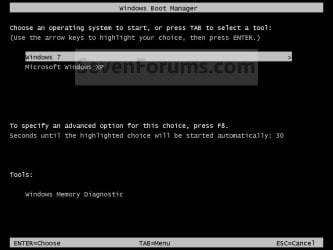
EXAMPLE: Windows Boot Manager
NOTE: This is the boot screen where you select what operating system that you would like to start. By default, you have 30 seconds to choose another operating system before the default operating system will start automatically.
Example.jpg


OPTION ONE

When XP is Installed First


NOTE: If you have a RAID setup, you will need to have the Windows 7 RAID drivers on a USB flash drive available to select and load while installing Windows 7.
1. Do step 2 or 3 below for where you wanted to install Windows 7 at.

2. To Create a New Partition from the XP Hard Disk Drive
A) With your Windows 7 installation disc boot into the Command Prompt from the System Recovery Options screen.
NOTE: Make sure that the CD/DVD drive is selected first in the boot order in the BIOS.

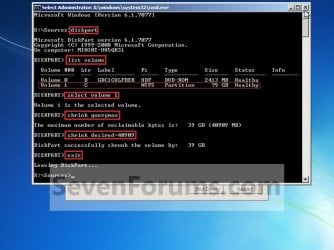
B) In the command prompt, select and shrink the XP volume by how many MB (1024 MB = 1 GB) you want to have for this Windows 7 partition. (See screenshot below)
NOTE: You would do steps 2 to 9 in METHOD TWO at that link. Windows 7 will need a minimum of 16 GB (16384 MB).
XP-W7_1.jpg
C) Click on the X at the top right corner to close the command prompt. (See screenshot above)

D) Click on the X at the top right corner to close System Recovery Options. (See screenshot below)
XP-W7_2.jpg
E) Go to step 4.
3. To Use a Separate Hard Disk Drive than the XP Drive
A) Boot from your Windows 7 installation disc.
NOTE: Make sure that the CD/DVD drive is selected first in the boot order in the BIOS.
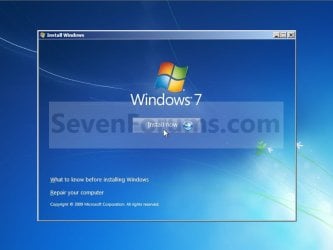
4. Click on the Install now button. (See screenshot below)
XP-W7_3.jpg
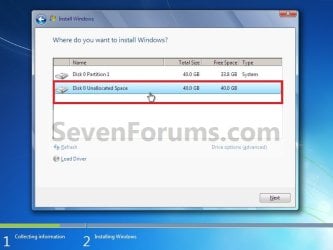
5. When you get to this point, select the partition (step 2) or hard drive to install Windows 7 on. (See screenshot below)
XP-W7_4.jpg
6. Finish installing Windows 7.
NOTE: You would start at step 9 in that link to finish installing Windows 7.

7. When finished, restart the computer to have the option to boot from XP (Earlier Verision of Windows) or Windows 7. (See screenshot below)

   Note
If you are only booting into Windows 7 and do not have XP listed in the Windows Boot Manager, then you can install only EasyBCD (step 8 Option Two below) to add XP (or Windows 7) while started in Windows 7 the same way to the boot list.

Example.jpg


OPTION TWO

When Windows 7 is Installed First


   Warning

1. To Create a New Partition from the Windows 7 Hard Disk Drive
NOTE: If you want to install XP on a separate internal hard drive instead, then skip this step and go to step 2.
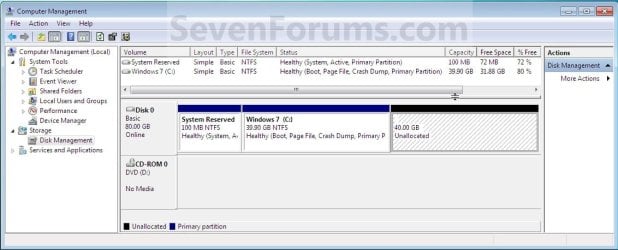
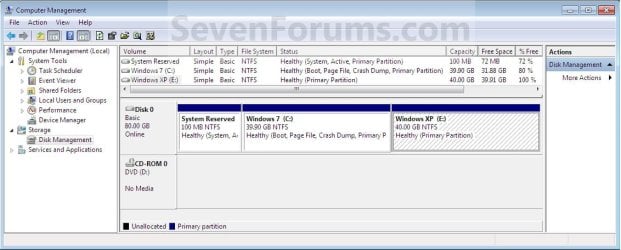
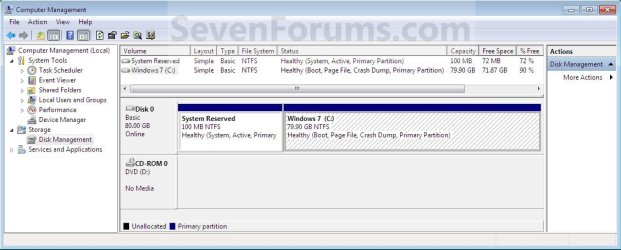
A) In Windows 7, select and shrink the Windows 7 volume in Disk Management by how many MB (1024 MB = 1 GB) you want to have for this XP partition. (See screenshots below)
NOTE: You would do all of Method One at that link.
W7-XP-1.jpg

W7-XP-2.jpg

W7-XP-3.jpg
2. Insert your XP installation disc, then restart the computer and press any key to boot from it when prompted. (See screenshot below)
NOTE: Make sure that the CD/DVD drive is selected first in the boot order in the BIOS.

Step1.jpg
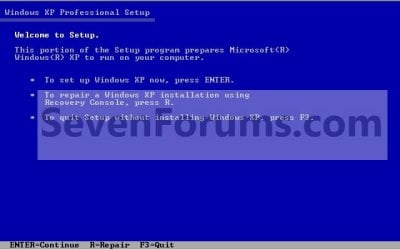
3. From XP Setup, Press Enter. (See screenshot below)


   Warning

W7-XP-4.jpg
4. Press F8. (See screenshot below)
NOTE: On some multimedia keyboards, you may need to press the F-Lock or Function key before pressing F8.
W7-XP-5.jpg
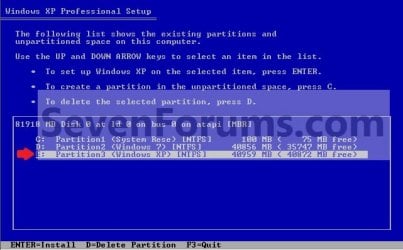
5. Select the partition (step 1) or hard drive that you want to install XP on using the arrow keys and press Enter.
W7-XP-6.jpg
6. Finish installing XP.


   Tip
If you get Error loading Operating System after XP restarts:
  • Using your Windows 7 installation disc, boot to the command prompt at startup.
  • Type in these comands below, and press enter after each one.
    • bootrec /FixMbr
    • bootrec /FixBoot
    • bootrec /RebuildBcd
  • Exit the command prompt and restart the computer.
  • At this point, Windows 7 should boot up the same way before trying to install XP.
  • Continue to step 8 below and run EasyBCD from Windows 7 instead.

7. In XP, download and install .Net Framework 2.0 (32-bit) version or .Net Framework 2.0 (64-bit) version first, and EasyBCD (free version) for your 32-bit (x86) or 64-bit (x86) XP.
NOTE: In XP, Net Framework is required to be installed to run EasyBCD. After you click on Register (at bottom of link) for the free EasyBCD, registration is not required to download it.

8. Run EasyBCD (free version).
NOTE: This is required to repair the Windows 7 boot file and add XP to the Windows Boot Manager list.

9. On the left side of EasyBCD, click on the Add New Entry button. (See screenshot below)
A) In the top section under Operating Systems, click on the Windows tab. (See screenshot below)
B) To the right of Type, select Windows NT/2k/XP/2k3 from the drop down menu. (See screenshot below)
:warn:WARNING: Be sure to leave the Automatically detect correct drive box checked.

C) To the right of Name, you can leave the default Microsoft Windows XP as the name to be displayed in the Windows Boot Manager, or you can type whatever name you would like to have instead. (See screenshot below)
D) Click on the Add Entry button. (See screenshot below)
W7-XP-7.jpg
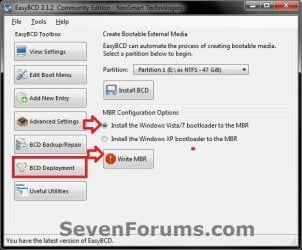
10. On the left side of EasyBCD, click on the BCD Deployment button, select (dot) the Install the Windows Vista/7 bootloader to the MBR option, and click on the Write MBR button. (See screenshot below)
W7-XP-9.jpg
11. Close EasyBCD.

12. Restart the computer to have the option to boot from Microsoft Windows XP or Windows 7. (See screenshot below)
Example2.jpg
   Tip
If Windows 7 will not start up when selected, then use your Windows 7 installation DVD to do a Startup Repair.

That's it,
Shawn


Last edited:
It's always best to install the older OS first, so if you're amenable to clean reinstall then I'd follow Option One in this tutorial to have best performance.

The only way I know to always avoid problems in Dual Boot is to use separate HD's Dual-booted via the BIOS, which I understand is likely not possible on your laptop.

You can get by with a full format using the XP CD to create the target partition of the size you want before install.

Then boot the Win7 installer to create and format it's partition in the unallocated space you left for it. Clean Install Windows 7

If there are any install probs, Clean the boot sector from Win7 DVD: SSD - HDD Optimize for Windows Reinstallation

Is Vista the native OS that came with your HP?
 
Last edited:
Solved

Hi gregrocker,
thanks for the quick reply.
Vista was the original OS that came with the machine. It is now three years and 5 months old. At two years, 11 months & 2 weeks it died completely.
Luckily I had taken out a 2 year extension insurance out on it and HP replaced the motherboard and screen. I did not even realize the screen was faulty.
So basically it is a new machine.
With this Hybrid Seagate drive 7 Ultimate boots up in about 20 seconds ready to go.
I wish I had looked around earlier, it would have saved me some work.
I will do a fresh install the right way around this time.
Many thanks for your help
KingWhiskers

:)
 

My Computer My Computer

At a glance

Windows 7 Ultimate x64intel i7 3610QM8GBNvidia 630 M 2GB
Computer type
PC/Desktop
Computer Manufacturer/Model Number
ASUS N56VM
OS
Windows 7 Ultimate x64
CPU
intel i7 3610QM
Memory
8GB
Graphics Card(s)
Nvidia 630 M 2GB
Sound Card
Realtek HD Audio
Monitor(s) Displays
Laptop Display
Screen Resolution
1920 x1080 Native Resolution
Hard Drives
Seagate ST500LM012 HN-M500MBB 500GB
Keyboard
English UK
Mouse
Microsoft Trackball Explorer, Synaptics Touchpad
Internet Speed
17 Meg Broadfband
Browser
Chrome
Using a Hard Drive that already has XP installed on it

I have just replaced a PC that has XP installed on its C Drive.

I was to install the XP drive into my new Windows 7 X64 PC to allow dual booting.

Advice on which of the above steps I should use would be greatly appreciated
 

My Computer My Computer

At a glance

Windows 7 64 bit
OS
Windows 7 64 bit
I have just replaced a PC that has XP installed on its C Drive.

I was to install the XP drive into my new Windows 7 X64 PC to allow dual booting.

Advice on which of the above steps I should use would be greatly appreciated

If the hard drive came from another computer an older and probably a 32 bit machine it is doubtful it will work in a new 64 bit machine as is, drivers needed for it to work will not be there.
There is nothing to stop you from using that hard drive in your newer machine and reinstalling XP on it if you have the installation disc for XP. Probably best to disconnect the hard drive with 7 on it and follow the tutorial on how to install and Dual Boot with 2 hard drives.
This seems to be the best solution
- Connect Windows 7 HDD and set as primary HDD
- Connect Windows XP HDD as secondary HDD
- Booted up workstation and it loaded Windows 7
- Follow steps 8 - 12 of How to Setup a Dual Boot Installation with Windows 7 and XP

I am still a newbie at this but it looks like it is better to have the XP and 7 on different hard drives and select which hard drive to boot from in bios by pressing F9 at startup,on my HP laptop. the F9 can vary from machine to machine to get to the boot menu on my asus desk top its F8 to get to the boot menu. Your machine it might be something else.
I am pretty sure there is a tutorial on here more specific to setting up on 2 hard drives, or it might be over on the vista forum. I have seen it but I can't remember where.
Also you might have problems with drivers for your XP installation.
It would pay to research your new machine to see if it is backwards compatible to XP by looking on the manufacturers web site.
I have made my daughters HP DV9820 Laptop work with XP only after modifying .ini files to get drivers to install. I have also got it to work with 7 Ultimate with less problems but had to find drivers from other HP machines. The HP DV9820 was originally built for Vista.
So be prepared for some issues getting things to work.
I found that by searching the net with the device ID from the properties page in Device manager I was able to find solutions for all my driver problems
Hope this helps
KingWkiskers
 

My Computer My Computer

At a glance

Windows 7 Ultimate x64intel i7 3610QM8GBNvidia 630 M 2GB
Computer type
PC/Desktop
Computer Manufacturer/Model Number
ASUS N56VM
OS
Windows 7 Ultimate x64
CPU
intel i7 3610QM
Memory
8GB
Graphics Card(s)
Nvidia 630 M 2GB
Sound Card
Realtek HD Audio
Monitor(s) Displays
Laptop Display
Screen Resolution
1920 x1080 Native Resolution
Hard Drives
Seagate ST500LM012 HN-M500MBB 500GB
Keyboard
English UK
Mouse
Microsoft Trackball Explorer, Synaptics Touchpad
Internet Speed
17 Meg Broadfband
Browser
Chrome
I have just replaced a PC that has XP installed on its C Drive.

I was to install the XP drive into my new Windows 7 X64 PC to allow dual booting.

Advice on which of the above steps I should use would be greatly appreciated

If you move the XP HD to new hardware it is likely it will need an XP Repair Install to start up. You can try to boot it first to see. Do this with the Win7 HD unplugged and XP HD set to boot first in BIOS, after CD drive.

Once XP starts on the new hardware, power down to plug back in the Win7 HD, set preferred HD first to boot in BIOS, then boot the other HD by tapping the one-time BIOS Boot Menu key given on first boot screen.
 
getting 3 xp in the menu !!

hi
thanks for the tutorial it worked almost perfectly
I don't know why, but when I restart the coputer, I get the menu as following :
windows 7
windows xp
windows xp
windows xp
they all work but it's kind of annoying :confused:
thanks in advance
 

My Computer My Computer

At a glance

Windows 7 Ultimate x64
OS
Windows 7 Ultimate x64

My Computer My Computer

At a glance

64-bit Windows 11 Pro for WorkstationsIntel i7-8700K OC'd to 5 GHz64 GB (4x16GB) G.SKILL TridentZ RGB DDR4 3600...ASUS ROG-STRIX-GTX1080TI-O11G-GAMING
Computer type
PC/Desktop
Computer Manufacturer/Model Number
Self built custom
OS
64-bit Windows 11 Pro for Workstations
CPU
Intel i7-8700K OC'd to 5 GHz
Motherboard
ASUS ROG Maximus XI Formula Z390
Memory
64 GB (4x16GB) G.SKILL TridentZ RGB DDR4 3600 MHz
Graphics Card(s)
ASUS ROG-STRIX-GTX1080TI-O11G-GAMING
Sound Card
Integrated
Monitor(s) Displays
2 x Samsung Odyssey G7 27"
Screen Resolution
2560x1440
Hard Drives
1TB Samsung 990 PRO M.2,
4TB Samsung 990 PRO PRO M.2,
TerraMaster F8 SSD Plus NAS
PSU
Seasonic Prime Titanium 850W
Case
Thermaltake Core P3
Cooling
Corsair Hydro H115i
Keyboard
Logitech wireless K800
Mouse
Logitech MX Master 4
Internet Speed
2 Gb/s Download and 100 Mb/s Upload
Antivirus
Malwarebyte Anti-Malware Premium
Browser
Google Chrome
Other Info
Logitech Z625 speaker system,
Logitech BRIO 4K Pro webcam,
HP Color LaserJet Pro MFP M477fdn,
APC SMART-UPS RT 1000 XL - SURT1000XLI,
Galaxy S23 Plus phone
it worked :)
thanks a lot
 

My Computer My Computer

At a glance

Windows 7 Ultimate x64
OS
Windows 7 Ultimate x64
You're most welcome. :)
 

My Computer My Computer

At a glance

64-bit Windows 11 Pro for WorkstationsIntel i7-8700K OC'd to 5 GHz64 GB (4x16GB) G.SKILL TridentZ RGB DDR4 3600...ASUS ROG-STRIX-GTX1080TI-O11G-GAMING
Computer type
PC/Desktop
Computer Manufacturer/Model Number
Self built custom
OS
64-bit Windows 11 Pro for Workstations
CPU
Intel i7-8700K OC'd to 5 GHz
Motherboard
ASUS ROG Maximus XI Formula Z390
Memory
64 GB (4x16GB) G.SKILL TridentZ RGB DDR4 3600 MHz
Graphics Card(s)
ASUS ROG-STRIX-GTX1080TI-O11G-GAMING
Sound Card
Integrated
Monitor(s) Displays
2 x Samsung Odyssey G7 27"
Screen Resolution
2560x1440
Hard Drives
1TB Samsung 990 PRO M.2,
4TB Samsung 990 PRO PRO M.2,
TerraMaster F8 SSD Plus NAS
PSU
Seasonic Prime Titanium 850W
Case
Thermaltake Core P3
Cooling
Corsair Hydro H115i
Keyboard
Logitech wireless K800
Mouse
Logitech MX Master 4
Internet Speed
2 Gb/s Download and 100 Mb/s Upload
Antivirus
Malwarebyte Anti-Malware Premium
Browser
Google Chrome
Other Info
Logitech Z625 speaker system,
Logitech BRIO 4K Pro webcam,
HP Color LaserJet Pro MFP M477fdn,
APC SMART-UPS RT 1000 XL - SURT1000XLI,
Galaxy S23 Plus phone
Hello ppl!

My HDD crushed and I bought a new 320 GB Seagate SATA drive (check my system specs). I had to disable "Native sata mode" in BIOS to install a "clean" (no service) pack version of Win XP. Afterwards, I've installed SP2 and SP3 and all the necessary drivers acquired form the HP site. I've also installed "SATA drivers" (for HP Compaq laptop see here: HP Communities - Enabling SATA Native Mode after XP Install - Enterprise Business Community) and was able to enable Native Sata Mode" in BIOS.

Now, since my HDD is 320GB, XP only recognized 120GB (or so) of my drive I've created a single partition (C: ), and after the install of SP3 it recognized the rest of the HDD space as the "unallocated" space (200GB).

I went and created a new partition from this unallocated space of 100 GB (D: ) as FAT32 and filled it with my docs (music, video, pics, docs etc...)

Now I have C: a System partition with XP installed on it, D: as "Storage" drive and 100 GB of unallocated space.

I created a new partition named it (E: ) formatted it NTFS and tried to install Windows 7 Ultimate as dual boot.

I carefully followed the instructions from initial post here and after I installed W7 and restarted the computer got to the Windows Boot Manager. Now, when trying to boot into W7, i get the black screen:
"Windows has encountered a problem communicating with a device connected
to your computer.

This error can be caused by unplugging a removable storage device such as an external USB drive while the device is in use, or by faulty hardware such as a hard drive or CD-ROM drive that is failing.

Make sure any removable storage is properly connected and then restart your computer.

File: \Windows\system32\winload.exe

Status: 0xc00000e9

Info: An unexpected I/O error has occurred.
(I can boot into XP just fine, and the XP show E: drive and all of the files and folders of W7 in place)

I've tried to boot from the W7 DVD and ran System recovery which identified my new W7 installation, and ran "Automatic Startup Repair" at least 4 times (as explained here: http://www.sevenforums.com/tutorials/105541-startup-repair-run-3-separate-times.html ) but with no luck.

The ASR log states the error is: "boot manager cannot find os loader"

I can boot XP normally and I've downloaded EasyBSB 2.1.2. and it shows both XP and W7 (7 being default) boot entries with path to W7 being \Windows\system32\winload.exe

I've looked in boot.ini (via msconfig) and it looks like this:
; This boot.ini was automatically generated by NeoSmart Technologies' BootGrabber.exe
; Use EasyBCD from Download EasyBCD 2.1.2 - NeoSmart Technologies to manage your bootloader

[boot loader]
timeout=15
default=multi(0)disk(0)rdisk(0)partition(1)\WINDOWS
[operating systems]
multi(0)disk(0)rdisk(0)partition(1)\WINDOWS="Windows XP on C:\" /fastdetect
Now, how come it does not show W7? Is it because this is XP boot.ini and not W7 boot.ini which "took over" the computer?

I've also tried to run:

bootrec.exe /fixmbr
bootrec.exe /fixboot
bootrec.exe /rebuildbc


after booting W7 DVD and entering cmd via System recovery, but it didn't work either.

(this part is a bit foggy to me... when loading bootrec should i call:
bootrec.exe /nt60 C:\ or bootrec.exe /nt60 E:\ since my W7 is installed on E partition?)

I've even tried to change the \Windows\system32\winload.exe path to \Windows\system32\boot\winload.exe using bcdedit.exe but with no luck...

Now, after two days and hours goggling, I've deleted the W7 boot record, and deleted partition E: and now have only XP installed and 100 GB of unallocated space to start over :party:.

Advice would be appreciated since I've tried to reinstall W7 couple of times...

How can I repair W7 boot?

Some more info: I ran chkdsk form XP and it found no errors, and since I can boot into XP just fine I presume I can rule out HDD or optical drive problems, and since I installed the W7 on another computer last week and it worked fine I can assume it's not a faulty DVD...

Cheers!
 

My Computer My Computer

At a glance

Microsoft Windows XP Professional, Version 5....Intel(R) Core(TM)2CPU T5600@ 1,83GhzATI Mobility Radeon X1600 256MB
Computer Manufacturer/Model Number
HP Compaq nx9420 (RH441EA#AKN)
OS
Microsoft Windows XP Professional, Version 5.1.2600 Service Pack 3 Build 2600
CPU
Intel(R) Core(TM)2CPU T5600@ 1,83Ghz
Graphics Card(s)
ATI Mobility Radeon X1600 256MB
Hard Drives
Seagate 320 Gb SATA
Did you read the WARNING in Option Two?
 

My Computer My Computer

At a glance

ME/XP/Vista/Win7
OS
ME/XP/Vista/Win7
Did you read the WARNING in Option Two?

Yes, as I stated in my post, I've installed the SATA drivers from within XP and now my HDD works in native sata mode...
I do not have a RAID setup, I use a single 320Gb HDD...

Please post back a screenshot of your maximized Disk Management drive map with listings, using the Snipping Tool in Start Menu. Screen Shots
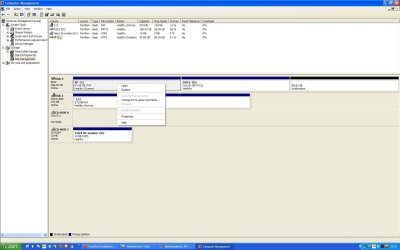
I'm not shure what exactly do you mean since I can boot in XP only and don't have Snipping Tool, but here is a screenshot of my XP Disk Management:

diskmanagment.JPG
 

My Computer My Computer

At a glance

Microsoft Windows XP Professional, Version 5....Intel(R) Core(TM)2CPU T5600@ 1,83GhzATI Mobility Radeon X1600 256MB
Computer Manufacturer/Model Number
HP Compaq nx9420 (RH441EA#AKN)
OS
Microsoft Windows XP Professional, Version 5.1.2600 Service Pack 3 Build 2600
CPU
Intel(R) Core(TM)2CPU T5600@ 1,83Ghz
Graphics Card(s)
ATI Mobility Radeon X1600 256MB
Hard Drives
Seagate 320 Gb SATA
Your compendium seems to imply that the new partition E was created in the Unallocated Space on Disk0 but as shown it has ended up on the second HD, DIsk1.

Since you have Win7 on separate HD, I would move the Win7 System boot files to E so that it boots on its own via the BIOS boot order or one-time BIOS Boot Menu key. Hopefully you correctly booted the installer to install so that it will show as C when booted into Win7.

To do this, unplug all but the Win7 HD, swap XP data cable to Win7 HD or set Win7 HD first to boot in BIOS setup, boot into the Win7 DVD Repair console or System Repair Disk to run Startup Repair up to 3 separate times until it writes the System boot files to the Active partition and Win7 boots on its own.

Then plug back in XP HD, boot it when needed using the one-time BIOS Boot Menu key. If the old Dual Boot Menu still appears, Delete the WIn7 listing in EasyBCD 2.02 Edit OS Menu tab.

What is the 1gb Removable Device J? If it's not bootable I would remove the Active flag so it cannot interfere, and mark XP partition Active as it should already be, make sure Win7 partition remains marked Active.
Partition - Mark as Active
http://www.sevenforums.com/tutorials/197157-partition-mark-inactive.html
 
I'm sorry, though I explained it in my initial post, the picture I submitted my lead you wrong. I have only one HDD in my laptop (Disk 0).

The (Disk 1) is an external hard disk I used to back up my D: drive just in case (it took the E: letter when I plugged it in since I deleted partition E: which held the W7 instalation which is now unallocated space on Disk 0...

The drive J: is an usb modem I use to connect to a 3G mobile network which has an micro SD card reader so it is a micro SD card and the drive H: is the same usb stick built in memory (it holds driver and connection manager setup)

I didn't notice that J: is "Active", but, it wasn't plugged in during the installation or booting the W7 before (at least not every time)

It seems I can't mark partition C as Active through built in XP storage manager? How come?

diskmanagment.JPG

Thnx, cheers!
 

My Computer My Computer

At a glance

Microsoft Windows XP Professional, Version 5....Intel(R) Core(TM)2CPU T5600@ 1,83GhzATI Mobility Radeon X1600 256MB
Computer Manufacturer/Model Number
HP Compaq nx9420 (RH441EA#AKN)
OS
Microsoft Windows XP Professional, Version 5.1.2600 Service Pack 3 Build 2600
CPU
Intel(R) Core(TM)2CPU T5600@ 1,83Ghz
Graphics Card(s)
ATI Mobility Radeon X1600 256MB
Hard Drives
Seagate 320 Gb SATA
Unplug all other HD's, externals and peripherals.

Boot the Win7 DVD, choose Custom Install, use Drive options to create a partition in the Unallocated Space.

If install fails, reset BIOS setup to defaults, try again.
 
Thank you I'll do just that as soon as we beat Serbia in Euro Handball championship tonight :). Ill post the results here. It seems I can't make C: active or remove "Active" from usb stick J: ...
 

My Computer My Computer

At a glance

Microsoft Windows XP Professional, Version 5....Intel(R) Core(TM)2CPU T5600@ 1,83GhzATI Mobility Radeon X1600 256MB
Computer Manufacturer/Model Number
HP Compaq nx9420 (RH441EA#AKN)
OS
Microsoft Windows XP Professional, Version 5.1.2600 Service Pack 3 Build 2600
CPU
Intel(R) Core(TM)2CPU T5600@ 1,83Ghz
Graphics Card(s)
ATI Mobility Radeon X1600 256MB
Hard Drives
Seagate 320 Gb SATA
i am currently running windows 7 as the main OS and want to install XP as a dual boot. i've followed all the steps above but after loading the win xp files [trying to complete XP installation] and trying to re- boot into xp i get a msg that says "press any key to load from cd" ..... and it hangs there

Thanks for the tutorial, great job.

BUT... Using method two, I can never actually finish the XP set up.

You know when the XP setup copies a bunch of files to the target drive and reboots (then the system should boot off the XP partition to complete the set up) ?

Well, I get the "Error loading OS" message. I fix it with the tip in the yellow section, Windows 7 boots again but the XP installation was never completed.

All I have in the partition is this WINXP folder and that's it.


EasyBCD does not recognize a Windows XP installation there, quite expectedly since the installation is not complete.

So, what am I doing wrong ?

exactly my issue, too
 

My Computer My Computer

At a glance

Windows 7 Ultimate 32bit.
OS
Windows 7 Ultimate 32bit.
Are you using XP SP3 installer?

Try setting HD first to boot in BIOS setup, use one-time BIOS boot menu key to trigger booting the CD, delete the XP partition then create a new one there, full format and install.

At exactly what step during install do you get the hang, and what appears exactly? Let it set for awhile.
 
Are you using XP SP3 installer?

do you mean am i trying to instal W XP SP3 version ?

XP Professional 2002 SP 3


Try setting HD first to boot in BIOS setup, use one-time BIOS boot menu key to trigger booting the CD, delete the XP partition then create a new one there, full format and install.

ok i can try that

At exactly what step during install do you get the hang, and what appears exactly? Let it set for awhile.

when i pick which partition to install XP to, full format, it loads install files & re-starts by itself.

i do nothing [as instructed, expecting installation to continue]
a black screen says "press any key to boot from CD ...."

the, nothing at all
 

My Computer My Computer

At a glance

Windows 7 Ultimate 32bit.
OS
Windows 7 Ultimate 32bit.
Back
Top