Dual Boot Installation with Windows 7 and XP

How to Setup a Dual Boot Installation with Windows 7 and XP


   Information
This will show you how to install Windows 7 and XP to dual boot with when you already have either Windows 7 or XP installed first.
   Note
With a dual boot installaton, you will have two operating systems (OS) installed. When you start the computer, you will have the choice to choose which OS you would like to start up to. This method is the easiest way of doing a dual boot with these two operating systems.
   Tip
When dual booting with another OS (ex: Vista or XP), you may not always have that OS partition show up in Computer with a driver letter in Windows 7. If this happens, then you will just need to add a drive letter to the OS (ex: Vista or XP) partition in Windows 7 Disk Management for it to show up in Computer with a driver letter.
   Warning
To stop XP from deleting your Windows 7 System Restore Points everytime XP is started, then see System Restore Points - Stop XP Dual Boot Delete to hide Windows 7 from XP.

Windows 7 Minimum Hardware Requirements


NOTE: For more information on this, see: Windows 7 system requirements
  • 1 GHz 32-bit or 64-bit processor
  • 1 GB RAM for 32-bit Windows 7 OR 2 GB RAM for 64-bit Windows 7
  • 16 GB available disk space 32-bit Windows 7 OR 20 GB for 64-bit Windows 7
  • Support for DirectX 9 graphics with 128 MB memory (in order to enable Aero theme)
  • DVD-R/W Drive
  • Internet or phone access to activate Windows 7.
Windows XP Minimum Hardware Requirements

NOTE: For more information on this, see: System requirements for Windows XP operating systems
  • PC with 300 megahertz (MHz) or higher processor clock speed recommended; 233-MHz minimum required;* Intel Pentium/Celeron family, AMD K6/Athlon/Duron family, or compatible processor recommended
  • 128 megabytes (MB) of RAM or higher recommended (64 MB minimum supported; may limit performance and some features)
  • 1.5 gigabyte (GB) of available hard disk space.*
  • Super VGA (800 × 600) or higher resolution video adapter and monitor
  • CD-ROM or DVD drive
  • Keyboard and Microsoft Mouse or compatible pointing device
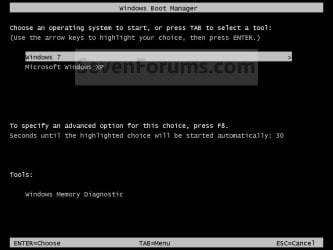
EXAMPLE: Windows Boot Manager
NOTE: This is the boot screen where you select what operating system that you would like to start. By default, you have 30 seconds to choose another operating system before the default operating system will start automatically.
Example.jpg


OPTION ONE

When XP is Installed First


NOTE: If you have a RAID setup, you will need to have the Windows 7 RAID drivers on a USB flash drive available to select and load while installing Windows 7.
1. Do step 2 or 3 below for where you wanted to install Windows 7 at.

2. To Create a New Partition from the XP Hard Disk Drive
A) With your Windows 7 installation disc boot into the Command Prompt from the System Recovery Options screen.
NOTE: Make sure that the CD/DVD drive is selected first in the boot order in the BIOS.

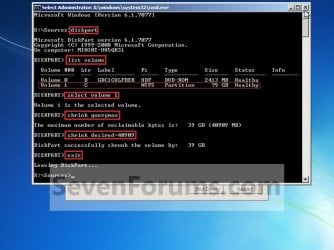
B) In the command prompt, select and shrink the XP volume by how many MB (1024 MB = 1 GB) you want to have for this Windows 7 partition. (See screenshot below)
NOTE: You would do steps 2 to 9 in METHOD TWO at that link. Windows 7 will need a minimum of 16 GB (16384 MB).
XP-W7_1.jpg
C) Click on the X at the top right corner to close the command prompt. (See screenshot above)

D) Click on the X at the top right corner to close System Recovery Options. (See screenshot below)
XP-W7_2.jpg
E) Go to step 4.
3. To Use a Separate Hard Disk Drive than the XP Drive
A) Boot from your Windows 7 installation disc.
NOTE: Make sure that the CD/DVD drive is selected first in the boot order in the BIOS.
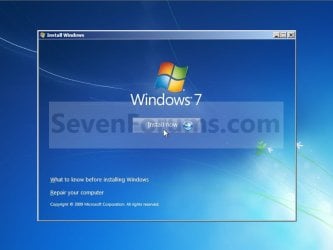
4. Click on the Install now button. (See screenshot below)
XP-W7_3.jpg
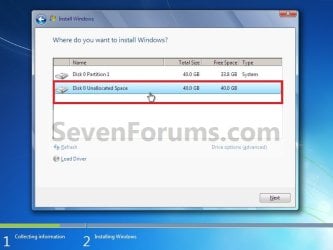
5. When you get to this point, select the partition (step 2) or hard drive to install Windows 7 on. (See screenshot below)
XP-W7_4.jpg
6. Finish installing Windows 7.
NOTE: You would start at step 9 in that link to finish installing Windows 7.

7. When finished, restart the computer to have the option to boot from XP (Earlier Verision of Windows) or Windows 7. (See screenshot below)

   Note
If you are only booting into Windows 7 and do not have XP listed in the Windows Boot Manager, then you can install only EasyBCD (step 8 Option Two below) to add XP (or Windows 7) while started in Windows 7 the same way to the boot list.

Example.jpg


OPTION TWO

When Windows 7 is Installed First


   Warning

1. To Create a New Partition from the Windows 7 Hard Disk Drive
NOTE: If you want to install XP on a separate internal hard drive instead, then skip this step and go to step 2.
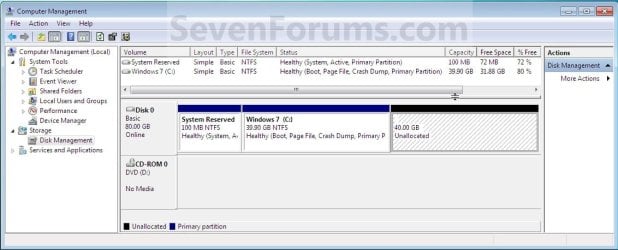
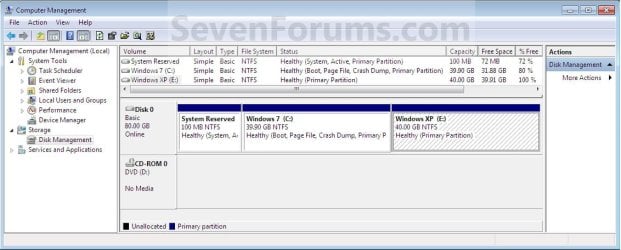
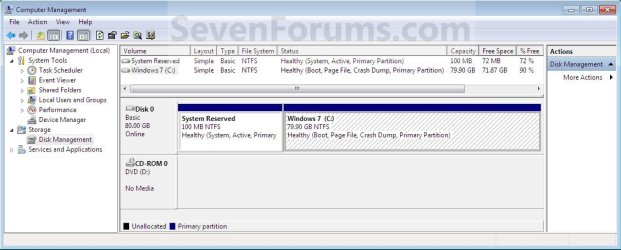
A) In Windows 7, select and shrink the Windows 7 volume in Disk Management by how many MB (1024 MB = 1 GB) you want to have for this XP partition. (See screenshots below)
NOTE: You would do all of Method One at that link.
W7-XP-1.jpg

W7-XP-2.jpg

W7-XP-3.jpg
2. Insert your XP installation disc, then restart the computer and press any key to boot from it when prompted. (See screenshot below)
NOTE: Make sure that the CD/DVD drive is selected first in the boot order in the BIOS.

Step1.jpg
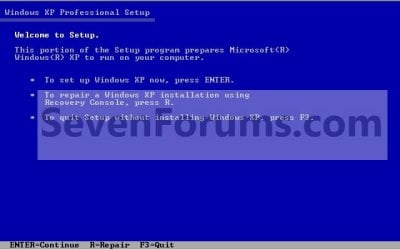
3. From XP Setup, Press Enter. (See screenshot below)


   Warning

W7-XP-4.jpg
4. Press F8. (See screenshot below)
NOTE: On some multimedia keyboards, you may need to press the F-Lock or Function key before pressing F8.
W7-XP-5.jpg
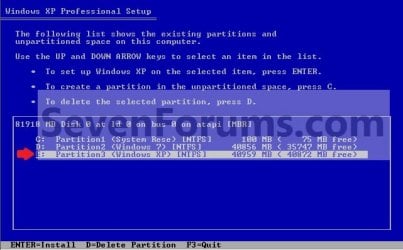
5. Select the partition (step 1) or hard drive that you want to install XP on using the arrow keys and press Enter.
W7-XP-6.jpg
6. Finish installing XP.


   Tip
If you get Error loading Operating System after XP restarts:
  • Using your Windows 7 installation disc, boot to the command prompt at startup.
  • Type in these comands below, and press enter after each one.
    • bootrec /FixMbr
    • bootrec /FixBoot
    • bootrec /RebuildBcd
  • Exit the command prompt and restart the computer.
  • At this point, Windows 7 should boot up the same way before trying to install XP.
  • Continue to step 8 below and run EasyBCD from Windows 7 instead.

7. In XP, download and install .Net Framework 2.0 (32-bit) version or .Net Framework 2.0 (64-bit) version first, and EasyBCD (free version) for your 32-bit (x86) or 64-bit (x86) XP.
NOTE: In XP, Net Framework is required to be installed to run EasyBCD. After you click on Register (at bottom of link) for the free EasyBCD, registration is not required to download it.

8. Run EasyBCD (free version).
NOTE: This is required to repair the Windows 7 boot file and add XP to the Windows Boot Manager list.

9. On the left side of EasyBCD, click on the Add New Entry button. (See screenshot below)
A) In the top section under Operating Systems, click on the Windows tab. (See screenshot below)
B) To the right of Type, select Windows NT/2k/XP/2k3 from the drop down menu. (See screenshot below)
:warn:WARNING: Be sure to leave the Automatically detect correct drive box checked.

C) To the right of Name, you can leave the default Microsoft Windows XP as the name to be displayed in the Windows Boot Manager, or you can type whatever name you would like to have instead. (See screenshot below)
D) Click on the Add Entry button. (See screenshot below)
W7-XP-7.jpg
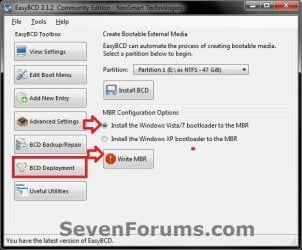
10. On the left side of EasyBCD, click on the BCD Deployment button, select (dot) the Install the Windows Vista/7 bootloader to the MBR option, and click on the Write MBR button. (See screenshot below)
W7-XP-9.jpg
11. Close EasyBCD.

12. Restart the computer to have the option to boot from Microsoft Windows XP or Windows 7. (See screenshot below)
Example2.jpg
   Tip
If Windows 7 will not start up when selected, then use your Windows 7 installation DVD to do a Startup Repair.

That's it,
Shawn


Last edited:
I have 500 gb hard disk
Step 1 Install windows xp 32 bits Image on blank hard disk .
Step 1a While installing add name of C: drive as XP.
Step 1 b partition for my 500 gb hard drive is for C : drive 80 (for xp)
D: drive 80 for (Win 7 64 bits) E: drive 170 F: drive 170
Step 1 c to check if drive is SATA or Raid . I guess it will b SATA
As RAID is old .
Now my windows XP 32 bits via its image is installed on C:drive with 80 gb
D: drive 80 E: drive 170 F: drive 170

Now I will go to STEP 2 i.e. installing windows 7 64 bits on D: drive via its image ?
Step 2 intalling window 7 image at D:drive
Step 3 now windows 7 is installed and I restart computer & Mark its partition active
From windows 7 .
Step 4 Install EASYBCD in windows 7 to add XP from Add os Entry Menu , accept XP
boot files let it autocomplete , save , reboot .

Now my Ques 1 where is need to shrink hard drive in my process?
Ques 2 Is my hard disk Partition rite .
Ques 3 when to do this step which is
To stop XP from deleting your Windows 7 System Restore Points everytime XP is started, then see System Restore Points - Stop XP Dual Boot Delete to hide Windows 7 from XP. ???

Please guide me thanks as I m confused but when I do it once ill get confidence thanking in advance


Image XP to a partition on the target HD, get it started.

Then image Win7 to another partition, Mark its Partition Active and if necessary run Startup Repair - Run 3 Separate Times to get it started.

Install EasyBCD to Win7 to add XP from Add OS Entry menu, accept XP boot files, let it autocomplete, Save, reboot.
 

My Computer My Computer

At a glance

windos 7 64 bits
OS
windos 7 64 bits
Your steps are confusing and make no sense. You start by installing XP and then a few steps later apply an XP image. You don't need to use an XP image if you plan to install it.

Just install it first, then create a second partition to apply the Win7 image onto, start Win7 then add XP using EasyBCD.

You only need to mark Active Win7 partition to run Startup Repairs if it doesn't start on it's own and show the System Active flags on its partition.

If you need to create partitions to apply the images onto then use free Partition Wizard bootable CD to create and resize as needed: Partition Wizard Create Partition Video Help
Partition Wizard Resize Partition Video Help.
 
hello

im having some trouble, when i set the dvd drive as 1st priority it didn't work the first time so i 'disabled' the others and they just disappeared instead of saying [disabled] next to them and so i saved and exited, i followed the steps and installed xp and then it restarted but then it kept installing but then it kept doing that and i think that is because it is still booting off the cd/dvd and the drive/drive section that i made disappeared.

It would really help if you could tell me how to re-select the drive to load up? i tried to find a way by putting the windows 7 boot disk in but it was just rejected and it would only work when i put the xp boot disk in.

sorry if this question has been asked before i could not be bothered to read the 150+ pages of replies

thanks, Ben :D
 

My Computer My Computer

At a glance

windows 7 home premium 64-bit
OS
windows 7 home premium 64-bit
ok now i have intalled c:drive win xp 32 bits & win 7 64 bits in d :drive
now i want to know how to check if everything is 100% ok with dual booting .
I m able to boot into both operating system as of now but i wana check if everything is fine
wt i have done is normally installed xp with cd n after that installed windows 7
have not used anything easy bcd , or To stop XP from deleting your Windows 7 System Restore Points everytime XP is started, then see System Restore Points - Stop XP Dual Boot Delete to hide Windows 7 from XP. ???

so how to check if everything is fine n working 100 %
 
Last edited:

My Computer My Computer

At a glance

windos 7 64 bits
OS
windos 7 64 bits
hello

im having some trouble, when i set the dvd drive as 1st priority it didn't work the first time so i 'disabled' the others and they just disappeared instead of saying [disabled] next to them and so i saved and exited, i followed the steps and installed xp and then it restarted but then it kept installing but then it kept doing that and i think that is because it is still booting off the cd/dvd and the drive/drive section that i made disappeared.

It would really help if you could tell me how to re-select the drive to load up? i tried to find a way by putting the windows 7 boot disk in but it was just rejected and it would only work when i put the xp boot disk in.

sorry if this question has been asked before i could not be bothered to read the 150+ pages of replies

thanks, Ben :D

Hello Ben, and welcome to Seven Forums.

It sounds like you disabled all drives except your DVD drive in the boot priority list. This would be why it's only booting from the DVD over and over since you have no HDD available to boot from after you disabled them. You would need to go back into your BIOS settings, and enable the other drives in your boot priority list. Normally you would have the DVD drive 1st, and the Windows HDD listed 2nd.

Hope this helps,
Shawn
 

My Computer My Computer

At a glance

64-bit Windows 11 Pro for WorkstationsIntel i7-8700K OC'd to 5 GHz64 GB (4x16GB) G.SKILL TridentZ RGB DDR4 3600...ASUS ROG-STRIX-GTX1080TI-O11G-GAMING
Computer type
PC/Desktop
Computer Manufacturer/Model Number
Self built custom
OS
64-bit Windows 11 Pro for Workstations
CPU
Intel i7-8700K OC'd to 5 GHz
Motherboard
ASUS ROG Maximus XI Formula Z390
Memory
64 GB (4x16GB) G.SKILL TridentZ RGB DDR4 3600 MHz
Graphics Card(s)
ASUS ROG-STRIX-GTX1080TI-O11G-GAMING
Sound Card
Integrated
Monitor(s) Displays
2 x Samsung Odyssey G7 27"
Screen Resolution
2560x1440
Hard Drives
1TB Samsung 990 PRO M.2,
4TB Samsung 990 PRO PRO M.2,
TerraMaster F8 SSD Plus NAS
PSU
Seasonic Prime Titanium 850W
Case
Thermaltake Core P3
Cooling
Corsair Hydro H115i
Keyboard
Logitech wireless K800
Mouse
Logitech MX Master 4
Internet Speed
2 Gb/s Download and 100 Mb/s Upload
Antivirus
Malwarebyte Anti-Malware Premium
Browser
Google Chrome
Other Info
Logitech Z625 speaker system,
Logitech BRIO 4K Pro webcam,
HP Color LaserJet Pro MFP M477fdn,
APC SMART-UPS RT 1000 XL - SURT1000XLI,
Galaxy S23 Plus phone
yes issue have come up
1. getting this error when i click on touchpad icon on taskbar in windows xp restarts
the error it shows is c000021a{fatal system error}
the windows subsystem process terminated unexpectedly with a c0000005 {0x7c910f2b 0x00c7ef2c}
2. internet working very very slowly in win xp
3. cannot update windows xp it shows this error 0x8024400A
4.as of now windows 7 working smoothly .
 

My Computer My Computer

At a glance

windos 7 64 bits
OS
windos 7 64 bits
Try installing the XP drivers for your model computer or devices. Start with chipset, then network driver, sound, display.

Do you have SP3 installed? If not download and run it's standalone installer.
 
i have win xp sp 2
and wt is standalone intaller ??? srry if question is dumb.
 

My Computer My Computer

At a glance

windos 7 64 bits
OS
windos 7 64 bits
ok thanks will update from sp 2 to sp 3 via standalone installer
n will get back to you
 

My Computer My Computer

At a glance

windos 7 64 bits
OS
windos 7 64 bits
Ok guys, think I'm facing a small problem with my XP installation and would appreciate if someone can help me out.

I've followed every step that Brink has posted for a Dual Boot installation with Windows 7 & XP (awesome and very detailed info by the way, c/w screen shots), but when i try to boot with the boot-up CD created using N-Lite, the existing Windows 7 OS will just take over bypassing the whole XP installation procedures.

Any way around this? And thanks in advance.
 

My Computer My Computer

At a glance

WIndows 7 ProIntel Core i3-21204GB
Computer Manufacturer/Model Number
HP Pro 3300
OS
WIndows 7 Pro
CPU
Intel Core i3-2120
Memory
4GB
Hard Drives
500GB 7200rpm SATA-3G
Are you setting the CD drive to boot first in BIOS setup, or tapping the F-key given on first screen for Boot Menu to choose it from there? We can't advise you specifically because you didn't fill in your System Specs.

If you have set the CD drive to boot correctly and are not prompted to "Press Any key to boot disk" then the disk needs to be burned again. I would use ImgBurn at 4x speed if in doubt.
 
Hi Greg, thanks much for the response. I've filled up some important details of system specs but skipped some as info is not in hand.

I've set PC up properly, i.e. it boots up from CD-drive and I'm asked to press any key to boot. However, once I've pressed a key it'll just bypass the installation CD and automatically start-up Windows7. It seemed like a same problem I initially encountered when I tried to install XP over Windows7 before I came over to this forum for help. Then, it said that I had a newer OS than the one on CD and thus did not allow me to install XP. Only difference now, is there is no such message but will just start Windows7 automatically, bypassing the XP installation procedures.

Hope you get what I mean & thanks again.
 

My Computer My Computer

At a glance

WIndows 7 ProIntel Core i3-21204GB
Computer Manufacturer/Model Number
HP Pro 3300
OS
WIndows 7 Pro
CPU
Intel Core i3-2120
Memory
4GB
Hard Drives
500GB 7200rpm SATA-3G
Is the XP disk dirty or scratched? Give it a good cleaning.

Try another XP SP3 installer for your licensed version.

See if any other bootable CD will boot correctly.

Try writing XP ISO to flash stick using Win2Flash - USB video
 

My Computers My Computers

  • At a glance

    7 X64i5 84002x8gb 3200mhz
    Computer type
    PC/Desktop
    OS
    7 X64
    CPU
    i5 8400
    Motherboard
    gigabyte b365m ds3h
    Memory
    2x8gb 3200mhz
    Hard Drives
    various
    PSU
    pure power 11 400w cm
    Case
    Coolermaster
    Cooling
    cryorig m9i
  • At a glance

    7x64g54008gb ddr4 2400
    Computer type
    PC/Desktop
    OS
    7x64
    CPU
    g5400
    Motherboard
    ga b365m ds3h
    Memory
    8gb ddr4 2400
    PSU
    xfx pro 450w
Installation Disc NOT a Win-32 Application.

I have arrived at Step 4, but cannot go any further with my Windows 7 64-bit installation disc. I have a PC with XP Pro 32-bit installed on my C drive and 3Gb of memory. I have created another partition on the same HDD as the C Drive is located on. This is now Drive I:\

If I try to access theWindows 7 64-bit installation disc directly, I am told that it is not a valid Win32 application, and I am brought to a halt. I have used msconfig.sys to alter the bootup constituents but it makes no difference, I still get the same message. If I try to boot with the installation disc in the DVD Drive, having changed the BIOS settings to start the boot with the CD/DVD, I end up with XP Pro being loaded into the PC, and no input from the Windows 7 installation disc in the DVD Drive at all.

I really cannot think of any other way forward from this point. I would like to have the 64-bit system installed, but just as an experiment, thinking I might be able to change from 32 to 64 bits later on, I tried to load the 32-bit installation disc for Windows 7, but that didn't work either - another message saying it was an invalid Win32 application.

Help please! If you can help me, please please make the steps I have to take on my journey very detailed and easy to follow. You must have gathered by now that I am not the brightest spark in all things computer, so be patient with lots of detail.

Regards
Philhen
 

My Computer My Computer

At a glance

Windows XP Pro SP33.5GB
OS
Windows XP Pro SP3
Motherboard
MSI Neo 965
Memory
3.5GB
First off I would use 32 bit with 3gb RAM unless you plan to upgrade it to at least 4gb.

The problem is that you're not booting the disk - it's trying to start from the OS and then it's bypassing booting disk to start XP.

Set the DVD drive first to boot in BIOS setup. Is there a prompt to Press Any Key? If not try the one-time BIOS Boot Menu key given on first boot screen.

If these fail make sure you have the latest official installer ISO burned to DVD or written to flash stick as outlined in Steps 1 and 2 in Clean Reinstall - Factory OEM Windows 7.
 
Hi, Gregrocker,

Many thanks for taking the trouble to reply and help. I have only installed 3Gb of ram for the Windows XP Pro OS, and yes, if I can get 64-bit Win 7 working, I will install more ram.

I should have mentioned that I have purchased the Windows 7 Home Premium edition which contains 2 discs, one for Windows 7 32-bit, and the other for Windows 7 64-bit. The package also contains a Product Key and a small booklet entitled 'Welcome to your PC, simplified - Windows 7.' The 2 discs appear to be genuine with holgrams on/in each, and are overwritten, 'Includes Windows Anytime Upgrade'.

I am not sure what screen you are talking about when you mentioned Boot screen - can you make it absolutely clear to me what I am looking for? When I do switch the computer on, the screens flash by very very quickly, far too fast for me to read their contents. Is there a temporary way of slowing this down?

Regards,

Philhen.
 

My Computer My Computer

At a glance

Windows XP Pro SP33.5GB
OS
Windows XP Pro SP3
Motherboard
MSI Neo 965
Memory
3.5GB
What is the computer make/model?

Read the manual on the computer or mobo model's Support Downloads webpage to find out which key is pressed at boot to enter BIOS setup. Then find the BIOS Boot order and set DVD drive to boot first as shown here: How To Boot From a CD (or DVD or BD) Disc

Every computer or mobo has a one-time BIOS Boot Menu key which you can also find in your manual, by googling, or on the first BIOS screen. By tapping that key you can also trigger the DVD drive to boot.
 
Back
Top