Dual Boot Installation with Windows 7 and XP

How to Setup a Dual Boot Installation with Windows 7 and XP


   Information
This will show you how to install Windows 7 and XP to dual boot with when you already have either Windows 7 or XP installed first.
   Note
With a dual boot installaton, you will have two operating systems (OS) installed. When you start the computer, you will have the choice to choose which OS you would like to start up to. This method is the easiest way of doing a dual boot with these two operating systems.
   Tip
When dual booting with another OS (ex: Vista or XP), you may not always have that OS partition show up in Computer with a driver letter in Windows 7. If this happens, then you will just need to add a drive letter to the OS (ex: Vista or XP) partition in Windows 7 Disk Management for it to show up in Computer with a driver letter.
   Warning
To stop XP from deleting your Windows 7 System Restore Points everytime XP is started, then see System Restore Points - Stop XP Dual Boot Delete to hide Windows 7 from XP.

Windows 7 Minimum Hardware Requirements


NOTE: For more information on this, see: Windows 7 system requirements
  • 1 GHz 32-bit or 64-bit processor
  • 1 GB RAM for 32-bit Windows 7 OR 2 GB RAM for 64-bit Windows 7
  • 16 GB available disk space 32-bit Windows 7 OR 20 GB for 64-bit Windows 7
  • Support for DirectX 9 graphics with 128 MB memory (in order to enable Aero theme)
  • DVD-R/W Drive
  • Internet or phone access to activate Windows 7.
Windows XP Minimum Hardware Requirements

NOTE: For more information on this, see: System requirements for Windows XP operating systems
  • PC with 300 megahertz (MHz) or higher processor clock speed recommended; 233-MHz minimum required;* Intel Pentium/Celeron family, AMD K6/Athlon/Duron family, or compatible processor recommended
  • 128 megabytes (MB) of RAM or higher recommended (64 MB minimum supported; may limit performance and some features)
  • 1.5 gigabyte (GB) of available hard disk space.*
  • Super VGA (800 × 600) or higher resolution video adapter and monitor
  • CD-ROM or DVD drive
  • Keyboard and Microsoft Mouse or compatible pointing device
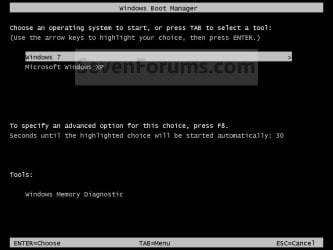
EXAMPLE: Windows Boot Manager
NOTE: This is the boot screen where you select what operating system that you would like to start. By default, you have 30 seconds to choose another operating system before the default operating system will start automatically.
Example.jpg


OPTION ONE

When XP is Installed First


NOTE: If you have a RAID setup, you will need to have the Windows 7 RAID drivers on a USB flash drive available to select and load while installing Windows 7.
1. Do step 2 or 3 below for where you wanted to install Windows 7 at.

2. To Create a New Partition from the XP Hard Disk Drive
A) With your Windows 7 installation disc boot into the Command Prompt from the System Recovery Options screen.
NOTE: Make sure that the CD/DVD drive is selected first in the boot order in the BIOS.

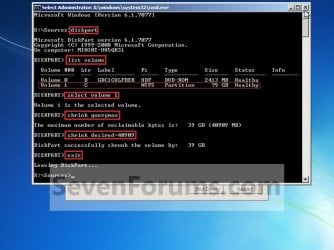
B) In the command prompt, select and shrink the XP volume by how many MB (1024 MB = 1 GB) you want to have for this Windows 7 partition. (See screenshot below)
NOTE: You would do steps 2 to 9 in METHOD TWO at that link. Windows 7 will need a minimum of 16 GB (16384 MB).
XP-W7_1.jpg
C) Click on the X at the top right corner to close the command prompt. (See screenshot above)

D) Click on the X at the top right corner to close System Recovery Options. (See screenshot below)
XP-W7_2.jpg
E) Go to step 4.
3. To Use a Separate Hard Disk Drive than the XP Drive
A) Boot from your Windows 7 installation disc.
NOTE: Make sure that the CD/DVD drive is selected first in the boot order in the BIOS.
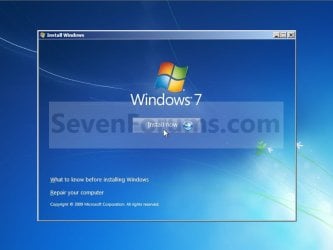
4. Click on the Install now button. (See screenshot below)
XP-W7_3.jpg
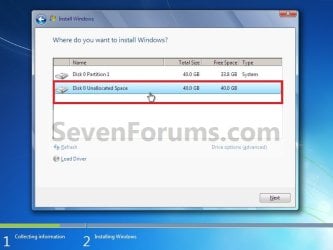
5. When you get to this point, select the partition (step 2) or hard drive to install Windows 7 on. (See screenshot below)
XP-W7_4.jpg
6. Finish installing Windows 7.
NOTE: You would start at step 9 in that link to finish installing Windows 7.

7. When finished, restart the computer to have the option to boot from XP (Earlier Verision of Windows) or Windows 7. (See screenshot below)

   Note
If you are only booting into Windows 7 and do not have XP listed in the Windows Boot Manager, then you can install only EasyBCD (step 8 Option Two below) to add XP (or Windows 7) while started in Windows 7 the same way to the boot list.

Example.jpg


OPTION TWO

When Windows 7 is Installed First


   Warning

1. To Create a New Partition from the Windows 7 Hard Disk Drive
NOTE: If you want to install XP on a separate internal hard drive instead, then skip this step and go to step 2.
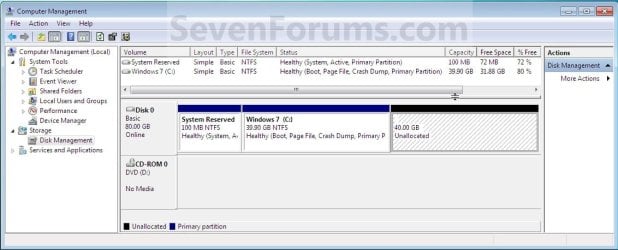
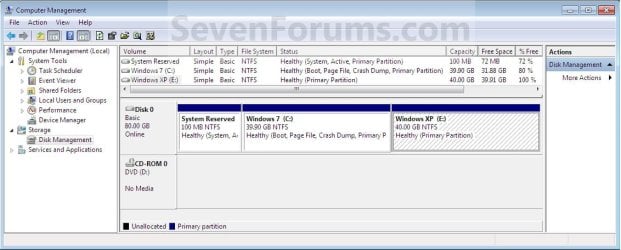
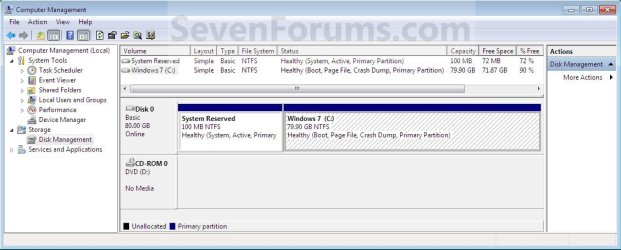
A) In Windows 7, select and shrink the Windows 7 volume in Disk Management by how many MB (1024 MB = 1 GB) you want to have for this XP partition. (See screenshots below)
NOTE: You would do all of Method One at that link.
W7-XP-1.jpg

W7-XP-2.jpg

W7-XP-3.jpg
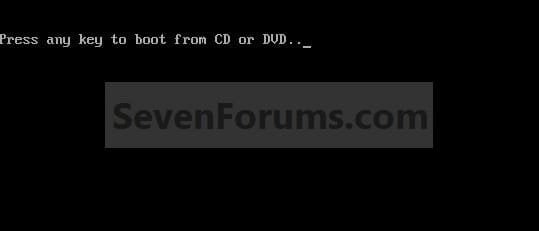
2. Insert your XP installation disc, then restart the computer and press any key to boot from it when prompted. (See screenshot below)
NOTE: Make sure that the CD/DVD drive is selected first in the boot order in the BIOS.
Step1.jpg
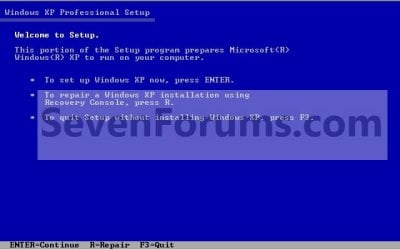
3. From XP Setup, Press Enter. (See screenshot below)


   Warning

W7-XP-4.jpg
4. Press F8. (See screenshot below)
NOTE: On some multimedia keyboards, you may need to press the F-Lock or Function key before pressing F8.
W7-XP-5.jpg
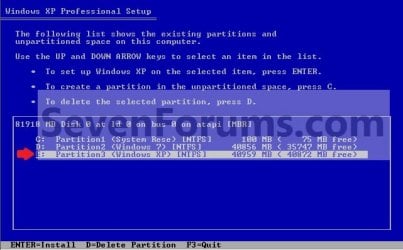
5. Select the partition (step 1) or hard drive that you want to install XP on using the arrow keys and press Enter.
W7-XP-6.jpg
6. Finish installing XP.


   Tip
If you get Error loading Operating System after XP restarts:
  • Using your Windows 7 installation disc, boot to the command prompt at startup.
  • Type in these comands below, and press enter after each one.
    • bootrec /FixMbr
    • bootrec /FixBoot
    • bootrec /RebuildBcd
  • Exit the command prompt and restart the computer.
  • At this point, Windows 7 should boot up the same way before trying to install XP.
  • Continue to step 8 below and run EasyBCD from Windows 7 instead.

7. In XP, download and install .Net Framework 2.0 (32-bit) version or .Net Framework 2.0 (64-bit) version first, and EasyBCD (free version) for your 32-bit (x86) or 64-bit (x86) XP.
NOTE: In XP, Net Framework is required to be installed to run EasyBCD. After you click on Register (at bottom of link) for the free EasyBCD, registration is not required to download it.

8. Run EasyBCD (free version).
NOTE: This is required to repair the Windows 7 boot file and add XP to the Windows Boot Manager list.

9. On the left side of EasyBCD, click on the Add New Entry button. (See screenshot below)
A) In the top section under Operating Systems, click on the Windows tab. (See screenshot below)
B) To the right of Type, select Windows NT/2k/XP/2k3 from the drop down menu. (See screenshot below)
:warn:WARNING: Be sure to leave the Automatically detect correct drive box checked.

C) To the right of Name, you can leave the default Microsoft Windows XP as the name to be displayed in the Windows Boot Manager, or you can type whatever name you would like to have instead. (See screenshot below)
D) Click on the Add Entry button. (See screenshot below)
W7-XP-7.jpg
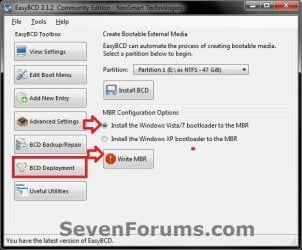
10. On the left side of EasyBCD, click on the BCD Deployment button, select (dot) the Install the Windows Vista/7 bootloader to the MBR option, and click on the Write MBR button. (See screenshot below)
W7-XP-9.jpg
11. Close EasyBCD.

12. Restart the computer to have the option to boot from Microsoft Windows XP or Windows 7. (See screenshot below)
Example2.jpg
   Tip
If Windows 7 will not start up when selected, then use your Windows 7 installation DVD to do a Startup Repair.

That's it,
Shawn


Last edited:
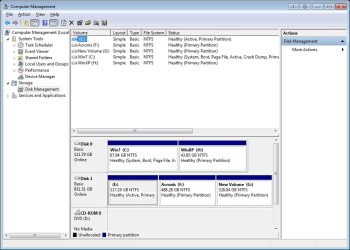
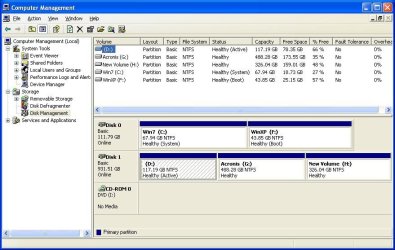
We know from the picture that D is booting the entire System since it is the only one labeled "System."

To make Windows 7 HD and C independently bootable you would have kept all others unplugged during install. When other HD's are plugged in then it will place the boot files on the existing OS partition, or if you run Repairs it will only confirm that they are there, or repair them there.

In addition if no other OS is present then install or repair may still place the boot files on a preceding Primary partition, so if at all possible I would have the WIn7 HD plugged into DISK0 with no preceding Primary partitions to avoid this.

You may accomplish this now by powering down to swap the data cable from XP to Win7 HD (if possible for the SSD), unplug all other HD's, set Win7 HD first to boot in BIOS setup. The run Startup Repair - Run up to 3 Separate Times until Win7 starts and holds the System flag.

When you plug the other HD's back in, keep Win7 HD set first to boot, boot XP using one-time BIOS Boot menu key. You can remove the Win7 boot listing from XP in msconfig>Boot by highlighting its listing to Delete, or in EasyBCD on Edit OS Menu tab. Or you can keep a Windows Boot menu from either OS yet each will still be independently bootable via the BIOS.

Mark any other than the OS's partitions Inactive as only the partition booting the OS should be marked Active: Partition - Mark as Inactive - Windows 7 Forums
 
Hello,
Thank you for your answer..i will apply the manipulation soon....
But i fear one thing ...in my partition E) there is a busy space of 100MO...it seems me its the ssystem partition that has been created at the installation of windows7. I remember also that in the repair sequence the Windows7 OS is located on partition E) . I saw the same thing when i executed the command diskpart .
What will be the conséquences if i program as inactive this partition????
Thank you for your help..i hope i will succeed the manipulation.
I hope your advice.
Jean Luc Ferré
 

My Computer My Computer

At a glance

windows 7 home premium 32 bitsathlon3go
Computer type
PC/Desktop
OS
windows 7 home premium 32 bits
CPU
athlon
Motherboard
asus
Memory
3go
Hard Drives
80gohard drive
120 go hard drive
120go ssd
Antivirus
norton
Browser
ie11
You should not mark E Inactive until you are ready to delete it. THis is why I said you should mark any other than the OS partitions Inactive. Only OS partitions should be marked Active, not data drives.

When you are ready to delete XP it may require marking it Inactive to delete its partition in Disk Mgmt or you can use Diskpart command to "Delete Partition Override." DiskPart Command-Line Options or Partition Wizard boot CD Delete function.
 
Last edited:
Hello,
I have applied your method and manipulation and now it works fine..the system boots on the SSD and windows7.
My HDD drives were IDE and my SSD is SATA, so i can't swap the data cables...but repairing without the other hard disks plugged has made the system working.
I have not yet delete the E) partition and suppress XP.
Thank you for your help...i hope the system will work long like this.
Thank You
 

My Computer My Computer

At a glance

windows 7 home premium 32 bitsathlon3go
Computer type
PC/Desktop
OS
windows 7 home premium 32 bits
CPU
athlon
Motherboard
asus
Memory
3go
Hard Drives
80gohard drive
120 go hard drive
120go ssd
Antivirus
norton
Browser
ie11
I have XP Pro loaded on a 650 gig hard drive and Windows 7 loaded on a 1T hard drive, how to I do a dual boot? Both drives are SATA's
 

My Computer My Computer

At a glance

Windows 7 32bit/ WP Pro 32 bitAMD Athlon8 gASU
Computer type
PC/Desktop
Computer Manufacturer/Model Number
custom build
OS
Windows 7 32bit/ WP Pro 32 bit
CPU
AMD Athlon
Motherboard
MSI
Memory
8 g
Graphics Card(s)
ASU
Hard Drives
650 g running XP

1 T running Windows 7
Antivirus
Norton 360
Browser
Firefox
Hello Bad Hand, and welcome to Seven Forums. :)

How did you set them up?

Did you have both drives connected when you installed the other OS? If so, which OS was installed first?
 

My Computer My Computer

At a glance

64-bit Windows 11 Pro for WorkstationsIntel i7-8700K OC'd to 5 GHz64 GB (4x16GB) G.SKILL TridentZ RGB DDR4 3600...ASUS ROG-STRIX-GTX1080TI-O11G-GAMING
Computer type
PC/Desktop
Computer Manufacturer/Model Number
Self built custom
OS
64-bit Windows 11 Pro for Workstations
CPU
Intel i7-8700K OC'd to 5 GHz
Motherboard
ASUS ROG Maximus XI Formula Z390
Memory
64 GB (4x16GB) G.SKILL TridentZ RGB DDR4 3600 MHz
Graphics Card(s)
ASUS ROG-STRIX-GTX1080TI-O11G-GAMING
Sound Card
Integrated
Monitor(s) Displays
2 x Samsung Odyssey G7 27"
Screen Resolution
2560x1440
Hard Drives
1TB Samsung 990 PRO M.2,
4TB Samsung 990 PRO PRO M.2,
TerraMaster F8 SSD Plus NAS
PSU
Seasonic Prime Titanium 850W
Case
Thermaltake Core P3
Cooling
Corsair Hydro H115i
Keyboard
Logitech wireless K800
Mouse
Logitech MX Master 4
Internet Speed
2 Gb/s Download and 100 Mb/s Upload
Antivirus
Malwarebyte Anti-Malware Premium
Browser
Google Chrome
Other Info
Logitech Z625 speaker system,
Logitech BRIO 4K Pro webcam,
HP Color LaserJet Pro MFP M477fdn,
APC SMART-UPS RT 1000 XL - SURT1000XLI,
Galaxy S23 Plus phone
No I didn't have both drives set up I just switched the cable from the XP drive to the 7 drive. Which was probably a mistake. I also have a separate drive that I use for back up, I have 3 hard drives. What I have done is just switch the cables between the 2 drives.
 

My Computer My Computer

At a glance

Windows 7 32bit/ WP Pro 32 bitAMD Athlon8 gASU
Computer type
PC/Desktop
Computer Manufacturer/Model Number
custom build
OS
Windows 7 32bit/ WP Pro 32 bit
CPU
AMD Athlon
Motherboard
MSI
Memory
8 g
Graphics Card(s)
ASU
Hard Drives
650 g running XP

1 T running Windows 7
Antivirus
Norton 360
Browser
Firefox
Plug Win7 into the cable set to boot first, or adjust it in BIOS setup.

Plug the XP hard drive into another cable, boot it using the one-time BIOS Boot Menu key.

If this is not to your liking, install EasyBCD (click Download - no Name or Email required) to Win7 to add XP to a Windows Boot menu. The drives will remain indepently bootable to come and go as you please.
 
gregrocker, I want to thank you for the help with the dual boot it is working perfectly. Glad I found this forum.
 

My Computer My Computer

At a glance

Windows 7 32bit/ WP Pro 32 bitAMD Athlon8 gASU
Computer type
PC/Desktop
Computer Manufacturer/Model Number
custom build
OS
Windows 7 32bit/ WP Pro 32 bit
CPU
AMD Athlon
Motherboard
MSI
Memory
8 g
Graphics Card(s)
ASU
Hard Drives
650 g running XP

1 T running Windows 7
Antivirus
Norton 360
Browser
Firefox
Thank you for great tutorial, but... just quick question: If I install Windows 7 while keeping XP, will it still delete files on the disk where it's being installed to? As I know, if i wouldn't keep XP it would just delete files on the disk where I would install it. Thanks.
 

My Computer My Computer

At a glance

Windows XP, 32bit
Computer type
PC/Desktop
OS
Windows XP, 32bit
The partition where you install the OS will be the only one overwritten by the install. So be sure to back up any files on the partition you intend to install upon, and not to touch any other partitions during the Clean Install Windows 7.
 
I want XP as drive letter C:

Hi, I have searched and not found the answer. I have 7 installed and installed XP on a separate partition, several times so far, and I'll do it again, but it keeps getting a drive letter other than C:. I even used a separate boot manager (GAG) to see if that would fix it, but it's still F:. First, can I change that behavior after installation, and if not, HOW do I get it installed correctly so both OSes boot as their own C: drive (and I'm NOT reinstalling 7). Thanks for any help.

Side note: All I want to do is play some Steam games and I don't have room (yet?) to let them install on C: Win7. I guess I'll try one install and see where it goes.

Eric
 

My Computer My Computer

At a glance

Windows 7 Pro x64
Computer type
PC/Desktop
Computer Manufacturer/Model Number
custom
OS
Windows 7 Pro x64
I don't remember ever seeing XP start as anything but C in all of these cases. So it must be interference by the 3rd party boot manager which I would uninstall first and hope it doesn't leave code like GRUB once did corrupting everything until the HD is wiped with Clean Command to clear the boot code: http://www.sevenforums.com/tutorials/52129-disk-clean-clean-all-diskpart-command.html

Next make sure you correctly boot the XP installer, delete the target partition, full format it again, then install XP it should always start up as C. However it will steal the bootloader from Win7, so http://www.sevenforums.com/tutorials/71432-partition-mark-active.html the Win7 partition then run http://www.sevenforums.com/tutorials/105541-startup-repair-run-3-separate-times.html until Win7 starts.

Then install EasyBCD Download Registration - NeoSmart Technologies to Win7, add XP on Add Boot menu entry tab.

Either OS should then boot as C.
 
I have installed XP about 4 times now and always from the CD and it always gets some letter besides C. And that was before installing the 3rd party manager. When I used the third party app, XP was still on F and the C drive was hidden. Oh, well, Steam installed fine and the games are working so I will stop banging my head against the wall unless I get bored some day. Thanks.
 

My Computer My Computer

At a glance

Windows 7 Pro x64
Computer type
PC/Desktop
Computer Manufacturer/Model Number
custom
OS
Windows 7 Pro x64
Thanks for the interest. Here are the Disk Management (DM) screens in 7 and XP. The labels tell what is where.
 

Attachments

  • Win7DM.jpg
    Win7DM.jpg
    79.9 KB · Views: 140
  • WinXPDM.jpg
    WinXPDM.jpg
    72.6 KB · Views: 130

My Computer My Computer

At a glance

Windows 7 Pro x64
Computer type
PC/Desktop
Computer Manufacturer/Model Number
custom
OS
Windows 7 Pro x64
Only the System partition should be marked Active in both OS's, but I don't think that is causing the prob.

What is the source of the XP CD. Has it ever installed to C?

Would you want to do a test install to the other/another HD with Win7 drive unplugged? Make sure no other partition is marked Active. http://www.sevenforums.com/tutorials/197157-partition-mark-inactive.html

Others may recall better but I don't remember XP ever booting as anything but C. Win7 will if its installer is run from an OS on C but XP is only smart enough to grab C and overwrite any other boot loader.
 
The CD is a direct DL from MS. As far as I know it has never installed as C. I read a lot of articles and forums trying to find an answer and I saw 2 things: Either it installs and boots as C or it doesn't. I believe if you install XP first, then 7, it works fine but the other way round, it can do this, and I haven't found a solution anywhere. It would probably work fine on a different HD but as a partition, it's weirdly annoying. I could try setting the XP partition as Active too.
 

My Computer My Computer

At a glance

Windows 7 Pro x64
Computer type
PC/Desktop
Computer Manufacturer/Model Number
custom
OS
Windows 7 Pro x64
i'm having problems dual booting xp in win7. formatted a new 40gig partition on the C drive and when i put the xp home ed cd in the drive and boot, win7 boots. when i restarted again hit "delete" hot key for bios set up, went to see the boot sequence, the hdd was 1st so i changed the first boot to cd/dvd rom then the hdd to 2nd and hit f10. restarted again and the cd rom boots (hear it running) but win7 boots. when i restart again then hit the f12 hot key (bios boot option screen) the hdd is listed first and the cd/dvd rom 2nd. i chose cd/dvd option to boot and again win7 boots.
 

My Computer My Computer

At a glance

Windows 7 Home Premium 64bitamd phenom 11x4 820 quad core4 gb samsung dimmnvidia geforce 9200
Computer type
PC/Desktop
Computer Manufacturer/Model Number
gateway sx2311-03
OS
Windows 7 Home Premium 64bit
CPU
amd phenom 11x4 820 quad core
Motherboard
gateway base board sx2311
Memory
4 gb samsung dimm
Graphics Card(s)
nvidia geforce 9200
Sound Card
nvidia hda / realtek hda / nvidia virtual wdm
Monitor(s) Displays
acer b223w
Screen Resolution
1366x768 (landscape)
Hard Drives
wdc wd10 eads-22m2bo scsi
wd my book 1111 usb device
Keyboard
emachine hid keyboard device
Mouse
logitech hid wireless
Internet Speed
NVIDIA nForce 10/100/1000 Mbps Ethernet/ 65.0mbps
Antivirus
norton
Browser
firefox
The disk is not being read. If smudged or scratched, wash it to be sure. Try another bootable disk in drive to make sure its not the drive. Try the disk in another PC to make sure its not the disk.
 
Back
Top