Linux - Install on Windows 7 Virtual Machine using VirtualBox

   Information
Microsoft Virtual PC is my choice to run Windows virtual machines. However, installing Linux on Virtual PC is not something I would recommend. Main reason is the lack of integration elements; Virtual PC integration components are designed to run well on XP, Vista and 7 virtual machines. For Linux, Virtual PC does not (at least at this moment) offer any integration components.

VirtualBox integration components are called Guest Additions. They install and run well also in any Linux distro. That's why I recommended creating Linux virtual machines in VirtualBox.

I am using Ubuntu 10.10 to make this tutorial. At the moment it is the most Windows like Linux distro available, a safe bet for a beginner to start experimenting Linux.

For more advanced Linux users I recommend using Novell SUSE 11.3 which is a commercial Linux distribution, free to test, or its free counterpart OpenSUSE 11.3. The setup procedure in VirtualBox is exactly the same.

Microsoft Virtual PC, Oracle VirtualBox and VMware Player are at the moment the best free virtualization applications. All have their pros and cons, I'm not going to put them in any order here. Let's just say I'm using Microsoft Virtual PC for all my XP and Vista virtual machines, and VirtualBox for older Windows and Linux machines.

You can download these virtualization applications here:
Microsoft: Virtual PC
Oracle: VirtualBox
VMware: WMware Player

OK, let's start. First, download and install VirtualBox using the link above. Then download latest Ubuntu Linux ISO image here: Download | Ubuntu


Part 1: Create a new virtual machine for Ubuntu

  1. Launch VirtualBox
  2. Click New:
    .
    Linux_in_VirtualBox_1.png

    .
  3. This opens New Virtual Machine Wizard. Click Next:
    .
    Linux_in_VirtualBox_2.png

    .
  4. Give your new virtual machine a name, choose the right OS and version. These are automatically selected if VirtualBox can determine it from the name you gave. Click Next:
    .
    Linux_in_VirtualBox_3.png

  5. Set the amount of RAM you want to assign to Ubuntu. For running a Linux vm (virtual machine), 512 MB is enough. You can assign as much as you want to, maximum being about 512 MB less of your host computer's RAM. Keep in mind though that RAM used by a running vm is away from the RAM Windows can use; assigning more RAM can make your vm run faster and better but at the same time make your Windows crawl so slowly even the vm halts. My recommendation is always leave at least 2 GB for Windows, or if you have under 4 GB of RAM only give maximum of 1 GB to a vm. Click Next:
    .
    Linux_in_VirtualBox_4.png

    .
  6. VirtualBox asks now if you want to create a new vhd (virtual hard disk), or use existing vhd. Choose Create new and click Next:
    .
    Linux_in_VirtualBox_5.png

    .
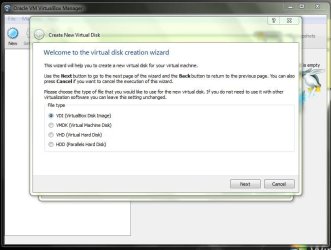
  7. New Virtual Disk Wizard starts. Click Next:
    .
    Linux_in_VirtualBox_6.png

    .
  8. Click Next to accept Dynamically expanding storage:
    .
    Linux_in_VirtualBox_7.png

    .
    Dynamically expanding vhd means that although the guest consideres the HD being the size given (max value), host Windows only uses as much space on HD as is actually needed; a 20 GB dynamic vhd where only 4 GB is used is seen by Windows host as a 4 GB vhd file, not as a 20 GB file, but the guest OS sees the same vhd file as a 20 GB hard disk with 16 GB free. I recommend 8 to 12 GB for Ubuntu.
  9. You can now accept the default location where VirtualBox offers to save the vhd, or change the location by clicking the small folder symbol. Default save folders are Your_Username\.VirtualBox (VirtualBox 3.2 and older) or Your_Username\VirtualBox VMs (from version 4 Beta). You can also change the original size of vhd here. Click Next:
    .
    Linux_in_VirtualBox_8.png

    .
  10. Click Finish to end New Virtual Disk Wizard:
    .
    Linux_in_VirtualBox_9.png

    .
    [*]Click Finish to end New Virtual Machine Wizard:
    .
    Linux_in_VirtualBox_10.png

    .
    [*]Now choose the virtual machine you just created and click Settings:
    .
    Linux_in_VirtualBox_11.png

    .
    [*]Choose Storage from the left pane, CD/DVD from under the title IDE controller, and click the small CD symbol on the right:
    .
    Linux_in_VirtualBox_12.png

    .
    [*]Now you need to tell VirtualBox which install media you want to use. You can assign any of the host system's CD/DVD drives to vm , or an ISO image to act as a CD/DVD drive. For now, you want to use the Ubuntu ISO you downloaded earlier. Browse to its location, choose it and click Open:
    .
    Linux_in_VirtualBox_13.png

    .
    [*]Now choose Display from the left pane, assign the maximum 128 MB video RAM to virtual machine's emulated video card:
    .
    Linux_in_VirtualBox_14.png

    .
    [*]Next you need to setup network controller. Click Network on the left pane, choose Enable Network Adapter, choose Bridged Adapter, and choose your host computer's network adapter from drop down list:
    .
    Linux_in_VirtualBox_15.png

    .
    [*]
    Click OK to save edited settings:
    .
    Linux_in_VirtualBox_16.png

    .

Part 2: Install Ubuntu on a virtual machine
  1. Choose Ubuntu vm, click Start:
    .
    Linux_in_VirtualBox_17.png

    .
  2. When vm starts, it shows you the first screen of Ubuntu setup. Choose the language you want from over 60 languages, or wait 30 seconds for English to be selected:
    .
    Linux_in_VirtualBox_18.png

    .
  3. Ubuntu starts now in so called Live Mode. Double click Install Ubuntu icon:
    .
    Linux_in_VirtualBox_19.png

    .
  4. Once again, choose your installation language:
    .
    Linux_in_VirtualBox_20.png

    .
  5. Choose Download updates while installing. You might also want to install Fluendo MP3 plugin offered for better audio features. Click Forward:
    .
    Linux_in_VirtualBox_21.png

    .
  6. Choose Erase and use the entire disk. Notice please, we are now talking about the virtual hard disk we created earlier, not the actual hd on your host computer. In other words, this does not mean your HD with Windows on it will be erased ;) Click Forward:
    .
    Linux_in_VirtualBox_22.png

    .
  7. Click Install Now:
    .
    Linux_in_VirtualBox_23.png

    .
  8. Choose your time zone:
    .
    Linux_in_VirtualBox_24.png

    .
  9. Choose your preferred keyboard layout. To avoid confusion, I recommend choosing the same you are using on your host computer's Windows. Click Forward:
    .
    Linux_in_VirtualBox_25.png

    .
  10. Tell Ubuntu your name, choose the computer name and set up a password. Click Forward:
    .
    Linux_in_VirtualBox_26.png

    .
  11. Installation starts, you have now some 20+ minutes for a coffee break, or you can watch a presentation about Ubuntu by clicking those arrow symbols on left and right:
    .
    Linux_in_VirtualBox_27.png

    .
  12. When installation is finished, you have to unmount (deattach) Ubuntu ISO image before reboot. Before clicking Restart Now, Open Devices menu from vm window, click CD/DVD devices, choose Unmount CD/DVD Device:
    .

    Linux_in_VirtualBox_29.png

    .
  13. Click Restart Now:
    .
    Linux_in_VirtualBox_28.png

    .
  14. When Ubuntu has booted, click your username to open a password prompt. Type your password, click Log In:
    .
    Linux_in_VirtualBox_30.png


    .
    Linux_in_VirtualBox_31.png

    .
  15. To fully integrate Ubuntu vm to your Windows 7 desktop, to allow networking and for instance cross platform copy & paste, you need to install VirtualBox Guest Additions. Click Devices menu, choose Install Guest Additions:
    .
    Linux_in_VirtualBox_32.png


    .
  16. If the CD/DVD icon appears on the desktop, right click it and choose Open With Autorun Prompt:
    .
    Linux_in_VirtualBox_33.png


    .
  17. If the CD/DVD icon does not appear on desktop (happens sometimes), open Ubuntu's Places menu, and choose VBOXADDITIONS. Choose then Open Autorun Prompt from VBOXADDITIONS window:
    .
    Linux_in_VirtualBox_34.png


    .
    Linux_in_VirtualBox_36.png


    .
  18. Choose Run to start Guest Additions setup:
    .
    Linux_in_VirtualBox_35.png

    .
  19. You must now enter the administrative password. It is the same you chose for your account, so enter it now:
    .
    Linux_in_VirtualBox_37.png

    .
  20. When Guest Additions are set up, you must press Return (Enter) to close the window:
    .
    Linux_in_VirtualBox_38.png

    .
  21. Restart Ubuntu:
    .
    Linux_in_VirtualBox_39.png

    .
  22. After reboot, you are ready to go:
    .
    Linux_in_VirtualBox_40.png
That's it. Made easy by Windows 7 and a virtualizaton application.


Kari
 
Last edited:
thank you soooooo much for the tips!
installing the GUEST ADDITIONS worked perfectly, for my desktop and laptop PC's, awesome!!
 

My Computer

OS
win7
:) You are welcome.

Kari
 

My Computer

Computer type
Laptop
Computer Manufacturer/Model Number
HP ENVY 17-1150eg
OS
Windows 10 Pro x64 EN-GB
CPU
1.6 GHz Intel Core i7-720QM Processor
Memory
6 GB
Graphics Card(s)
ATI Mobility Radeon HD 5850 Graphics
Sound Card
Beats sound system with integrated subwoofer
Monitor(s) Displays
17" laptop display, 22" LED and 32" Full HD TV through HDMI
Screen Resolution
1600*900 (1), 1920*1080 (2&3)
Hard Drives
Internal: 2 x 500 GB SATA Hard Disk Drive 7200 rpm
External: 2TB for backups, 3TB USB3 network drive for media
Cooling
As Envy runs a bit warm, I have it on a Cooler Master pad
Keyboard
Logitech diNovo Media Desktop Laser (bluetooth)
Mouse
Logitech Performance Mouse MX
Internet Speed
50/10 Mbps VDSL
Antivirus
Windows Defender 4.3.9431.0
Browser
Maxthon 3.5.2., IE11
Thanks for the answer Kari. I'm not so familiar with the virtual machine's. :)
 

My Computer

Computer type
PC/Desktop
Computer Manufacturer/Model Number
Custom Build
OS
Windows 10 Pro x64
CPU
Intel Core i5 4440 @Stock
Motherboard
Gigabyte Z97 D3H
Memory
4 x 4GB HyperX Fury DDR3
Graphics Card(s)
Gigabyte GTX 1050Ti O4G
Sound Card
Integrated
Monitor(s) Displays
Dell P2417H
Screen Resolution
1920 x 1080
Hard Drives
Samsung EVO 850 120GB / Toshiba DT01ACA050 1TB 7200prm 32MB
PSU
Riotoro Onyx 750W
Case
NZXT H500 Black-Red
Cooling
Stock CPU + NZXT 120mm + 2x120mm red fans
Keyboard
Modecom Volcano Lanparty
Mouse
Asus ROG Gladius / DeepCool E-Pad Plus
Internet Speed
DOCSIS 50/3 Mbit
Browser
Google Chrome
Other Info
Asus K55VJ(i5 3210M, GT635M / 2GB, 8GB DDR3, 500GB HDD)
No problem. It's just that it's practically impossible to install any chipset, NIC, audio or video drivers to a vm. A virtual machine emulates the core hardware and uses it's own drivers.

The integration elements then contain additional drivers. For instance In VirtualBox these are called Guest Additions, in Microsoft Virtual PC Integration Features and in VMware simply VMware Tools. These tools check the host hardware and add components and drivers to better integrate guest machine's emulated hardware to host.

This about changing the resolution on a VirtulaBox guest machine is a good example how integration tools work. The emulated GPU of guest works without any additional drivers, but with only basic functions. Installing Guest Additions adds then needed components in between the host and guest, allowing them to communicate better, so for instance user can change the guest resolution simply by resizing it from the host, resizing the guest window. When mouse button is released after dragging window bigger or smaller, host system sends the information to guest which then adjusts the resolution parameters and changes resolution to exactly that what user on host decided.

What is noticeable in this is that these integration components are installed on both host and guest. The core of the guest already contains all drivers needed to run it, integration components work as a bridge between the emulated hardware of guest and physical hardware of host. You could say the communication between the host and the guest is like swimming over from San Fransisco to Marin County. It works, can be done. Takes time and effort, though. Integration components are the Golden Gate Bridge; no need to swim anymore ;)

Kari
 
Last edited:

My Computer

Computer type
Laptop
Computer Manufacturer/Model Number
HP ENVY 17-1150eg
OS
Windows 10 Pro x64 EN-GB
CPU
1.6 GHz Intel Core i7-720QM Processor
Memory
6 GB
Graphics Card(s)
ATI Mobility Radeon HD 5850 Graphics
Sound Card
Beats sound system with integrated subwoofer
Monitor(s) Displays
17" laptop display, 22" LED and 32" Full HD TV through HDMI
Screen Resolution
1600*900 (1), 1920*1080 (2&3)
Hard Drives
Internal: 2 x 500 GB SATA Hard Disk Drive 7200 rpm
External: 2TB for backups, 3TB USB3 network drive for media
Cooling
As Envy runs a bit warm, I have it on a Cooler Master pad
Keyboard
Logitech diNovo Media Desktop Laser (bluetooth)
Mouse
Logitech Performance Mouse MX
Internet Speed
50/10 Mbps VDSL
Antivirus
Windows Defender 4.3.9431.0
Browser
Maxthon 3.5.2., IE11
I'm new here and I wanna thank the guy involve. Thank You Kari! :)
 

My Computer

Computer Manufacturer/Model Number
Microsoft
OS
Windows 7 Ultimate 64-bit OS
CPU
ASUS
Motherboard
AMD
Memory
DDR2
Graphics Card(s)
NVIDIA GeForce 9500 GS
Sound Card
WDM
Monitor(s) Displays
ACER
Hard Drives
SEAGATE
PSU
PSU
Case
Aspire
Cooling
Aspire
It works!

I'm posting from my VirtualBox Linux distro right now.

Cool. The tutorial works.
:)

This is the first how-to on this topic that's worked for me. I've even tried it without a how-to and couldn't get everything working-a how to that works is just what I needed.

Hooray!! I'm so excited.
:)
 

My Computer

OS
Home Premium 32bit
Nice to hear it works for you geeks :)

Kari
 

My Computer

Computer type
Laptop
Computer Manufacturer/Model Number
HP ENVY 17-1150eg
OS
Windows 10 Pro x64 EN-GB
CPU
1.6 GHz Intel Core i7-720QM Processor
Memory
6 GB
Graphics Card(s)
ATI Mobility Radeon HD 5850 Graphics
Sound Card
Beats sound system with integrated subwoofer
Monitor(s) Displays
17" laptop display, 22" LED and 32" Full HD TV through HDMI
Screen Resolution
1600*900 (1), 1920*1080 (2&3)
Hard Drives
Internal: 2 x 500 GB SATA Hard Disk Drive 7200 rpm
External: 2TB for backups, 3TB USB3 network drive for media
Cooling
As Envy runs a bit warm, I have it on a Cooler Master pad
Keyboard
Logitech diNovo Media Desktop Laser (bluetooth)
Mouse
Logitech Performance Mouse MX
Internet Speed
50/10 Mbps VDSL
Antivirus
Windows Defender 4.3.9431.0
Browser
Maxthon 3.5.2., IE11
Excellent! An easy to follow tutorial that has opened up the world of virtualisation and linux to me. Well done Kari.
 

My Computer

Computer type
PC/Desktop
Computer Manufacturer/Model Number
Golden Mk. I.4
OS
Windows 10 Pro x64 ; Xubuntu x64
CPU
Intel i7 860 @ 2.80 GHz O/C'ed to 4.0GHz
Motherboard
Gigabyte P55A-UD3R Rev.1. Award BIOS F13
Memory
16GB Corsair Vengance DDR3 @ 661 MHz Dual Channel (9-9-9-24)
Graphics Card(s)
EVGA NVidia GTX 560 1024MB
Sound Card
Realtek Integrated
Monitor(s) Displays
Dual Samsung SyncMaster 2494HS
Screen Resolution
1920*1080 and 1920*1080
Hard Drives
1*Samsung 840 EVO 120GB SSD;
1*OCZ Vertex 2 60GB SSD;
2*Samsung F3 SpinPoint 1TB in RAID0;
1*Samsung F1 SpinPoint 1TB;
2*Western Digital 1TB External USB 3.0
1*Western Digital 500GB External USB 3.0
1*Seagate 500GB External USB 2.0
PSU
Thermaltake ToughPower QFan 750W
Case
Thermaltake Element S VK60001W2Z
Cooling
Corsair H60 Water Cooling, 2*230mm and 2*80mm case fans
Keyboard
Logitech G110
Mouse
Logitech MX518
Thanks!
 

My Computer

Computer type
Laptop
Computer Manufacturer/Model Number
HP ENVY 17-1150eg
OS
Windows 10 Pro x64 EN-GB
CPU
1.6 GHz Intel Core i7-720QM Processor
Memory
6 GB
Graphics Card(s)
ATI Mobility Radeon HD 5850 Graphics
Sound Card
Beats sound system with integrated subwoofer
Monitor(s) Displays
17" laptop display, 22" LED and 32" Full HD TV through HDMI
Screen Resolution
1600*900 (1), 1920*1080 (2&3)
Hard Drives
Internal: 2 x 500 GB SATA Hard Disk Drive 7200 rpm
External: 2TB for backups, 3TB USB3 network drive for media
Cooling
As Envy runs a bit warm, I have it on a Cooler Master pad
Keyboard
Logitech diNovo Media Desktop Laser (bluetooth)
Mouse
Logitech Performance Mouse MX
Internet Speed
50/10 Mbps VDSL
Antivirus
Windows Defender 4.3.9431.0
Browser
Maxthon 3.5.2., IE11
Kari, I do not know what to say, you are just the best VM teacher I have seen, you just know everything about VMs, NASA must hire you, you know :)

Thank you so much, you ROCK!
 

My Computer

Computer Manufacturer/Model Number
The cousin of our lawyer sold it to us.
OS
Windows 7 Ultimate
CPU
Dual Core
Memory
2GB RAM
Graphics Card(s)
8800 something
Monitor(s) Displays
Small monitor, and not flat
Hard Drives
320 GB HDD
Cooling
It has a strong ventilator, I can perfectly hear it :P
Mouse
Logitech
Internet Speed
No idea.
Thanks, Stefany :)
 

My Computer

Computer type
Laptop
Computer Manufacturer/Model Number
HP ENVY 17-1150eg
OS
Windows 10 Pro x64 EN-GB
CPU
1.6 GHz Intel Core i7-720QM Processor
Memory
6 GB
Graphics Card(s)
ATI Mobility Radeon HD 5850 Graphics
Sound Card
Beats sound system with integrated subwoofer
Monitor(s) Displays
17" laptop display, 22" LED and 32" Full HD TV through HDMI
Screen Resolution
1600*900 (1), 1920*1080 (2&3)
Hard Drives
Internal: 2 x 500 GB SATA Hard Disk Drive 7200 rpm
External: 2TB for backups, 3TB USB3 network drive for media
Cooling
As Envy runs a bit warm, I have it on a Cooler Master pad
Keyboard
Logitech diNovo Media Desktop Laser (bluetooth)
Mouse
Logitech Performance Mouse MX
Internet Speed
50/10 Mbps VDSL
Antivirus
Windows Defender 4.3.9431.0
Browser
Maxthon 3.5.2., IE11
Thanks Kari. Guide still does a good job. I had one hiccup. Removing the iso (CD) after the install. Seemed to freeze the reboot. Got around it though & all is good. Think I forced a shutdown of virtualbox then restarted.
 

My Computer

Computer Manufacturer/Model Number
Custom
OS
Windows 7 Pro x64 -- PCLinuxOS KDE4 FullMonty 2011
CPU
i7-875k @ Turbo - 7,6,5,5 - 3.6ghz
Motherboard
Asus P7P55D-E Deluxe
Memory
Corsair CMD8GX3M4A1600C8 8gb
Graphics Card(s)
Asus EAH5850 DirectCU/2DIS/1GD5
Sound Card
On Board
Monitor(s) Displays
Samsung SyncMaster T220 - Panasonic VT30a 50"
Screen Resolution
1680x1050 -
Hard Drives
Corsair Force 3 SSD 120GB x 2 ::
WD VelociRaptor 150GB WD1500HLFS x 2
PSU
Corsair HX-850 Power Supply
Case
Coolmaster HAF 932
Cooling
Corsair H50
Keyboard
Logitech Wireless MK700
Mouse
Logitech Wireless MX620
Internet Speed
Good enough for now
Other Info
Voip. Insanely cheap phone calls.
I'll confirm what Hipster Doofus wrote. I, too, had the freeze at reboot. I Went to the Machine dropdown and chose Reset. Shortly Ubuntu rebooted and the signin screen appeared.
 

My Computer

Computer Manufacturer/Model Number
Homebrew
OS
Win 7 Home Premium 64bit
CPU
Intel Q6600
Motherboard
Gigabyte GA-EP35-DS3R
Memory
4GB DDR2-1066
Graphics Card(s)
GeForce 8500GT
Sound Card
onboard
Monitor(s) Displays
SyncMaster 912N
Screen Resolution
1280 x 1024
Hard Drives
SATA - non RAID, WD 320GB, WD 320GB, WD 160GB, Hitachi 160GB
PSU
PC P&C Silencer 610
Case
X-Blade II
Cooling
Case Fan
Keyboard
MS Natural
Mouse
TrackMan Wheel
Internet Speed
6gig
What do I choose here?
 

Attachments

  • Virtualbox.JPG
    Virtualbox.JPG
    54.6 KB · Views: 192

My Computer

Computer Manufacturer/Model Number
Dell Inspiron E 1505
OS
Windows 7 Professional 32 Bit
CPU
Genuine Intel(R) CPU T2080 @ 1.73GHz 1.73 GHz
Motherboard
DELL
Memory
2GB
Graphics Card(s)
ATI Mobility Radeon X1400
Sound Card
High Definition Audio Device
Screen Resolution
1280 by 800
Hard Drives
136 GB
Recovery 10 GB
I went with the first one. :)
 

My Computer

Computer Manufacturer/Model Number
Custom
OS
Windows 7 Pro x64 -- PCLinuxOS KDE4 FullMonty 2011
CPU
i7-875k @ Turbo - 7,6,5,5 - 3.6ghz
Motherboard
Asus P7P55D-E Deluxe
Memory
Corsair CMD8GX3M4A1600C8 8gb
Graphics Card(s)
Asus EAH5850 DirectCU/2DIS/1GD5
Sound Card
On Board
Monitor(s) Displays
Samsung SyncMaster T220 - Panasonic VT30a 50"
Screen Resolution
1680x1050 -
Hard Drives
Corsair Force 3 SSD 120GB x 2 ::
WD VelociRaptor 150GB WD1500HLFS x 2
PSU
Corsair HX-850 Power Supply
Case
Coolmaster HAF 932
Cooling
Corsair H50
Keyboard
Logitech Wireless MK700
Mouse
Logitech Wireless MX620
Internet Speed
Good enough for now
Other Info
Voip. Insanely cheap phone calls.

My Computer

Computer type
PC/Desktop
Computer Manufacturer/Model Number
Custom Build
OS
Windows 10 Pro x64
CPU
Intel Core i5 4440 @Stock
Motherboard
Gigabyte Z97 D3H
Memory
4 x 4GB HyperX Fury DDR3
Graphics Card(s)
Gigabyte GTX 1050Ti O4G
Sound Card
Integrated
Monitor(s) Displays
Dell P2417H
Screen Resolution
1920 x 1080
Hard Drives
Samsung EVO 850 120GB / Toshiba DT01ACA050 1TB 7200prm 32MB
PSU
Riotoro Onyx 750W
Case
NZXT H500 Black-Red
Cooling
Stock CPU + NZXT 120mm + 2x120mm red fans
Keyboard
Modecom Volcano Lanparty
Mouse
Asus ROG Gladius / DeepCool E-Pad Plus
Internet Speed
DOCSIS 50/3 Mbit
Browser
Google Chrome
Other Info
Asus K55VJ(i5 3210M, GT635M / 2GB, 8GB DDR3, 500GB HDD)

My Computer

Computer type
Laptop
Computer Manufacturer/Model Number
HP ENVY 17-1150eg
OS
Windows 10 Pro x64 EN-GB
CPU
1.6 GHz Intel Core i7-720QM Processor
Memory
6 GB
Graphics Card(s)
ATI Mobility Radeon HD 5850 Graphics
Sound Card
Beats sound system with integrated subwoofer
Monitor(s) Displays
17" laptop display, 22" LED and 32" Full HD TV through HDMI
Screen Resolution
1600*900 (1), 1920*1080 (2&3)
Hard Drives
Internal: 2 x 500 GB SATA Hard Disk Drive 7200 rpm
External: 2TB for backups, 3TB USB3 network drive for media
Cooling
As Envy runs a bit warm, I have it on a Cooler Master pad
Keyboard
Logitech diNovo Media Desktop Laser (bluetooth)
Mouse
Logitech Performance Mouse MX
Internet Speed
50/10 Mbps VDSL
Antivirus
Windows Defender 4.3.9431.0
Browser
Maxthon 3.5.2., IE11
Thanks a lot guys!!

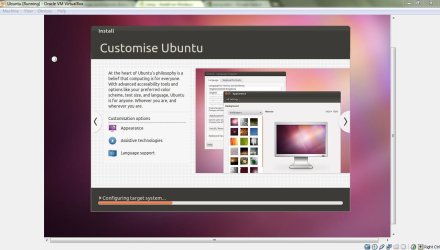
By the way, right now I have come across this problem. It's been stuck at this screen for more than an hour now. Does that happen? Or should I redo my installation all over again?
 

Attachments

  • Ubuntu install.JPG
    Ubuntu install.JPG
    89.4 KB · Views: 176

My Computer

Computer Manufacturer/Model Number
Dell Inspiron E 1505
OS
Windows 7 Professional 32 Bit
CPU
Genuine Intel(R) CPU T2080 @ 1.73GHz 1.73 GHz
Motherboard
DELL
Memory
2GB
Graphics Card(s)
ATI Mobility Radeon X1400
Sound Card
High Definition Audio Device
Screen Resolution
1280 by 800
Hard Drives
136 GB
Recovery 10 GB
The installation can take quite a while depending on your PC and vBox configuration. Does the progress bar still move ??
 

My Computer

Computer Manufacturer/Model Number
HP, Dell, Gateway, Toshiba - 4 laptops and 2 desktops
OS
Vista, Windows7, Mint Mate, Zorin, Windows 8
CPU
from 1.6GHz Duo to i7
Monitor(s) Displays
2x HP w2207
Hard Drives
5x HDD, 7x SSD, 12x Externals
Keyboard
with trackball - no mices
Mouse
Trackball mice
Internet Speed
DSL 6000
No, it's been the same for the past 45 minutes
 

My Computer

Computer Manufacturer/Model Number
Dell Inspiron E 1505
OS
Windows 7 Professional 32 Bit
CPU
Genuine Intel(R) CPU T2080 @ 1.73GHz 1.73 GHz
Motherboard
DELL
Memory
2GB
Graphics Card(s)
ATI Mobility Radeon X1400
Sound Card
High Definition Audio Device
Screen Resolution
1280 by 800
Hard Drives
136 GB
Recovery 10 GB
Back
Top