SATA port numbers vs assignemnt of Disk numbers/

mediaman09

New member
Member
VIP
Local time
12:24 AM
Messages
260
Location
Toronto
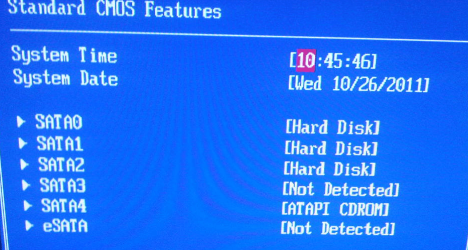
I have three SATA hard drives :

  • Main system/boot drive , WD Caviar Black 1 TB, connected to the SATA 0 port
  • A backup drive, identical WD Caviar Black 1 TB, connected to the SATA 1 port
  • Another dirve, Hitachi 1 TB, connected to the SATA 2 port
When I installed Win 7, only the main drive was connected... and it remains the only drive with active/system/boot partitions.

QUESTION 1.
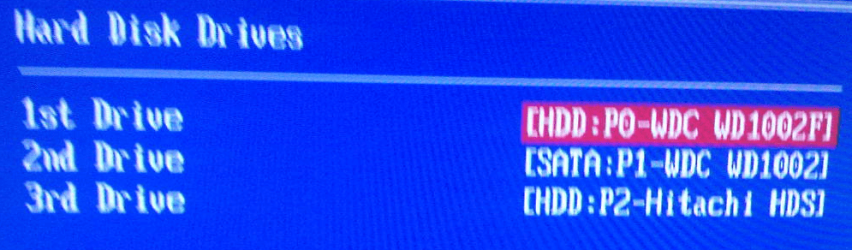
All three drives reporr correctly in the BIOS, and in the right order, but why is it that only one of the drive (the one on SATA port 1) has a "SATA:" prefix and the others have a "HDD:" prefix ?

QUESTION 2,
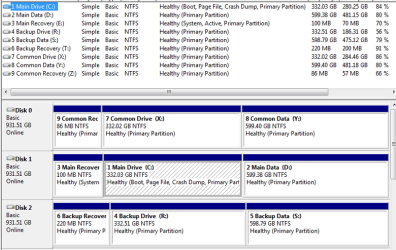
Why is it that the assignment of Disk #0, 1, 2 ( as seen in Disk Maanger or DiskPart) does not seem to have nay rhyme or reason?

I would have expected:

- the hardrive connected to SATA port O, to be assigned as Disk 0
- the hardrive connected to SATA port 1, to be assigned as Disk 1
- the hardrive connected to SATA port 2, to be assigned as Disk 2

but instead, I have:

- the hardrive connected to SATA port 2, is assigned as Disk 0
- the hardrive connected to SATA port 0, is assigned as Disk 1
- the hardrive connected to SATA port 1, is assigned as Disk 2

Just curious why that is.

I am assuming there is no way to chagne this. Its not something I would dream of reinstalling Windows 7 to correct ( even if it did correct it).
 

Attachments
  • SATA-Q-LIST.PNG
    SATA-Q-LIST.PNG
    180 KB · Views: 55
  • SATA-Q-PORTS.PNG
    SATA-Q-PORTS.PNG
    295.5 KB · Views: 59
  • SATA-Q-DM.PNG
    SATA-Q-DM.PNG
    60.9 KB · Views: 223

My Computer My Computer

At a glance

DELL Win 7 Home Premium 64 BitIntel Core i7-930 (8MB L2, 2.8GHz) // ntel Co...16GB // 18GB DDR3 SDRAM 1333Mhhz 6 DIMMS (3x2...AMD HD7570 // AMD Radeon HD6750 // ATI Radeon...
Computer type
PC/Desktop
Computer Manufacturer/Model Number
DELL XPS 8500 // DELL XPS Studio 9100 // DELL Dim 9200
OS
DELL Win 7 Home Premium 64 Bit
CPU
Intel Core i7-930 (8MB L2, 2.8GHz) // ntel Core 2 Quad Q6600
Motherboard
?? // Dell A02 BIOS // ??
Memory
16GB // 18GB DDR3 SDRAM 1333Mhhz 6 DIMMS (3x2, 3x4) //4 GB
Graphics Card(s)
AMD HD7570 // AMD Radeon HD6750 // ATI Radeon HD5670 1 GB GD
Sound Card
?? // THX TruStudio PC //?
Monitor(s) Displays
Dual Dell 2405 WFP-HC24 //SAmsung 27" // Triple 19" LCD
Screen Resolution
1900 x 1200
Hard Drives
Main :WD Caviar Black 1 TB SATA WD1002FAEX
Backup :WD Caviar Black 1 TB SATA WD1002FAEX
PSU
?? // Ultra 900W // ??
Best advice, leave it alone. It may bother your (and others) sense of order but it won't affect how anything works, and no re-installing Windows won't change it.
 

My Computer My Computer

At a glance

Win 7 Ultimate x64FX-8350 @ 4.6 GHz so farADATA XPG V1 Series Black 8GB DDR3 1600Sapphire R9 270x Dual-X
Computer type
PC/Desktop
Computer Manufacturer/Model Number
Me
OS
Win 7 Ultimate x64
CPU
FX-8350 @ 4.6 GHz so far
Motherboard
Asus M5A97 EVO
Memory
ADATA XPG V1 Series Black 8GB DDR3 1600
Graphics Card(s)
Sapphire R9 270x Dual-X
Sound Card
Xonar DGX w/ Corsair Vengence 1300
Monitor(s) Displays
Acer S232HL Abid
Screen Resolution
1920x1080
Hard Drives
120 GB OCZ Vertex 3
500 GB Seagate 7200.12
PSU
Antec Earthwatts 650W Green
Case
Antec Three Hundred
Cooling
Cooler Master 212 EVO
Keyboard
Logitech G510
Mouse
Logitech G500s
Internet Speed
35000/3000
SATA ports, Disk numbers, and Windows Setup

I realize this thread's old, and the single response suggests it's not something many people have noticed or care about. But.....

I've always assumed, supported by the evidence of my particular Windows machines, that:

  1. SATA port numbers reflect physical locations, i.e., connectors on the M/B. Iin the BIOS, these have labels like P0, P1, etc.
  2. These SATA port numbers translate directly to the disk numbers shown in Windows Disk Management.
  3. Windows Setup uses these same port/disk number assignments in its partition selection display.

So in a two-drive laptop, the hard drive in the P0 bay becomes Windows Disk 0, and if you re-install Windows, that drive's partitions will be displayed as Disk 0 Partition 1, Disk 0, Partition 2, etc.

Recently, however, I've seen two cases that proved my #3 assumption wrong. The BIOS, Diskpart, and Windows Disk Management all show the disks consistently. But then Windows Setup reverses the disk numbers.

Can anyone explain how Windows Setup constructs that disk/partition table? And what could be happening to reverse the disk numbers like that? If an owner relied on the disk numbers they see in Disk Management to select their new install location, this reversal in Windows Setup could be disastrous.
 

My Computer My Computer

At a glance

Windows 7 Pro 64bit
OS
Windows 7 Pro 64bit

My Computer My Computer

At a glance

Windows 7x64 Home Premium SP1Intel i7 2600kG.Skill Ripjaws (DDR3-1600) 2x4GBNvidia GeForce GTS 450; Intel HD Graphics 300...
Computer type
PC/Desktop
Computer Manufacturer/Model Number
Own build
OS
Windows 7x64 Home Premium SP1
CPU
Intel i7 2600k
Motherboard
ASUS P8Z68 Deluxe
Memory
G.Skill Ripjaws (DDR3-1600) 2x4GB
Graphics Card(s)
Nvidia GeForce GTS 450; Intel HD Graphics 3000(GT2+)
Monitor(s) Displays
Dell Ultrasharp IPS panel U2311H, Samsung SyncMaster P2350
Screen Resolution
1920x1080
Hard Drives
Samsung 850 Pro SSD 256GB, Samsung SSD 840 120GB, Seagates 1TB Barracuda ST31000528AS x2
PSU
Seasonic M12II 520W
Case
Lian Li Lancool PC-K60
Cooling
Case: 1x120mm, 3x140mm CPU: Hyper 212+
Keyboard
Logitech MK520 (wireless)
Mouse
Logitech MK520
Internet Speed
6-7 Mbps
Antivirus
Norton Security Premium, Malwarebytes on 2 (MSE on 3rd PC)
Browser
FireFox
Other Info
Audio: Logitech Z523 2.1
I also thought of Dwarf's theory when I read the revival of this thread because it is the most logical theory I've read on this. Good on you Michael for finding it. Bookmarked.
 
Thanks for the responses, guys. I didn't find that thread when I started researching this.....I'm off to read it now. :)
 

My Computer My Computer

At a glance

Windows 7 Pro 64bit
OS
Windows 7 Pro 64bit
Just finished reading the referenced thread and associated links. Really interesting stuff!

@mjf:
At one point, you had asked what consequence this might have, aside from being a nuisance. I see this as a serious trap for newbies trying to do clean installs, in a couple ways.

  • First, if they look in Windows to determine where to put the new install, it's very possible they could end up installing on the wrong hard drive and maybe even lose important data in the process, if the enumeration changes when they boot to the installer.
  • Second...and I didn't even know about this until I read the MS KB article...in some scenarios, the reversed disk enumeration can cause Windows Setup to put the System Reserved partition on a different HDD from the system partition. This could cause issues down the line with drive upgrades, disk imaging, etc. This seems like much more than a nuisance, and something worth avoiding.
I frequently help the technically-challenged through clean installs, via email, PMs, or texts. If I can't figure out a way to ensure consistent drive enumeration, I can't standardize a simple instruction for determining installation location. (I'm talking about people who are completely new to this, the ones who need a step-by-step walkthrough.) I've wanted to avoid making them open their laptops to disconnect cables or remove drives, if possible.

It's clear that some folks much more knowledgeable than me have put a lot of effort into figuring this out. Nonetheless, I think I'll do some experimenting with my machines, if just to try and discern a pattern for when it happens. Intuitively, it just doesn't make sense to me that NOTHING changes between boot A and boot B, yet the disc enumeration changes.

I'm not especially optimistic that I'll find anything, considering the efforts already applied by others, but I'll report back if I do.
 

My Computer My Computer

At a glance

Windows 7 Pro 64bit
OS
Windows 7 Pro 64bit
That's the mentioned KB article. Am I missing a point you're making about it?
 

My Computer My Computer

At a glance

Windows 7 Pro 64bit
OS
Windows 7 Pro 64bit
I recognize that this post is literally 2 years old. However, what people have not considered is when you have an issue with windows and need to do a repair or fresh install. In my case windows in repair mode cannot find the windows drive, now this can be due to to AHCI on my gigabyte x58-ud5 rev 2 or some other reason. In my case what I needed to do was take out all of my other hard drives and load it with just windows.

If I did otherwise windows would not be seen in repair mode, then if I did a reinstall (custom) with windows 7 I had to direct it to disk 5 when in reality it was on port 0.

I wish there was an easier solutiom
 

My Computer My Computer

At a glance

Windows 7 Ultimatei7-930 @3.99ghzG.Skill 6GBTitan
OS
Windows 7 Ultimate
CPU
i7-930 @3.99ghz
Motherboard
Gigabyte X58-UD5
Memory
G.Skill 6GB
Graphics Card(s)
Titan
Sound Card
onboard
Monitor(s) Displays
Dell 30"
Screen Resolution
2560x1600 surround
Hard Drives
4 1.5 TB seagate HD
PSU
Corsair HX750
Hi dinglesniff,

The thread's old...and so am I!....but we're still around. ;) The issues with clean installs are indeed a more serious consequence of this disc enumeration "quirk." (That was largely the focus of one of my later posts.)

Generally speaking, though, you shouldn't need to actually remove the other discs to force Windows onto a particular drive. Selective disconnection, or disabling SATA ports in the BIOS (when that option's available) are usually adequate. But even given that, I completely agree with you....it should never have been this hard.

If Windows Repair literally does not see your Windows drive, that would be a different matter (as apposed to the confusion of not being able to discern which drive/partition its on from the list, due to changing disc enumeration).
 

My Computer My Computer

At a glance

Windows 7 Pro 64bit
OS
Windows 7 Pro 64bit
Back
Top