

Actually the hdd subtest is the only part of wei that IS worth anything imho.
...
SSD is still the biggest "actually feel it" performance boost to your computer, watch newegg for x25-v to dip below 100$ and get one (or 2!).
... I don't take their WEI rating system too seriously either, but like anything in computers, if it gives a number, people want that number to be higher, so it creates competition and boosts hardware sales... It's just another one of the contributing factors to helping computer technology move along.I really can't complain but the current HDD is pulling my score down and I honestly do not have much faith in Microsoft's assessment of systems.
...
... I do agree with you on they play the game to boost sales and people do like the NUMBERS.
For the rest of us, if your computer does what you want and whenever you want it to then be happy. If you wish to race and get the newest toys then do so, what ever makes you happy! I just wish there was some true and blue HDD or SSD that would fill the numbers game.
Agree, it's not a real benchmark.
WEI came out after Vista did, to help people check if Vista could run effectively on their current hardware, which was a major issue at the time.
The WEI was introduced in Windows Vista to provide one means across PCs to measure the relative performance of key hardware components. Like any index or benchmark, it is best used as a relative measure and should not be used to compare one measure to another. Unlike many other measures, the WEI merely measures the relative capability of components. The WEI only runs for a short time and does not measure the interactions of components under a software load, but rather characteristics or your hardware. As such it does not (nor cannot) measure how a system will perform under the your own usage scenarios. Thus the WEI does not measure performance of a system, but merely the relative hardware capabilities when running Windows 7.
More from... Engineering Windows 7
Sorry,
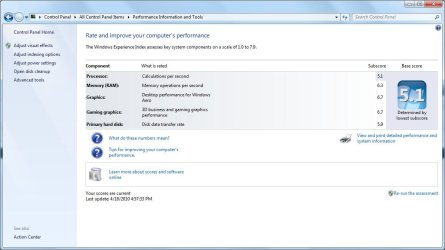
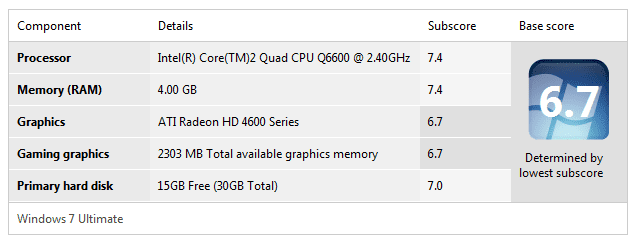
Forgot to post my updated WEI score from the old WEI score for the new system. Same old bottleneck.
View attachment 67756
Nice scores

There are a lot of us waiting for the SSDs to improve and the prices to drop.
As mentioned above, you can find ~40GB SSDs for sub $100, getting into the possibly acceptable range (for me anyway), should be enough space for a boot drive. You can always load some of your programs on the old spinner.
Let's see what the $/GB is after the 25nm flash comes out later this year.
Have read the X25-V will get you a 7.4 - 7.6, and two in RAID 0 will get you 7.9
That is if your looking at the WEI score.
As mbreslin said, this upgrade is one you can actually feel.
Still waiting for that feeling, hopefully not for long

Last edited:
My Computer
At a glance
Windows 7 Ult x64 - SP1/ Windows 8 Pro x64Intel Core i5-3570K 4.6GHz8GB (2X4GB) DDR3 1600 Corsair Vengeance CL8 1.5vSapphire HD 7770 Vapor-X OC 1GB DDR5
- Computer type
- PC/Desktop
- Computer Manufacturer/Model Number
- 76~2.0
- OS
- Windows 7 Ult x64 - SP1/ Windows 8 Pro x64
- CPU
- Intel Core i5-3570K 4.6GHz
- Motherboard
- Gigabyte GA-Z77X UD3H, f18
- Memory
- 8GB (2X4GB) DDR3 1600 Corsair Vengeance CL8 1.5v
- Graphics Card(s)
- Sapphire HD 7770 Vapor-X OC 1GB DDR5
- Sound Card
- Onboard VIA VT2021
- Monitor(s) Displays
- 22" LCD Dell
- Screen Resolution
- 1680x1050
- Hard Drives
- Samsung 840Pro 128GB SSD,
Seagate Barracuda 500GB SATA2 7200rpm 32MB cache, Seagate Barracuda 1TB SATA2 7200rpm 32MB cache,
- PSU
- Corsair HX650W
- Case
- Cooler Master Storm Scout
- Cooling
- Corsair H80 2x12cm Noctua NF P12 , 2x14cm case fans
- Keyboard
- Logitech Wave
- Mouse
- CM Sentinel
- Internet Speed
- Dismal
- Antivirus
- Avast
- Browser
- Opera Next
- Other Info
- Haswell laptop: HP Envy 17t-j, i7-4700MQ, GeForce 740M 2GB DDR3, 17.3" Full HD 1920x1080, 16GB RAM, Samsung 840 Pro 128GB, 1TB Hitachi 7200 HDD,
Desktop: eSATA ports,
External eSATA Seagate 500GB SATA2 7200rpm,
External WD USB 500GB







 I reset my


